The Ten of Cups means shared happiness: warmth that is not kept private but held between people — a partner, a family you were born into or chose, a household that feels safe to walk back into. Upright, it describes belonging that has already been built and is now being lived in. Reversed, it describes the distance between the picture of a happy home and the way that home feels from inside.
In love readings it speaks to the long arc rather than the first spark: whether this connection could hold an ordinary shared life. It will not confirm that someone intends to propose, name the week a reconciliation lands, or report what another person privately feels. It shows the shape of what you are building and asks whether you still want to build it.
Here is the whole card in a few lines before we go closer.
- Upright: belonging, family harmony, a safe home, happiness that is shared out rather than hoarded.
- Reversed: a household under strain, estrangement, performed contentment, or an inherited idea of a good life that no longer fits.
- In love: a partnership with a future shape to it; reversed, two people quietly wanting different lives.
- Yes or no: a warm yes upright, especially about home and family; reversed, not yet.
- Element and astrology: Water, and Mars in Pisces — the last ten degrees of the sign.
- Older title: Lord of Perfected Success.
An arc of ten cups over a meadow: reading the image
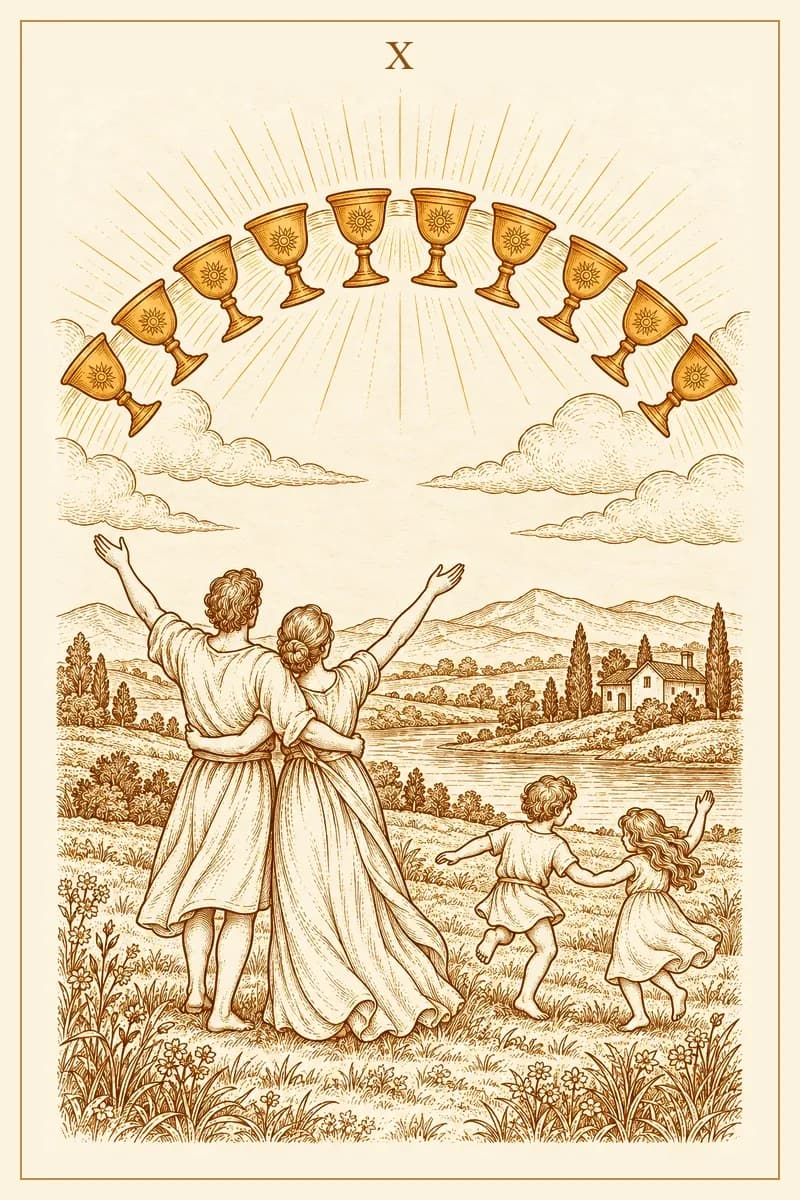
The Ten of Cups is drawn as one wide scene rather than a symbol on a plain ground, and nearly every detail is about relationship: who touches whom, who faces which way, what waits in the distance.
Ten gold cups and the light behind them
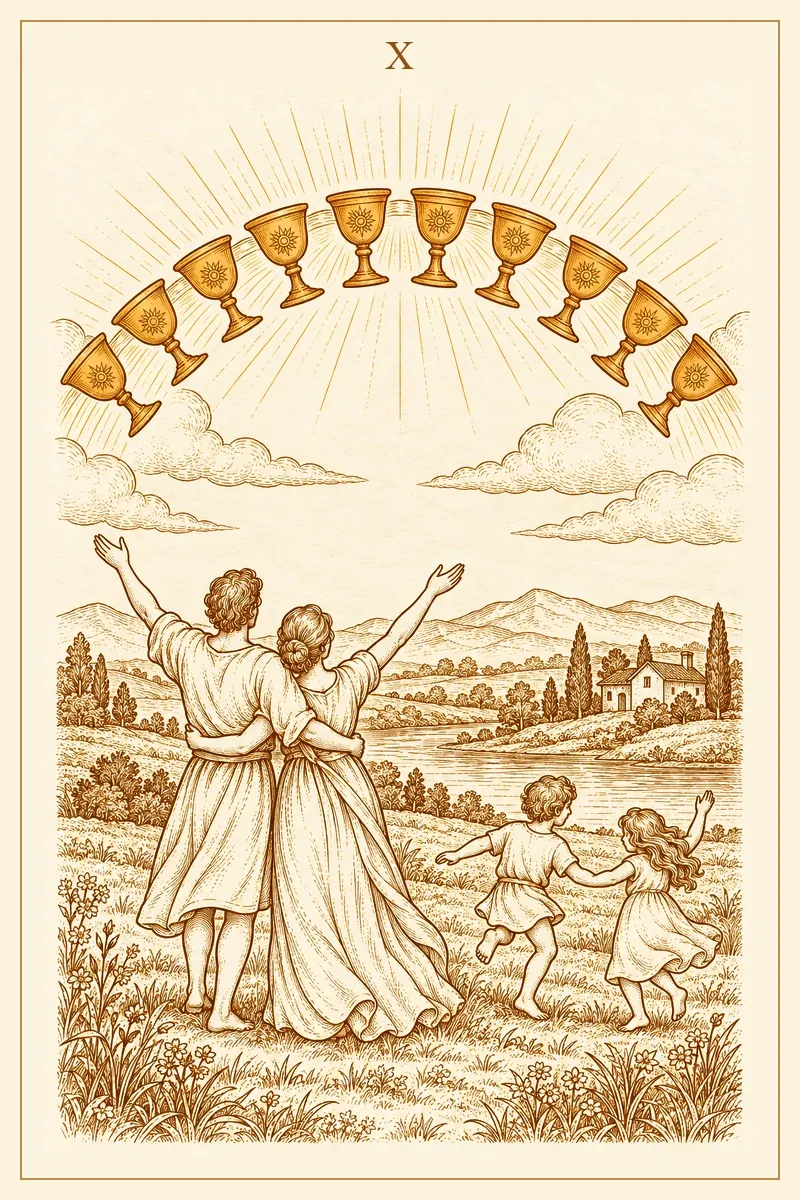
Ten identical goblets hang in a high arc across the sky, each bowl stamped with a small sunburst rosette, with the numeral ten above them. Fine dashed rays fan out from the middle of the arc and fill the upper half of the card with light, and low banks of engraved cloud sit beneath each end. Nobody holds the cups and nobody pours from them. At this stage, happiness is no longer chased one cup at a time: the ten are already gathered, and the work left is to stand underneath them and let the light reach the ground.
Two standing still, two running ahead
Below the arc, two adults stand with their backs to us in a meadow, each with an arm around the other's waist and the free arm lifted toward the cups. One wears a short belted tunic and stands barefoot in the grass; the other wears a long gown whose train drags behind them. To their right, two children run hand in hand through the flowers, their free arms flung wide.
No face is visible anywhere on the card, which keeps the scene from being one particular family and turns it into a question: what would it feel like to stand in that field? The adults hold on and look up together, while the children are neither watched nor managed, only allowed to run. A happy household needs both halves.
The house on the far side of the water
The middle distance is a wide, slow river. Beyond it, on a green slope, stands a small farmhouse with a chimney and a tiled roof, flanked by cypress trees, with wooded hills and a pale mountain ridge behind.
Notice that the house is not where the family stands. It is across the water: in full view, plainly theirs, clearly reachable, but reached by a walk they have not taken inside this frame. Read it generously and that is the promise, since the home exists and the way to it is open. Read it honestly and it also says a good life is somewhere you keep walking toward rather than a place you arrive at once.
Where the Ten of Cups sits in the suit
Cups follow feeling from its first stirring to its fullest social form. The Ace of Cups is a feeling offered. The Two of Cups is that feeling answered by one other person. The Three of Cups widens it to friends. By the Nine of Cups the suit has reached private satisfaction. The Ten is what happens when that satisfaction stops being private: happiness with other people inside it, which makes it both richer and more fragile.
In the older astrological scheme the card belongs to Mars in Pisces, the final decan of the final sign — drive meeting the most boundaryless of the water signs, effort that ends by dissolving into something larger than one person. Its nineteenth-century title, Lord of Perfected Success, says the same thing. Not success that happened to arrive, but success that has been finished.
Ten of Cups upright: happiness that is shared out
What it usually describes
Upright, the card describes a stretch of life in which your closest relationships are working. Not dramatic — working. People in your household speak honestly, support travels in both directions, and you can be plainly yourself in the rooms where you spend most of your hours. It often turns up around a reconciliation that has settled, a move that finally feels like home, or a new housemate who fits, and sometimes around something far less visible: the week you stopped bracing for the next argument.
Built, not given
The quiet claim of this card is that the scene in the meadow was earned. Someone apologized first. Someone learned to name what they needed before resentment set in. Someone forgave a thing that would have been easier to keep holding. Upright, the Ten of Cups credits that work rather than luck, which hands the job back to you: the arc stays lit because people keep tending it.
When it arrives as advice
In an advice position this card rarely says wait and be happy. It says turn toward the people already in your life. Call the sibling. Say the appreciative thing out loud instead of assuming it is obvious. Choose the option that lets you eat dinner with the people you love more often, even when it is smaller on paper. Happiness here is measured in ordinary evenings rather than milestones.
Ten of Cups reversed: when the picture and the room disagree
Reversed, the arc is still overhead but the light is not reaching the field. Nothing has been destroyed; the relationship between the parts has come loose. Three readings cover most reversals.
The household that looks fine from outside
The first reversal is performance. From the street the home looks settled, and the answer to how is everyone is good, thanks. Inside, people are managing each other rather than meeting each other. Nobody is cruel; everyone is careful. The card asks which conversation has been postponed so many times that avoiding it has become the shape of the house.
Distance, estrangement and slow repair
Sometimes the reversal is literal distance: a relative you no longer speak to, a parent you call out of duty, a partner who is present and emotionally elsewhere. It does not tell you to reconcile at any cost, because some distance is protective and deserves to stay. What it asks is whether you have confused an absence of contact with an absence of feeling, since unfinished grief about a family keeps costing something even when stepping back was the right call.
A borrowed idea of a good life
The third reversal is about the picture itself. You may be grieving a version of home you never actually wanted: the one your family assumed, or the one everyone around you appears to have. People build full lives as single people, as couples without children, as a chosen family spread across three cities. Reversed, this card asks you to describe your own ending in your own words, then to notice how much of the unhappiness came from somebody else's picture.
Ten of Cups in love readings
If you are in a relationship
Upright, it is one of the steadiest cards you can draw for an established partnership: a bond that has moved past proving itself and into living well together, with shared routines, needs that get met, and a working assumption that the other person is on your side. For couples weighing a bigger commitment it says the emotional foundation is sound, which is very different from a promise about a date.
If you are single
For single readers it usually clarifies what you are actually looking for, and the answer is rarely chemistry on its own. It is someone you could share an unremarkable Tuesday with. This is a good moment to notice whether the search has been aimed at being chosen rather than at building something, and to let the people who already love you count as part of your emotional life instead of a placeholder for it.
Reversed in a love reading
Reversed in love, the usual message is divergence. Two people can care for each other sincerely and still want different lives: one wants a quiet house in one town, the other wants movement; one wants children, the other does not. That is not a failure of love and no card settles it. It is a conversation, and this reversal surfaces when the conversation keeps being avoided. It can also point to family pressure straining a bond that is otherwise fine.
Marriage, children and the questions underneath them
Readers often want to know whether this card means a wedding or a baby. It can accompany either and confirms neither, because what it describes is belonging, and belonging takes many forms. If marriage is your real question, read the Ten of Cups beside the other cards that point toward marriage and be precise about what you want: a ceremony, a legal status, a shared address, or simply the certainty that someone is staying.
Work, money and the practical side of home
At work
Upright, this is less a promotion card than a card about fit. It describes work that leaves enough of you for the rest of your life: a team you trust, and hours that let you be present at home. Reversed, it flags a job quietly eating the evenings, or a workplace where you perform cheerfulness all day and have none left by the time you get in.
Money
Money here is infrastructure, not the prize. Upright, it suggests finances steady enough that the household is not renegotiating every week, and spending that buys time together rather than status. Reversed, money has become friction: an imbalance one person resents, or a silence around numbers that is doing damage. Take it as a prompt to talk plainly, not as a forecast about your accounts.
Moving, renting and making a place yours
Because the house in the picture sits across the water, this card is useful for questions about where to live. Upright, it supports a move that brings you nearer to the people you love, or the decision to finally treat a rented place as a home by hanging the pictures and learning the neighbors' names. Reversed, it can describe a home that never settled: boxes still taped shut, a town you moved to for someone else, a room you avoid sitting in.
Rest and the body
In well-being questions this is a gentle card about the link between feeling safe and feeling well. Upright, rest comes more easily because the household is calm. Reversed, it suggests that ongoing tension at home may be part of what is tiring you, and that the help you need could be relational rather than anything a spread can supply. For anything that genuinely worries you about your health, speak to a professional.
Yes, no and when with the Ten of Cups
Upright, this is one of the warmest yes cards in the deck, strongest when the question concerns home, family, reconciliation, moving in together or long-term compatibility. For a quick result or a sharp strategic choice, it is less a yes than a note that this is not what matters here. If you use a fixed method for binary questions, the usual rules for a yes or no tarot reading still apply, because a question has to be answerable before a card can answer it.
Reversed, read it as not yet, with the obstacle named, rather than as a flat no. Something the reversal points at — an unsaid thing, a mismatch of plans, an old resentment — is holding the answer open.
On timing, the card is poor at dates and decent at seasons. Its link to Pisces places it in late winter and early spring in the northern hemisphere, and a ten closes a cycle, so it tends to describe something completing after the current arrangement has run its course rather than next week. If timing is the heart of your question, read it alongside a dedicated approach to timing in tarot and hold the answer loosely.
Cards that change what the Ten of Cups is saying
A neighboring card tells you which part of the picture to look at: the couple, the children, the cups overhead, or the house across the water.
With the Nine of Cups: your wish beside everyone else's
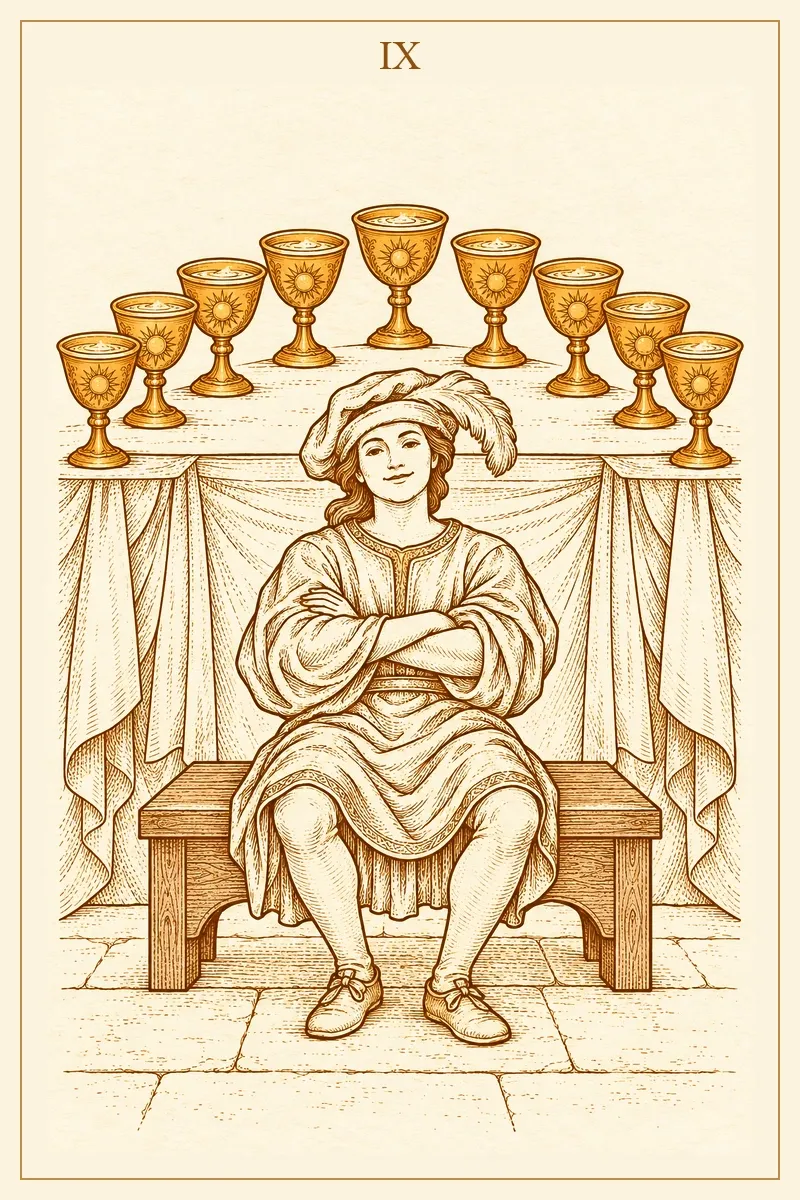
Together these two sort private satisfaction from shared life. Nine first and ten second reads as a personal win that opens outward. Ten first and nine second can warn that you are measuring the whole household's happiness by your own comfort. The fuller meaning of the Nine of Cups is worth reading beside it.
With the Ten of Pentacles: the people and the roof
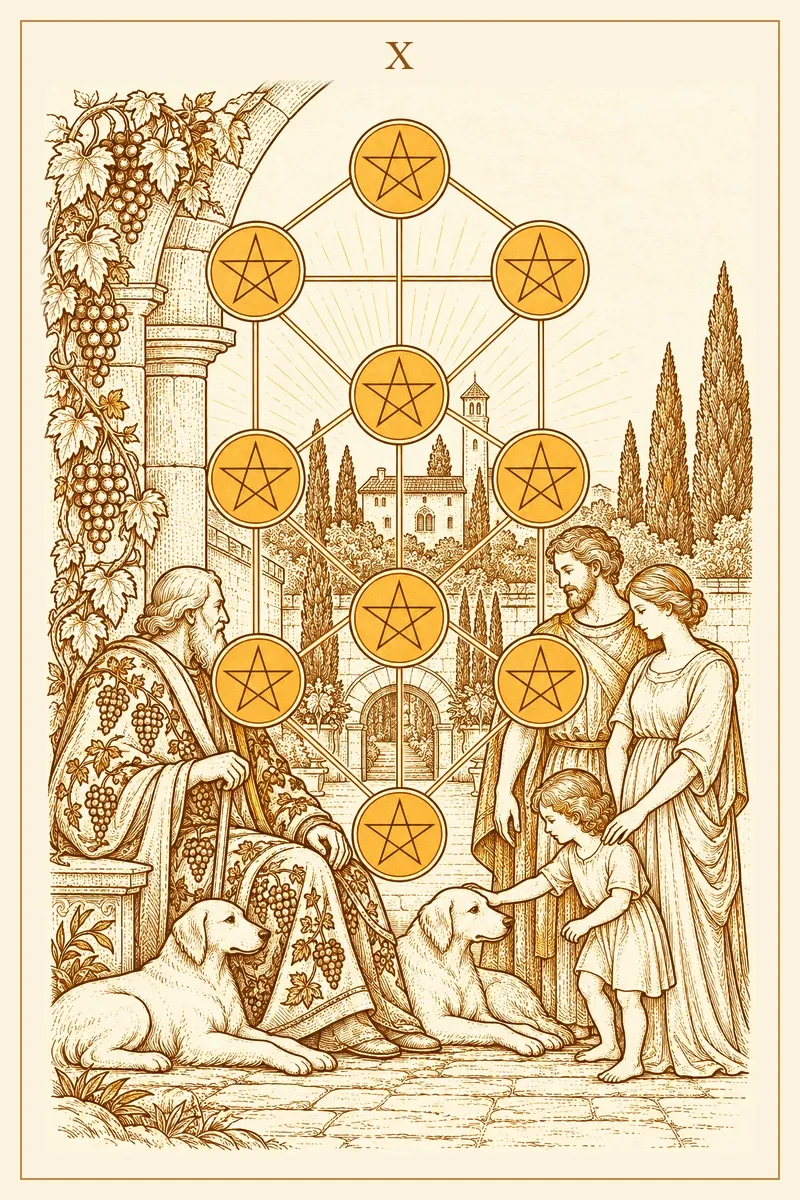
Two tens of family, approached from opposite ends. This card is the feeling in the room; the Ten of Pentacles is the building, the money and the inheritance. Side by side they mean an arrangement sound on both counts, which makes them a strong pair for questions about buying a home or merging two lives. When one is reversed, it tells you which half is lagging: warmth without security, or security without warmth. The Ten of Pentacles in full covers the material half.
With the Four of Cups: the arc you stopped looking at
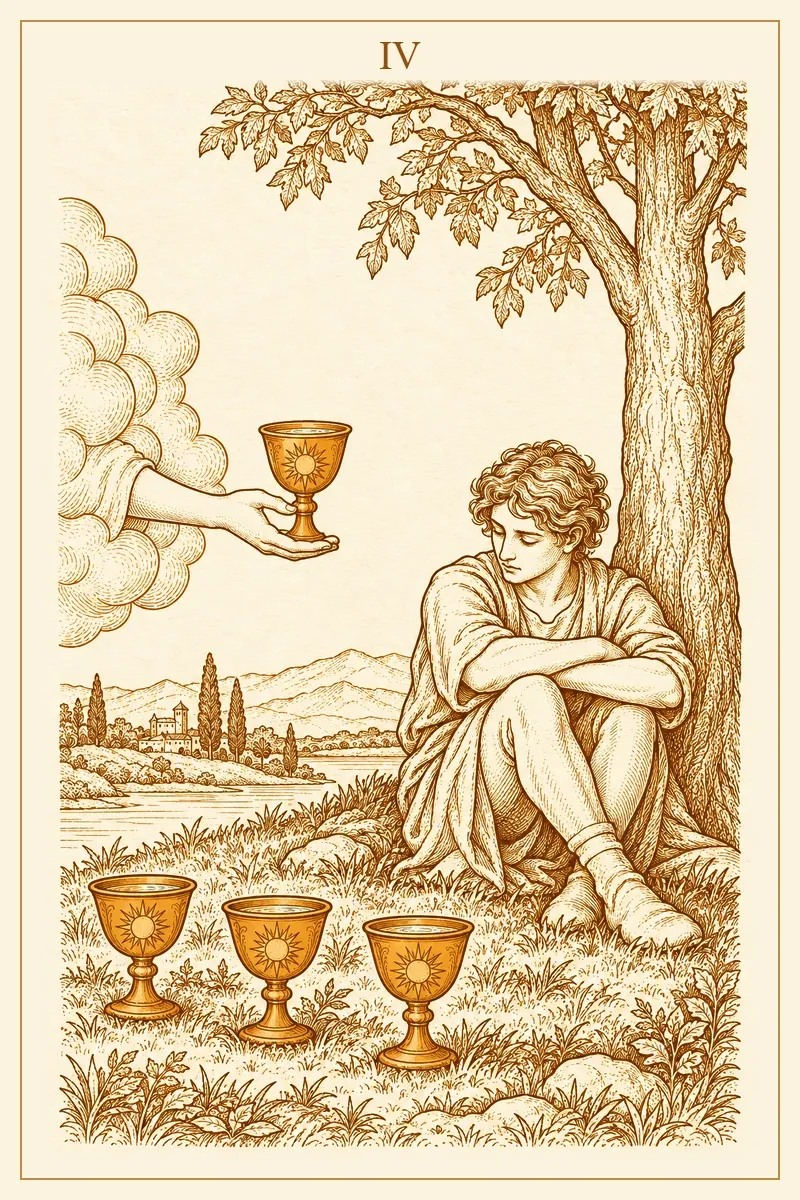
The Four of Cups shows someone sitting with folded arms while a cup is held out to them. Beside the Ten it makes one of the most pointed pairs in the suit: the good life is already here and you have gone numb to it. That is not a scolding. Numbness usually means something else has taken the attention — exhaustion, low mood, a grief nobody named out loud. Read the Four of Cups as the diagnosis and the Ten as what waits once the fog clears.
With the Five of Cups: grief inside a good life
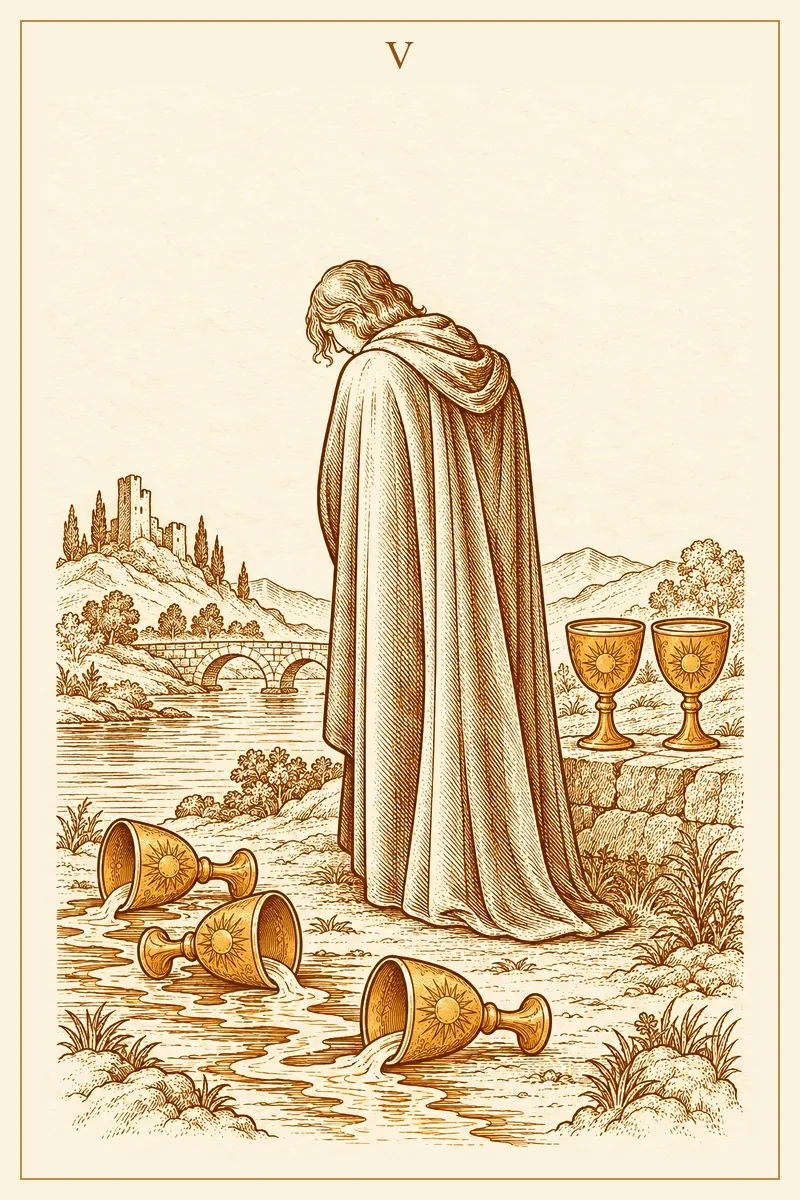
The Five of Cups stands over what was spilled with two cups still upright behind it. Next to the Ten it describes one of the more honest situations in tarot: a home that is genuinely loving, and a loss inside it that has never been digested. The pair insists both are true at once. The Five of Cups has more on how that grief moves.
Three more pairings worth knowing
With The Sun, the happiness becomes visible and uncomplicated, which makes it a good draw for anything you have been keeping quiet, and the full reading of The Sun explains why that card so rarely hedges. With The Tower, a shared structure gives way, and the reading is about what the family becomes afterward rather than about blame. With the Eight of Cups, somebody is walking away from the meadow, and the useful question is whether they are leaving the people or a role.
The Shared Roof spread: five positions for a life you are building
Use this when the Ten of Cups has appeared and you want to work with it instead of admiring it. Shuffle with one question in mind, about a household, a partnership or a family, and lay five cards in a row.
- The room as it is. What is true here right now, before you tidy up the description.
- What we share. The real common ground: what both people want, enjoy or protect.
- What I carry alone. The work or worry that has quietly become one person's job.
- What this home needs. The missing ingredient — time, honesty, help, space, repair.
- The smallest step toward it. Something you could begin without anyone else's agreement.
Read positions three and five together, because that is where this spread earns its keep. If the third card is heavy and the fifth is tiny, that is the correct relationship between them: one honest small step is what actually moves a household.
A reading in practice: a full house and a quiet kind of lonely
Take a question many people arrive with and struggle to phrase: my home is full of people I love and I still feel alone in it, so what am I missing? Three cards, drawn for the room as it is, what I carry alone, and the smallest step.
The room as it is: Ten of Cups, upright
The first card settles something that was in doubt. The warmth in the house is not imaginary and the people in it are not pretending. Whatever is wrong, it is not that the family has failed, and that distinction matters, because a question phrased this way often arrives half convinced that the loneliness proves everybody is faking.
What I carry alone: Four of Cups, reversed
Reversed in this position, the Four reads less as apathy and more as a fog beginning to lift. What is being carried alone is a private withdrawal: months of saying yes to logistics and no to conversation, of being in the room without being in it. Nobody shut a door. The reaching stopped, and that distance got read as everyone else's.
The smallest step: Two of Cups, upright
Not the whole household, then. One person. The Two narrows the task to a single honest exchange with one member of the family, which is a far smaller ask than repairing the atmosphere of an entire house. One name, one unhurried hour, nothing on the agenda.
What the cards cannot do is tell you how that hour goes. What they did was turn a vague ache into a describable one: the belonging is real, the withdrawal is yours, and the repair is person-sized.
Questions to sit with when the Ten of Cups arrives
- If you had to describe your own happy ending in one plain sentence, with nobody else's expectations in it, what would that sentence say?
- Which people in your life already give you the feeling this card describes, and when did you last tell them so?
- What would have to change for the place you live to feel like a home rather than an address?
- Is there a conversation in your household that everyone has started being careful around?
Frequently asked questions
Is the Ten of Cups a yes or no card?
Upright it is a strong yes for questions about home, family, commitment and long-term happiness, and a softer yes everywhere else. Reversed it reads as not yet: the thing is possible and something unresolved stands in the way. Tarot cannot verify an outcome, fix a date or reveal another person's intentions, so treat even a confident yes as a well-informed hunch.
What does the Ten of Cups mean in a love reading?
It describes a relationship with a shared life inside it: not only attraction, but the ordinary daily fit that makes a future plausible. For couples it is reassurance about the foundation; for single readers it redirects the search toward being genuinely suited.
Does the Ten of Cups mean marriage or a baby?
It can appear around either, and it confirms neither. The card is about belonging, and belonging takes as many forms as there are households. If a wedding or a child is your real question, say so out loud while you shuffle, and read this card as one voice among several rather than as an announcement.
What is the difference between the Ten of Cups and the Nine of Cups?
The Nine is personal: your wish, your satisfaction, your own comfort. The Ten is collective, a happiness that includes other people and therefore depends on them. The Nine can be enjoyed alone. The Ten has to be maintained together.
Does the Ten of Cups reversed always mean a broken family?
No, and reading it that way causes needless alarm. It can just as easily describe strain, a postponed conversation, or performed contentment. Estrangement is one possible meaning among several, and even then the card speaks about how the distance feels rather than whether it is permanent.
How does the Ten of Cups answer a question about timing?
Loosely. As the last card of its suit it points to something completing rather than starting, and its Pisces association suggests late winter moving into spring. Months fit it better than days, and any date you take from a card is a working guess instead of a schedule.
One small thing for the week ahead
The Ten of Cups is unusual among the happier cards because the action it asks for is so small. Not a plan, not a move, not a decision, but one call, one unhurried hour, one appreciative sentence said out loud instead of assumed. The cups in the picture are already lit; what the scene needs is people standing underneath them. When you want to ask about your own household, bring the question to a quiet reading at Veil Soul and begin with the room as it is.