The Knight of Wands is the tarot card of bold action taken at speed: passion, adventure, travel and the urge to go now rather than later. Upright, the Knight of Wands meaning is a green light for movement, whether that is a launch, a move, a trip or a confident first step toward someone you like. Reversed, the same fire runs ahead of its rider and shows up as haste, frustrating delays, a short temper or a string of plans started and dropped.
Like every court card, he can stand for a person in your life, a role you are stepping into, or the kind of energy a situation asks for, and the question you ask usually makes clear which. A card can describe momentum, but it cannot tell you what someone else privately intends, guarantee how a venture turns out, or fix a date. Read it as a mirror for how you are using your own drive at the moment.
The essentials:
- Upright keywords: action, courage, adventure, passion, charisma, travel, a sudden move.
- Reversed keywords: recklessness, impatience, delays, scattered energy, burnout, a temper that flares fast.
- Element: Fire of Fire in the Golden Dawn system; books that give every knight the element of air call him Air of Fire.
- Astrology: 20° Scorpio to 20° Sagittarius, so mostly Sagittarius.
- Yes or no: upright, yes, and soon; reversed, yes once you have a plan for the second week.
- In love: fast, exciting attraction; reversed, a spark that may not stay lit.
- At work: a launch, a pitch, a bold career move, or a stalled project that suddenly gets moving.
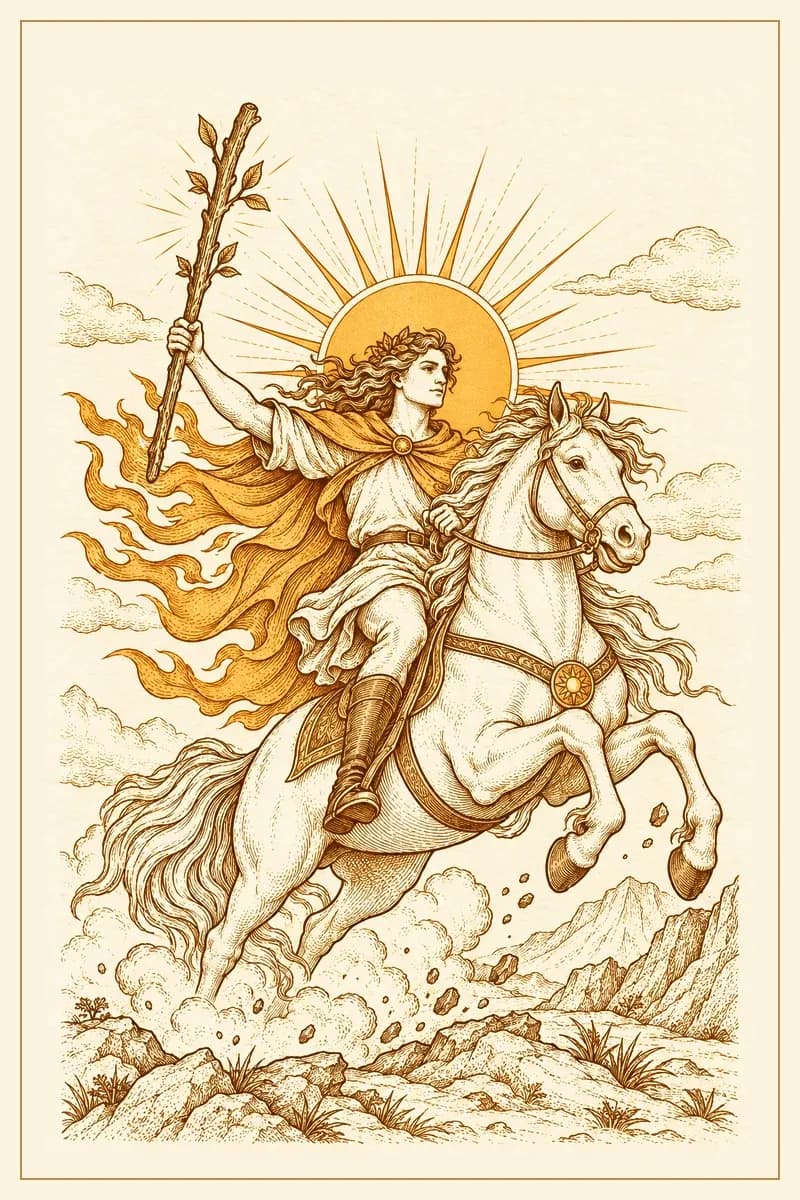
A rider in mid-leap under a blazing sun
Most court figures sit or stand. This one is airborne. A young rider on a white horse is caught at the top of a leap, the horse's forelegs tucked under its chest, its hind legs pushing off from dry, rocky ground in a burst of dust and flying stones. Behind them a huge sun spreads its rays across the upper half of the card, and a jagged peak rises on the right. Everything in the picture points one way: forward and slightly up.
The sprouting wand and the cloak of flame
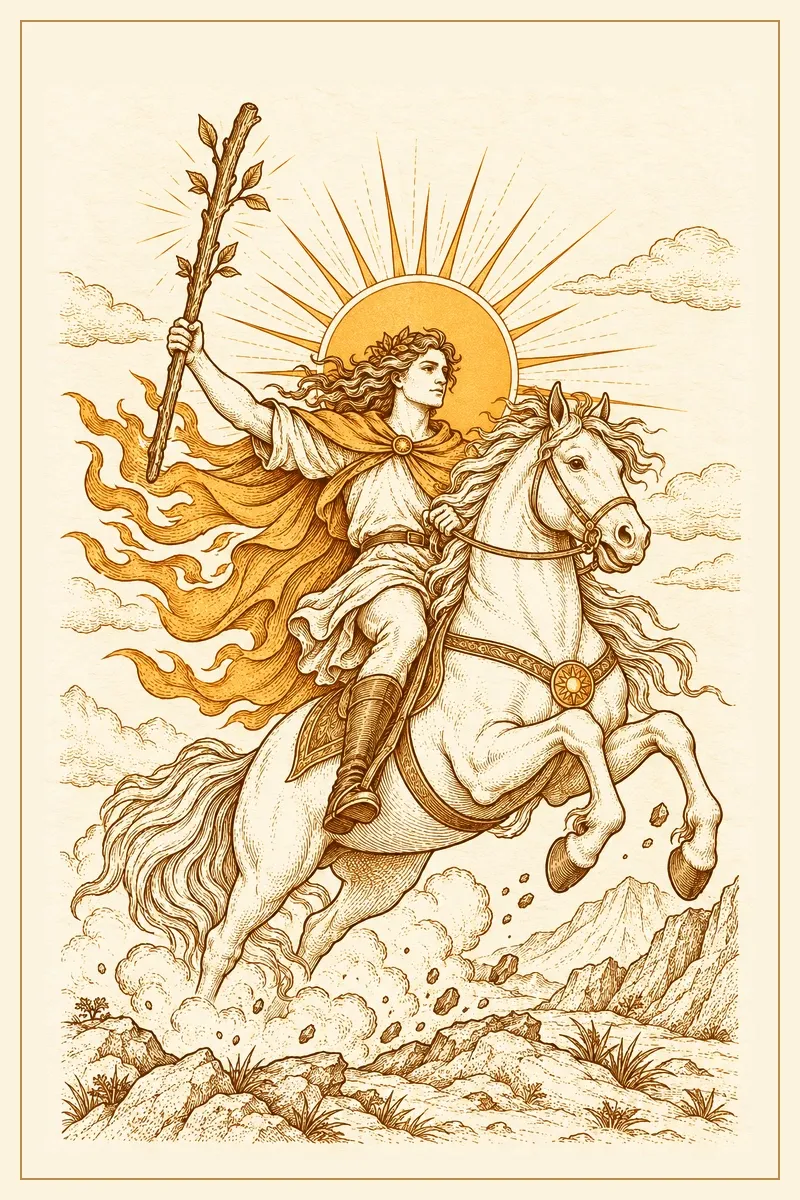
In his raised right hand the rider holds a long, rough wand with fresh leaves growing along it, lifted high like a signal. This is living wood, so the fire he carries is not destruction for its own sake but growth on the move. His left hand holds the reins lightly, close to the horse's neck. His cloak streams back from his shoulders and turns, at its edges, into tongues of flame. The fire is not something he grips; it trails off him as he rides and burns out behind him, which is both the card's gift and its warning.
No armor, a laurel wreath, and a sun on the harness
Notice what he is not wearing: no helmet, no breastplate, no shield. He rides in a simple tunic and tall boots with a laurel wreath in his windblown hair, as if he has already decided he will win. That mix of confidence and exposure is the whole card: brave, likable and a little underprotected. A small sun disc on the horse's breast strap echoes the great sun behind his head, so horse and rider share one source of heat. Compare the King of Wands, who sits still on a lion-carved throne with fire salamanders around him. The King has learned to keep fire close and steady. The Knight is still learning that fire needs a hearth as well as a road.
Fire of Fire: the Golden Dawn King who rides as a Knight
Wands are the fire suit: will, desire and the drive to begin. Each court card blends the suit's element with the element of its rank. The Golden Dawn, whose correspondences many readers still use, had four court ranks: King, Queen, Prince and Princess. Its King was the mounted figure, the Lord of the Flame and the Lightning, and he corresponds to the modern Knight of Wands. Read that way, the card is Fire of Fire: sudden, swift and hard to hold. The Golden Dawn Prince, who rides in a chariot, corresponds to the seated modern King of Wands; he is Air of Fire and covers 20° Cancer to 20° Leo. The Thoth deck renamed the mounted figure a Knight, which is one reason the two systems line up more easily than their names suggest. Many modern books instead give every knight the element of air, which makes this card Air of Fire. Both mappings are in use; pick one and stay with it.
In the zodiac, that mounted figure, today's Knight of Wands, rules from 20° Scorpio to 20° Sagittarius, roughly mid-November to mid-December. The last stretch of Scorpio gives him the will to break out of something; the larger Sagittarius share gives him his love of the open road, his bluntness and his impatience with anything that feels like a cage. If that restlessness sounds familiar, Sagittarius and its tarot cards shows how the sign's adventurous side runs through several Wands. The same sign's Major Arcana card is Temperance, which hints at the Knight's homework: the archer's fire is meant to be aimed and measured, and the Temperance tarot meaning explains that slower art in full. For the suit as a whole, the fire element in tarot covers how fire behaves across the deck.
Knight of Wands upright: the urge to go now
Upright, the Knight brings momentum. Something that has been sitting in the planning stage suddenly wants to move, and the card's question is less "should I?" than "how will I ride this well?" He tends to show up in three ways.
The person who arrives at speed
As someone in your life, he is the friend who books the trip while everyone else is still comparing dates, or the colleague who pitches the idea in the first meeting. Charming and direct, he signs up for adventures faster than for routines.
The fire in you that wants out
As advice, the card asks you to act on the thing that excites you. Send the application, make the call, say the honest sentence. If you have been circling a decision for weeks, his arrival suggests that more analysis will not make it clearer. The next piece of information tends to arrive once you move.
Journeys, moves and sudden changes of address
Older card meanings list departure, absence and change of residence among the Knight's themes, and many readers still treat him as one of the deck's strongest travel cards. He can point to a spontaneous trip, a relocation made on enthusiasm, or simply a season with more movement than usual. Beside cards about home and settling, he may describe an exciting trip that ends with coming back.
Knight of Wands reversed: the horse bolts, or will not leave the gate
Reversed, the fire is still there. What changes is the steering. Either the energy goes everywhere at once, or it is blocked and turns into frustration. Older meanings give the reversed card as interruption and discord; in modern readings it tends to look like one of three patterns.
Ten starts and no finish
The most familiar reversed reading is scattered energy: a new hobby every month, three side projects at sixty percent, a plan announced loudly and dropped quietly. It is rarely laziness. The Knight loves the beginning so much that the middle feels like a betrayal. The card's suggestion is not to put out the spark but to pick one thing and stay with it past the point where it stops being new.
Delays, cancellations and a short fuse
Sometimes the movement is blocked from outside: a trip postponed, a launch held up, a move delayed by paperwork. The real risk then is your reaction. Impatience turns into sharp words, and a fixable delay becomes a burned bridge. When the horse cannot run, use the waiting time well instead of kicking at the gate.
Charging in without looking
The third pattern is recklessness: quitting before you have a plan, a big purchase made on a high, a confrontation started because you are tired of waiting. Confidence slips into arrogance, and risk is taken for the thrill rather than the goal. A useful question here: if it works out, what will I do in week two? If you have no answer, you are probably riding on adrenaline.
Love readings: attraction at a gallop
In love, the upright Knight of Wands is chemistry that moves fast. For someone single, it often points to a bold, exciting person who makes their interest obvious, or to a season when you feel brave enough to make the first move yourself. For a couple, the card can bring the adventure back through a trip together, a shared project or a renewed physical spark.
What the upright Knight does not promise is staying power. He is a beginning card. If you are asking whether a new flame will last, look at the cards around him, and at what happens once the excitement is no longer new.
Reversed, the love picture is often about inconsistency: someone who comes on strong and then disappears, plans that keep getting canceled, a partner who wants freedom more than closeness, or jealousy that flares quickly. In a question about an ex, the reversed Knight can describe a sudden message driven by restlessness rather than reflection. If your own pattern is to chase the rush of a new connection and lose interest once it gets real, the card holds up that mirror kindly.
Work and money: launches, pitches and the price of haste
Career
At work, the upright Knight is the start of something: a new role, a business launch, a pitch you believe in, a stalled project that suddenly gets moving. He suits sales, startups, travel-heavy jobs, performance and any work that rewards nerve and quick thinking. Go after the opportunity, and back the enthusiasm with one practical step that makes it last, such as a schedule, a budget or a second pair of eyes on the plan.
Reversed, the career Knight warns about haste: applying everywhere without a focus, quitting in a moment of frustration, promising a deadline you cannot meet, or clashing with a manager because you hate waiting.
Money
Financially, the upright Knight leans toward spending on experiences and ventures: travel, a course, the equipment that gets a business started. It is a card of bold moves rather than careful saving, so it works best with a clear ceiling on how much you are willing to risk. Reversed, money goes out on impulse, or a risky bet looks better from the inside than it really is. Tarot can show you your habits around money; it is not financial advice, and a large decision deserves a qualified second opinion.
Energy, rest and the restless spirit
For well-being, the upright Knight points to high energy and a body that wants to move; under this card you may feel better when you get outside, run, dance or try a new physical challenge. Reversed, it can describe pushing past tiredness, or energy that spikes and then crashes. Tarot cannot diagnose anything, so take the card as a nudge to pace yourself, and see a professional about anything that worries you.
Spiritually, he is the seeker who throws himself into a new practice with real fire. Reversed, that hunger for the next exciting practice can become a way to dodge the slow work of change, sometimes called spiritual bypassing.
Yes, no and how fast: reading speed with this Knight
Upright, the Knight of Wands is a clear yes, and an energetic one. Questions about starting, traveling, applying or reaching out get a green light, as long as you are willing to act rather than wait for certainty.
Reversed, the answer is "not like this." It is less a no than a request to slow down: yes once you have a plan, a budget or a calmer head.
For timing, knights are the moving court cards, and this one moves fastest. Many readers take him as days or weeks rather than months, and readers who use astrological timing link him to his zodiac span, about mid-November to mid-December. Treat both as a feel for pace, not a date on the calendar.
Spark, rider, queen and king: the Wands court in order
When the Knight shares a spread with other Wands court cards, read them as stages of one fire growing up.
Page of Wands: the spark before the ride
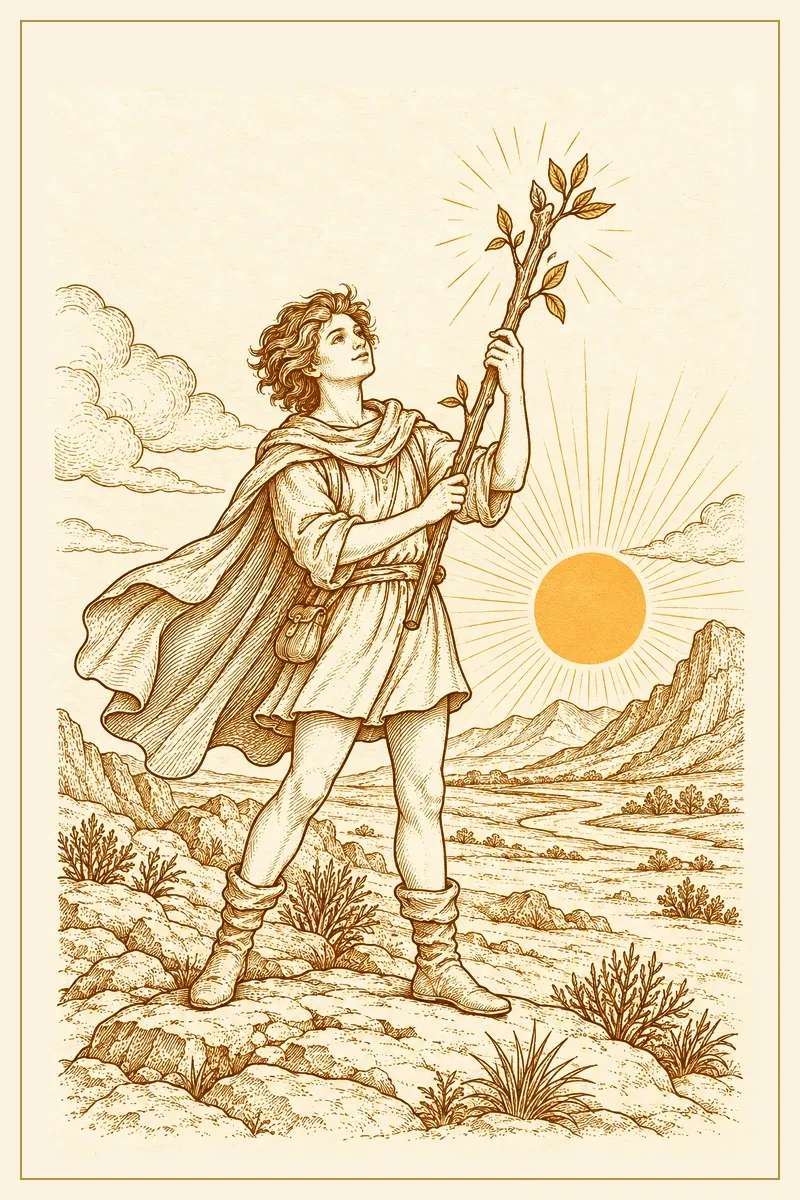
The Page of Wands stands on foot in a rocky valley, cloak blowing, gazing up at the leafing wand in his hands while the sun hangs low behind him. He has found the idea; he has not left yet. Beside the Knight, the Page can mean an idea about to get legs, or the curiosity that came before your current plans. The Page of Wands tarot card meaning covers that stage of first excitement.
Queen of Wands: fire that stays lit
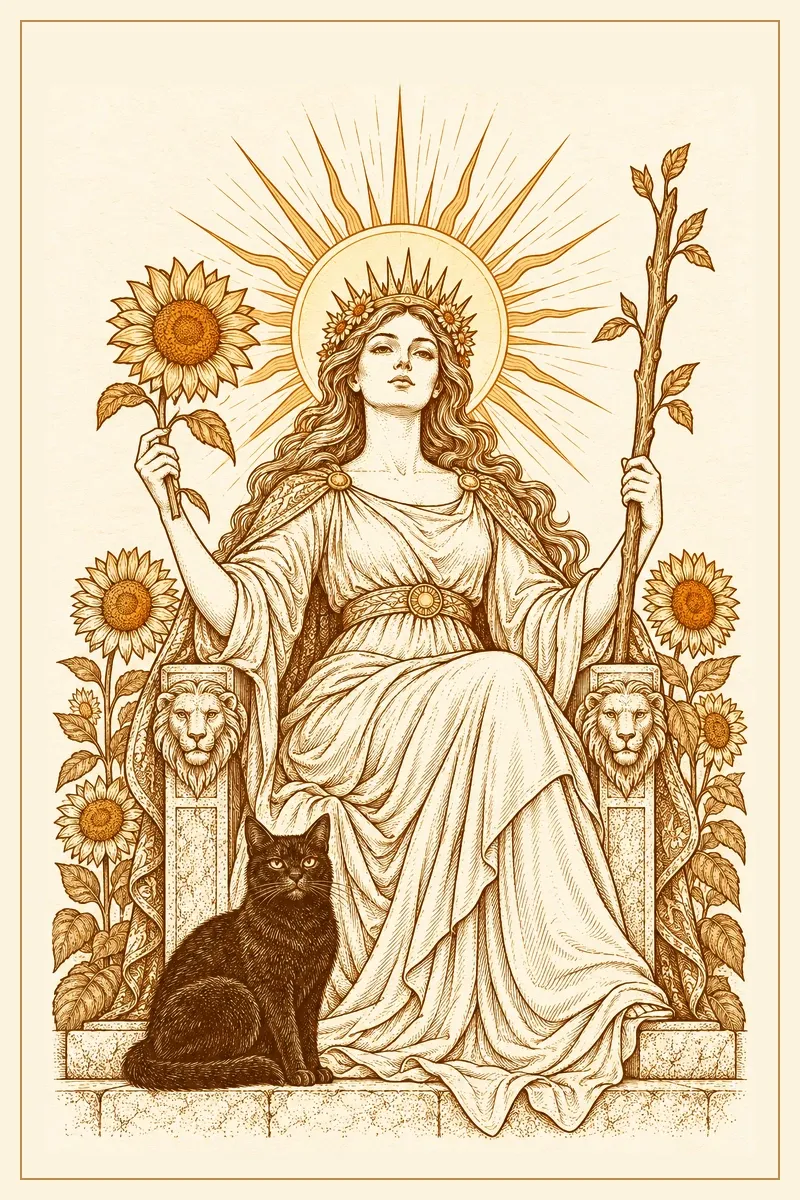
The Queen of Wands sits on a lion-carved throne surrounded by sunflowers, a leafing wand in one hand and a sunflower in the other, a black cat at her feet. She has the Knight's warmth without his restlessness. With the Knight, she often describes a fiery partnership, or the next step for your own energy, from chasing to attracting. The Queen of Wands meaning shows how that fire matures into steady confidence.
King of Wands: the road becomes a vision
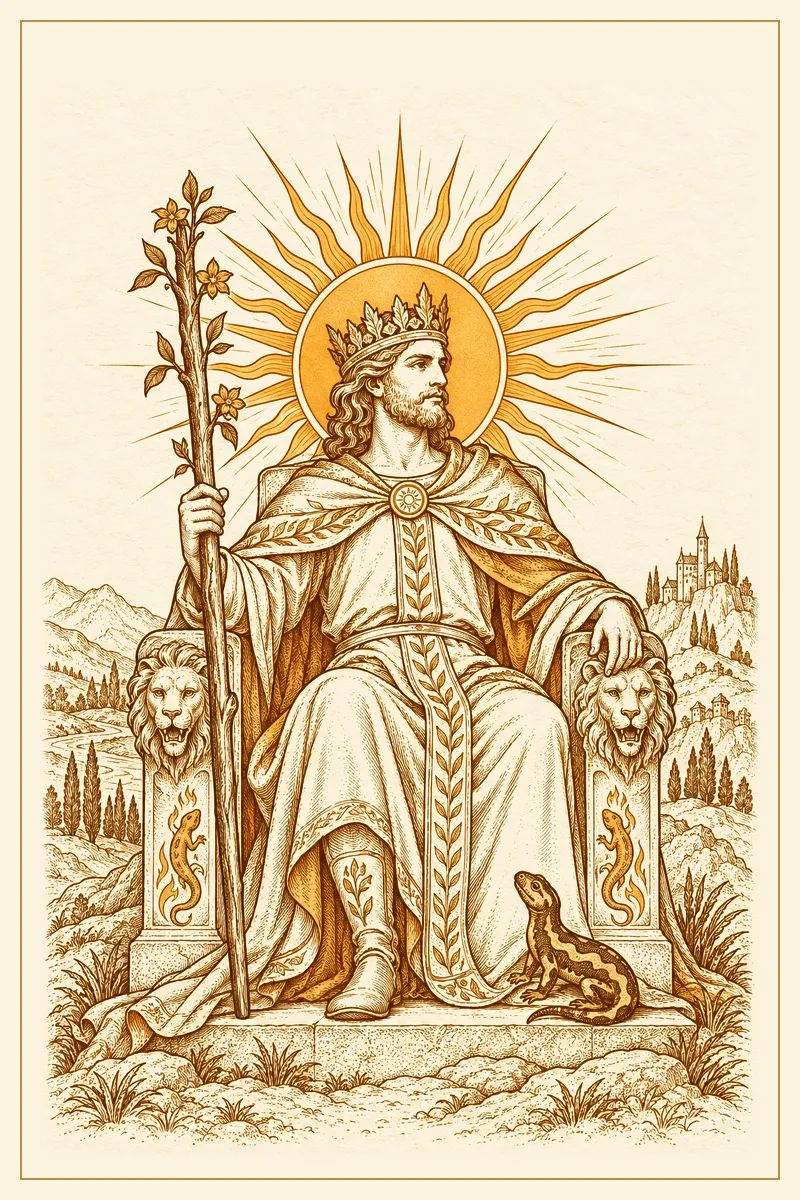
The King holds a flowering wand upright, rests his other hand on a carved lion's head, and has a salamander at his feet. He has stopped riding in order to plan where everyone else should go. Next to the Knight, he can be a mentor who believes in your project, or the version of you who already knows where your fire works best. The King of Wands card meaning covers leadership and long-range vision in the suit.
Five cards that change where the Knight rides
With The Chariot, two riders meet: the Knight leaping forward on instinct, and the charioteer standing still in his car while two sphinxes, one dark and one light, wait for his command. Together they promise strong forward movement, with the discipline the Knight lacks. The Chariot tarot meaning goes deeper into willpower that holds its line.
With The Lovers, attraction ignites quickly and a choice of the heart is in play, sometimes one you are tempted to make in a rush. The Lovers tarot meaning explains why that card is as much about choosing as about romance.
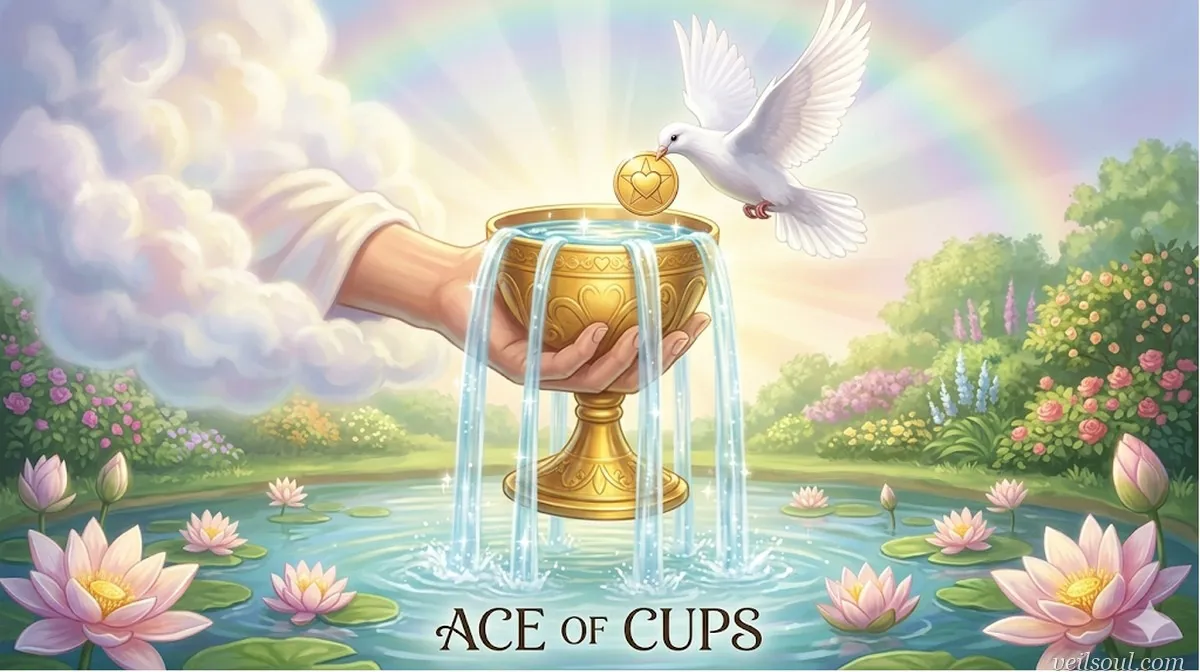
With Temperance, the angel's patient pouring from one golden goblet into another slows the horse to a pace it can keep. The pair asks you to balance passion with patience, the lesson of the Knight's own sign.
With The Tower, action turns disruptive: a bold move that shakes an established structure, or an upheaval that forces you to move fast. The full Tower tarot meaning explains why that kind of collapse can also clear ground.
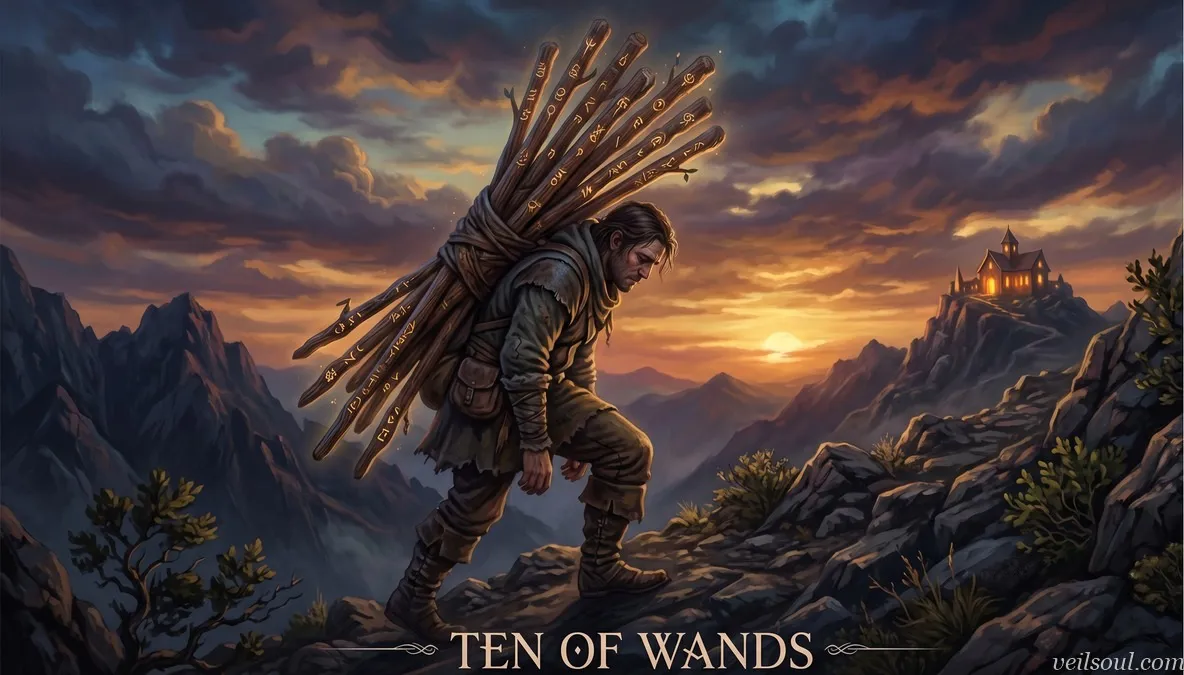
With the Four of Pentacles, whose seated figure hugs one coin to his chest and keeps two under his feet, the tension is between adventure and security. The Knight wants to ride; the Four wants to stay. The reading usually asks how much safety you need before you go, not whether to go at all.
The Open Road spread: five positions before a fast decision
This spread borrows its positions from the Knight's own picture. Use it when you feel the pull to act quickly and want to check the ride before you start. Shuffle, draw five cards and lay them left to right.
- The wand: what is lighting you up, and why now.
- The horse: what will carry you, such as skills, savings, health and the people behind you.
- The reins: the part that needs steering, the detail you are tempted to skip.
- The dust: what this move leaves behind or stirs up.
- The horizon: where this road leads if you ride it with care.
Read positions two and three together: a strong horse with loose reins is the classic Knight of Wands problem.
A sample reading: a job offer in another city
Imagine someone who has been offered a job in a city several hours away. The role is exciting, the start date is three weeks out, and they ask: "Should I say yes now, and how do I do it well?" They lay out the Open Road spread.
- The wand: Knight of Wands, upright.
- The horse: Eight of Pentacles.
- The reins: Two of Wands.
- The dust: Four of Wands.
- The horizon: Six of Wands.
The Knight in the first position names the pull honestly: this is real excitement, not just a wish to escape. The Eight of Pentacles as the horse says the skills are there; years of steady work made the offer possible. The Two of Wands in the reins position is the key. It is the card of planning from a high place and choosing a direction, and here it asks for the step the Knight likes to skip: compare the offer in detail, check the cost of living, negotiate the start date.
The Four of Wands in the dust position is the tender one: a home, friends and a community that will be left behind or stretched thin. It does not say "stay," only that the departure deserves a proper goodbye. The Six of Wands on the horizon points toward recognition if the move is made well. A grounded response: say yes with enthusiasm, ask for one extra week, and plan a gathering with the people who make the current city feel like home. The fire stays; the reins get used.
Before you ride: steps for the coming week
- Take one concrete step toward the thing that excites you within forty-eight hours, even a small one.
- Write down what week two looks like before you commit to week one.
- Put one night between a heated feeling and a heated message.
- Finish one thing you started in a burst of enthusiasm and then abandoned.
Then ask yourself: is my passion building something right now, or burning through it? What would the bravest version of me do this week, and what would the wisest version add?
Frequently asked questions
Is the Knight of Wands a yes or no card?
Upright, it is a strong yes that favors acting soon. Reversed, it is "yes, but slow down": make a plan, check the details, and do not decide from frustration or a rush of excitement.
Does the Knight of Wands mean someone is interested in me?
It can describe strong attraction and bold, flirtatious energy in a connection. But no card can confirm what another person privately feels, guarantee that they will act, or tell you when. Use it to read the dynamic, then watch what the person actually does over time.
What does the Knight of Wands reversed mean in love?
Usually inconsistency or haste: hot-and-cold attention, canceled plans, or arguments that flare quickly. It can also reflect your own habit of losing interest once the early excitement fades.
Is the Knight of Wands a travel card?
Yes, one of the clearest: trips, moves and adventures, often decided quickly. Reversed, it can mean travel delays or a restlessness that wants to go somewhere without knowing where.
What zodiac sign is the Knight of Wands?
In the Golden Dawn system, where the mounted King corresponds to the modern Knight, the card covers 20° Scorpio to 20° Sagittarius, so it is mostly Sagittarius. Readers who match the ranks by name give that span to the King of Wands instead, so check which system your book follows.
Does the Knight of Wands have to be a man?
No. Court cards describe styles of energy, not genders. Anyone, at any age, can be the bold and adventurous figure on this card, and sometimes the card is not a person at all but a fast-moving situation.
Hold the reins, keep the fire
The Knight of Wands is the moment the fire leaves the hearth and takes to the road. His gift is courage; his lesson is steering. When a decision of your own is pulling at you, you can start a calm reading with your question and see which road the cards show.