Swift, decisive action driven by a clear mind is the core of the Knight of Swords tarot card meaning. Upright, the Knight of Swords meaning is a decision already made and carried out at speed: honest words, quick progress, a problem cut through rather than circled. Reversed, the same speed loses its aim and turns into haste, harsh words, arguments that run ahead of the facts, or a plan that charges off and then stalls.
As a court card he can describe a person, a role you are playing, or the pace a situation is asking for. He shows how a mind is moving; he cannot reveal what another person privately thinks, promise how a fast decision will turn out, or pin down a date. Read him as a question about your own clarity: do you know where you are riding, or only that you want to ride?
The card in brief:
- Upright keywords: decisive action, direct speech, ambition, quick thinking, the courage to say what is true.
- Reversed keywords: haste, aggression, blunt words that wound, burnout, scattered effort, a charge that stalls.
- Element: Fire of Air in the Golden Dawn system, which called this mounted figure a King; modern books that give every knight air make him Air of Air.
- Astrology: 20° Taurus to 20° Gemini, roughly mid-May to mid-June.
- Yes or no: upright, yes, and act soon; reversed, not until you have checked your aim.
- In love: fast pursuit and frank conversations; reversed, sharp words and a pace that leaves no room to breathe.
- At work: a deadline met, a debate won, a quick call made well; reversed, a rushed decision or a colleague steamrolled.
Sword up, horse at full stretch: the rider on the card
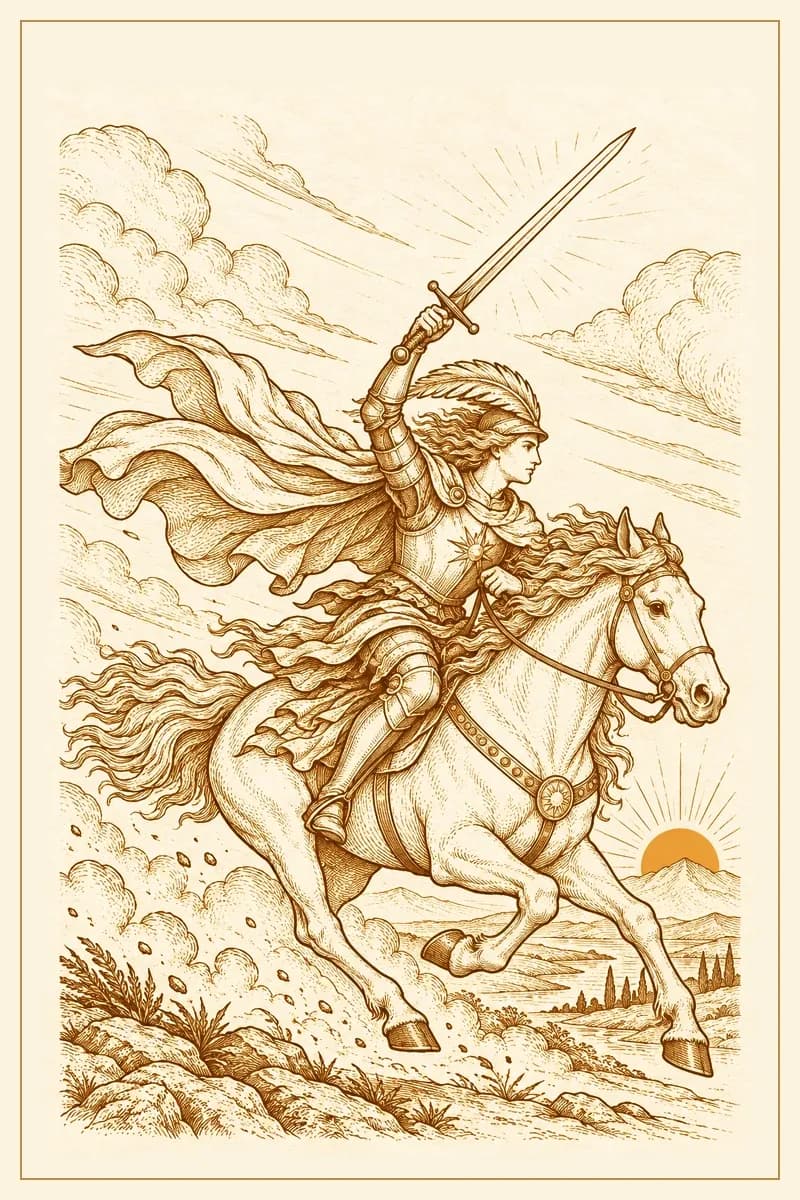
Every line of this card leans to the right. A pale horse gallops across rough, rocky ground at full stretch, front hooves reaching, hind legs driving, a spray of dust and pebbles thrown up behind it. Its mane and tail stream back like the rider's cape, and long wind lines cut across the clouds overhead. Nothing in the picture stands still, and nothing looks back.
A blade lifted into the light
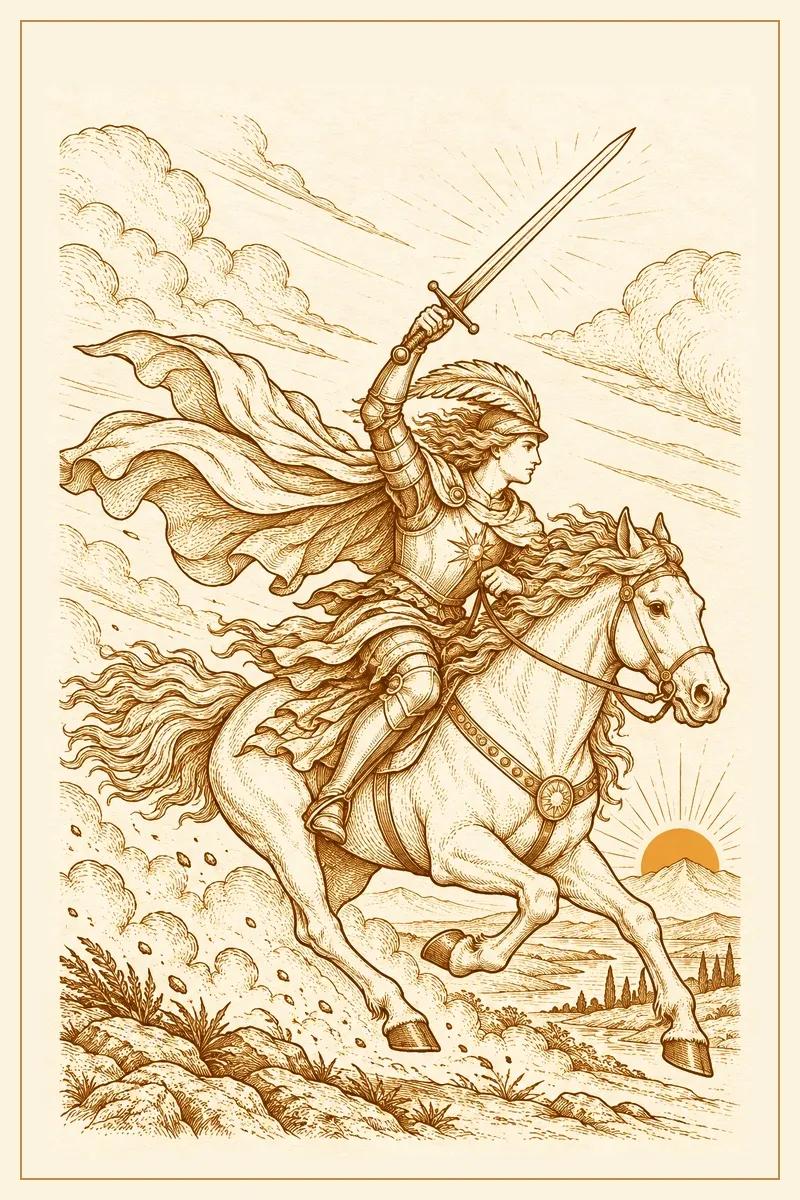
The rider holds his sword high in his right hand, angled forward, and thin rays break from the sky just behind its tip. This is a thought that has become a decision: the blade is raised and moving, not resting on a shoulder or pointed at the ground. The rays suggest the clarity is real; whether the blow lands where it should is the question the rest of the card asks.
Plume, armor and a star on the chest
This Knight is dressed for a fight: a breastplate with a star-shaped boss at its center, jointed plates on his arms and legs, a feathered crest on his helmet, and a matching round medallion on the horse's breast strap. The plume deserves a second look in a reading, since it is the one piece of his gear that is there to be seen rather than to serve. Speed that is about looking decisive is a different thing from speed that serves a cause.
Into the wind, toward a low sun
Ahead of him, near the right edge, a low sun sits on a hill above a river valley lined with slim cypress trees. The sky is breezy rather than stormy, yet he rides straight into the wind, cape, hair and mane all flying backward. The destination is bright and in view; the ground between here and there is rough and passing fast under the hooves. A rider at this speed sees the sun. He does not always see the stones.
Lord of the Winds and Breezes: Fire of Air from late Taurus into Gemini
Swords belong to air, the element of thought, speech and judgment, and each court rank adds an element of its own. The Golden Dawn's ranks were King, Queen, Prince and Princess, and its King was the mounted warrior, titled Lord of the Winds and Breezes and King of the Spirits of Air. That rider is the modern Knight of Swords. As the fiery part of air he is wind at its fastest, the gust that arrives before you see it coming.
The Golden Dawn Prince, the Prince of the Chariots of the Winds, rides in a chariot and corresponds to the modern, seated King of Swords: Air of Air, ruling 20° Capricorn to 20° Aquarius. Books that match ranks by name instead of by picture hand the Knight's fire and zodiac span to the King, and many modern guides give every knight the element of air, which makes this card Air of Air. Both systems are in use; pick one and read consistently.
In the zodiac, today's Knight rules from 20° Taurus to 20° Gemini, about mid-May to mid-June. The last decan of Taurus lends him stamina and a stubborn streak; the larger Gemini share gives him a quick tongue, a hunger for information and a restless need to keep moving. The result is a mind that decides fast and then holds on hard, which explains both his effectiveness and his trouble admitting a wrong turn.
Speed, speech and certainty: the card upright and reversed
Read the Knight through the three things he does: he moves fast, he speaks plainly, and he is sure of himself. Upright, each of these is a strength; reversed, each tips over into its shadow. Older divinatory lists already hold both sides, giving the card skill and bravery alongside wrath and opposition, with imprudence and extravagance for the reversal.
Speed: a clean decision or a reckless charge
Upright, the Knight says the deliberating is done. You have gathered what you need, the plan is sound. Send the proposal, make the call, start the hard conversation this week. Where the Page of Swords watches and collects, the Knight acts on what has been collected.
Reversed, speed outruns thought. Decisions get made to end the discomfort of not knowing rather than because the facts are in: four things started at once, a change of course mid-gallop, a deadline nobody could meet. Sometimes it looks like the opposite problem, a loud start that stalls because the plan was never checked against the ground it had to cross.
Speech: honest directness or words that cut
Upright, this is the card of saying what needs to be said. It favors clear emails, frank feedback, the question everyone else is avoiding, and a willingness to be briefly unpopular for the sake of the truth.
Reversed, directness loses its care. Bluntness gets mistaken for honesty, an argument is won and a relationship is lost, a message is sent at midnight and regretted by breakfast. The card can also put you on the receiving end of someone who interrupts, debates every point, or uses facts as a weapon.
Certainty: conviction or a closed mind
Upright, conviction is what lets the Knight ride into the wind. He believes in his cause and will defend it, which makes him a strong advocate or problem solver. Reversed, conviction hardens into a refusal to listen, and admitting a mistake feels like being thrown from the saddle. A useful reversed question: what would I need to hear to change my mind, and have I let anyone say it?
When the Knight is a person in your spread
Court cards often point to people, and this one has a recognizable style: the colleague who answers every message within minutes and has opinions about all of them, the friend who tells you the hard truth before you have finished the story, the family debater who cannot let a wrong fact go. Quick, articulate and impatient with vagueness, he is more loyal to ideas than to comfort.
In a position about other people, he usually shows someone pushing things forward faster than you would like. In a position about you, he is a compliment and a caution at once: your clarity is a gift, and others may need you to slow the horse long enough for them to climb on. Sometimes he is not a person at all but a situation moving at his pace: news that travels fast, a Friday deadline, an argument that breaks open a stuck topic.
Love: fast pursuit, frank talks and arguments that run ahead
For someone single, the upright Knight often describes attraction at speed: a person who asks you out directly, texts back at once and makes their interest unmistakable. Notice whether you are being courted or swept along. If you are the one pursuing, be honest about your interest and leave the other person room to answer at their own pace.
In a relationship, the upright card often points to a conversation that is overdue: about money, about the future, about a habit that has quietly irritated one of you for months. Said plainly and soon, it clears the air, as long as the honesty is aimed at the problem and not at your partner.
Reversed, the card tends to show communication going wrong: arguments that escalate before anyone has listened, sarcasm, a partner who must win every disagreement. In a question about an ex, it can describe an abrupt message or a sudden reappearance driven by impulse rather than reflection. The advice stays the same: slow the exchange down, say less, and ask one more question before you answer.
Career and money: deadlines, debates and quick decisions
At work
Upright, the Knight of Swords favors work that rewards fast, clear thinking: law, journalism, research, consulting, technology and crisis management. It can mark the moment to pitch the idea, push back on a bad plan, apply for the role that scares you or take charge of a project that has drifted.
Beside The Emperor, decisive action meets structure and authority, a strong pairing for leadership and for turning a bold plan into a system that lasts; the Emperor tarot card meaning explains that steady side. Reversed, the career Knight warns of a pace you cannot keep, a decision rushed to look decisive, or progress that steamrolls colleagues. The fix is rarely to stop; it is to check the plan with one other person before you ride.
Money
With money, the upright card favors well-researched moves made promptly, before the window closes; speed helps only when preparation came first. Reversed, it describes impulsive spending or a hasty decision made on a rush of certainty, and a telling sign is that you cannot explain the choice to someone else in two calm sentences. Tarot can show you your habits around money; it does not replace a qualified financial professional.
Health and spirit: a racing mind needs a rest stop
For well-being, the upright Knight brings drive to a goal: a training plan started in earnest. Reversed, the same intensity works against the body: overtraining, ignoring signs of exhaustion, a mind still arguing with the day at midnight. The Four of Swords, whose figure lies at rest on a stone tomb beneath three swords hung on the wall, is the natural counterweight here; the Four of Swords tarot card meaning explains why that kind of rest is a skill and not a failure. A card cannot diagnose anything, so take any worry about your health to a doctor.
Spiritually, he is the seeker who reads everything, debates everyone and wants the truth now. Reversed, that hunger can turn into arguing about beliefs, or racing through practices without giving any of them time to work. Insight on this path tends to arrive when the horse is finally standing still.
Asking a yes-or-no question: answer fast, check the aim
Upright, the Knight of Swords is a yes, and a quick one. Questions about acting, speaking up, applying, deciding or confronting a problem get a green light, provided your direction is clear and your reasons hold up when someone challenges them.
Reversed, the answer is closer to "not like this." It is less a flat no than a request to check your aim: gather the missing fact, cool down, or rewrite the plan so it can survive its second week.
For timing, he belongs to the fast end of the deck: days or a couple of weeks rather than months, or, for readers who use astrological timing, his span of mid-May to mid-June. Treat either as a sense of pace, not a calendar date.
The Knight between the Page, Queen and King of Swords
When other Swords court cards share the spread, read them as one sharp mind at different stages: learning, acting, understanding and judging.
Page of Swords: the question before the charge
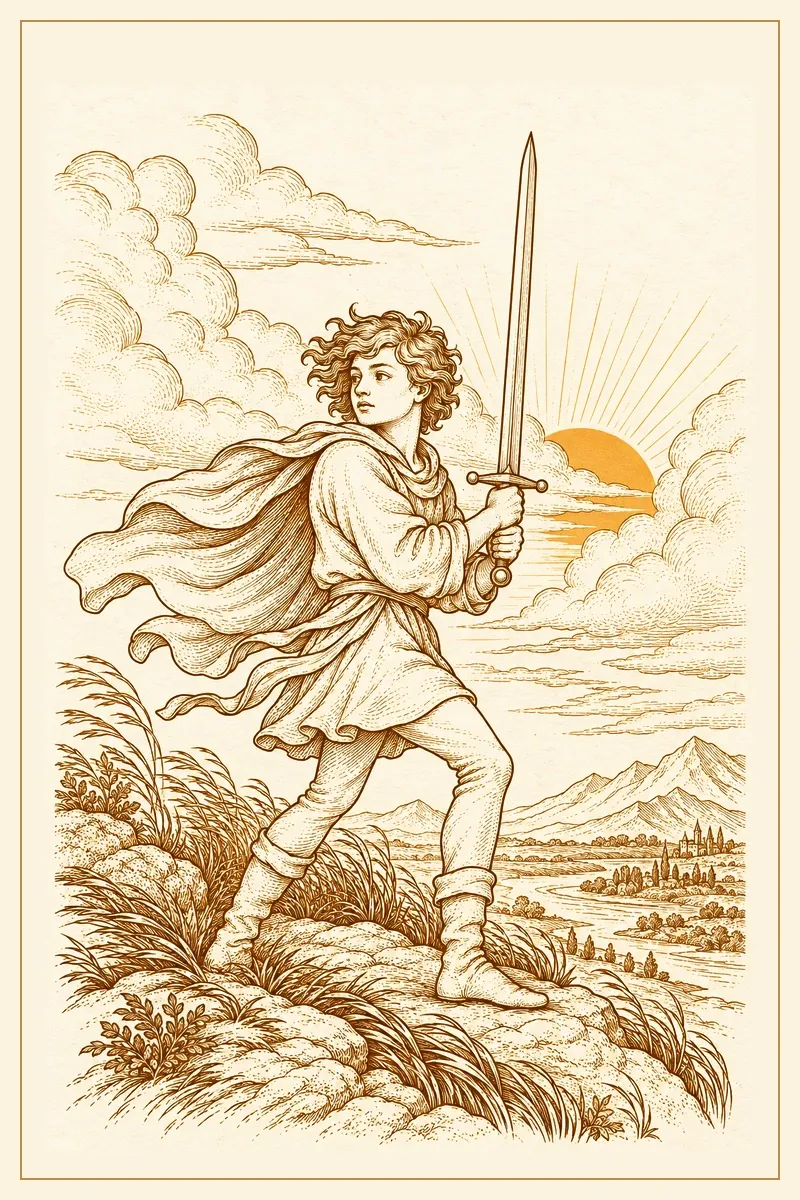
The Page stands on a grassy hilltop with his sword held upright, cloak blowing, glancing back over his shoulder while a low sun breaks through the clouds behind him. He is alert and curious but still on foot, still checking what is behind him; the Knight has stopped looking back. Side by side, they often describe an idea about to move from watching to doing. The Page of Swords tarot card meaning covers that watchful, information-gathering stage.
Queen of Swords: clarity that has learned to listen
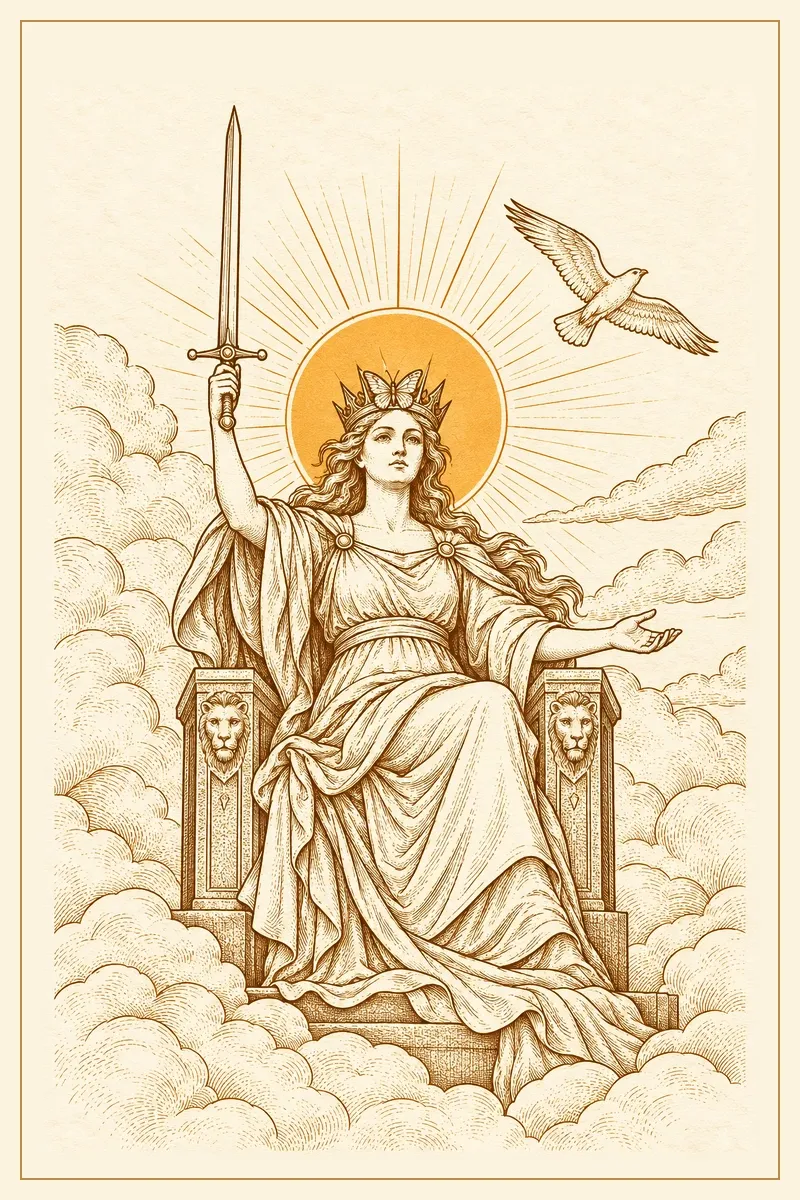
The Queen of Swords sits on a stone throne above the clouds, a sun-disk halo behind her crowned head, her sword held straight up and her other hand held open at her side, while a bird flies past overhead. She is as sharp as the Knight but needs to ride nowhere to prove it. Beside him, she can be honest counsel worth hearing before you act, or your own next step from fast truth to fair truth. The Queen of Swords meaning explains her blend of independence and discernment.
King of Swords: the verdict after the ride
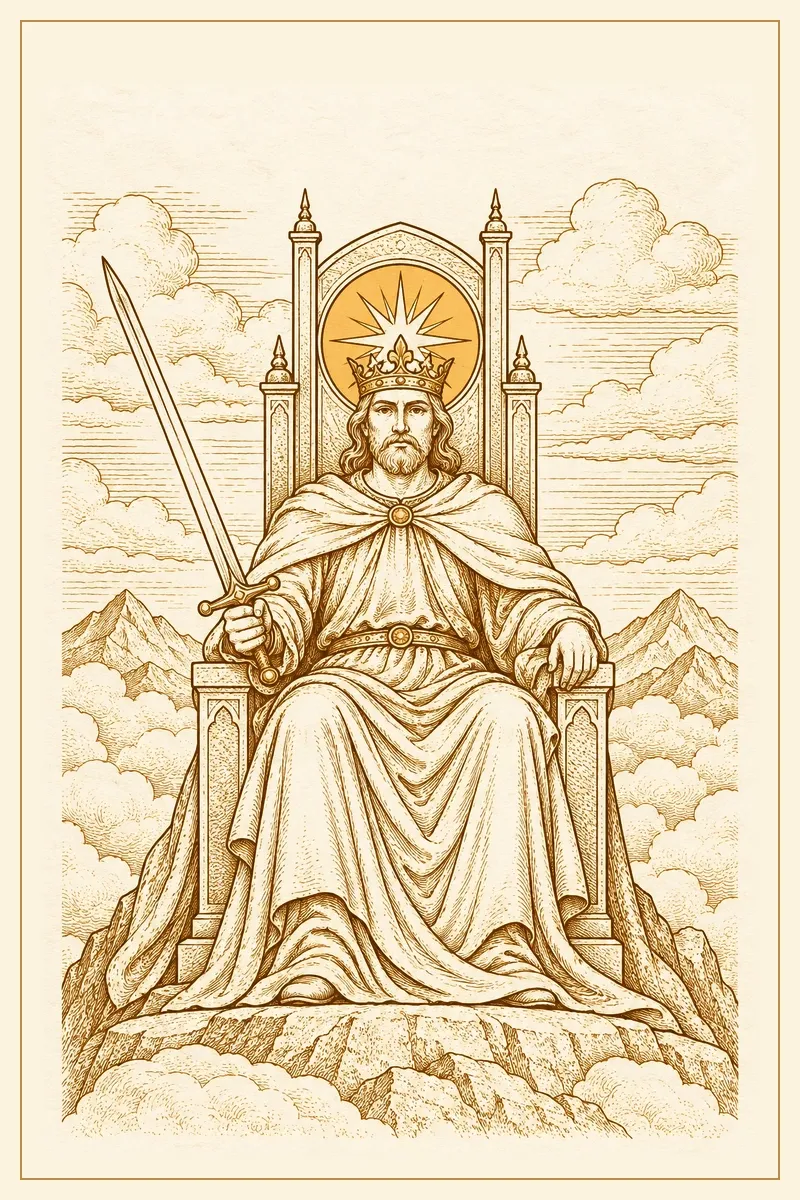
The King sits face-on in a tall throne set on rock, a star blazing behind his crown, his sword held at a slant in his right hand. Where the Knight acts on a conclusion, the King weighs evidence, sets rules and takes responsibility for the result. Paired with the Knight, he may be a mentor or authority who can turn your fast idea into a fair decision. The King of Swords tarot card meaning covers that judging side of the suit.
Five cards that redirect the charge
With The Chariot, two kinds of forward motion meet. The charioteer stands still in his car while a dark sphinx and a light sphinx wait for his command, and that control steadies the Knight's speed into a real victory. The Chariot tarot meaning explores willpower that holds its line.
With Temperance, the angel pouring water from a jug into a cup, one foot in the stream, asks the Knight to pace himself: go, but measure the effort and blend speed with patience. The Temperance tarot meaning explains that art of mixing.
With The Tower, lightning knocks the crown off a burning tower and two figures fall. Either your charge brings down a structure that was already unstable, or you are riding hard to get clear of a collapse. The Tower tarot meaning shows how that kind of upheaval also clears the ground.
With The Emperor, as the work section describes, decisive action gains structure and authority. With the Four of Swords, action and rest belong together: even the fastest rider has to dismount, or horse and rider both give out.
The Headwind spread: five positions drawn from the card
This layout borrows its positions from the Knight's own picture. Use it when you feel ready to act fast and want to check your aim first. Shuffle with your question in mind, draw five cards and lay them in a row from left to right, the way the Knight rides.
- The raised blade: the idea, truth or decision you are about to act on.
- The plume: how much of this is about being seen as right, fast or brave.
- The wind: the pressure pushing you to hurry, from inside or outside.
- The stones under the hooves: the fact, feeling or person you are tempted to ride over.
- The low sun: where this charge leads if you ride it with a clear head.
Read positions two and four together. A strong plume and heavy stones usually mean the plan is fine but the motive or the method needs a second look.
Reading it through: a late-night email to the whole team
Imagine a project lead who has just learned that a decision she argued against was approved anyway. It is late, she has drafted a long reply to the whole team, and she asks: "Should I send this tonight?" She lays out the Headwind spread.
- The raised blade: Justice.
- The plume: Knight of Swords, reversed.
- The wind: Five of Wands.
- The stones under the hooves: Three of Pentacles.
- The low sun: Six of Swords.
Justice as the blade says her point is fair and worth raising. The reversed Knight in the plume position is the honest mirror: part of the urge to send it tonight is about being seen to be right. The Five of Wands as the wind is a team that is already arguing, where one more sharp message would add heat rather than light.
The Three of Pentacles under the hooves is the detail she is tempted to skip: colleagues built this plan with her and deserve to be consulted, not corrected in public. The Six of Swords as the low sun points toward calmer water if she changes course. A grounded response: sleep on the draft, cut it to its three strongest points, and send it in the morning to the person who made the call, with a request to talk. The blade stays sharp; only the swing changes.
Before you charge: steps and questions for the week
- Write the decision down in one sentence. If you cannot, you are not ready to ride.
- Put one night between a heated thought and a sent message.
- Ask one person who disagrees with you to explain their view, and listen without rebutting.
- Schedule real rest this week, not just a change of task.
Then sit with a few questions. Am I charging forward with clarity, or just charging forward? Is my directness helping the conversation or damaging the connection? Where in my life is the Knight's decisiveness exactly what is needed right now? And am I moving at a pace I can keep, or riding toward burnout?
Frequently asked questions
Is the Knight of Swords a yes or no card?
Upright, it is a yes that favors acting soon, as long as your plan is clear. Reversed, it means "slow down first": check the facts and your motives before you move.
Does the Knight of Swords mean someone has feelings for me?
It can describe an intense, direct, fast-moving dynamic and someone who knows what they want. No card, though, can confirm what another person privately feels, guarantee what they will do, or say when. Read it as a picture of the energy between you, then pay attention to how the person actually behaves.
What does the Knight of Swords reversed mean in love?
Usually communication under strain: arguments that escalate, careless words, pressure to move faster than trust allows, or a sudden impulsive message. It can also point to your own habit of arguing to win.
What zodiac sign is the Knight of Swords?
In the Golden Dawn system, where the mounted King is today's Knight, the card rules 20° Taurus to 20° Gemini, so mostly Gemini, while the modern King of Swords takes 20° Capricorn to 20° Aquarius. Books that match ranks by name swap the two, so check which system your source follows.
How is the Knight of Swords different from the King of Swords?
The Knight acts on a conclusion at speed; the King weighs the evidence, sets the rules and owns the outcome. One is truth on the move, the other truth with responsibility attached.
Is the Knight of Swords a bad card?
No. It is a powerful card that asks for direction. Its upright gifts are courage, honesty and momentum; its risks are haste and harshness. Most readings with this Knight come down to one question: is the speed serving the goal?
Ride fast, aim first
The Knight of Swords is a mind that has decided and a horse that is already running. His gift is the nerve to act on the truth; his lesson is to watch the ground as well as the sun. If a decision of your own is pulling at the reins, you can bring your question to a calm reading and see where the cards point.