You connect with a tarot deck by using it. Handle the cards daily, look at each picture before you look anything up, ask one honest question at a time, and write down what you drew and what you made of it. Within a few months the deck stops being a reference book you consult and becomes something you think with. Familiarity does the work that ritual usually gets credit for.
None of this can be done badly enough to offend a deck, and none of it asks you to believe the cards are alive. Tarot is a way of thinking out loud with pictures, and its limits are firm: it will not tell you what another person is privately thinking, supply a date, or settle a medical, legal or money question, however long you have read with the same cards. What a strong working relationship gives you instead is speed, nuance, and readings you trust enough to act on.
At a glance, a working relationship with a deck is built from:
- Handling. Minutes a day with the cards in your hands, reading or not.
- One question at a time. A clear question, asked once and answered before you draw again.
- A written record. The draw, your first thought, and what happened afterward.
- Attention to the art. What this deck emphasizes, and where it differs from what you expected.
- Knowing when to stop. Putting the cards down before a reading turns into reassurance-seeking.
What connection with a deck is made of
Readers tend to describe this in mystical language, but what they are describing is ordinary and observable. Four things change as you spend time with one deck.
- Recognition replaces decoding. A card lands and a meaning arrives with it, because you have met that image in forty different questions and remember how each one turned out.
- The deck fits your hands. You know how many shuffles it takes before the order feels genuinely mixed, and which corner has softened.
- You learn this deck's accent. Decks draw the same seventy-eight ideas with different emphasis, and in time you read the picture in front of you rather than the one you first memorized.
- You keep a card you dislike. The real test is whether an uncomfortable draw stays in the reading instead of being reshuffled away.
Notice what is not on that list: being chosen by a deck, being worthy of one, or performing an opening ritual correctly. Nothing is keeping score. What you are building is skill with a particular set of pictures, and skill grows out of contact and honest record-keeping.
The first session with a new deck
Set aside forty quiet minutes on the day a deck arrives rather than reading with it immediately. The point is not ceremony: you are about to work with seventy-eight images you have never looked at, and looking at them once, slowly, saves months of fumbling.
- Go through the whole deck face up, in order. Majors first, then each suit from ace to king. Do not interpret. Let each picture register the way it would in a gallery.
- Mark the extremes. Set aside the three cards you keep returning to and the three that unsettle you. Those six say more about your reading style than any spread will.
- Break it in. A deck fresh from the box slides in blocks and refuses to interleave; that is the varnish, not a message, and it eases after a few hundred shuffles. Pick a motion your hands can repeat calmly — the guide to shuffling tarot cards sets out five that are kind to new cards.
- Set your house rules. Reversals or upright only, how many cards you pull, whether you cut before you deal. Keep it steady for a month, so you can tell a genuine shift from a change of method.
- Ask one question. Something real and current rather than "what do you want me to know." Draw a single card and write the card, your first impression, and the date.
Two practical matters often inflated into ritual: keep the deck somewhere you will actually reach for it, and clean it occasionally. Both are covered in the guide to storing and caring for tarot cards, and neither has to happen before your first reading. Sleeping with a new deck beside the bed is harmless if you enjoy it, and skipping it costs nothing.
If you are still deciding which deck to buy, borrow a friend's for an evening first; the questions worth asking are gathered in the guide to choosing your first tarot deck.
Five cards that describe a reader and a deck
These five are not a ritual and not a compatibility test. They are a vocabulary: when something in your practice feels off, one of them usually names it faster than a paragraph of self-analysis. Each is read here about your relationship with the cards rather than about love or work.
Page of Cups: arriving with fresh eyes

Upright, the Page of Cups is unguarded curiosity, the state worth being in during a first session. The Page lifts the cup and finds a fish looking back out of it, with no sign of having expected anything in particular. Applied to a deck, that means letting a picture say something no book mentioned and writing it down even when it sounds slight. The wider Page of Cups meaning covers the card outside this context.
Reversed, curiosity can turn into collecting: buying decks faster than you read them, or expecting a new one to charm you into practicing. The opposite failure shows here too: a first impression overruled a second later by a memorized definition. If you check a meaning before you have looked at the card for ten seconds, that habit is the reversal in action.
Two of Cups: a practice that runs both ways

Upright, the Two of Cups is an even exchange, and it is the most honest picture of what a reading is. You bring a question you care about; the deck brings an image you did not choose. Neither half works alone: a vague question gives a vague reading however beautiful the deck, and the loveliest card says nothing useful if you were not really asking. See the full Two of Cups meaning for its other contexts.
Reversed, the exchange has gone one-sided. The familiar form is asking the same question five ways until a card agrees with you, which reports on your anxiety rather than your situation. The quieter form is a card a day pulled with your coat on, never considered, never recorded. Ask once, sit with the answer, and let a day pass before you ask again.
Queen of Cups: learning what a deck is good at

Upright, the Queen of Cups reads tone. She notices the mood of a room before anyone states it, and that is the skill behind knowing a deck's voice: after a few hundred readings you can feel when a draw is being gentle with you and when it is blunt. Decks genuinely differ here, and noticing it is observation rather than superstition; much of building your tarot intuition is learning to translate between what a picture shows and what your question needs. The full Queen of Cups meaning explores the card more broadly.
Reversed, attunement tips into projection. You read your own mood into every card, so a tired evening produces a reading about exhaustion whatever came up. The check is to write the draw down before you interpret it, then read your interpretation back the next morning; if it describes your day more precisely than the cards, the reversal is pointing at you.
Nine of Wands: still reading out of duty

Upright, the Nine of Wands keeps going after the enthusiasm has gone: one more watch, one more day. Sometimes that is the right posture, because a daily card has value in a dull week and there is no requirement to feel inspired. But the card also shows a guard expecting the next arrival to be an attack, and reading in that state finds a threat in every spread. There is more in the Nine of Wands meaning.
Reversed, the message is simpler: put the cards down. Persistence past the point of usefulness is how readers come to resent a deck they once loved. Nothing is lost by closing the practice for two weeks, and the first draw after a real break often feels sharper than anything in the month before it.
The Hanged Man: the deliberate pause
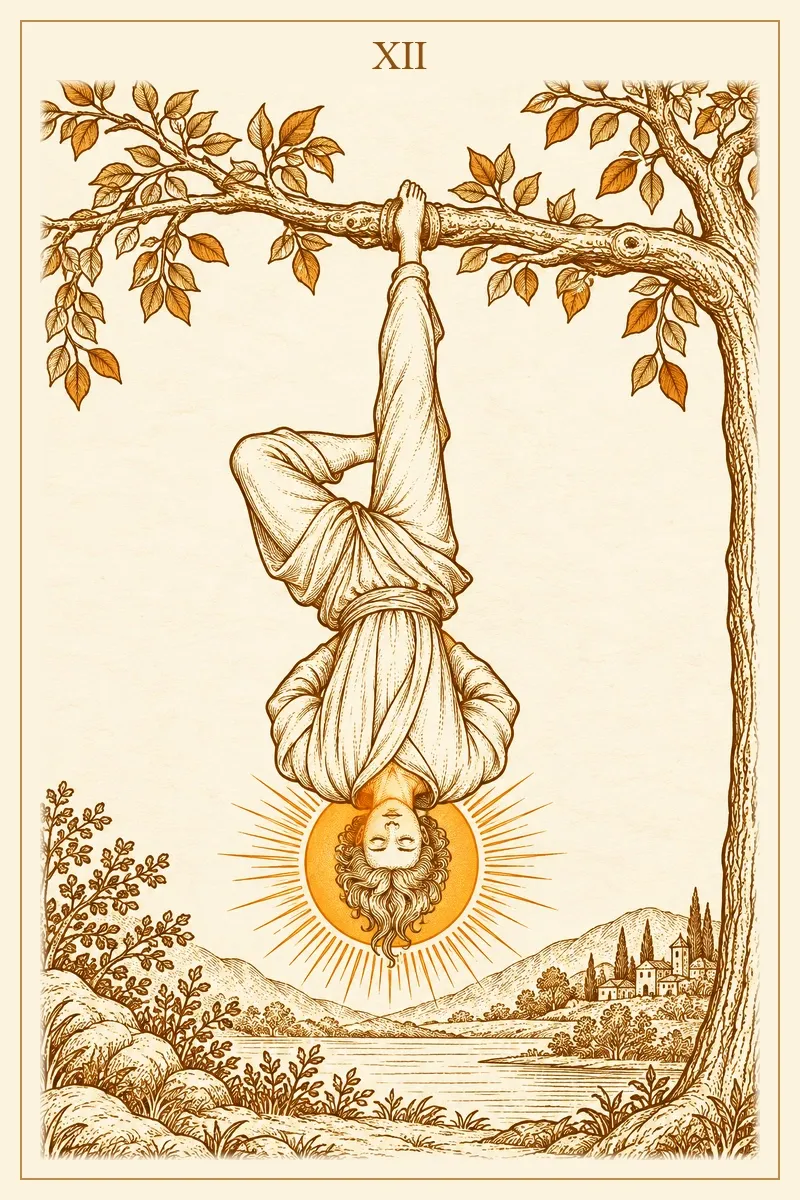
Upright, The Hanged Man describes a pause you choose, which differs from drifting away because life got busy. A chosen pause has a shape: wrap the cards, put them out of easy reach, name the date you will take them out, and let the question you were circling sit unanswered until then. The Hanged Man meaning takes the card well beyond this use.
Reversed, the pause has become avoidance, usually because one reading said something you were not ready to hear. If a deck has been in a drawer for months and you flinch slightly when you think about it, that is the reversal. The way back is deliberately low-stakes: pull one card about something trivial and let the deck be ordinary again.
The conversation spread: four positions
Once a season, read about the practice instead of with it. This is not the deck answering as a personality; it is you using a familiar set of images to look at a habit you are too close to see. Shuffle with the practice in mind rather than a question, and lay four cards left to right.
- The habit. How you have actually been reading lately, not how you meant to: time of day, state of mind, the questions you default to.
- The blind spot. What you skip, soften or explain away — a suit you under-read, a position you gloss over, a subject you never raise.
- The offer. What this practice is ready to give you if you show up for it. Read it generously; most readers hurry past this position.
- The small change. One adjustment to carry for a month. If the card suggests three, take the smallest.
Starting with the habit keeps the spread concrete, and finishing with a single change stops it becoming an audit of your character. Keep it rare: laid monthly it becomes another anxious loop, but at the turn of a season it shows you where your attention has drifted.
A worked example: eight months in, and the draws stopped landing
Suppose you have read with the same deck almost every morning since spring, and for the last few weeks the cards have gone past you without catching. The question you bring to the conversation spread is: "This has become automatic. What is going on here?"
The cards come up as the Knight of Wands in the habit, the Seven of Pentacles in the blind spot, the Nine of Cups in the offer, and Strength in the small change.
The Knight of Wands in the first position is speed: he arrives, acts and is gone, which describes a draw made standing up with a bag over one shoulder. The practice has not lapsed, it has compressed. Eight months of consistency built the habit, and the habit shrank to the smallest version of itself that still counts as done.
The Seven of Pentacles in the blind spot is the card of stopping to assess, and here it points at what was skipped: in eight months of daily cards you have almost certainly never read back through the record. Each morning felt thin because each was judged alone, while the pattern that would make them interesting sits unread in the notebook.
The Nine of Cups in the offer is contentment, modest rather than grand in this position. It suggests the practice can still be the part of the morning you look forward to — not a more profound reading, just an enjoyable one. Flat practices are often abandoned in search of something dramatic when they only needed to be pleasant again.
Strength in the small change is the gentle variety of persistence: steady hands, no force. The adjustment is not a new deck or a bigger spread but sitting down for the draw instead of standing, and giving the card two minutes instead of twenty seconds.
Read as a set, the four cards do not say the deck is finished. They say a good habit got hurried and the record went unread. Another reader holding the same four would land somewhere else, which is the honest limit of a spread like this: it organizes your thinking, it does not hand down a verdict.
Daily use: the habit that builds familiarity
All of this depends on contact, and contact is cheap. Five to ten minutes a day, kept for three months, does more for your reading than any weekend of study.
- One card, same time, written down. Morning or evening, whichever you will keep. The shape of it is set out in the guide to the one-card daily draw, and the writing matters as much as the drawing.
- A record you reread. Date, card, one sentence. Reread it on the first of the month: that is where a deck starts to feel as though it knows you, because you can see how one card has behaved across twenty appearances. Keeping a tarot journal is what makes the review possible.
- One card a week, studied. Choose it on Monday, look at it properly, and on Sunday compare your impressions against a traditional meaning. Over about eighteen months you meet the whole deck this way.
- Handling without reading. Shuffling while a kettle boils is how a new deck stops being slippery and a familiar one stays easy.
- Two lines per deck. At the front of the notebook, write what this deck does well and where it misleads you. "Reads warm, so I under-call the warnings" is a useful note, and a second deck will need its own pair.
What you can skip: thanking the deck out loud, lighting anything, or beginning with a set phrase. If they please you, keep them; if they have become a checklist you resent, drop them. Resentment is the one thing that reliably ends a reading habit.
When a deck feels flat
Almost every reader hits a stretch where the cards say nothing. The deck is rarely the variable that changed, so work through the ordinary explanations first.
- You are asking about one worry. Six readings in a week about the same unresolved thing look alike, because you bring the same mind to each.
- You are reading tired. Late-evening draws at the end of a long day tend to produce either doom or nothing.
- Your questions have narrowed. If every spread is a version of "will this work out," the deck has little room to surprise you.
- You have stopped writing. Unrecorded readings blur together within days, which is what "the cards all feel the same" usually means.
- You are bracing. After a run of unwelcome draws, readers start reading defensively and flatten everything into mild reassurance.
The repairs are small: change the time of day, ask something you do not already know the answer to, or read for a friend, where your own hopes are not in the way. If the flatness is partly volume, the honest check is whether you are reading more often than you can absorb, a line examined in the piece on doing too many tarot readings.
A reset also helps, less because anything is stuck in the cards than because it marks a boundary between the last run of readings and the next. Sorting the deck back into its original order is the plainest version; the methods for cleansing a deck are worth a look if you want that pause to have more shape.
Resting, retiring and returning to a deck
Resting a deck is a normal part of a long practice rather than a failure of the relationship. Wrap it, put it where you will not see it every day, and name the date you will take it out again; a month is usually enough. Nothing needs explaining to the cards, and nothing accumulates while you are away.
Coming back deserves care, because a cold return after a long gap is where people decide, wrongly, that the connection has gone. Go through the deck face up once more before you read, as you did on the first day. Some cards will have changed for you in the interval, which tells you where the relationship actually lives.
Some decks simply leave the rotation: the art stops speaking to you, or the cards have worn to the point where handling them distracts you mid-reading. Letting one go asks for no ceremony and no apology. If you own several, moving between them keeps each one distinct in your mind and spreads the wear.
Practical next steps
- This week. Go through your current deck face up, in order, even after years, and note the three cards you can barely remember drawing.
- Tomorrow morning. Pull one card, sit down for it, and write three lines: the card, your first impression, and the question on your mind.
- For a month. Keep the same reversal policy and the same number of cards, so a real change is distinguishable from a change of method.
- On the first of next month. Reread the month in one sitting and write your two lines about the deck.
- At the turn of the season. Lay the four-position conversation spread and take the smallest change it offers.
Frequently asked questions
How long does it take to feel connected to a new deck?
For most readers, two weeks to three months of near-daily use. The milestone is not a feeling: it is the first time a card arrives and you know what it means in this deck before you have consciously thought about it. A deck left unused for a year will feel new again when you return to it, and that is not a sign anything was broken.
Do I need a ritual before I can use a new deck?
No. Looking through the cards once and shuffling them properly covers everything a new deck needs. Rituals help when they mark a boundary between the rest of your day and the reading; they are a problem only when skipping one makes you anxious. A practice that has become an obligation you resent is working against the thing it was meant to support.
What if a deck and I just do not get along?
Give it a month of ordinary use, since most early friction is unfamiliar artwork or stiff new cards rather than a mismatch. If you still avoid reaching for it, the likely cause is register: the art may be harsher, busier or more abstract than the questions you tend to bring. That is a reasonable basis for using a different deck, and it says nothing about you as a reader.
Should I name my deck or pick a card to represent me?
Both are optional and harmless. A name can make it easier to notice what a deck is like, the way naming any tendency helps you see it. A significator, one card set aside as yours, is useful mainly as a point of comparison when it turns up in a spread. If neither appeals to you, your readings will be no worse for it.
I stopped reading for months. How do I come back to a deck?
Start smaller than you think you need to: one card about something low-stakes, such as the shape of the week, written down in two lines. Avoid returning with the hardest question in your life, a common instinct and a common reason the return feels discouraging. Three ordinary draws rebuild the habit faster than one ambitious reading.
What can tarot not tell me, however well I know my deck?
It cannot report what another person is thinking or feeling in private, name a date, or decide a medical, legal or financial question; those belong with the people involved or a qualified professional. A long relationship with a deck improves your fluency, not the cards' access to facts. If readings have started to feel compulsory, or you cannot make an ordinary decision without consulting them, that is worth raising with a counselor rather than with the deck.
Where this goes next
The relationship you are building is not with the paper. It is with a set of images you have learned well enough to think with, and it grows every time you handle the cards, ask something honest and write down what you saw. When you would like to try that on a question you are carrying now, start a tarot reading with Veil Soul and give the first card two unhurried minutes of your attention.