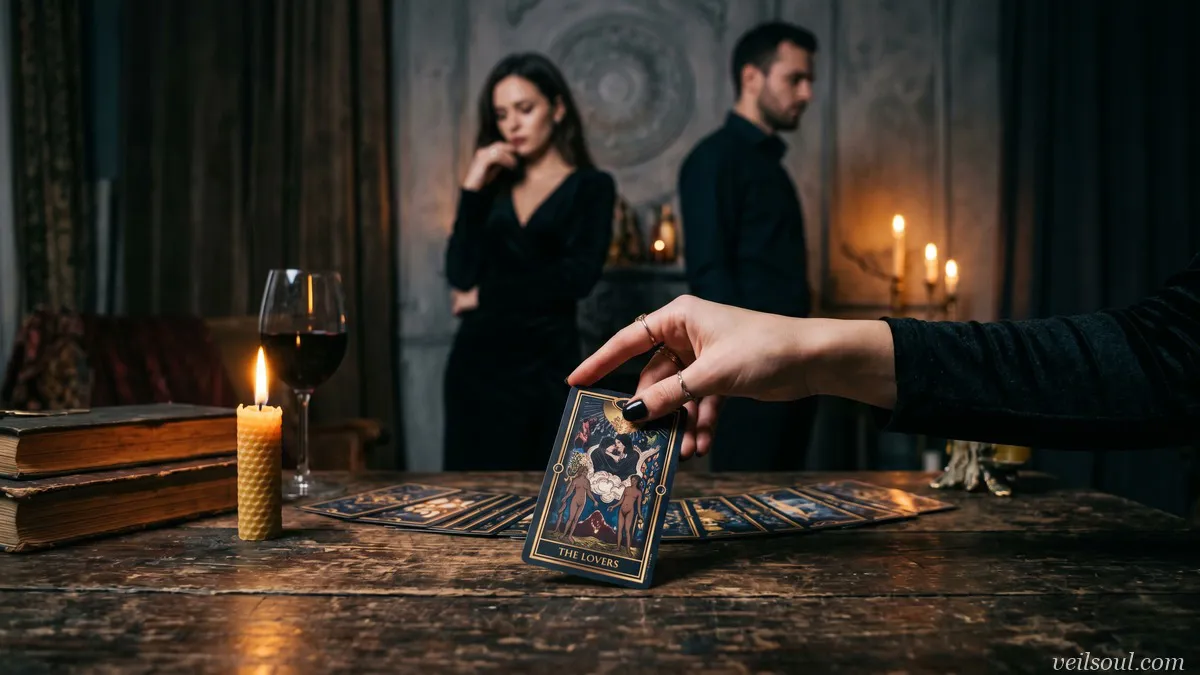
The cards most often read as secrecy, deception or betrayal in a love reading are the Seven of Swords, The Moon, the Three of Swords and The Devil, together with The Lovers and the Two of Cups when they appear reversed. No card can prove that someone is cheating: tarot cannot see another person's actions or read their mind, so treat these cards as pointers to trust, secrecy, unmet needs and your own fears, and to the conversation that may need to happen.
If you are reading this with a knot in your stomach, that is understandable. Suspicion is exhausting, and it is natural to want a clear answer. What a reading can offer is steadier than a verdict: a way to sort what you know from what you fear, and to choose your next step with a calmer mind.
At a glance, these are the cards people most often connect with cheating or betrayal, and what each one more usually describes:
- Seven of Swords: secrecy, something held back, acting alone.
- The Moon: uncertainty, mixed signals, fear filling the gaps.
- Three of Swords: hurt, painful words, grief over lost trust.
- The Devil: temptation, compulsion, an unhealthy attachment.
- The Lovers reversed: values or choices that no longer line up.
- Two of Cups reversed: an imbalance or break in mutual care.
- The Tower: a sudden revelation or a shake-up of assumptions.
- Five of Cups: grief and disappointment, with something still standing.
- Seven of Cups: fantasy, temptation or imagined scenarios.
- Eight of Cups: emotional withdrawal or walking away.
- Ace of Cups reversed: blocked or withheld feelings.
Reading a "cheating card" in context
A card describes a pattern, not an event. The Seven of Swords is about something being kept back, but that something could be an affair, a debt, a job worry, a health concern, or feelings someone has not found words for. It could also be something you are keeping back yourself. The question you asked, the position the card lands in and the cards around it decide which reading fits.
Before you read, separate what you have actually observed, what you have been told, and what you are imagining. A change in routine or a phone kept face down is an observation; "they must be seeing someone" is an interpretation. Cards can help you notice which one you are standing on. And a reading about trust is often really a reading about you: how safe you feel, what you need, and whether you feel able to ask for it. That is the part of the situation you can act on.
Six cards most often read as secrecy or betrayal
These six cards come up most often when people ask about cheating. For each, here is the upright and reversed reading and what it can mean in a relationship question other than infidelity.
Seven of Swords: secrecy and what is held back
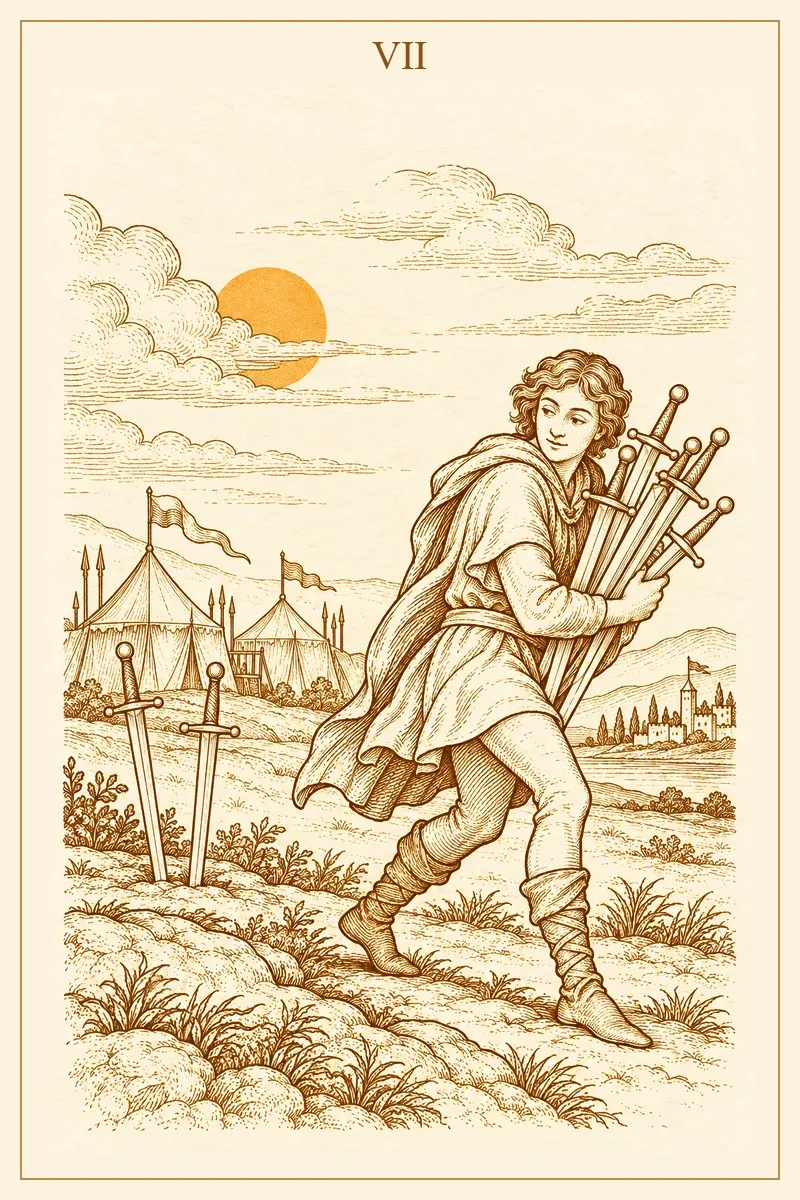
Upright, the Seven of Swords is the card most associated with deception. Traditionally it shows someone slipping away with swords that are not all theirs, and its themes are secrecy, strategy, acting alone and avoiding consequences. In a love reading it asks whether something is being kept out of the conversation, without saying that the something is an affair. For its full range of meanings, see the Seven of Swords tarot meaning.
Reversed, it often points to secrets surfacing, a guilty conscience or the wish to come clean. It can also describe self-deception: a comfortable story told because the truth would require a hard decision.
Besides cheating, the card can mean a partner handling a problem alone, going quiet to avoid conflict, keeping money or plans private, or protecting themselves after an old hurt. It may equally point at you, if you have been checking, testing or hiding your worries instead of saying them aloud. A useful line to journal is: "What is not being said here, and on whose side?"
The Moon: uncertainty and fear filling the gaps

Upright, The Moon is the card of uncertainty, illusion and intuition. By moonlight shapes blur, and the mind fills in what it cannot see. In a trust question it can describe mixed signals or information that is genuinely missing, and just as often anxiety, old wounds or a past betrayal shaping how you see the present. The Moon tarot meaning covers the card in more depth.
Reversed, it tends to show fog lifting: confusion clearing, a fear losing its grip, or something becoming clear slowly rather than in one dramatic moment.
Besides cheating, The Moon can mean that you are misreading each other, that one of you is going through something private and hard to explain, or that you need more information before deciding anything. Its practical advice is to slow down: write what you know, what you suspect and what you fear in three columns, and notice how much sits in the third.
Three of Swords: hurt that needs to be named
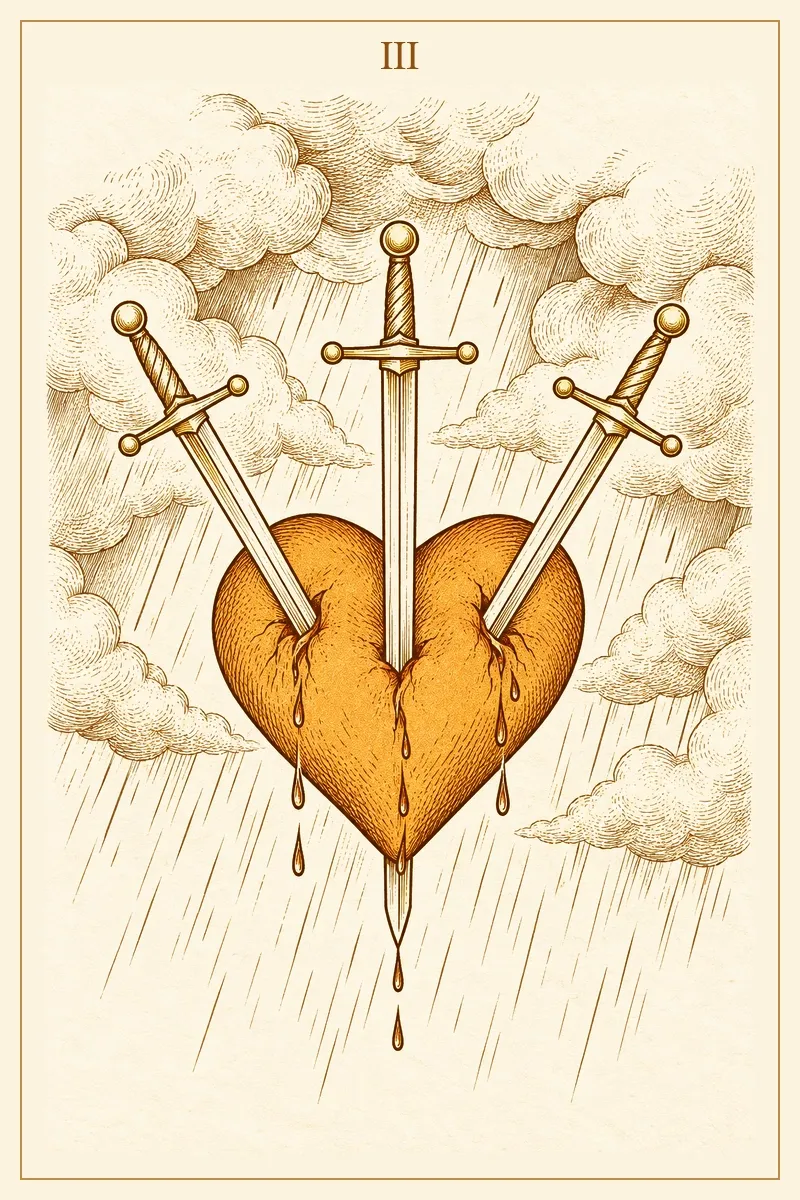
Upright, the Three of Swords is heartbreak, grief and painful truth. It describes the hurt, not its cause. In a reading about cheating it often reflects how much pain you are already carrying, whatever the facts turn out to be. You can read more in the full Three of Swords tarot meaning.
Reversed, it can show recovery beginning and forgiveness slowly becoming possible, or hurt being swallowed instead of expressed, which tends to come out sideways as resentment or suspicion.
Besides cheating, it can mean a hurtful argument, words that landed harder than intended, grief from outside the relationship weighing on it, or an old wound from a previous partner reopened. The card asks you to acknowledge the hurt honestly, to yourself first and then, when you are ready, to the person involved.
The Devil: compulsion and unhealthy attachment
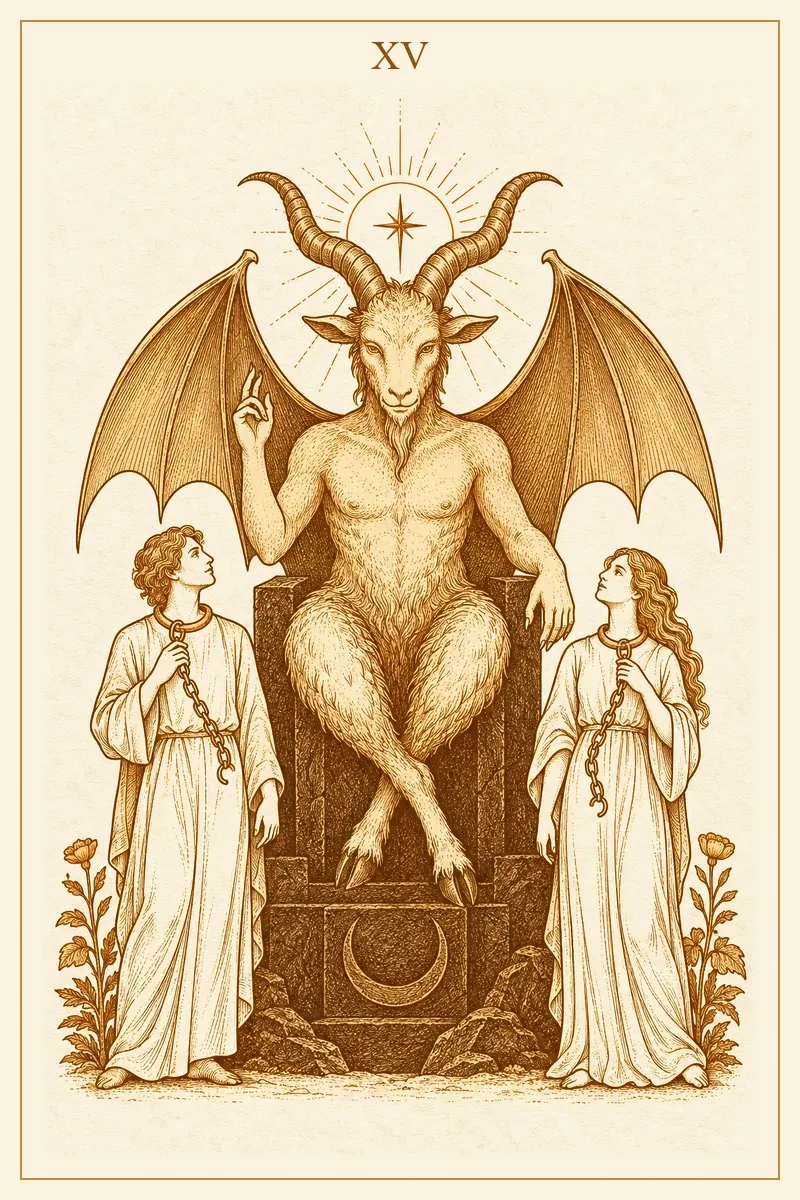
Upright, The Devil speaks of temptation, compulsion and patterns that feel hard to break. The figures traditionally shown in chains could lift them off: the card is about bonds held by fear, habit or desire rather than force. In a trust reading it can point to temptation, but just as often to jealousy, control or dependency. The full Devil tarot meaning explores both its shadow and its release.
Reversed, The Devil often marks awareness and release: seeing a pattern clearly and taking back a sense of choice. For someone consumed by suspicion, it can be the moment of stepping back from checking.
Besides cheating, it can mean a habit kept hidden out of shame, such as spending, gambling or drinking, an attraction that has outgrown its emotional foundation, or a possessive pattern on either side. If The Devil comes with fear of your partner rather than fear of losing them, make your safety the first question, ahead of anything the cards say.
The Lovers reversed: values and choices out of line
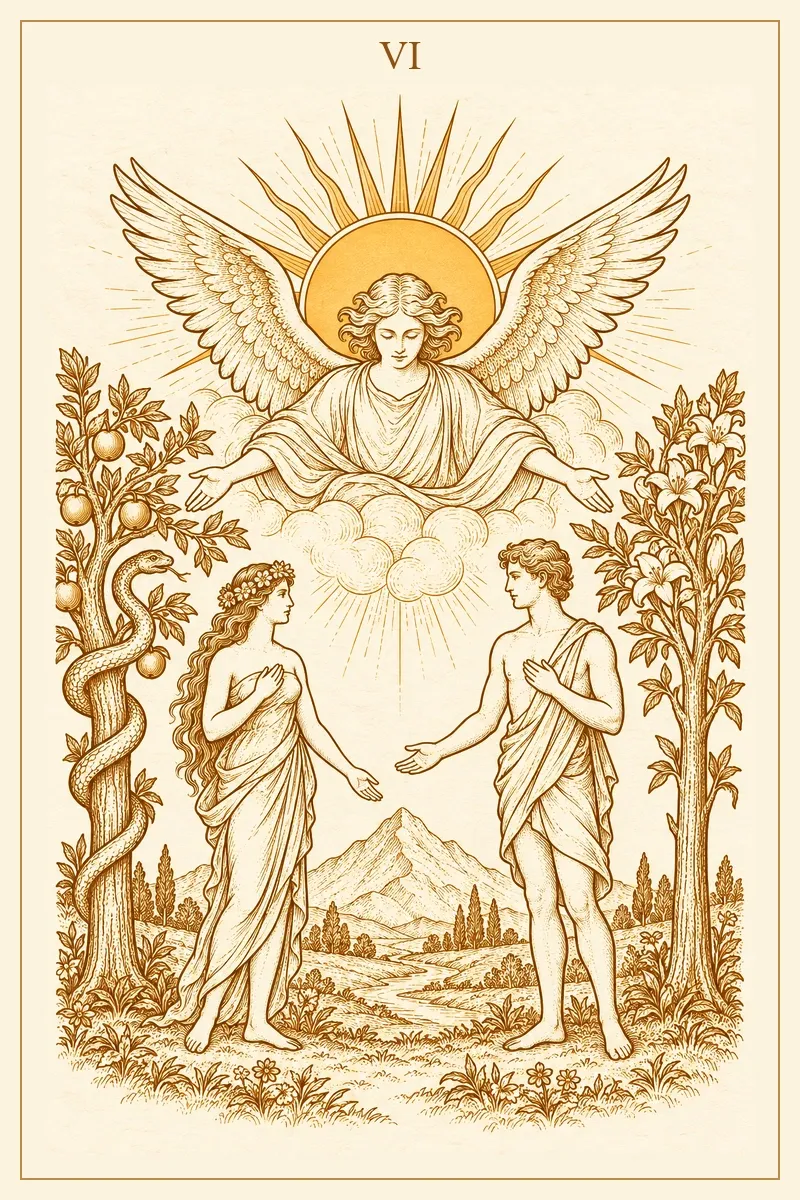
Upright, The Lovers is about union, alignment and choosing in line with your values. Reversed, it can describe misalignment: two people wanting different things, a choice that does not honor the relationship, or inner conflict about where your heart lies. That is why it appears in cheating questions, but it does not single out infidelity. The full Lovers tarot meaning explains the card in other contexts.
Besides cheating, it can point to a values gap that has grown quietly (children, money, where to live), a decision one partner keeps postponing, or your own doubt about whether the relationship still fits. Its question is not "who is to blame?" but "what are we each choosing, and do those choices still meet?"
Two of Cups reversed: an imbalance in the bond
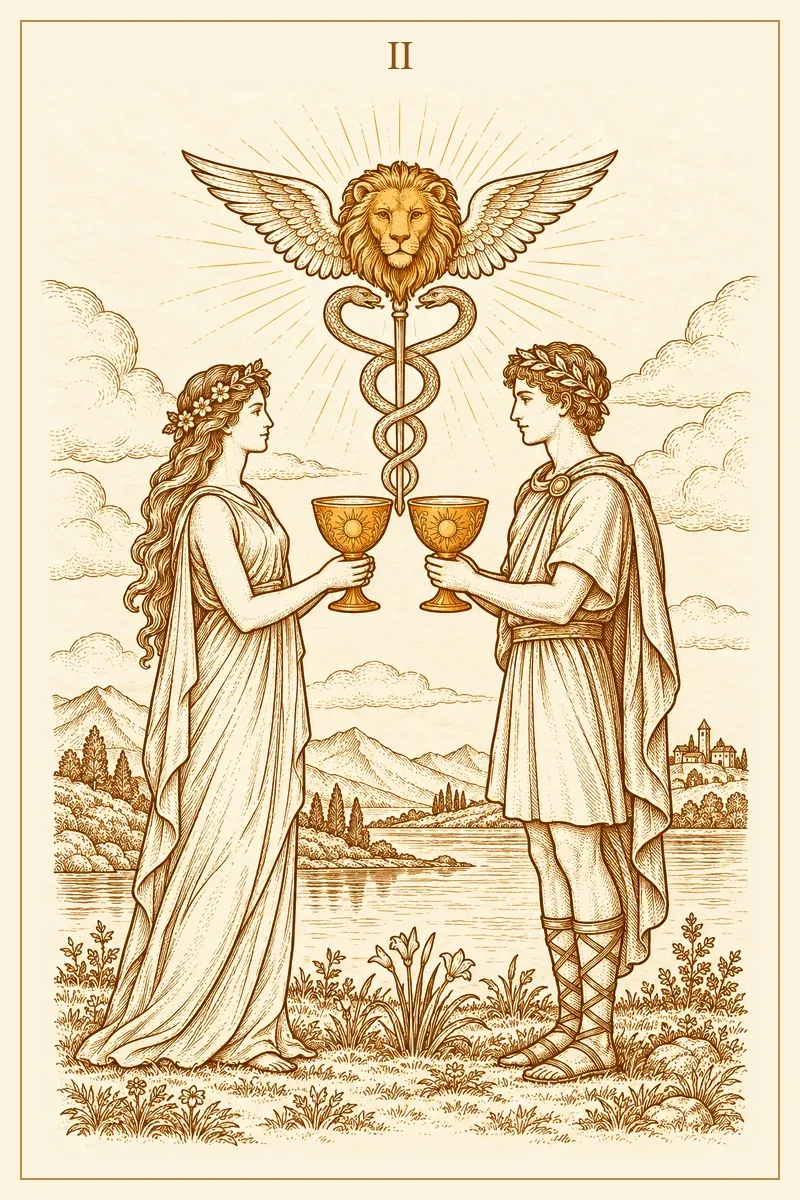
Upright, the Two of Cups is one of the warmest love cards: mutual attraction, respect and an even exchange of care. Reversed, that exchange is disrupted: one-sided effort, a breakdown in communication, or one person's attention going elsewhere. That last meaning puts it on cheating lists, but "elsewhere" is often work, family or a private struggle. The full Two of Cups tarot meaning covers both orientations.
Besides cheating, it can describe a couple who have stopped making time for each other or a repair after an argument that never happened. It is a prompt to talk about what each of you gives, what each of you needs, and where the balance slipped.
Cards that can look like cheating but usually aren't
Some cards make anxious readers think of betrayal because they carry loss, temptation or distance. In practice they more often describe something else.
The Tower: sudden change or the collapse of an assumption. It can mean something hidden comes out, but equally a job change, a move or an argument that clears the air. Reversed, it shows change being resisted.
Five of Cups: grief and disappointment, with two cups still standing. In a trust reading it usually reflects your own sadness about how things feel now; reversed, acceptance. It is about loss, not another person's actions.
Seven of Cups: imagination and wishful thinking. In a cheating question it very often points to the asker's own imagination: scenarios replayed at night, each more vivid than the last. Reversed, it suggests clarity.
Eight of Cups: walking away from what no longer fulfills. It can show a partner withdrawing, or you realizing you need more. Withdrawal hurts, but it is not betrayal, and it can be talked about. Reversed, it can mean coming back to try again.
Ace of Cups reversed: feelings blocked or withheld. It often describes someone shut down, stressed or depleted, who needs care before they can give more.
Four of Cups: apathy and turning inward. A distant partner may be preoccupied or low rather than interested elsewhere. Reversed, it shows re-engagement.
Six of Cups: nostalgia and the past. Some read it as an ex, but it more usually describes memories or a longing for how things were, sometimes your own. Reversed, it means letting the past rest.
Combinations to read with care
Pairs can sharpen a theme, but no pair is a verdict. Here are the combinations people most often worry about, read more calmly.
- Seven of Swords + The Moon: secrecy beside uncertainty. The grounded reading is "information is missing here," not "you are being betrayed." It is also the classic pair for anxiety filling a silence.
- The Devil + Seven of Swords: a pattern kept out of sight, such as a compulsion someone is ashamed of. It names a problem, not necessarily another person.
- The Tower + Three of Swords: a painful truth or a hard argument coming into the open. Arrange support for yourself before a difficult conversation.
- The Moon + Knight of Cups reversed: romantic words without follow-through. Watch actions over time rather than the intensity of what is said.
- Seven of Cups + Page of Cups reversed: fantasy beside emotional immaturity; someone, possibly the reader, not ready for a serious talk about commitment.
How to word your question so the reading helps
"Is my partner cheating?" asks the cards for a fact they cannot supply, and a frightened mind will hear "yes" in almost any card. Questions about the relationship and about yourself give the reading something to work with:
- Instead of "Are they cheating on me?", ask "What do I need to understand about the distance I feel in this relationship?"
- Instead of "Who are they texting?", ask "What is making it hard for us to be open with each other right now?"
- Instead of "Will I catch them?", ask "What do I need to feel safe and respected, and how can I ask for it?"
- Instead of "Are they lying?", ask "How can I raise my worry in a way that invites honesty rather than defense?"
Keep the reading on your side of the relationship. Reading in secret to monitor someone tends to deepen anxiety, and if you want to draw again and again until a card says what you need to hear, put the deck down for the day. Our guide to reading tarot for your relationship has more on framing questions that involve a partner.
A five-card spread for trust and clarity
This spread aims at clarity, not at catching anyone. Shuffle while holding a question like the ones above, then lay out five cards in a row.
- Position 1 — What I know: the facts and feelings you can stand on. If The Star appears here, it often reflects a steadier inner sense beneath the noise.
- Position 2 — What is unspoken: what has not been said or looked at, by either of you. Secrecy cards weigh most here; read them as a missing conversation.
- Position 3 — The bond as it is now: the current state of connection, a picture of the relationship rather than a report on your partner.
- Position 4 — What I need to accept: a truth that would serve you, even if it is uncomfortable.
- Position 5 — My next honest step: one action within your control.
Afterward, read positions 2 and 5 together, since the unspoken thing and your next step are often linked. For other layouts, our guide to love tarot spreads collects several, from quick check-ins to deeper readings.
A worked example
Imagine someone whose partner has been coming home later for a month, spending long stretches on their phone and seeming flat at weekends. They have not asked about it. Instead of "Are they cheating?", they ask: "What do I need to understand about the distance I feel between us, and how can I talk about it?"
What I know: The Moon. They know less than they fear: a few real observations with a lot of imagined story layered on top.
What is unspoken: Seven of Swords. Something is not being said. It might sit with the partner, or it might be the reader's own worry, carried for weeks instead of raised. The card says a conversation is missing.
The bond as it is now: Four of Cups. Withdrawal and flatness, which fits a partner who is stressed or low at least as well as one whose attention has gone elsewhere.
What I need to accept: Five of Cups. Grief about how things used to feel. Accepting that sadness, rather than turning it straight into suspicion, makes it possible to speak without accusing. Two cups are still standing.
My next honest step: Two of Cups. A calm conversation in which both people get to speak and be heard.
The reading does not answer "are they cheating?" and does not try to. It describes a gap in communication, a withdrawn partner and a reader who is hurting quietly. The outcome is a plan: choose a calm moment, describe what they have noticed without blame ("You've seemed far away lately, and I've been feeling worried and disconnected"), ask an open question, and listen. That conversation will tell them far more than another draw, and whatever they hear, they can decide their next step from facts rather than fear.
What to do after a difficult reading
Seeing several of these cards together can feel like the floor tilting. Give yourself time before acting on anything.
- Write it down. Note the question, the cards and your reactions, then, separately, only what you have actually seen or been told.
- Do not use the cards as evidence. "The tarot says you're hiding something" closes a conversation. Talk about what you noticed and how you feel.
- Have the honest conversation. Pick a calm time, speak in "I" statements, and leave room for a real answer. Starting is enough.
- Look after yourself. Sleep, eat, move, and talk to someone you trust.
- Consider a counselor. A couples counselor or therapist can help when trust is damaged, when talks keep turning into arguments, or when old betrayals color the present.
- Put safety first. If you are afraid of your partner, or feel controlled or monitored, contact a local support service or someone you trust before anything else.
If the reading touched on control or jealousy, our guide to tarot cards that warn about toxic relationships looks at those dynamics more broadly. And if you learn a betrayal did happen, whether to repair, take time apart or end things is yours to decide at your own pace, ideally with support around you.
Frequently asked questions
Can tarot tell if someone is cheating?
No. Tarot cannot observe another person or confirm what they have done, thought or felt. It can reflect themes such as secrecy, distance, hurt and fear, and help you decide what to say and do next. Let the facts come from honest conversation.
What is the most common cheating card in tarot?
The Seven of Swords is most often associated with deception. Even so, many of its meanings have nothing to do with infidelity: acting alone, avoiding a hard conversation, self-protection or a secret kept out of shame. It can point at the person asking as easily as at their partner.
Should I do a reading to check whether my partner is faithful?
A reading done to monitor someone usually reflects your fear back at you. Ask about the relationship and your own needs instead. If you feel you have to check on a partner through the cards, that feeling is itself a sign that something in the relationship needs attention.
What if I keep pulling the Seven of Swords?
A repeated card is worth noticing. It may be asking you to look at something unspoken, and that might be your own: a worry you have not voiced or something you already know but have not accepted. Rather than drawing again, try the spread above with a question about what is unsaid between you.
Does The Moon mean my partner is lying?
Not necessarily. The Moon describes things not yet being clear. It can point to missing information, but equally to anxiety, projection or an old hurt. Take it as a cue to gather real information gently, not to assume the worst.
Can these cards be about me rather than my partner?
Yes, often. Secrecy cards can reflect feelings you are hiding, The Moon your own fears, the Three of Swords hurt you carried in from before. Reading them this way is not self-blame; it is attention to the part you can work with directly.
Moving forward with care
Suspecting betrayal is lonely, and uncertainty can feel heavier than any answer. Cards like the Seven of Swords and The Moon are most useful when they help you slow down, separate fact from fear and work out what you need. You deserve honesty, and you deserve to feel steady in yourself whatever the answer turns out to be.
When you feel ready, try a calm reading on Veil Soul with a question about your relationship and your next step.