
Tarot cannot verify whether someone is a “twin flame” or a soulmate. Those words are ways people describe a connection: “soulmate” often points to belonging and mutual care, while “twin flame” is often used for an intense relationship that seems to expose old patterns. A spread can help you reflect on those experiences, but it cannot prove a cosmic bond, read another person’s thoughts or promise an outcome.
If you are trying to tell the difference, begin with what happens between you in ordinary life. Do you feel able to speak honestly, keep your boundaries and hear a no? Does closeness grow through shared effort, or does a cycle of distance and reunion consume your attention? The cards below can give language to those questions. They should never persuade you to stay in a situation that repeatedly harms you because it sounds spiritually significant.
At a glance, this is how the two words are usually used, and where tarot can genuinely help:
- Soulmate: belonging, ease and mutual care; growth that feels steady. Cards often read this way: The Lovers, Two of Cups, Ten of Cups.
- Twin flame: intensity, mirroring, push and pull; growth that feels disruptive. Cards often read this way: The Tower, The Devil, The Moon.
- What tarot can help with in either case: noticing reciprocity, pace, boundaries and your own patterns, so you can decide what to do next.
Soulmate and twin flame: two stories, not two diagnoses
People use “soulmate” in different ways. For some, it means a romantic partner with whom they feel deeply at home. For others, it includes a friend, family member or person who helped them grow. The word can express gratitude for a meaningful bond without claiming that the relationship was guaranteed or that it must last forever.
“Twin flame” usually comes from a spiritual story about two people mirroring one another with unusual force. Some versions say that one soul has two halves, or that separation and reunion are necessary stages. Those ideas are beliefs, not facts a tarot spread can establish. You may find the metaphor helpful for describing an encounter that challenged you. You do not have to accept the whole story, especially if it pressures you to excuse repeated hurt or wait indefinitely for someone who is unavailable.
That is why the most useful comparison is about how a relationship is lived. Comfort is not proof of a soulmate, and intensity is not proof of a twin flame. Any healthy relationship can contain conflict and change. Any exciting relationship can have moments of tenderness. A supportive connection allows both people to make choices, repair mistakes and remain whole outside the relationship. A difficult connection deserves honest attention to the difficulty, whatever name you give it.
In tarot, the same card can describe your desire, the present dynamic or a step you can take. Position and context do more work than a label. Before reading, decide what you want to understand: “What is happening between us?” is usually more helpful than “Which kind of soul bond is this?” A question you can act on protects you from turning every symbol into a verdict.
Cards that invite a look at mutual care
Some cards are useful when a connection feels steady and welcoming. They do not certify that two people are destined for each other. Instead, they ask whether affection can become a mutual practice. Read these cards against what both people actually do, particularly when plans change or a hard conversation is needed.
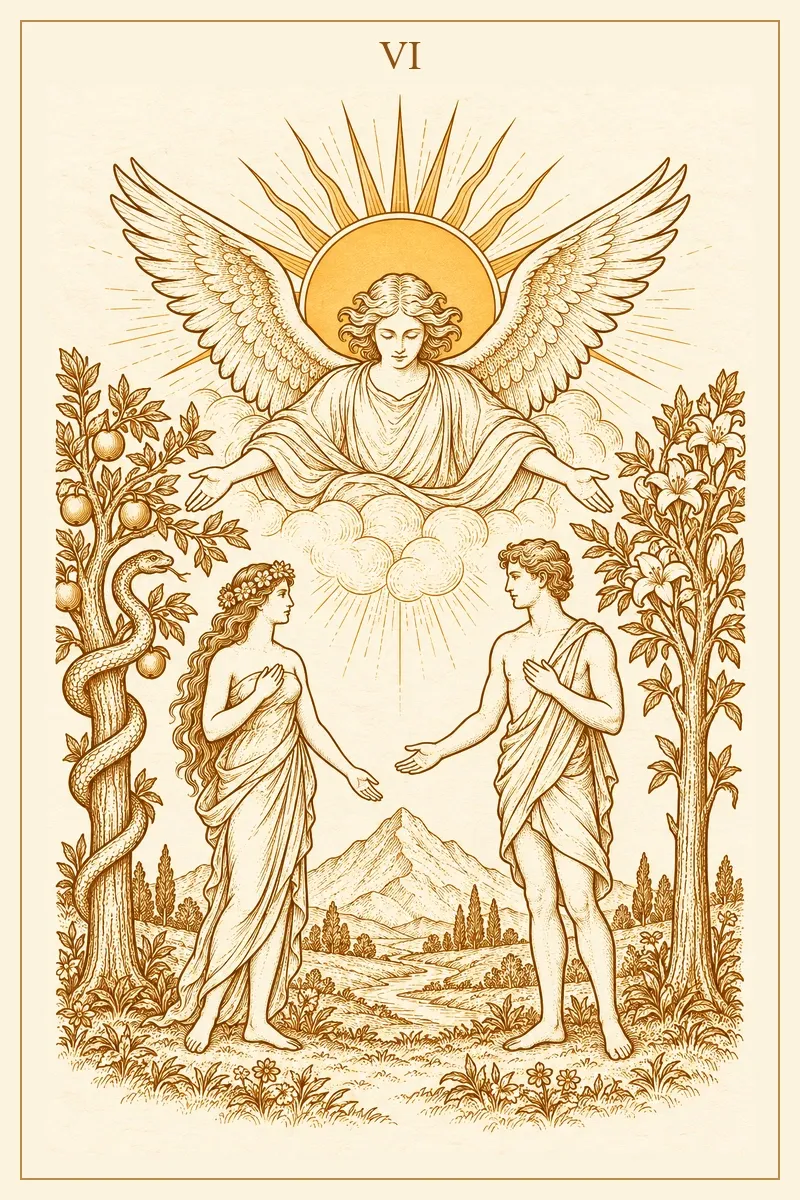
The Lovers: choice as well as attraction
The Lovers can be read as a moment of alignment between feeling, values and action. It is easy to see a promising relationship in the card and skip the word “choice.” Yet choosing a person means seeing them as they are, discussing what matters and allowing them to choose freely too. A spark may bring you together; it does not answer questions about time, commitment, trust or the kind of life each of you wants. For the card's upright and reversed meanings beyond this question, see the full Lovers tarot meaning.
Upright, the card might ask where you are ready to be clear instead of keeping every option open. If it appears in a position for a shared dynamic, consider whether each person can express a preference without fearing punishment or withdrawal. Reversed, it may point to divided priorities or a decision you are avoiding. It asks what honesty would require from you.
For example, someone may be warm in person but vague about future plans. The Lovers does not turn ambiguity into a promise. You might ask directly what kind of relationship they want, then listen to both the answer and the pattern that follows. If your needs differ, that is useful knowledge even when the attraction is real.
Two of Cups: reciprocity in the present
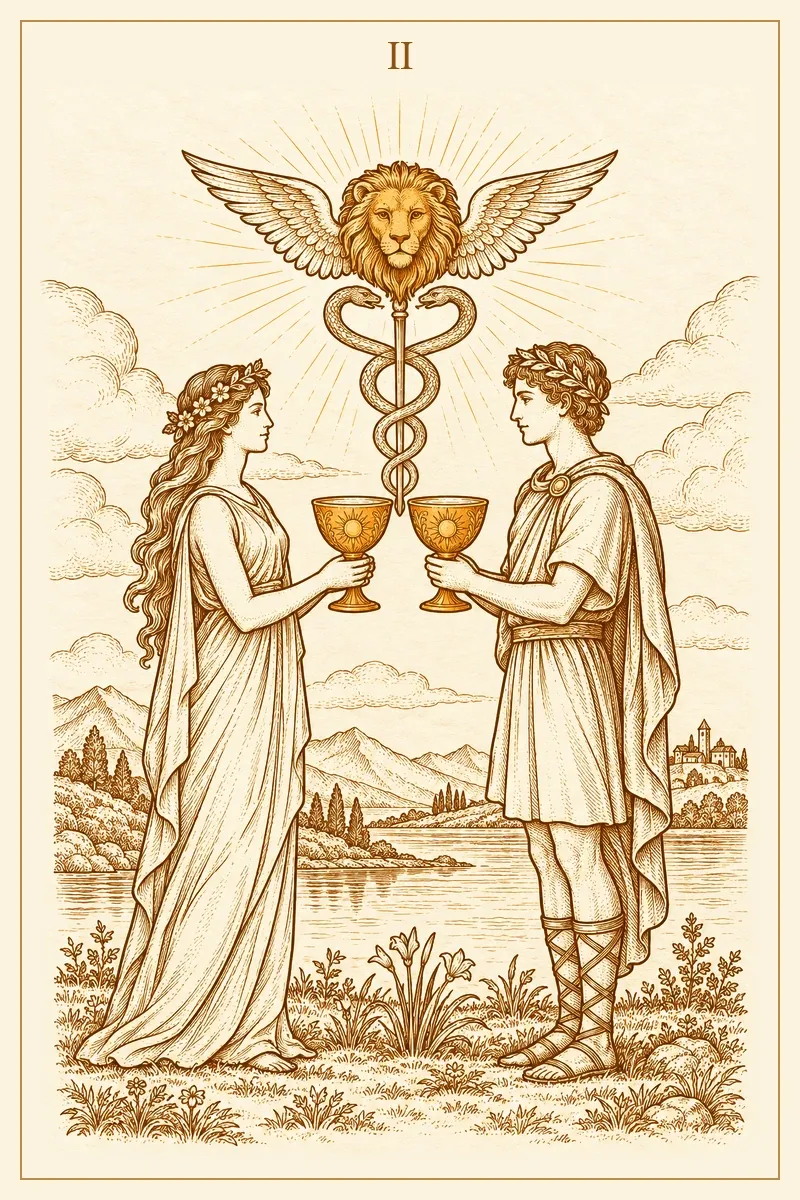
The Two of Cups is often associated with meeting one another openly. Its value in this comparison is not a magical confirmation; it is a question about exchange. Do both people show interest? Can both initiate contact, apologize, make space and receive care? A relationship can feel deeply familiar while still asking for these ordinary forms of reciprocity. The full Two of Cups meaning covers the card in love, work and reversed positions.
Upright, the card may reflect a promising conversation, a repair after a disagreement or the pleasure of being understood. Let it draw your attention to what happened, not only to what you hope will happen. Reversed, it may highlight uneven effort, a missed connection or your own difficulty trusting an offer of kindness. A reversal is not a sentence on the relationship. It invites a closer look at what each person can give.
Suppose you are always the one to restart contact after a painful silence. The card is not asking you to work harder until the other person responds. It may help you name your need for a more balanced exchange. Your next step could be a direct conversation, followed by space to see whether behavior changes. Mutuality is visible over time.
A gentle card does not mean a relationship will never challenge you. If you want a fuller look at cards often read through a soulmate lens, the related soulmate tarot cards guide explores hope, emotional beginnings and shared fulfillment. Here, the key question remains simpler: does the relationship make room for both people’s needs?
Cards that invite a look at intensity and disruption
Readers sometimes place dramatic cards in a “twin flame” category. The images can certainly describe upheaval, desire or old patterns coming into view. But a difficult card does not make suffering meaningful by itself. It is worth asking what changed, who is responsible for their choices and whether the relationship offers enough safety for honest repair.
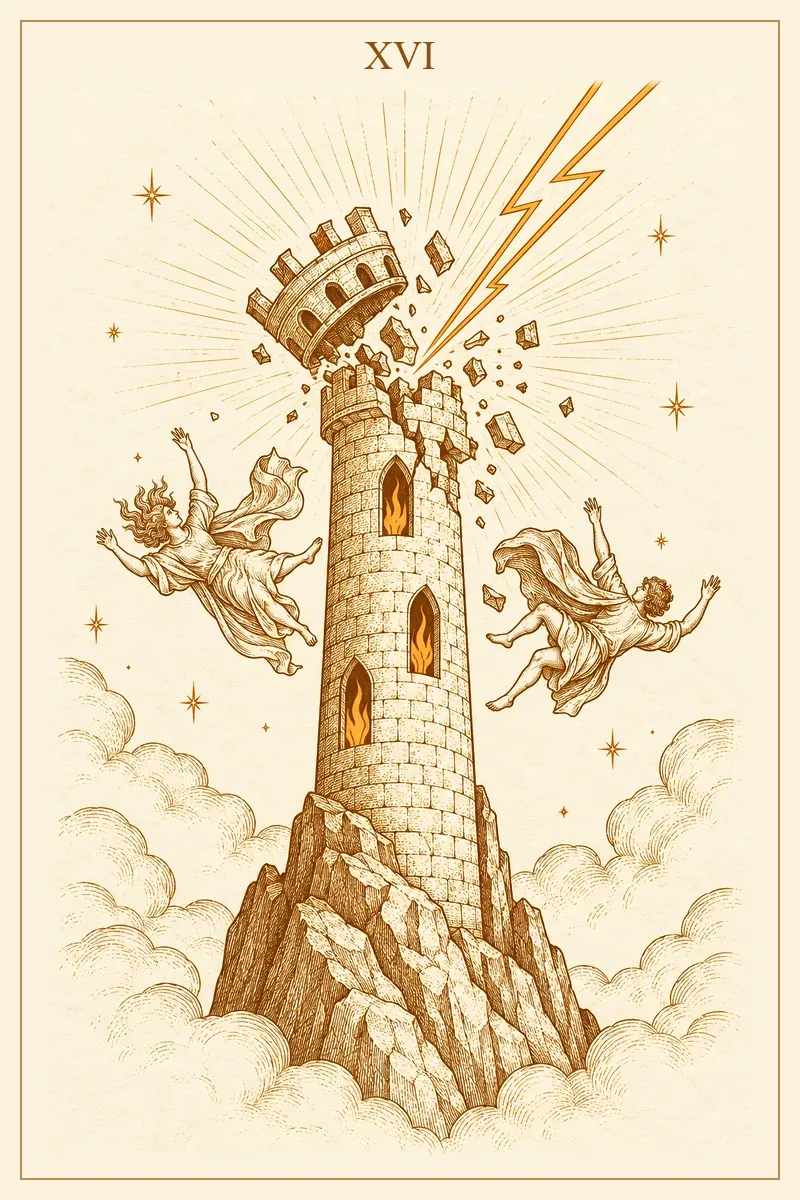
The Tower: when a story no longer holds
The Tower is a picture of sudden disruption. In a love reading it might describe a revelation, a breakup, a difficult truth or the collapse of assumptions you had been relying on. It can also reflect your fear that something important will fall apart. A reader should distinguish an event that has happened from an anxiety about what could happen. You can read more about the card itself in the full Tower tarot meaning.
Upright, ask what has become impossible to ignore. Perhaps the relationship has changed, or you now know that your wishes and the other person’s plans do not align. Reversed, the tension may feel contained but persistent: you sense a conversation is overdue, or you are trying to rebuild the same arrangement without addressing its weak point. Neither orientation predicts that a relationship must end.
If a conflict exposes a real problem, transformation is possible only through choices in real life. Both people would need to acknowledge what happened and make changes they can sustain. When that is absent, “the Tower is clearing the way” can become a comforting phrase that hides the cost of staying. Let the card help you see the structure clearly; it cannot make someone else rebuild it with you.
The Devil: attachment, freedom and boundaries
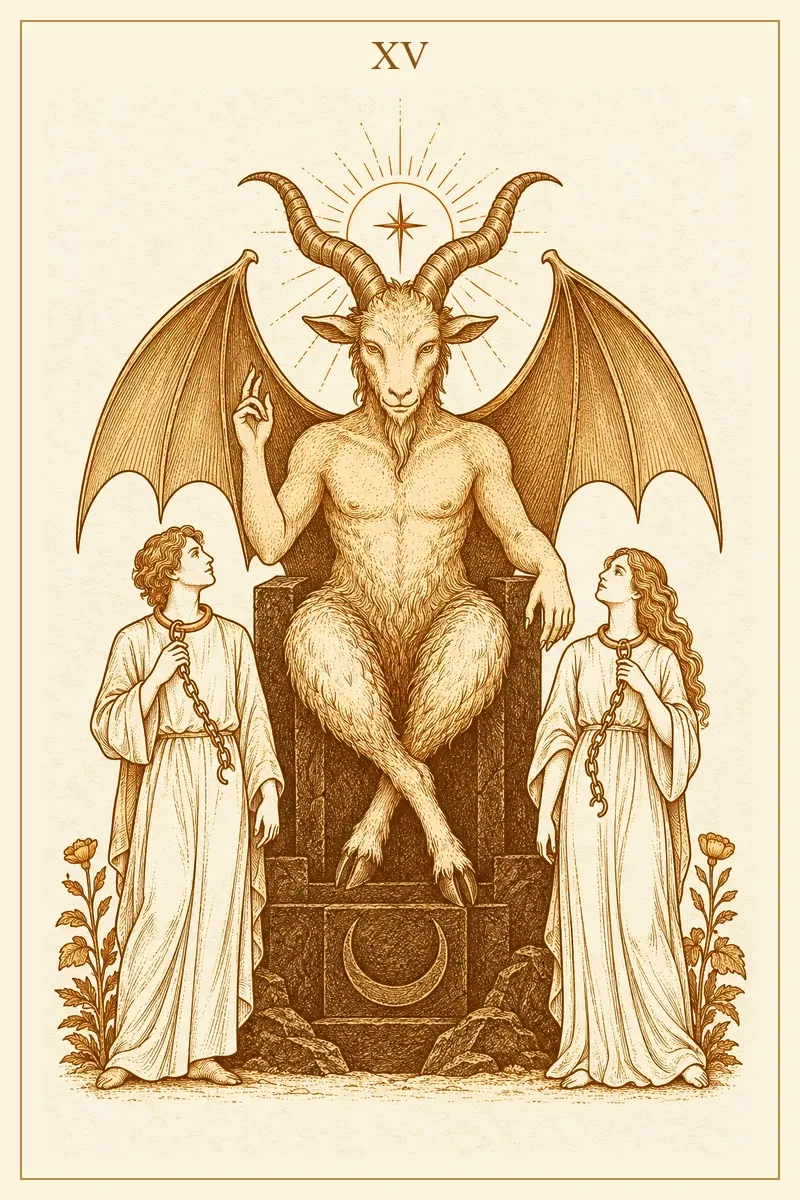
The Devil can bring attention to a pull that feels powerful even when it leaves you smaller. In a relationship reading it may invite questions about jealousy, secrecy, repeated bargaining with your own limits or the fear that you cannot step away. It does not diagnose either person. It also does not mean passion is bad. The point is to notice whether desire and choice still have room to coexist. The full Devil tarot meaning looks at the card outside relationships as well.
Upright, ask what you feel compelled to do and what happens when you do not. Do you rearrange your day around unpredictable contact? Do you conceal the relationship from people whose perspective you trust? Reversed, you might be recognizing a pattern and experimenting with a boundary.
If you call an exhausting push-pull dynamic a “twin flame journey,” pause over what the name allows. Does it encourage honest responsibility and a concrete change, or does it ask you to tolerate another round of the same hurt? You are allowed to leave a connection you once found profound. You are also allowed to seek support from a trusted person while you decide what is right for you. No label outranks your agency. If the pattern includes control, fear or repeated harm, our guide to tarot cards for toxic relationship patterns can help you name it.
Two other cards can soften an overly simple split between “gentle soulmate” and “difficult twin flame.” The Star may suggest hope and recovery after a painful chapter, without forecasting a new partner. Temperance can ask for pacing, balance and patient adjustment inside any relationship. Both can appear beside challenging cards. Their presence changes the question from “Which label wins?” to “What helps us act with care now?”
How to read mixed signals and card combinations
A spread with the Two of Cups and the Tower is not proof that one person is “both” a soulmate and twin flame. The pair may describe genuine affection meeting a disruptive fact. Perhaps you care for each other and disagree about commitment. Perhaps a long-held assumption has changed. Read the positions: “what connects us” and “what needs attention” tell a more useful story than two competing identity labels.
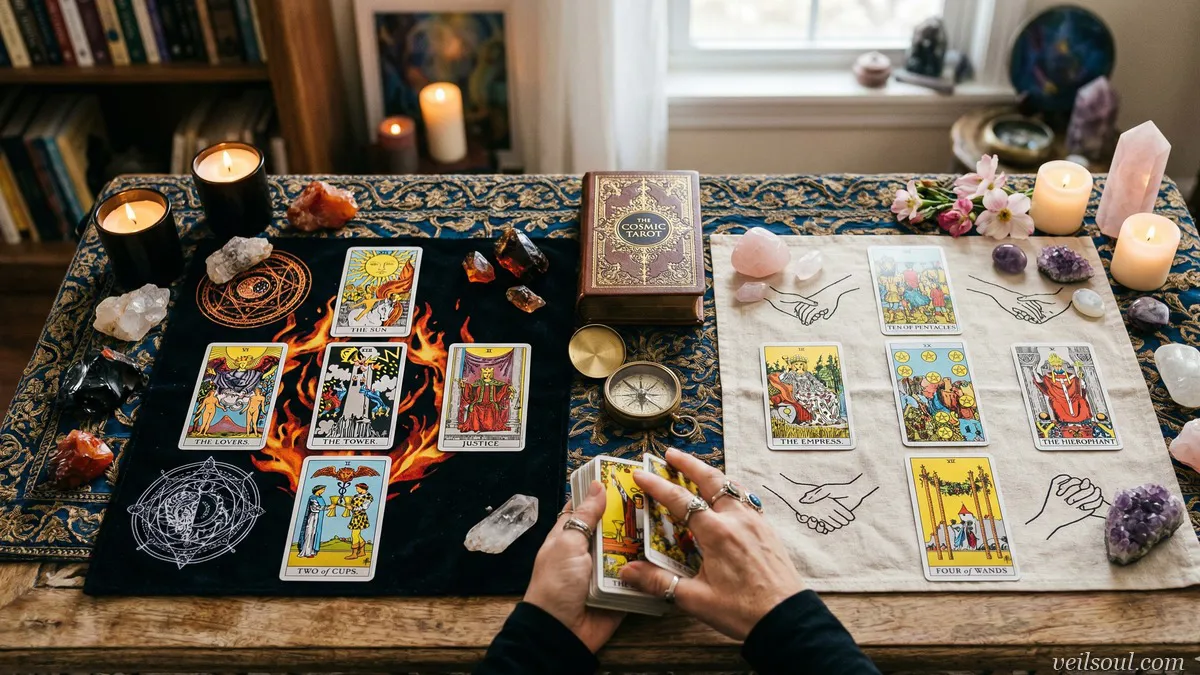
The Lovers beside the Devil may ask whether you are choosing freely or responding to fear, urgency or habit. It does not say that one person is inherently good and the other dangerous. If The Star appears nearby, the reading could highlight a hope you are rebuilding. If Temperance appears, it might suggest slowing the pace so your actions match your values.
Try giving each notable pair two plausible readings. One can express the hopeful interpretation; the other should take ordinary behavior seriously. For example: “We feel strongly connected and are learning to communicate,” and “I am doing most of the repair work and want it to be mutual.” Then choose one thing you can verify through a conversation, an agreed plan or a change in routine. A reading earns its place when it helps you see more clearly, not when it closes inquiry.
Repeated cards can also pull you toward certainty. If you draw the same image several times, record the question, positions and your first interpretation. Wait before asking again. The repetition may reflect a theme that occupies you, a similar question or the way chance works in a finite deck. Review what happened outside the reading before deciding what the pattern means for your next step.
A five-card spread for the relationship you are living
The question “Which type of bond is this?” can be made more practical without losing its depth. This five-card spread explores the connection, what it brings up and what you can do. If you are not in contact with the person, focus on your own experience rather than trying to fill the other person’s positions from afar. If a different layout suits your question better, our guide to love tarot spreads offers several.
- 1. What draws me toward this person? Name the attraction without judging it. Is it affection, shared values, familiarity, excitement or a wish to resolve an old story?
- 2. What do I observe between us? Look at actual exchanges: time, communication, respect and follow-through. Separate what happened from what you imagine it means.
- 3. What does this connection bring up in me? A card may point to a strength, a fear or a boundary. Keep the interpretation about your experience, not a diagnosis of theirs.
- 4. What needs to be spoken or protected? Find a conversation to have, an expectation to clarify or a limit to keep. Difficult cards can be useful here without becoming predictions.
- 5. What is one grounded next step? Choose an action within your control. You might ask a clear question, pause contact, make a plan together or give yourself time to think.
Imagine the Two of Cups in position two and the Tower in position four. You might feel heard when you are together, while an avoided issue is destabilizing the relationship. The spread does not decide whether to stay. It suggests naming the issue and watching whether both people can meet it. If the Devil appears in position three, you might ask whether fear of losing the connection shapes your response. If The Lovers appears in position five, the next step may be a choice that reflects your values rather than the hope of receiving a particular label.
Write a short note after the reading: “The card suggests…” followed by “I can check this by…” Later, compare the interpretation with your conversations and choices. You can revise it. A tarot reading is more useful when it remains open to new evidence.
What to do with the insight
Choose language that helps you act well. “Soulmate” may remind you to appreciate care that is present. “Twin flame” may help you name a relationship that stirred strong feelings and forced you to ask hard questions. If either word makes you ignore your needs or someone else’s clear answer, set it aside. A meaningful bond does not require a perfect spiritual explanation.
Consider three ordinary measures: mutuality, steadiness and freedom. Mutuality asks whether each person is making room for the other. Steadiness asks whether care continues when a day is difficult, rather than appearing only during reunion. Freedom asks whether both people can have boundaries, friendships and interests of their own. No relationship is perfect on all three, but persistent absence of one deserves attention.
If you have had the same painful conversation many times, look for a change in behavior rather than a new interpretation of the cards. If a person has said no or cannot offer the relationship you want, respect that answer and your own disappointment. If you both want to work on a problem, agree on a specific step and revisit it. In either case, you can take time to grieve an imagined future without treating the grief as evidence that the bond was fated.
Sometimes the next helpful move is simply to stop reading about the person for a while. Notice your sleep, focus, friendships and sense of ease. Return to the deck with a question about your own choices. You may still value what the relationship taught you while deciding that its present form is not right for you.
Frequently asked questions
Can tarot tell me which person is my soulmate or twin flame?
No. Tarot cannot establish a supernatural relationship type, read someone’s private thoughts, give a reliable reunion date or guarantee that a bond will last. It can help you examine feelings, patterns and choices. Use a person’s words and behavior, along with your own needs, to decide how to proceed.
Does a difficult card mean this relationship is a twin flame?
No. Every relationship can face disappointment, conflict or a sudden change. A difficult card may describe the question you brought, a fear, an event or a next step. It is not a badge that makes hurt necessary. Ask what the card’s position refers to and what evidence you have in daily life.
Can a soulmate relationship also change me deeply?
Yes. A caring bond can challenge habits and help you grow, just as a dramatic bond can contain genuine tenderness. The two labels do not divide relationships into separate decks. You can describe both comfort and change without forcing the person into a fixed category.
Can one person be both a soulmate and a twin flame?
If the words help you, yes. Many people describe a relationship that felt like home at one stage and like a mirror for hard lessons at another. Relationships change, and so does the language people use for them. What matters more than the label is whether, today, the connection has room for honesty, care and both people’s freedom.
What if I keep pulling the same cards?
Make a note of the repeated theme, then give yourself a break from asking the same question. Consider what you already know and what action is available. Repetition does not prove that a person is destined for you; it may tell you that the question matters and deserves attention away from the cards.
If you want space to reflect on a connection, try a calm tarot reading with one question you can act on. Keep the cards beside the facts of your life and let the next honest conversation matter most.