
Judgement in a love reading means a moment of honest reckoning: you see your relationship, or your pattern in relationships, clearly enough that you can no longer put off a decision you have been circling. Upright, it is a call to answer that clarity with a choice, whether that means recommitting with fresh eyes, offering a second chance on new terms, forgiving, or letting go for good. Reversed, the call is still sounding, but something muffles it: fear of repeating a mistake, a harsh inner critic, or a door kept half open so you never have to walk through it.
The card does not hand down a verdict on your love life, and neither does tarot as a whole. A reading cannot tell you what another person thinks, name the week something will happen, or guarantee whether a reunion lasts; what it can do is help you hear what you already know. The card's wider symbolism, along with its career and spiritual readings, lives in the complete Judgement tarot meaning, so this page stays with the heart.
Judgement in love, in brief:
- Upright: clarity arrives, an old pattern ends, and a decision is ready to be made.
- Reversed: the decision is stalled by fear, shame or a refusal to look at what you know.
- Single: an honest inventory of past relationships, and a different choice next time.
- Dating: the point where casual has to become clear, one way or the other.
- Committed: a shared wake-up call; renewal is possible if both of you answer it.
- Exes: a second chance worth weighing only if something real has changed.
- Their feelings: someone reassessing, seeing you and the past more clearly than before.
- Yes or no: yes to the decision you have already reached in your heart.
Card XX up close: three people climbing out of stone
What the engraving shows
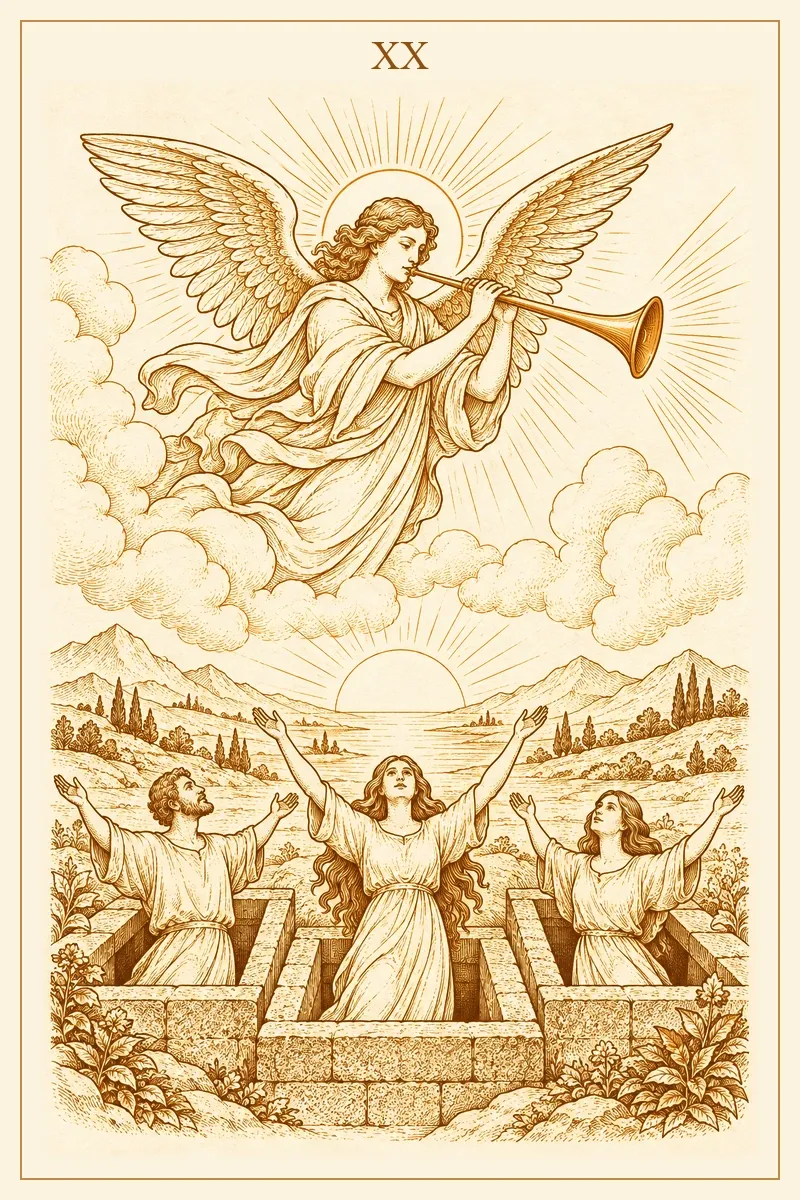
Beneath the numeral XX, a winged angel with curly hair and a round halo floats on a bank of clouds, eyes lowered, blowing a long golden trumpet. Rays spread from the halo and from the bell of the trumpet, as if the sound itself were light. Lower down, three open graves built from blocks of stone stand side by side with no lids. A bearded man rises from the left one, a young woman from the right, and a woman with long loose hair stands tallest in the middle; all three lift both arms with palms open and look up toward the call. Behind them a half sun sits on the horizon over a still lake, framed by hills, cypress trees and distant mountains, and leafy plants grow thick against the stones.
Four details that speak to a love question
One sound, three separate graves. The trumpet does not single anyone out; all three figures hear the same note at the same moment, yet each rises from a grave of their own. In a relationship, Judgement describes a truth both people can sense, even if only one of you is ready to say it aloud, and a reckoning each partner has to do for themselves.
Walls only waist high. Nothing seals these people in. There are no lids, and climbing out is a matter of deciding to. The card asks which old story you have been standing inside, and whether its walls are as high as they feel.
Open palms, empty hands. The figures are not holding on to anything. Rising, on this card, means setting down the grudge, the old role or the excuse you have carried, so your hands are free for what comes next.
A low sun and new leaves. The sun on the horizon could be rising or setting, and the picture leaves that open. Some reckonings begin a new day for a relationship; others close a long one gently. Either way, the plants pushing up around the stones say that life is already returning.
The upright call, depending on where your heart is
If you are single
For a single reader, Judgement turns the light on your own history: perhaps the people you choose share a type, or you over-give early, or you leave as soon as things get quiet. Seeing this is not a punishment; it is the moment the pattern loses its grip. The card favors a dating life rebuilt from what you have learned, with clearer standards and the courage to say what you want on a second date rather than the tenth.
If you are dating someone new
In early romance, Judgement marks the point where vagueness stops working. Maybe you have been seeing someone for months without naming what it is, or you keep postponing the conversation about exclusivity. The card says that conversation is due. It does not promise the answer you hope for, only that clarity, either way, will feel better than the waiting.
If you are in a long relationship
For couples, Judgement is a shared wake-up call, arriving after a crisis, a big life change or years of drifting, when both of you suddenly see what the relationship has become. Upright, it leans toward renewal: you look honestly at the habits that wore you down, own your part, and choose each other again with open eyes. That choice is real only when two people make it.
After a breakup
After an ending, Judgement speaks of understanding. The fog lifts, and you can see why it ended without rewriting the story as all their fault or all yours. That clarity is where real healing starts, and a breakup tarot reading gives you a spread for working through it. Whether it leads back to the same person is a separate question.
An ex, a second chance and the honest question underneath
Judgement carries a strong association with resurrection, so it is tempting to read it as a promise that a past love will return. The card asks something slightly different: whether a relationship can be raised into something new, not whether the old one can be reopened exactly as it was. A second chance that only repeats the first is not what the trumpet is calling for.
When Judgement appears in a reading about an ex, try three questions. What, specifically, has changed in you since the ending? What has changed in them, shown by actions rather than promises? And what would you do differently on day one? Concrete answers to all three mean the card supports exploring a reunion carefully. If the honest answers are "nothing yet," Judgement is asking you to rise on your own first.
Context helps: beside cards of reconnection, Judgement tilts toward a genuine second chance, and beside cards of departure, toward closure that finally holds. Our article on signs of reconciliation in tarot lists the cards that strengthen a reunion reading.
Forgiveness that is real, not performed
Traditional keywords for Judgement include absolution, and in love that can mean forgiving a partner, an ex, or yourself. The card asks for the honest kind: you look at the full weight of what happened, you feel it, and then you choose to stop carrying it, because carrying it has become heavier than letting it go.
That is different from saying "it's fine" to keep the peace while privately keeping score. Nor is forgiveness an obligation to return; you can release resentment and still decide not to rebuild. Our guide to tarot for forgiveness offers questions and cards for working through this slowly.
Self-forgiveness matters just as much. If you stayed too long or ignored warning signs, upright Judgement invites you to own it without turning it into a life sentence.
Verdict mode: when the card turns into scorekeeping
Every card has a shadow, and Judgement's is the courtroom. Instead of hearing a call to grow, a person in verdict mode starts handing out sentences. In love, this can look like a mental file of a partner's mistakes, ready to be read aloud in the next argument, or the partner who has done a lot of inner work and treats every disagreement as proof that the other has not. It can also sound like "I've moved past that," used to mean "your hurt about what I did is not my concern."
If you recognize yourself here, the remedy is humility, not shame: the angel on card XX calls everyone, including the one who feels most evolved. If you recognize your partner, name the pattern calmly and notice whether you are being invited to grow or simply being graded.
Judgement reversed in love: the call left unanswered
Reversed, the trumpet is still sounding. What changes is the response: hands over the ears, eyes down, feet still inside the stone. In a love reading, that response can take three shapes.
Repeating the same story
You can see the pattern. The new person resembles the last one in the ways that hurt, or the same argument has returned for the fifth time. Reversed Judgement says you know this and are choosing familiar discomfort over the unfamiliar effort of change. The way forward is small: name the pattern out loud to one trusted person, and do one thing differently this week.
The inner judge who never adjourns
Here the reckoning has turned cruel. Instead of learning from a past relationship, you sentence yourself for it over and over: you were foolish, you ruined it, you do not deserve better. That harshness does not protect you; it keeps you from rising at all. Speak to yourself the way you would speak to a friend who made the same mistake, and consider talking with a counselor if the self-blame feels too heavy to carry alone.
A door kept half open
The relationship ended, or needs to, but you keep a thread attached: late-night messages, a "just checking in" every few weeks that neither heals nor rebuilds. Reversed Judgement points at the space between closure and reunion, where nothing new can begin. Choosing one side, an honest conversation about trying again or a clear ending, is the release this card is asking for.
Judgement as feelings, yes or no, and how soon
What they may feel
As a feelings card, upright Judgement describes someone in a reflective, reassessing frame of mind, seeing what went wrong between you more clearly and perhaps ready to say what they have held back. Reversed, they may be aware of the issue but defensive or ashamed. A card here reflects the situation from your side of the table; it cannot confirm what is in another person's head, and a direct, kind conversation will tell you more.
Yes or no
Judgement leans toward yes: yes to the decision you have already reached when you are honest with yourself. If the question is "should I finally say what I feel?" the answer is a firm yes. If the question is "will they come back?" the card reframes it, and the more useful question becomes whether you would both be returning as different people. Reversed, it is closer to "not yet; something unresolved is in the way."
Timing
Judgement does not count days or weeks. As a timing card, it describes a threshold rather than a date: things move once a decision is made, and stall for as long as it is postponed.
Pairings that lean toward a reunion
Judgement takes much of its color from its neighbors. These two pairings tip it toward reconnection, whether with a past partner or inside a current relationship.
Judgement and the Six of Cups
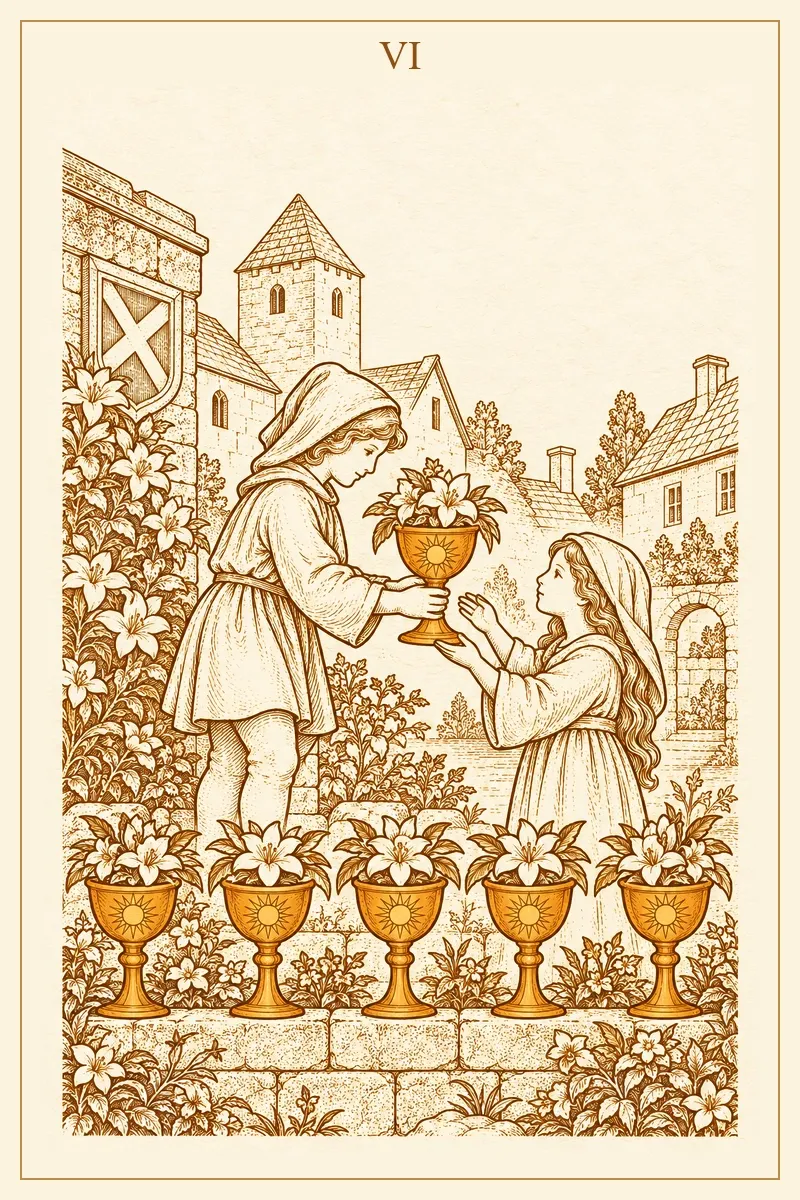
On the Six of Cups, a hooded child offers a cup filled with lilies to a smaller child, while five more flower-filled cups stand along a stone ledge and a village with a stone tower rises behind them. Next to Judgement, it brings the past back into view: an old flame making contact, a shared memory resurfacing, or a nostalgic mood that colors the question. Judgement asks you to separate the warmth of memory from who both of you are now. The Six of Cups tarot card meaning covers the card's nostalgia, including the reversed side, where people get stuck in the past.
Judgement and the Two of Cups

The Two of Cups shows a woman in a flower crown and a man in a laurel wreath facing each other, each lifting a cup toward the other, beneath a staff wound with two serpents and topped by a winged lion's head. With Judgement, it makes a very encouraging pair for a relationship at a crossroads: a recommitment made by both people, a bond renewed on honest terms. If you are weighing a second chance, it suggests the other person is answering the call too. The Two of Cups tarot card meaning covers its partnership themes in full.
The Star beside Judgement leans the same way, pointing to healing that has truly taken place.
Pairings that lean toward release
Not every reckoning ends in a reunion. These pairings tilt Judgement toward a closing chapter, one you leave with clarity rather than bitterness.
Judgement and the Eight of Cups

On the Eight of Cups, a cloaked traveler with a staff walks away along a lakeshore toward the mountains under a crescent moon, leaving eight golden cups behind in two rows, three standing behind five. With Judgement, this is a conscious departure: you have seen the relationship clearly, recognized that it no longer fills you, and found the courage to go, quietly rather than dramatically. The Eight of Cups tarot card meaning explores this kind of walking away in more detail.
Judgement and The World

The World shows a dancing figure holding two wands inside an oval laurel wreath, with an angel, an eagle, a bull and a lion watching from the four corners. The last two cards of the major arcana together describe a chapter that closes whole: a relationship that has run its full course and ends with gratitude, or, for a couple, one stage completed before a new commitment such as moving in or marrying. The World tarot meaning explains its sense of completion.
Death beside Judgement pushes toward release too, marking an ending already accepted.
The Trumpet Call spread: six positions for a love at a turning point
This spread borrows its positions from the picture on card XX. Shuffle with a question in mind, such as "What is this moment asking of me in love?", and lay six cards in two rows of three.
- The trumpet: what is calling for your attention in your love life right now.
- The stone walls: the old story, habit or role you are being asked to climb out of.
- The open palms: what you are ready to set down.
- The figure beside you: how the other person, or the relationship itself, is answering the same call.
- The low sun: whether this moment is shaping up as a beginning or a gentle ending.
- The new leaves: one concrete step that helps life return.
Read positions two and three together, since what you climb out of and what you set down tend to be connected. If you are single, read position four as your future relationships in general rather than a specific person.
A worked example (invented): a coffee invitation from an ex
The person here is invented, to show how the spread reads in practice. Dana has been single for fourteen months since she and Sam ended a three-year relationship. Last week Sam wrote to ask whether she would meet for coffee. Her question: "What do I need to see clearly before I answer Sam?"
- The trumpet: Judgement, upright.
- The stone walls: Five of Cups.
- The open palms: Nine of Swords, reversed.
- The figure beside you: Knight of Cups.
- The low sun: Temperance.
- The new leaves: Page of Swords.
Judgement in the trumpet position says this message is a real turning point, not a casual check-in: Dana is asked to decide consciously rather than drift. The Five of Cups names what she has been standing inside: fourteen months of attention on what was lost, while what remained (friendships, work, the routines she rebuilt) went mostly unnoticed. The reversed Nine of Swords is encouraging; the late-night replaying of the breakup has started to ease.
The Knight of Cups in Sam's position describes a sincere, emotional approach and raises a fair question: does his follow-through match the feeling? Temperance suggests neither a sudden reunion nor a slammed door, but a slow pace, and the Page of Swords asks Dana to be curious and direct. Taken together, the cards do not say whether the two belong together. They suggest she can accept coffee as a conversation rather than a reunion: bring two or three honest questions, such as what Sam thinks went wrong and what is different now, listen, and leave without deciding. If his answers are specific and his actions match them over the following weeks, a second conversation makes sense.
Answering the call: steps for the coming weeks
- Write down the decision you keep postponing in one plain sentence; on paper it looks smaller and clearer.
- Name your pattern. List three past relationships or three recurring arguments and note what they share.
- Have one honest conversation. Choose a calm moment, speak for yourself ("I feel," "I need"), and ask one real question rather than delivering a verdict.
- Write an unsent letter to an ex, a partner or your younger self: what you are angry about, what you are sorry for, what you are ready to release. The writing is the point.
- Set a date to revisit. If you truly need more time, pick a specific day to look at the question again, so waiting does not become a way of not deciding.
Frequently asked questions
Does Judgement mean my ex will come back?
Not by itself. Judgement points to a reckoning with the past, which can include a return, but the card cares more about whether anything has truly changed. Read it with the cards around it: reconnection cards strengthen the possibility, while release cards suggest closure. Either way, the choice stays with you.
Is Judgement a yes or a no in a love reading?
Upright, it leans yes, especially for questions about speaking up, making a decision or recommitting. Reversed, it is closer to "not yet," because fear or an unresolved issue is in the way. A yes from the cards is a prompt for reflection, not a guarantee.
Does Judgement mean my partner is judging me?
Despite its name, the card is about inner reckoning rather than criticism from someone else. If judgment is a theme in your relationship, the card asks both of you to replace scorekeeping with honest conversation.
What does Judgement reversed mean for a relationship?
It points to a call that is not being answered: a pattern repeated, a conversation avoided, a door kept half open, or harsh self-blame that keeps someone from moving forward. It is a nudge to face something, not a sign that the relationship is doomed.
Can Judgement point to marriage or a bigger commitment?
It can, when the relationship has been through an honest reassessment and both people choose it again. Beside the Two of Cups or The World, Judgement can describe a recommitment that opens a new chapter. It cannot predict a proposal or its date.
Can a tarot card tell me what to decide about my relationship?
No. Tarot cannot read another person's mind, foresee an outcome or make a decision for you. What a card like Judgement can do is help you notice what you already sense, so you can choose with more honesty and less fear.
Rising when you are ready
Judgement asks one thing of a love life: that you stop pretending not to hear what you already know. Answering may mean a renewed promise, a hard conversation or a goodbye that finally holds, and it can start with one honest sentence. When you would like a quiet space to put your own question to the cards, you can begin a reading whenever it suits you.