
Steadiness you can count on is the heart of the Emperor in a love reading. Upright, he describes commitment that shows up in actions rather than speeches: a partner who keeps their word, a relationship with clear terms, or your own readiness to stop guessing and ask for something solid. Reversed, the same energy tips out of balance, either into control and rigidity or into its opposite, a relationship with no reliable frame at all.
Read him as a mirror for how safety and power work between two people, not as a forecast. Tarot cannot tell you what someone privately feels, whether they will propose or come back, or when anything will happen. It can help you name what you need to feel secure and notice whether it is being offered. His meaning outside romance is covered in The Emperor tarot card meaning, so this page stays with love.
- Upright in love: commitment, reliability, protection that respects you, clear agreements, a partner who follows through.
- Reversed in love: control dressed as care, emotional distance, power struggles, or a missing frame where promises never become plans.
- For singles: getting clear on your terms; someone grounded and consistent, or your own wish to build rather than drift.
- For couples: a look at roles, money, decisions and routines, and whether that structure still protects the closeness inside it.
- For exes: a return works only on new terms; repeating the old arrangement is not reconciliation.
- As advice: say plainly what you need, then watch what is done over weeks rather than what is promised in one evening.
A throne built for one: the picture as a love card
How this deck draws the Emperor
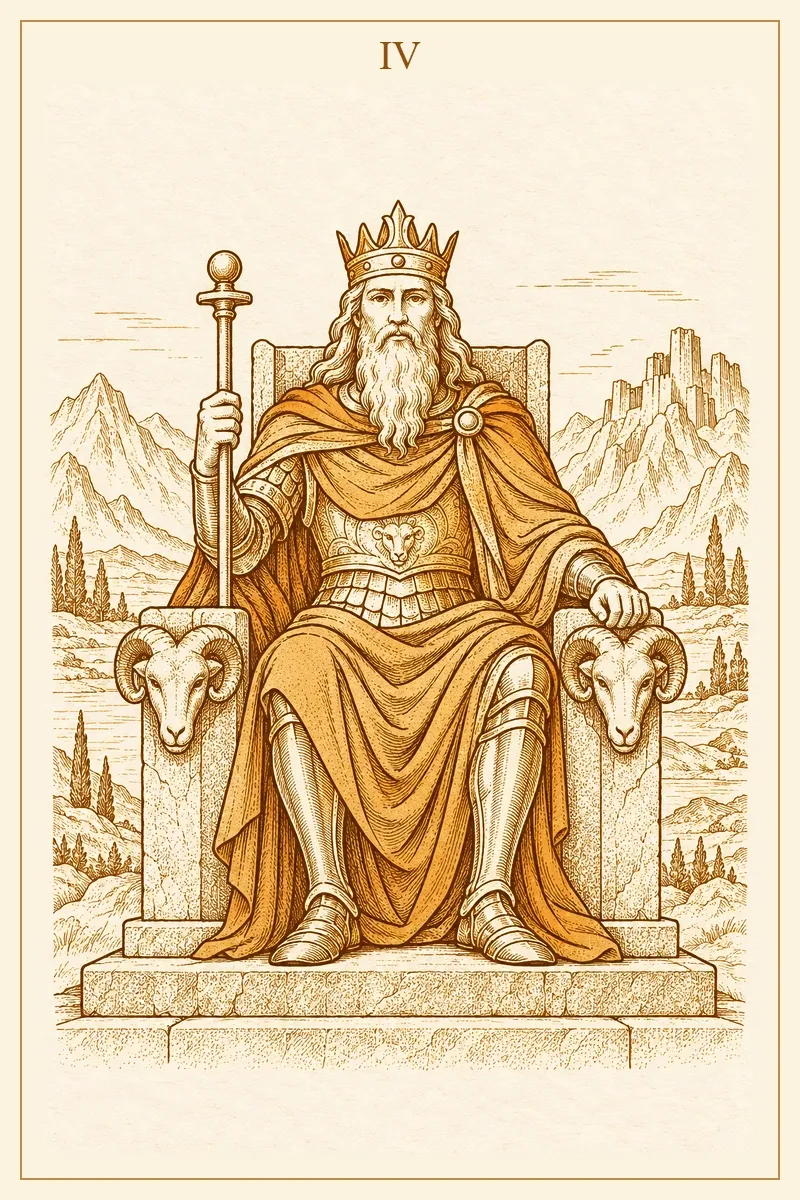
On this card a crowned king with a long white beard faces you squarely from a heavy seat of stone slabs on a low platform. Each armrest ends in a carved ram's head, and his left hand lies on one of them, relaxed rather than clenched, while his right holds a tall scepter capped with a small ball. An amber cloak pinned with a round brooch falls across his knees over full armor, with a ram's face worked into the breastplate. Behind him rise dry mountains and slim cypresses, and on the right a fortified town sits high on a rocky hill.
Read as a love card, three details stand out. The throne has room for exactly one person: no second chair, no one at his side, nothing soft in the scene. Has the life you have built left space for someone else to sit down in it? The armor is the second detail. Protection is part of how this figure loves, but armor that never comes off also keeps tenderness out. The walled town is the third, something he has built and will defend: a home, a shared plan, or the boundaries that keep a relationship safe. The card is number IV of the Major Arcana and is linked with Aries, so in love he prefers directness and would rather define a relationship than leave it hanging.
Upright Emperor in love, wherever you stand
Upright, the card favors love that can be relied on. How that lands depends on your situation.
Single and wondering what comes next
For someone single, the upright Emperor rarely describes a whirlwind. It may point to a person who is settled in themselves, who says what they want early and then does what they said. More often it points at you. You may be finished with vague arrangements and messages that never turn into plans, and ready to state your terms before letting anyone close. Knowing what you will and will not accept is not coldness; it is the frame that lets the right person recognize you. Try listing three things you need from a partner that have nothing to do with looks, such as keeping plans or staying through conflict. Our guide to tarot for singles has more ways to turn that clarity into a reading.
Dating someone new
Early on, the upright Emperor suggests the connection has a backbone. Plans get made and kept, and you are not left decoding silences. If you want the other person to make their intentions plain, this card supports asking directly. It also hints at pace: he builds in order, so the relationship may move steadily rather than quickly, which is not a lack of feeling but a check that the ground will hold. One caution: in the first weeks, steadiness and control are easy to confuse. Notice whether this person's plans include your preferences or simply arrive finished.
In a committed relationship
Inside an established relationship the upright Emperor speaks to the structure you have built together: routines, roles, money, how decisions get made. When the card is well placed, that structure is doing its job. Promises are kept, and each of you can rest because the other is dependable. This kind of love is quiet, and the card asks you to notice it.
He also raises a harder question: has the structure started to replace the closeness it was meant to protect? A couple can run a household beautifully and still feel like efficient coworkers. If that sounds familiar, the card is not warning of a breakup. It suggests giving the relationship the seriousness you give the budget and the chores, for example a standing evening that is not about logistics.
Moving in, engagement and other big steps
For a question about a formal step, the upright Emperor is encouraging about the practical side. He likes commitments with clear terms: who pays for what, where you will live, how you divide the work of a home. If the talk about moving in or marrying has been all feeling and no detail, add the detail. Under this card, commitment means agreeing on the shape of the life as well as on the love.
Reversed in love: walls too high, or no walls at all
The reversed Emperor does not say that structure is bad. It says the structure in your love life has lost its balance. It usually shows up in one of four ways, and the first step is to ask which one fits, and whether it describes the other person, the relationship, or you.
Control that calls itself care
The best-known reversed meaning is control. It rarely looks like shouting; more often it sounds reasonable: "I just worry about you," "I'm better with money, so let me handle it." Either line can come from real concern. The difference is whether you are still free to disagree. If decisions about your friends, spending or time are being made for you, and saying no carries a cost, the reversed card is naming something real. Our guide to tarot cards that warn about toxic relationships covers the warning cards worth reading alongside it. If you feel afraid of your partner, a reading is not the place to settle that; talk with someone you trust or a local support service.
The partner behind the fortress
Another reversed pattern is emotional absence. This partner pays their share and keeps the house running but is hard to reach. They remember the bill and forget the birthday; they solve problems and go quiet when asked how they feel. The armor never comes off. The card asks whether you can name the distance without blame, and whether the other person is willing to step out from behind the walls, even a little.
Two rulers, one throne
When both people want to lead, the reversed Emperor can describe a power struggle. Where you live, whose career comes first, whose family gets the holidays: if each of these turns into a contest, closeness has no room to grow because both of you are guarding territory. The card does not say who is right. It suggests that how you decide things together has never been settled, and that settling it matters more than winning the next round.
The missing frame
Reversed, the Emperor can also mean structure that never arrives. Plans are always "soon," labels are avoided, and one person keeps things pleasant and undefined because a definition would bring responsibility. The card is not asking you to be more patient. It asks you to decide how long you will wait for a commitment that has not been offered, and to say so. Sometimes the absent ruler is you, in a habit of letting the other person decide everything so you never have to.
The Emperor as feelings: steady, protective, slow to say it
Asked how someone feels about you, the upright Emperor describes feelings that are settled rather than loud. This person sees you as someone worth building around: they want to be counted on, they take the relationship seriously, and would rather define things than keep you guessing. The warmth is real, but it shows up as reliability, protection and plans more than as declarations. Like the hand resting easy on the ram's head, the feeling is calm and not going anywhere. If you have been waiting for the words, look instead at whether they are making room for you in their life.
Reversed, the feelings are harder to read, and that difficulty is itself the message. The other person may want you in a way that is more about keeping than about sharing, or may be guarding themselves so tightly that nothing tender gets through the armor. It can also describe someone unsure where they stand, who avoids the question by never giving the relationship a shape. None of these is a verdict on whether they care; they are patterns in how the caring is handled.
What to do with that: weigh their feelings by what they do consistently over time, and ask plainly for what you need instead of translating their silence for them. If you came for a yes or no, upright leans toward a committed yes that moves at its own careful pace.
Exes, second chances and the Emperor
About an ex, the Emperor gives an unusually practical answer. Upright, he suggests that any return would need new terms: not the old relationship picked up where it stopped, but an arrangement with agreements both people can keep. If the breakup came from broken promises or one person deciding everything, the card asks what would be different this time, in concrete terms. Upright can also point to you holding a line. If you have set a boundary, such as no contact or an end to an on-again, off-again cycle, the Emperor supports keeping it.
Reversed, the card warns against sliding back into the same dynamic: the ex who reappears with charm but no plan, or a return driven by the comfort of the familiar rather than real change. It can also describe an ex who still tries to control the story through money, shared friends or children. For the wider picture of which cards tend to suggest a reunion and which suggest closure, see our guide to signs of reconciliation in tarot.
Is the Emperor your partner, or you?
Any card can describe a person, and in a love spread the Emperor is easy to read as the other person. Before reading him as someone else, check whether he might be you.
When he describes the other person
As a partner, the upright Emperor is someone dependable, direct and protective, often with firm views about how things should be done. Gender and age do not matter; the card describes a manner, not a profile. This person shows love by doing: fixing, planning, turning up. They may be less fluent with words of affection, which can feel distant if you need those words. If you asked how someone feels and drew the Emperor, the honest reading is about how they act, since their care, if it is there, will show up as consistency. Our piece on how to read tarot for love answers explains why the cards describe behavior far better than they read a mind.
When he describes you
In a position about you, the Emperor may point to the role you play: the planner, the one who keeps everything running, the one who decides. That can be a strength, and it can be lonely. Do you lead because you want to, or because you do not trust anyone else to? Upright, the card supports asking plainly for what you need. Reversed, it may invite you to loosen your grip, or, if you hand over every decision, to take your own seat on the throne.
Cards that change the Emperor's love message
Neighboring cards shift his tone a great deal. These five pairings change his love message the most.
The Empress
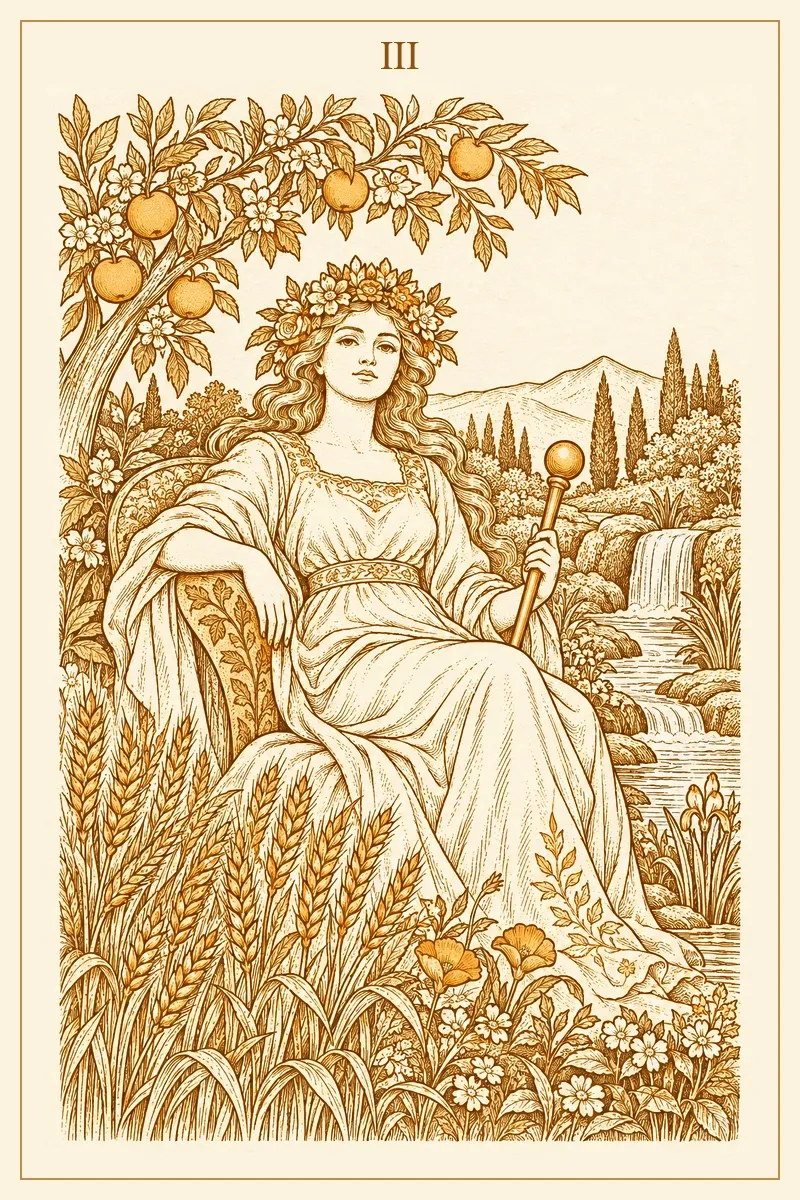
Beside The Empress, structure meets warmth. For a couple this is one of the most encouraging combinations: the frame is solid and plenty of affection is still growing inside it. If one of the two is reversed, look at which side has been neglected, the planning or the tenderness. Her own range of meanings is set out in The Empress tarot card meaning.
Two of Cups
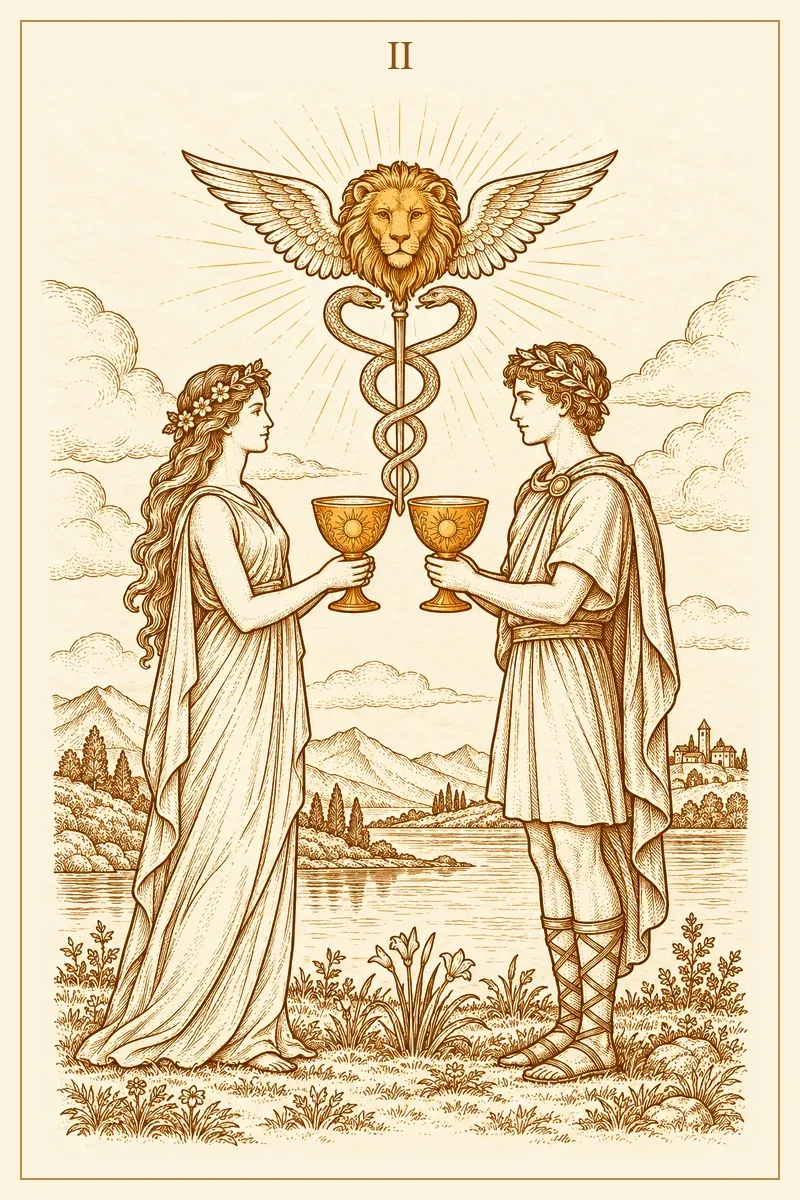
The Emperor with the Two of Cups describes a partnership chosen on purpose by two equals. Mutual attraction is backed by a willingness to make it official, or at least to agree on what you are to each other. For singles it can mean interest that turns into commitment without months of mixed signals. The full Two of Cups meaning covers the card's softer side in detail.
The Devil
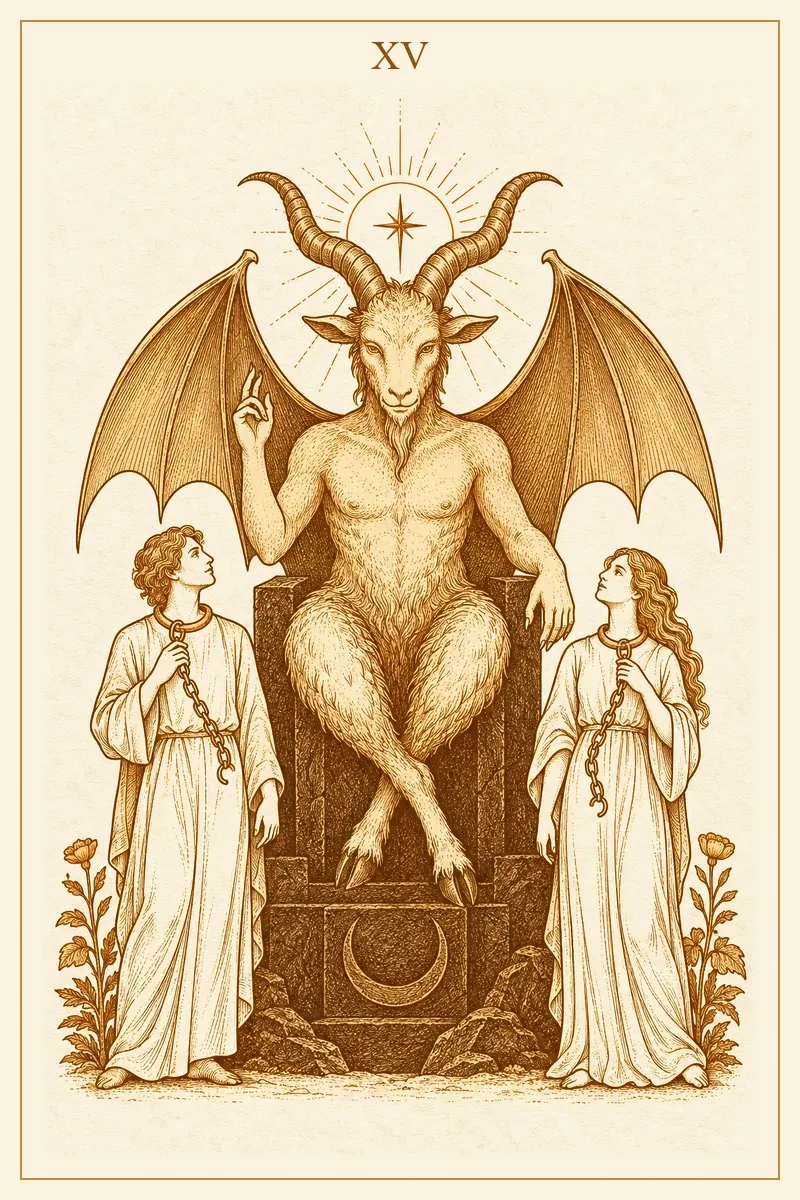
With The Devil, the Emperor's shadow grows stronger. Stability may be working as leverage, or the relationship's routines may be hiding a dependency neither of you has named, whether money, fear of being alone or plain habit. Ask whether you stay because you choose to or because leaving feels impossible. Our article on The Devil tarot meaning looks at attachment and release more closely.
The Tower
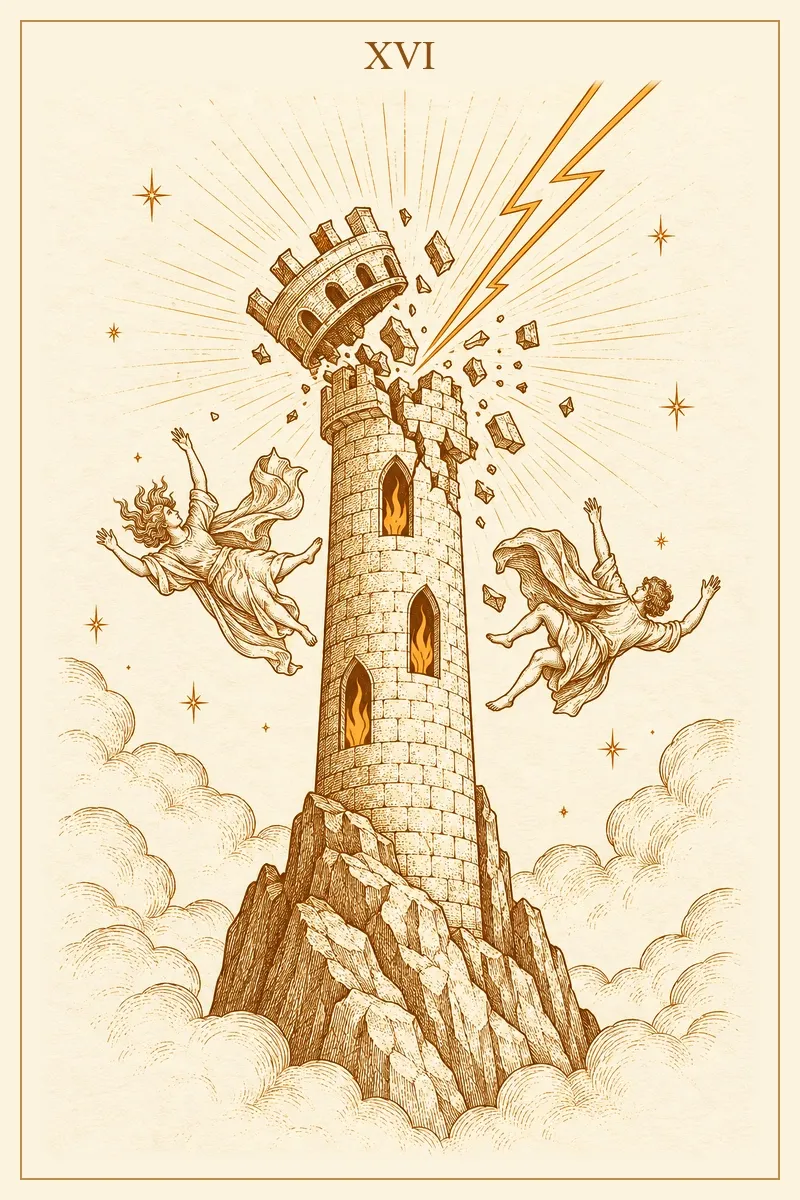
Next to The Tower, the Emperor suggests that a power arrangement in the relationship is about to be shaken, often by a revelation or a sudden change. What falls may be the relationship, or an unhealthy setup that rested on one person's authority. Read The Tower tarot meaning for ways to take in sudden upheaval without panic.
The Star
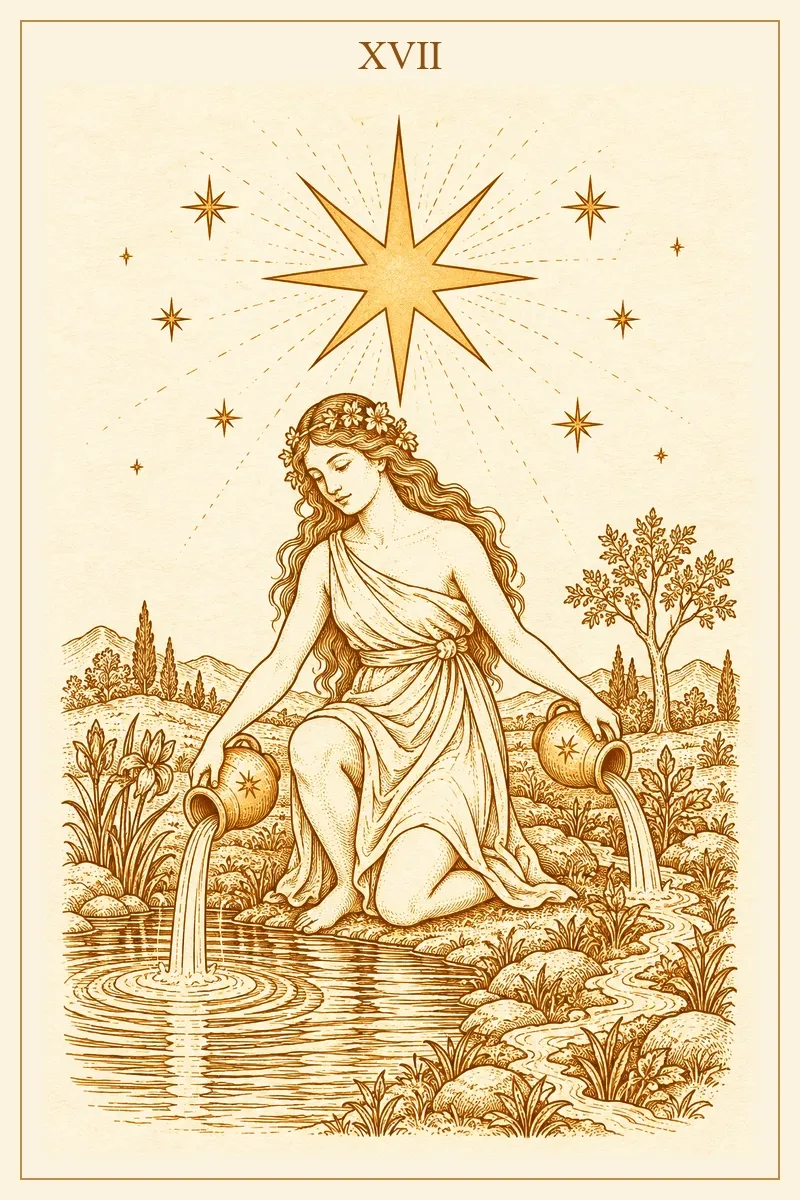
Paired with The Star, the Emperor describes healing inside a frame that held. For a couple after a hard stretch, the commitment survived and hope can return. For someone single after a painful ending, the boundaries you set may be what lets you trust again, a theme The Star tarot meaning explores further.
Outside these five, two more cards shift his message. With Death, the old balance of power ends so a fairer one can begin, often through renegotiated roles; with The Hierophant, the focus turns to formal commitment and family expectations, which makes the pair relevant to questions about engagement.
The Stone Seat spread: five cards for love and security
This layout borrows its shape from the throne. Place card 1 in the center, cards 2 and 3 on its left and right like the armrests, card 4 above as the back of the seat, and card 5 below as the step. It works for couples, for someone dating and, with one change, for someone single.
- The foundation: what this relationship, or your love life right now, actually rests on.
- My terms: what I need in order to feel secure, whether or not I have said it.
- Their terms: what the other person needs to feel secure. If you are single, read this as what a future partner will need from you.
- Where the walls stand: where protection has turned into distance or control, or where a boundary is missing.
- One agreement: a concrete conversation or step that would make the frame fairer for both people.
Phrase the question so the cards can work with it: "What would make this relationship feel secure for both of us?" rather than "Will he commit by summer?" For other kinds of relationship questions, our collection of tarot spreads for love and relationships has several layouts to choose from.
An illustrative reading: the partner who plans everything
The example below is invented to show the spread in use. It does not describe a real person or a real reading.
Imagine Dana, three years into a relationship with Sam. She books the trips, tracks the shared budget and decides most weekends. Lately she feels more like the manager of the relationship than a partner in it. Her question: "What is keeping me in charge of everything, and what would make this feel shared?"
- The foundation: Two of Cups, upright. The mutual choice is still there. Whatever is wrong, it is not a lack of affection between them.
- My terms: The Emperor, upright. Dana is the Emperor in this reading. Her need for things to run well is real and has served them both, but she has made it her job alone.
- Their terms: Four of Cups, upright. Sam looks withdrawn, not uncaring. Read beside her Emperor, it suggests he stopped offering ideas after too many of them were quietly improved on.
- Where the walls stand: Ten of Wands, upright. The wall here is the load itself. Dana is carrying everything, and the weight keeps her from seeing that she is also refusing help.
- One agreement: Temperance, upright. A blend rather than a swap. Not Sam taking over, but the work poured from cup to cup, a little at a time, until it is shared.
Taken together, the cards accuse no one. They describe a pattern both have settled into: one partner holds the throne, the other has stepped back, and both are a little lonely. Dana decides to hand Sam their weekends for the next two months, with no corrections, and to ask which part of their shared life he would like to own. Whether he rises to it will show in the weeks that follow, which is exactly where the Emperor would look for the answer.
Putting the Emperor to work in your love life
- Say one unspoken agreement out loud. Most couples run on assumptions about money, time or roles that were never discussed. Pick one and talk it through.
- Judge by a month, not a moment. Notice what is done consistently over several weeks before deciding what someone means.
- Share one decision. If you always decide, hand one over completely. If you never decide, choose one and own it.
- Run the freedom check. Can you say no in this relationship without paying for it later? If not, that deserves attention and support.
- Journal from the throne. Where do I feel safe in love? Where do I feel managed? What would I build if I were not afraid of being let down?
Frequently asked questions
Does the Emperor mean I will meet an older partner?
Not necessarily older in years. The card points to maturity: someone who knows what they want, can commit, and has the footing to build something real. That person may be your age or younger.
Is the Emperor a sign of a controlling relationship?
Upright, usually not; it describes healthy authority and protective love. Reversed, or surrounded by cards such as The Devil or The Tower, control becomes a real question. A simple test helps: does this person's strength leave you feeling safe, or feeling small? Safety belongs to the upright card. Feeling small belongs to its shadow.
What does the Emperor mean if I value my independence?
He does not ask you to give it up. He asks whether you can build something shared, with clear agreements, while keeping your own life intact. If the card makes you bristle, ask whether the resistance is about the card or about being depended on.
Is the Emperor a yes or a no in a love question?
Upright, readers usually treat it as a yes for questions about commitment, stability or making things official, with the condition that the yes comes with terms and follow-through. Reversed, it leans toward "not like this": not a final no, but a sign that the structure or the balance of power needs work first.
Can the Emperor tell me whether my ex will come back or my partner will commit?
No card can confirm another person's decision or a date. Tarot reflects the situation as you see it and the choices in front of you; it cannot see into someone else's mind or guarantee an outcome. What the Emperor can show is whether the conditions for a lasting commitment exist, and what you would need before saying yes.
Can the Emperor stand for a woman, or for me?
Yes. The card describes an energy and a role, not a gender. A woman, a man or a nonbinary partner can be the Emperor in a relationship, and so can you, whenever you are the one holding the structure.
Love you can lean on
The Emperor will never be the most romantic card in the deck. He asks one plain question that every lasting relationship eventually has to answer: can I count on you, and can you count on me? When the answer is yes and the actions match the words, you are looking at a love that holds weight.
When you want to bring your own question to the cards, a calm reading on Veil Soul lets you lay out the Stone Seat spread and take your time with each position.