Uncertainty you can feel but cannot yet see: that is The Moon in a love reading. Upright, it says the picture of your love life is only half lit right now. Mixed signals, unspoken worries, an old hurt coloring a new situation or an unchecked hope are blurring what is real, so the card asks you to slow down and look again before you decide anything. Reversed, the fog is starting to thin: a truth comes into view, an anxiety loosens its hold, or, in some readings, you are pushing away a feeling you would rather not have.
One thing The Moon is not: proof that someone is lying to you. It marks the limits of what you can see, not who is to blame for them. Tarot also cannot read another person's mind, confirm a hidden fact, name a date or decide how a relationship ends; it can help you notice what you are guessing and what you actually know. The card's full symbolism, astrology and work readings live in our complete guide to The Moon tarot meaning, so this post stays with love.
In brief, here is how The Moon reads in matters of the heart:
- Upright: uncertainty, mixed signals, projection, fears you have not said aloud.
- Reversed: clarity returning, a secret or worry surfacing, or an instinct you are muting.
- Single: an attraction built partly on imagination; take time to meet the real person.
- Dating: a talking stage full of guesswork; asking works better than decoding.
- In a relationship: worries both people carry and neither has named.
- After a breakup: an ending without a clear explanation, still replaying at night.
- Their feelings: real but unsettled, mixed with hesitation they have not voiced.
- Yes or no: not yet; there is too much you cannot see.
Borrowed light: card XVIII seen through a love question
The engraving, from the sky down
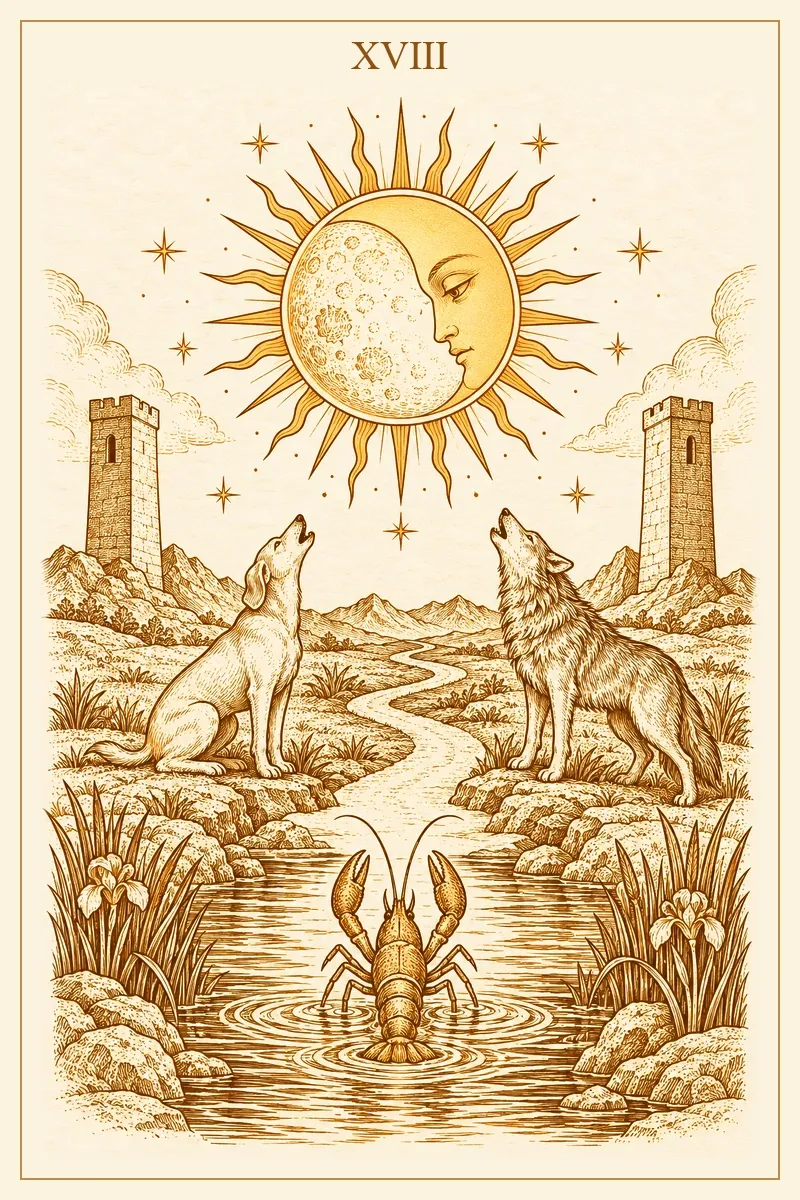
Below the numeral XVIII, a large round moon sits inside a crown of long, flickering rays, with small four-pointed stars on either side. The disk is split in two: the left half is pocked lunar rock, and the right half holds a serene face in profile, eyes lowered, turned away from you. Two square stone towers, each with notched battlements and one arched window, stand at the far left and right. Between them a pale dog sits on the left bank and a shaggy wolf stands on the right, both howling at the sky. A narrow path winds through low hills toward distant mountains, and at the very front a crayfish lifts its claws out of a rippling pool fringed with irises and reeds.
Four details to bring into a relationship question
A face shown only in profile. Half the disk is a face, and the face looks away. That is how The Moon describes a person or a relationship: you see one side clearly and guess the rest. The guess may be generous or fearful; either way, the card asks you to label it as a guess.
Two animals, one sound. The dog is the part of you that wants closeness and reassurance; the wolf is the part that scans for danger because you were hurt before. Under this light both are howling, and from the inside they sound alike. Much of this card's work in love is learning which one is speaking when you lie awake wondering about someone.
Something climbing out of the water. The crayfish, half out of the pool, stands for what surfaces from below: a memory of being left, a family pattern, a jealousy you thought you had outgrown. It is not your present partner's doing, though it can land on them.
A path that keeps going. The road between the towers is visible for a short stretch and then disappears into the hills. Nothing on the card says it is dangerous or that it ends nowhere. You can see the next few steps and not the destination, which is an honest description of loving anyone, and a reason to move at walking pace.
Upright Moon, read for where you are in love
If you are single
For a single reader, The Moon fits an attraction that runs ahead of the facts. You may be building a whole person out of a profile, a few conversations or one look. Enjoy the pull, but give it daylight: meet more than once, in more than one setting, and let the person show you who they are. The card can also describe a fear of being fooled that makes every new person look suspicious; if that rings true, the wolf is doing the reading for you.
If you are dating or in a talking stage
In early dating, The Moon speaks to guesswork: a reply that took a day, warmth on Friday and distance on Monday. Each interpretation pulls a little further from what was actually said. The card does not say the other person is playing games, only that neither of you has been clear yet. A plain question, such as "What are you looking for?", ends the fog faster than another night of reading tone into a text, even if the answer disappoints.
If you are in a committed relationship
For couples, The Moon points to the territory below the routine: worries each of you carries and neither has said out loud. One of you may fear the spark is gone; the other may fear being a burden. An old wound may be shaping how one of you reads a late message or a closed door. The card shows that guessing has taken the place of talking, and it asks for a calm daytime conversation about one specific worry, not a trial of the whole relationship.
After a breakup or with an ex
After a breakup, The Moon describes an ending that never quite made sense: a reason that does not add up, or no reason at all, and a mind that keeps filling the gap at night. A message from an ex under this card is hard to read; it could mean longing or boredom. Before you answer, ask what you would need to know to feel settled, and whether this person is able to tell you. The clarity you want may come from your own decision rather than their explanation.
Gut feeling or old fear? Sorting what the howling means
The hardest question The Moon raises in love is whether your unease is intuition or anxiety. Both feel urgent and certain, and both get louder after dark. These questions help separate them without another card:
- Is it tied to something you observed? A changed habit, a story that shifted. A feeling with a concrete anchor deserves a conversation; one with no anchor deserves some care first.
- Did you feel this before you met them? If the same fear has followed you through several relationships, it may belong to an older story.
- Does it change with sleep, food and company? A worry that is overwhelming at 2 a.m. and manageable at noon is telling you about your nervous system as much as about your partner.
- What would you do with the answer? If no answer would calm you, the question underneath may be about your own safety and worth.
The card also has a shadow in love: fear that turns into surveillance. Checking a phone, setting small tests, keeping a mental file of evidence. These moves promise protection, yet a relationship cannot breathe under constant suspicion, and they never produce the certainty they chase. If you recognize yourself here, you are not a bad partner; you are frightened, and fear deserves care. Our guide to tarot for anxiety offers gentler ways to use the cards when your mind will not settle.
If your unease comes from things a partner actually does, such as controlling where you go, reading your messages or frightening you, that is not a Moon question to interpret. Talk to someone you trust or a local support service, and put your safety first.
When the fog lifts: The Moon reversed in love
Reversed, The Moon shows the same night landscape with the light changing. That can be welcome news, or it can mean you have closed your eyes.
A truth comes into view
Something hidden or unspoken comes out: a partner's doubt, a secret, a plan, a feeling you had both been circling. It may be uncomfortable, but it replaces guessing with something you can respond to. Take a breath before reacting.
Worry loosens its hold
The dread that had no name starts to fade. You sleep better, stop rereading old messages, and a partner's ordinary habits look ordinary again. Nothing dramatic may have happened; you have simply had enough information, rest or reassurance for the wolf to lie down.
You see what you were projecting
The card can mark the moment you notice that a fear belonged to an earlier relationship, and that your suspicion of a new partner has the shape of an old betrayal. That recognition is a real turning point: you can now ask for reassurance about the present instead of punishing the present for the past.
When reversed means looking away
In some readings the reversed Moon describes muting an instinct rather than resolving it: deciding not to think about a pattern that bothers you, or numbing a feeling because facing it would change too much. If your new calm is mostly relief at not having to ask, check whether anything has actually been answered.
The Moon as feelings, yes or no and timing
The Moon as someone's feelings
In a position about another person's feelings, The Moon describes emotions that are real but unsettled. They may be drawn to you and unsure what to do with it, carrying a worry they have not shared, or not fully aware of what they feel. It is not a cold card, only an unclear signal, which is why their behavior may look inconsistent from where you stand. Reversed, their feelings are coming into focus: they may be getting ready to say what they have held back, or backing away from a feeling they find inconvenient, and what they do next will show you which. Either way, ask; do not decode.
Yes or no
For a yes-or-no love question, the upright Moon reads as "not yet": you do not have enough to decide well. Reversed, it leans toward a careful yes once the thing you were unsure about has been checked in the open.
Timing
The Moon has no clock in it. Its timing reads as "after you know more": decisions about commitment, reconciliation or leaving go better once a real conversation has happened or a pattern has had time to show itself. If a date matters, set your own check-in rather than waiting for a card to supply one.
Five cards that change The Moon's message in love
Neighboring cards tell you what kind of fog you are in. Take these five as directions for reflection, not fixed formulas.
The Moon with The High Priestess
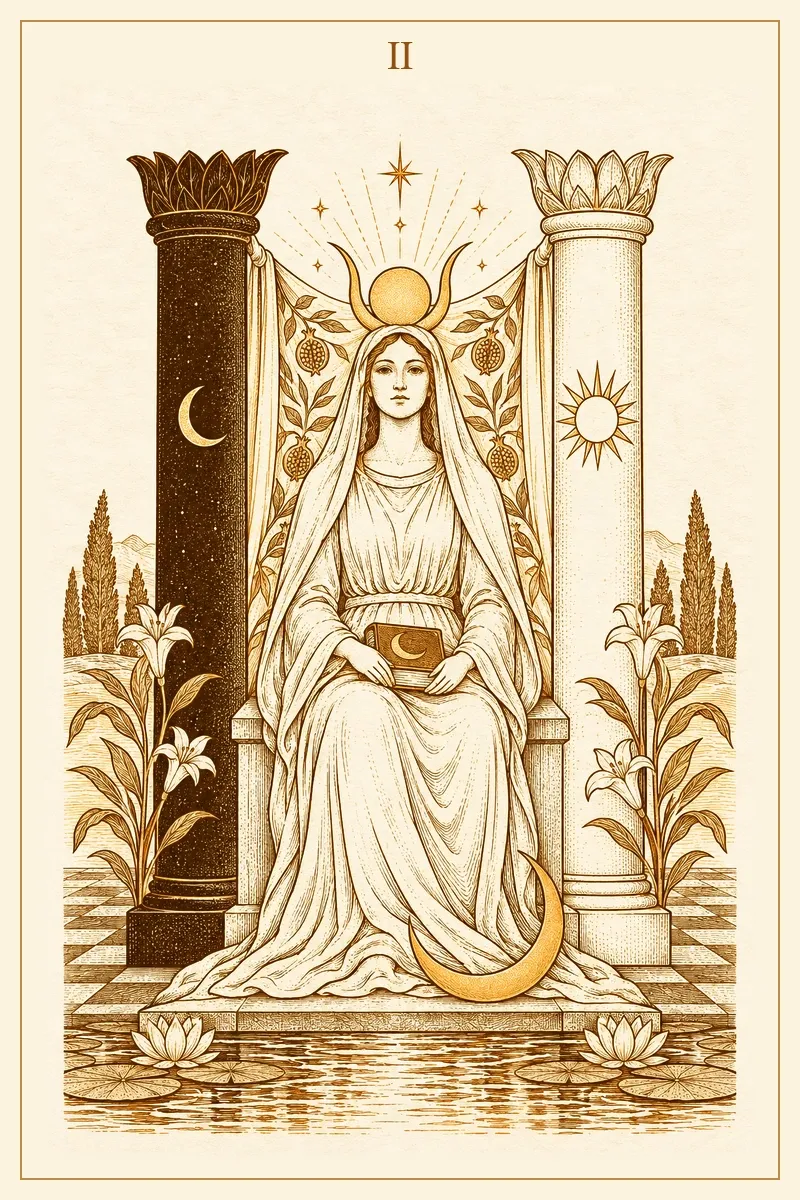
The High Priestess sits on a stone throne between a dark pillar painted with a crescent and stars and a pale one with a sun, a book stamped with a small moon on her lap and a large crescent at her feet. Paired with The Moon, she turns the reading toward intuition that is quiet rather than frantic: something important lives in what has not been said, and part of you already senses it. Listen inward and wait for the right moment to speak instead of hunting for proof. The High Priestess tarot meaning explains why she is called the keeper of hidden knowledge.
The Moon with the Seven of Cups
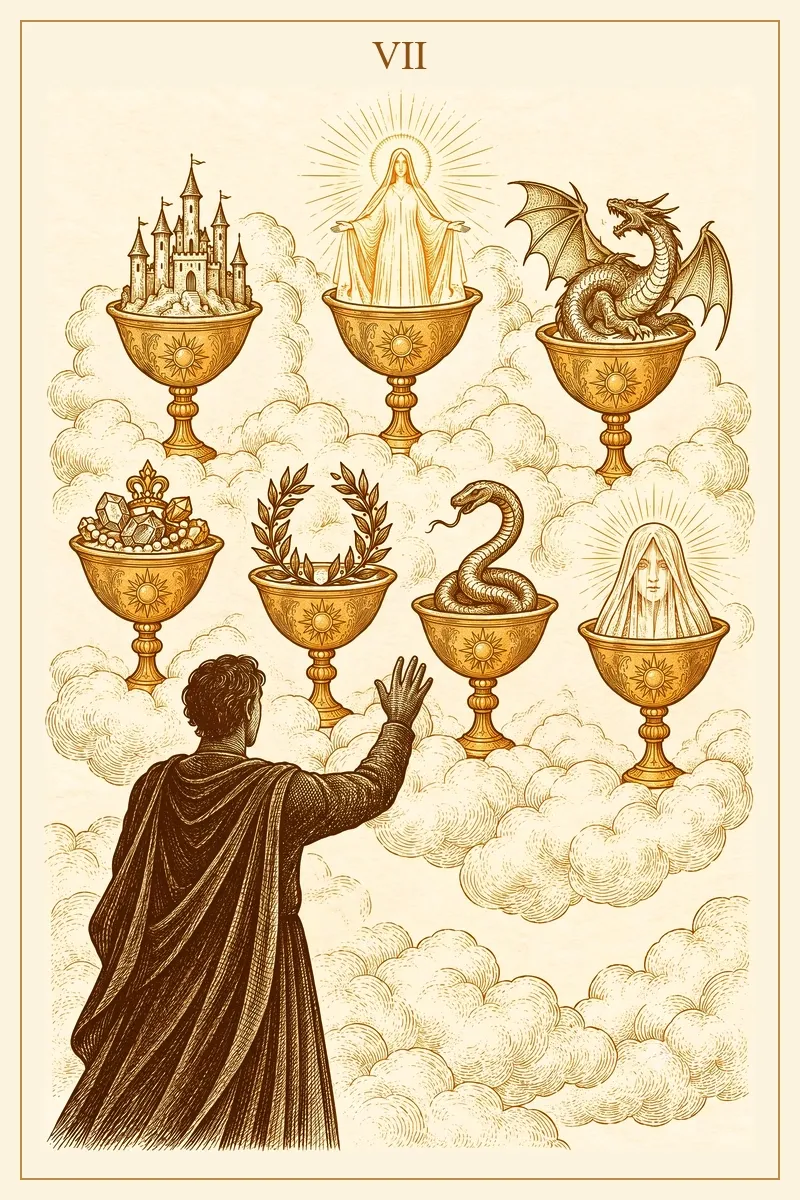
On the Seven of Cups, a cloaked figure seen from behind raises a hand toward seven golden chalices floating on clouds, each holding a vision: a castle, a radiant veiled figure, a dragon, jewels, a laurel wreath, a snake and a shrouded head. Next to The Moon, the fog is about fantasy: you may be in love with an idea of someone more than with the person who answers your messages. The fix is not cynicism but one real step, and then seeing what happens. See the Seven of Cups meaning for its other contexts.
The Moon with the Nine of Swords
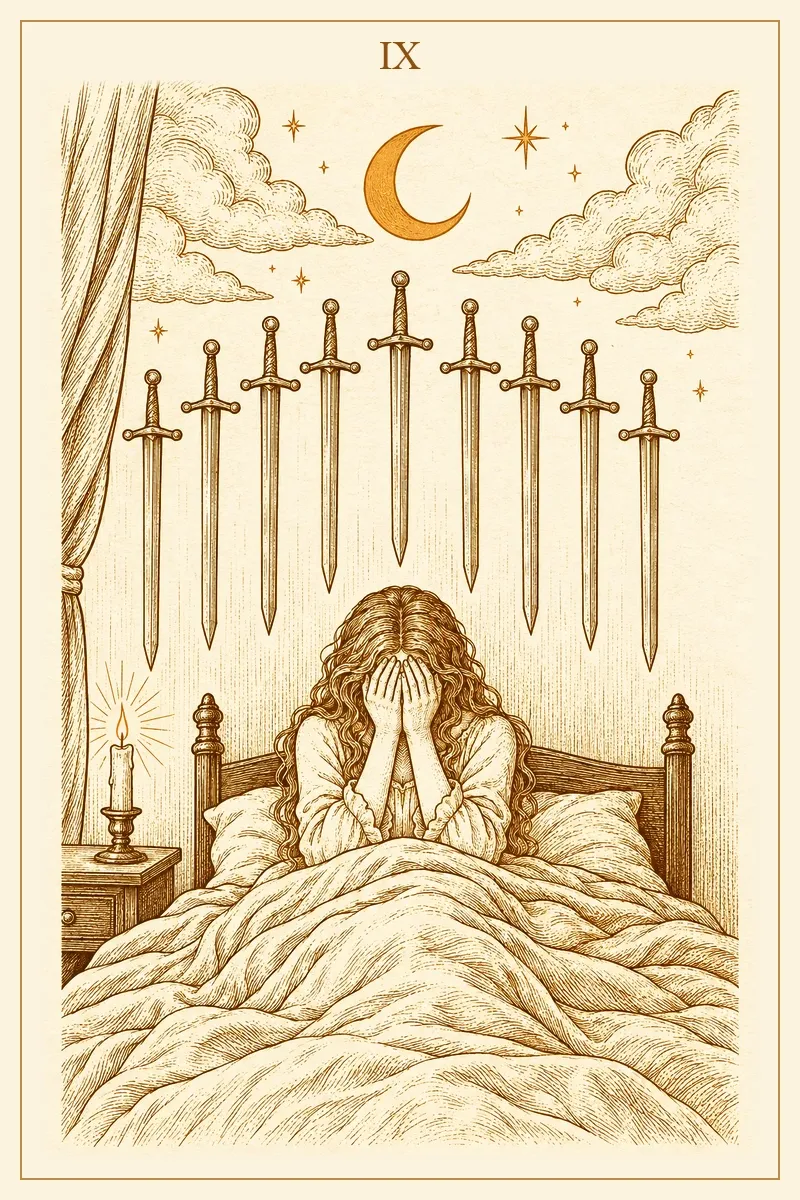
The Nine of Swords shows a woman sitting up in bed with her face in her hands, nine swords hanging in a row above her, a crescent moon and clouds overhead and a single candle on the nightstand. With The Moon, the pairing speaks to worry that does its worst work at night. Above her the swords float in the night air, and not one of them reaches her. What feels unbearable at 3 a.m. deserves to be checked again in the morning. The Nine of Swords tarot meaning covers this card's link to anxiety in more depth.
The Moon with the Two of Cups
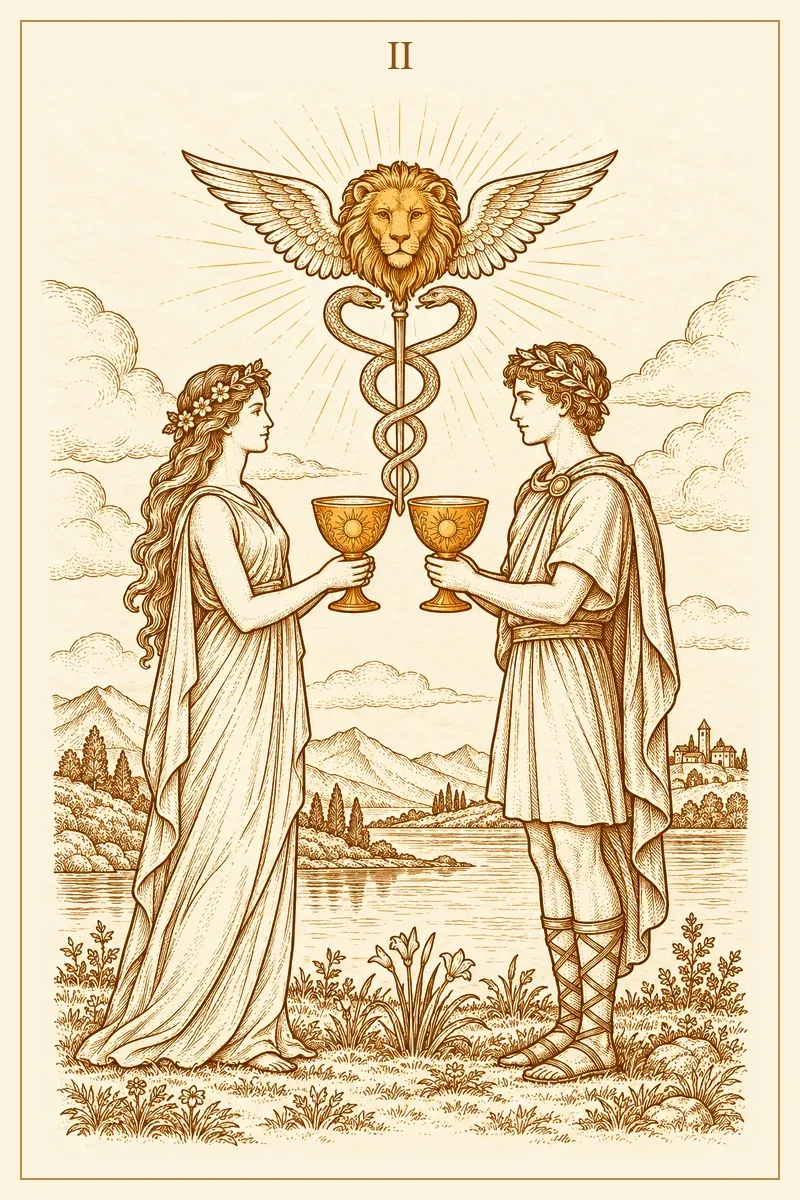
On the Two of Cups, two young people in classical dress, she in a flower crown and he in a laurel wreath, hold golden cups toward each other beneath a winged lion's head and a staff twined with two snakes, a lake and a hillside village behind them. Next to The Moon, it suggests real mutual feeling surrounded by unclear communication: the bond is there, but no shared understanding of what it is. This pairing is a good argument for having the "what are we?" conversation. The full Two of Cups meaning explores its upright and reversed sides.
The Moon with The Sun
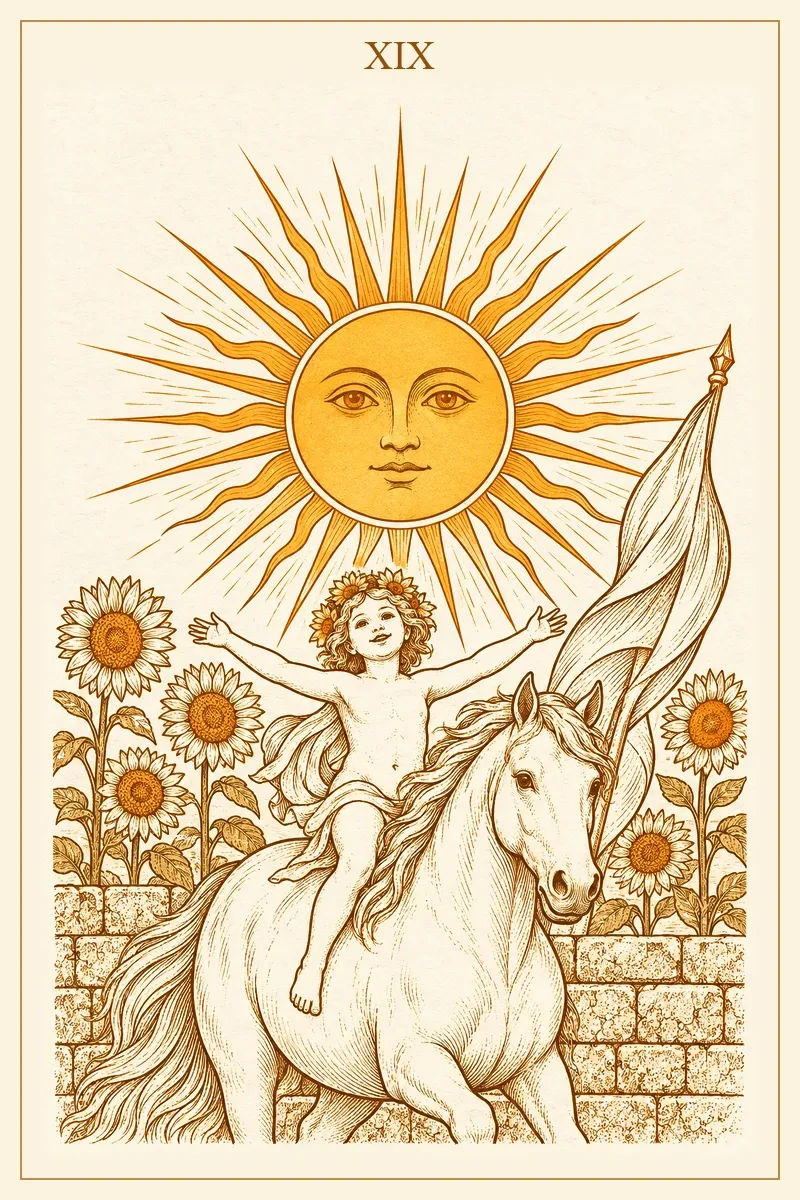
The Sun follows The Moon in the major arcana, and its engraving reads like a reply: a full sun facing forward with both eyes open, a child in a flower wreath riding a white horse with arms spread wide, a large white banner, and sunflowers behind a stone wall. Where The Moon shows a face in profile, The Sun looks straight at you. Together they describe confusion with a way out, such as a conversation that clears the air. If The Sun lands in a later position, read it as daylight you can work toward. The Sun tarot meaning covers its joy and clarity in full.
Briefly, three more. With The Devil, the confusion may come from an attachment you keep returning to even though it costs you. With the Seven of Swords, questions of honesty sharpen, though the deceit can be self-deception as much as someone else's secret. With the Three of Swords, a painful truth may be part of what is surfacing, and grief deserves room.
The Lantern spread: six positions for a love you cannot read yet
This spread is built from the card's own picture. Write your question first, such as "What do I need to see clearly in this relationship?", and keep the positions fixed so a frightening card cannot quietly change their meaning.
- What I can see clearly. The facts, and the parts of the relationship already in good light.
- What I am guessing. The story you tell about the gaps: the half of the face you cannot see.
- The dog: what I want. The need for closeness, safety or commitment behind your question.
- The wolf: what I fear. The alarm that has been howling, and what it is trying to protect.
- What is rising from the pool. An older hurt or pattern that may be shaping how you see this person.
- A lantern for the path. One question to ask or one step to take that would bring more light.
Read positions 2 and 4 side by side. If the guess and the fear say the same thing, the story may be coming from fear rather than from the facts in position 1. Position 6 should close the reading with something you can do this week, not a prediction about the other person.
An illustrative reading: a partner who has gone quiet
This example is invented to show how the spread works; Maya and Jonah are not real people.
Maya has lived with Jonah for two years. For a month he has been distracted, on his phone late at night, slow to answer when she asks about his day. She suspects he is losing interest and asks, "What do I need to see clearly about Jonah and me?"
Position 1, what she can see clearly, is the Two of Cups: when she lists the facts, they include care, since he still cooks on her late nights and still reaches for her hand. Position 2, what she is guessing, is The Moon itself, and it fits: nearly everything she fears is inference from a closed posture and a lit screen. Position 3, the dog, is the Six of Cups, her wish for the easy warmth of their first year. Position 4, the wolf, is the Nine of Swords, which matches her 2 a.m. scrolling. Position 5, rising from the pool, is the Three of Swords, and Maya recognizes it at once: a previous partner went quiet in the same way before he left.
Position 6, the lantern, is the Page of Swords, a card of curiosity and direct questions. Maya takes it as permission to ask rather than investigate. On a Saturday morning, not a late night, she says, "You've seemed far away this month, and I've been worried. What's going on?"
In this illustration, Jonah admits his team at work is being restructured and he has been afraid of losing his job. The cards did not reveal that; the conversation did. The reading helped Maya separate a fact (he is distracted) from a guess (he is leaving) and an old wound (the last partner did leave), so she could ask instead of accuse. A harder answer would not have made the method wrong: daylight first, conclusions afterward.
Finding your footing in the days after
The Moon is not an instruction to panic or to leave. It asks for a slower, better-lit look.
- Make two lists. What you know because you saw or heard it, and what you are inferring. Keep them in a notebook to see later which guesses held up; our guide to keeping a tarot journal shows a simple format.
- Do not decide at night. Postpone breakup texts, confrontations and big messages until you have slept and eaten.
- Ask one clear question. Choose the single thing you most need to know and ask it plainly, in person if you can, at a calm moment.
- Notice your own pattern. If the same fear has followed you through several relationships, a counselor or therapist can help in ways a card cannot.
- Stop redrawing. Pulling more cards to make The Moon go away keeps you in the night. One question, one reading, then real life.
Frequently asked questions
Is The Moon a sign that my partner is cheating?
Not on its own. The Moon shows that something is unclear, but it does not name who is hiding what. That can be a secret, but it can just as easily be a partner's private worry, a misunderstanding or your own fear carried over from an earlier relationship. If you have concrete reasons for concern, those matter more than any card; talk about them directly.
Is The Moon a bad card to get in a love reading?
It is an uncomfortable card, not a doom card. It can even describe the pleasant mystery of early attraction. It becomes a warning only when the fog hides something you need to know, and even then its message is to look, not to fear.
What should I do right after drawing The Moon about someone?
Pause before you act. Write down what you know, what you are guessing and what you fear, then pick one question you could ask the person, and ask it once you are rested.
Does The Moon reversed mean the confusion is over?
It means the light is changing. A truth may be coming out, or a worry may be losing its grip. Sometimes it means you have stopped looking at a feeling instead of resolving it, so check whether anything has actually been answered.
What does The Moon mean for a new crush?
That you are attracted to someone you do not know well yet, and your imagination is filling in the blanks. That is natural at the start; let the person show you more of who they are before you treat your picture of them as fact.
Can tarot tell me what is really going on in my relationship?
No. Tarot cannot see into another person's mind, confirm a hidden fact, name a date or promise how things will turn out. A reading like this can show you where you are guessing, so you can bring a clear question to the person who can actually answer it.
One step at a time, by the light you have
The Moon in a love reading does not ask you to see the whole road. It asks you to tell the dog from the wolf, notice what is climbing out of the pool, and take the next step with your eyes open. Clarity in love arrives through questions asked and answered, and through time.
When you are ready for a calm look at your own question, begin a reading and give the answer a day to settle.