Something real but unspoken is what The High Priestess usually describes in a love reading: a feeling still forming, a truth you have half-noticed, or a person who shows their heart slowly. Upright, she asks you to trust that quiet perception and let the situation reveal itself at its own pace instead of forcing an answer. Reversed, she points to a gut feeling being overridden, to worry posing as intuition, or to silence that has hardened into secrecy.
She is a patient card rather than a dramatic one, so it helps to be clear about what any card can do here. Tarot cannot read another person's mind, confirm what they are hiding, or name the week something will change; it can help you sort what you sense from what you know and choose a next step. Her wider symbolism and her meanings for work and money are covered in The High Priestess tarot card meaning, so this page stays with romance, feelings and the cards that shape her love message.
Her love meaning in brief:
- Upright: intuition you can trust, attraction that grows quietly, information that will surface in time.
- Reversed: a clear inner signal ignored, or overanalysis that makes every feeling look like a warning.
- As a person: someone reserved and perceptive who opens up slowly and shows care through attention.
- For singles: a connection that may already be near you, noticed in small exchanges more than big gestures.
- For couples: a subject both people sense and neither has named.
- Yes or no: most often "not yet."
- As advice: watch, listen, write down what you notice, and let the next clear fact arrive before you act.
A closed book in her lap: the picture read as a love card
Nearly every detail on this card is about timing and privacy, so it is worth a slow look.
What The High Priestess shows on this card
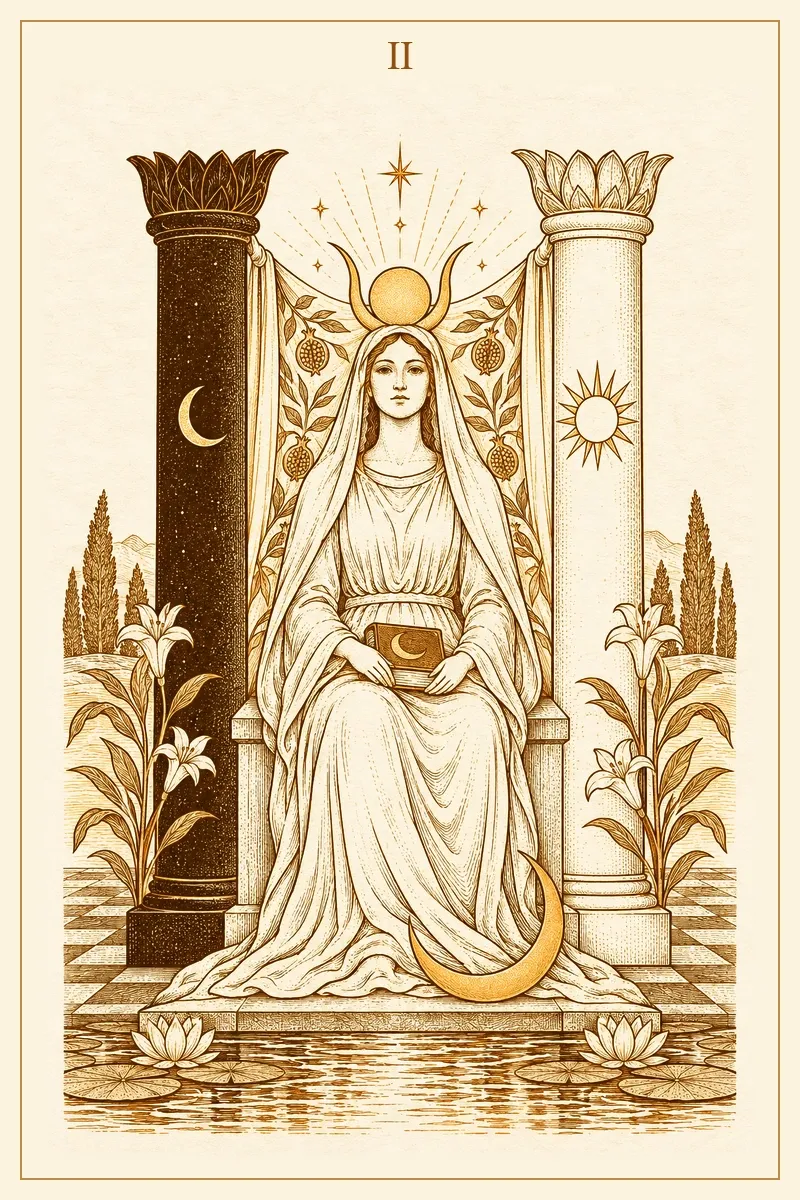
She sits on a stone seat, veiled from head to floor in pale cloth, facing you with a calm expression that gives little away. On the left stands a dark column scattered with tiny stars and marked with a crescent; on the right rises a light column bearing a rayed sun. Carved lotus flowers crown both columns. Between them hangs a cloth patterned with pomegranates and leaves, half hiding whatever is behind her. Her headdress is a pair of curved horns cradling a round disk, with an eight-pointed star above it. Both her hands rest on a closed book in her lap, its cover marked with a small crescent. A large crescent moon lies at her feet, lilies grow beside each column, cypress trees and soft hills fill the distance, and along the bottom edge a strip of still water holds lotus blossoms and floating leaves.
Read through a love question, the closed book is the heart of the card. What is written in it already exists, the feeling, the truth, the next chapter; it simply has not been opened, and she will not pry it open for you. The night and day columns mirror the two sides of any relationship: what you feel lying awake and what you say over dinner. She sits between them, which makes her a fitting card for anyone caught between what they sense and what they can prove.
The crescent and the still water suggest feelings that move in cycles and need to settle before they clear; water does not turn clear by being stirred. The pomegranate cloth adds that something kept private from a new partner is not automatically a lie.
Upright in love, from first glance to long commitment
Upright, The High Priestess favors patience, close attention and trust in your own reading of a person. How that plays out depends on where you stand.
If you are single
She rarely means a lightning-bolt meeting; more often, someone already within reach whose interest shows in quiet ways: the person who remembers a detail you mentioned once, who asks a second question, who is easy to sit in silence with. If you have been waiting for an obvious spark, look again at the connections that feel calm rather than electric. She can also describe a chosen pause from dating while you get clearer about what you want, a productive pause rather than a sign that love is passing you by.
If you have just started seeing someone
Early dating with this card nearby feels a little veiled. The other person may be warm and consistent while still keeping parts of their life back, and that alone is not a red flag; plenty of people share their history once trust has been built. Let them open up at a natural pace while you notice whether their actions match their words. Jot down your first impressions so you can compare them with what you learn over the next few weeks.
If you are in a committed relationship
In a settled partnership the card often points to a subject both of you sense but have not raised: a change in closeness, a decision about the future, a worry one partner has been carrying alone. She does not demand that it be dragged into the open tonight. She asks you first to admit to yourself what you already know, then to find a calm moment to name it gently. Being understood without words is a gift, but it is not the same as being told.
If you are thinking about an ex
About a past relationship, she tends to say that you understand why it ended better than you give yourself credit for. If you are wondering whether to reach out, the card advises waiting until you can say plainly what you would want from contact, rather than hoping the other person will guess. She does not predict a reunion.
When she stands for a person
In a spread that names people, The High Priestess can describe a partner, a love interest, or you. Her qualities belong to any gender.
The other person as The High Priestess
This is someone private, observant and emotionally deep who does not lead with declarations. They prefer one long conversation to a stream of short messages, and their care shows in attention: what they remember, what they ask, how they listen. The challenge with such a partner is not to read silence as rejection, and to ask openly instead of testing them.
You as The High Priestess
When the card describes you, it often means you sense more than you say. You may already know how you feel about someone and be waiting for a sign that it is safe to show it. The card supports that discernment and also asks how long you plan to keep the book closed, because too much mystery can leave a person who likes you unsure whether to try.
The reversed High Priestess in romance
Reversal does not turn her into a bad omen. It usually shows her gift, quiet perception, blocked or bent out of shape, in one of three patterns.
A gut feeling that keeps getting overruled
Something has felt off for a while, and you keep arguing yourself out of it: they look great on paper, your friends approve, you have already put years into this. Reversed, The High Priestess says the signal deserves a direct look. It may not be right, but it should be checked against facts rather than buried. Write down what you have actually observed, separate from what you fear, and see what remains on the page.
Worry dressed up as intuition
The opposite pattern is reading meaning into everything: a late reply, a shorter message, a change in tone. When anxiety is in charge, every small event looks like evidence. Intuition tends to feel calm even when its message is hard, while anxious guessing feels urgent and shifts with each new detail. Talking it through with a trusted friend often shows which of the two you are hearing.
Privacy that has turned into secrecy
Everyone has a right to an inner life. The shadow of this card is mystery used as a wall: withholding information to keep control, staying vague to avoid commitment, or answering every question with "I'm just private." Reversed, she can point to that pattern in a partner or in you, and the useful question is whether the silence protects something tender or simply keeps closeness out. A hidden matter is possible, so if you suspect one, look for concrete patterns over time.
The High Priestess as feelings, yes-or-no and timing questions
What does she say about their feelings?
Asked "how do they feel about me," The High Priestess usually reflects interest that is real but quiet: curiosity, attraction still being sorted out, or feelings held back until it feels safe. Reversed, it may reflect mixed feelings or something they are not ready to show. The useful next step is to compare that picture with how they actually treat you, and to give them an easy opening to say more.
Is she a yes or a no?
Many readers treat her as "not yet" rather than a clean yes or no. The answer exists but has not surfaced, so the card advises gathering more information before you decide. Reversed, she leans toward "look again at what you are ignoring." If you like single-card answers, this guide to yes or no tarot readings shows how to phrase the question so that a "not yet" card still tells you something useful.
Does she say when something will happen?
In the Golden Dawn tradition the card is attributed to the Moon, so some readers translate her timing loosely as about one lunar cycle. That is a reading convention, not a forecast. What the card says more reliably is about pace: things are developing slowly, and pushing for a date or a definition right now tends to backfire.
High Priestess combinations for love questions
Because she speaks softly, The High Priestess takes much of her love message from the cards beside her: a gentle neighbor suggests feelings forming in good faith, a heavy one gives the unspoken more weight. Five pairings get a full section below; shorter notes on others follow.
With the Two of Cups: a bond growing below the surface
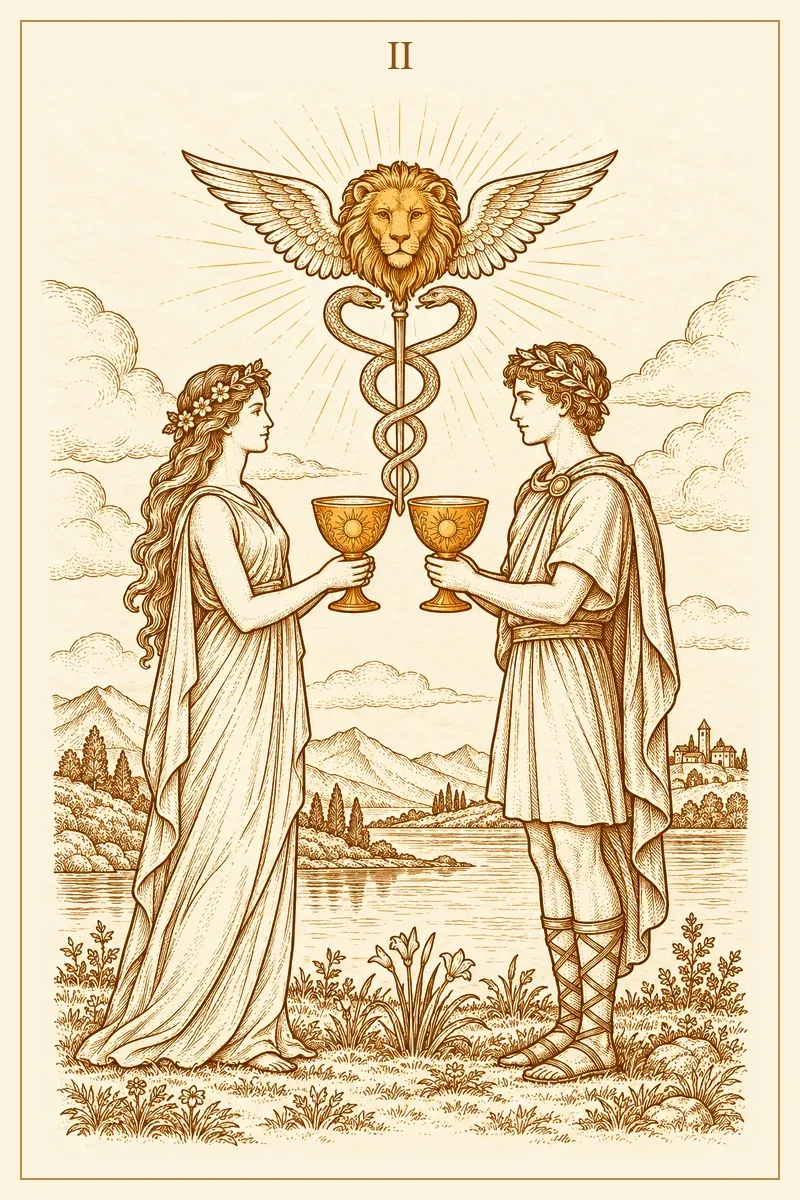
On the Two of Cups, a woman in a flower wreath and a man in a laurel wreath face each other beside a lake, holding out golden cups until the rims almost touch, while a winged lion head crowns a staff wound by two snakes above them. Paired with The High Priestess, this is one of her warmest combinations: a mutual connection that is real even if neither person has said much yet. The Two of Cups meaning covers the card's themes of mutual choice. With The High Priestess reversed beside it, one person may be holding back a feeling the other is ready to receive.
With the Knight of Cups: an offer worth listening to
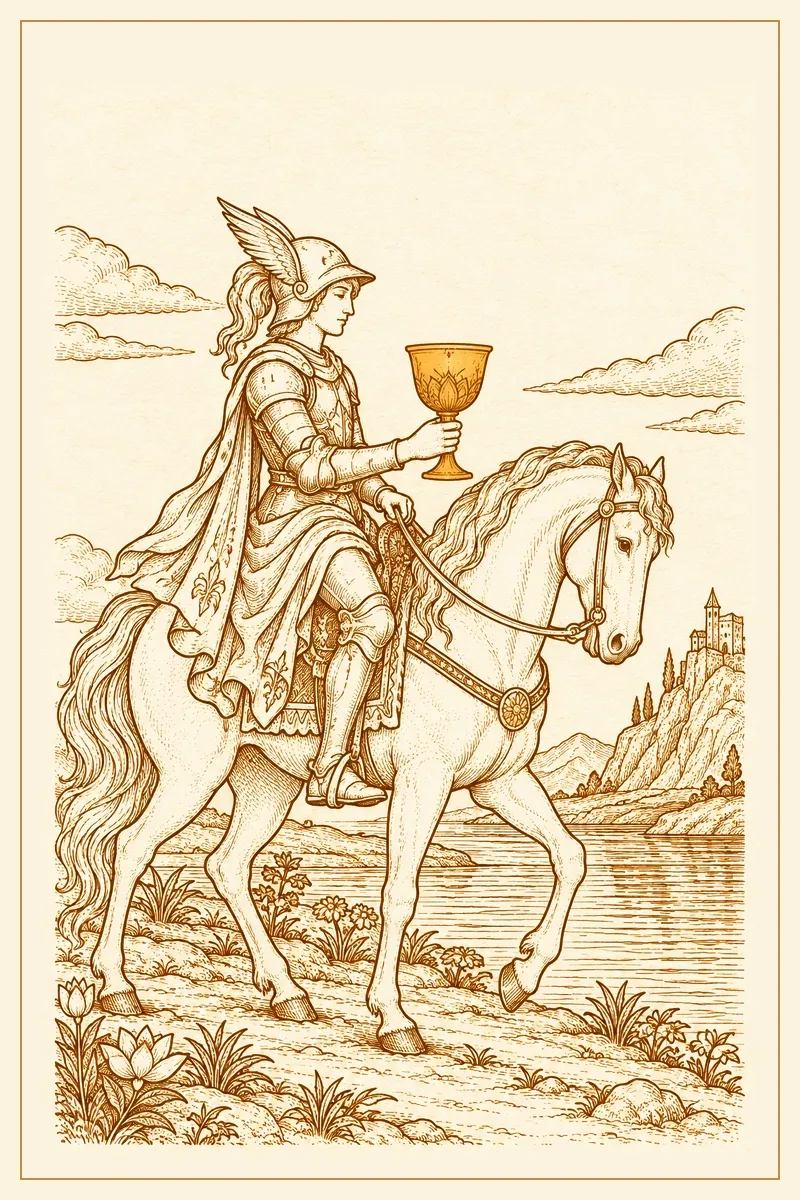
The Knight of Cups rides a white horse at an easy walk along a riverbank, wearing a winged helmet and holding a golden cup out in front of him. With The High Priestess, someone is approaching with romantic intention, and your first quiet impression is the best guide to whether the offer is sincere. If your gut agrees with his words, the pair is promising; if something feels rehearsed, notice that before charm carries you along. More on his romantic side is in the Knight of Cups tarot meaning.
With The Moon: when silence has gone on too long
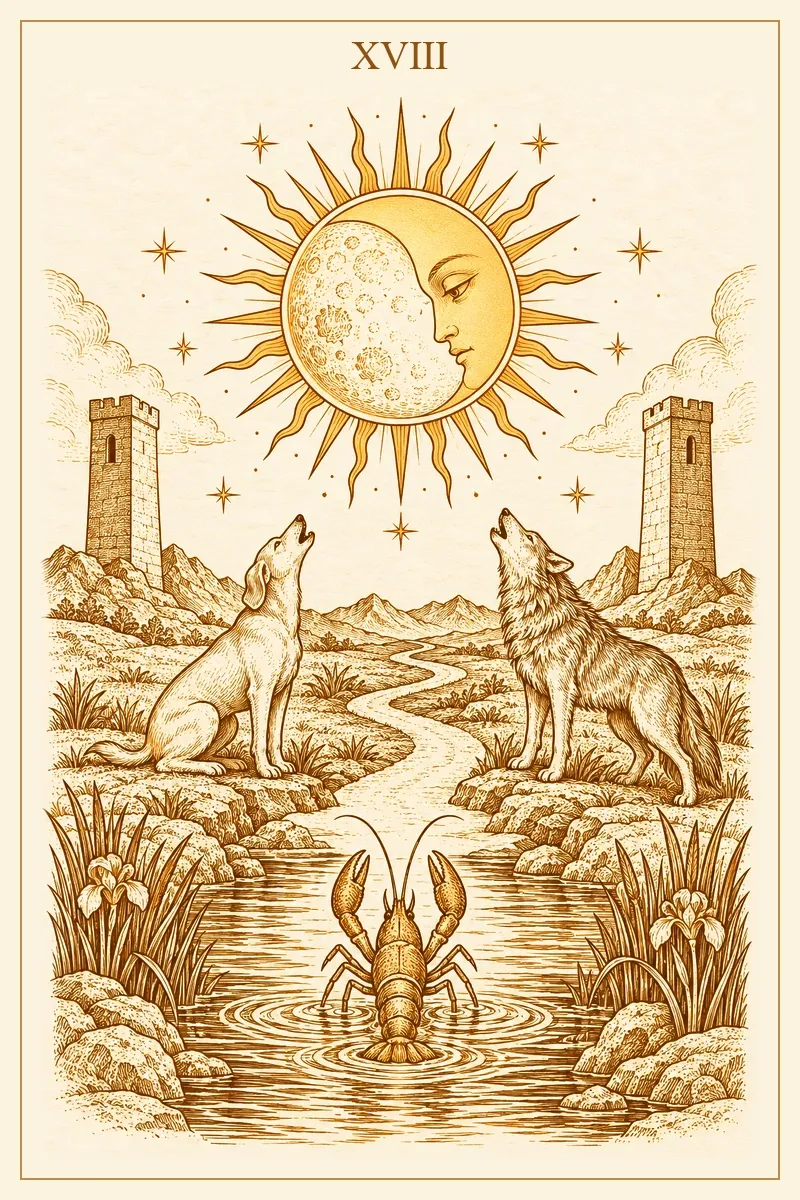
On The Moon, a crescent-shaped face in profile fills one side of a rayed moon disk above two stone towers, while a dog and a wolf howl on either side of a winding path and a crayfish climbs out of a pool. Both cards belong to the night, and together they deepen the theme of hidden things. In love this pairing can describe confusion, projection, or information being kept back, sometimes from you and sometimes by someone avoiding their own feelings. It asks for patience and fact-checking rather than accusation. The Moon tarot meaning explains how the card separates illusion from what is real.
With The Empress: intuition meets tenderness
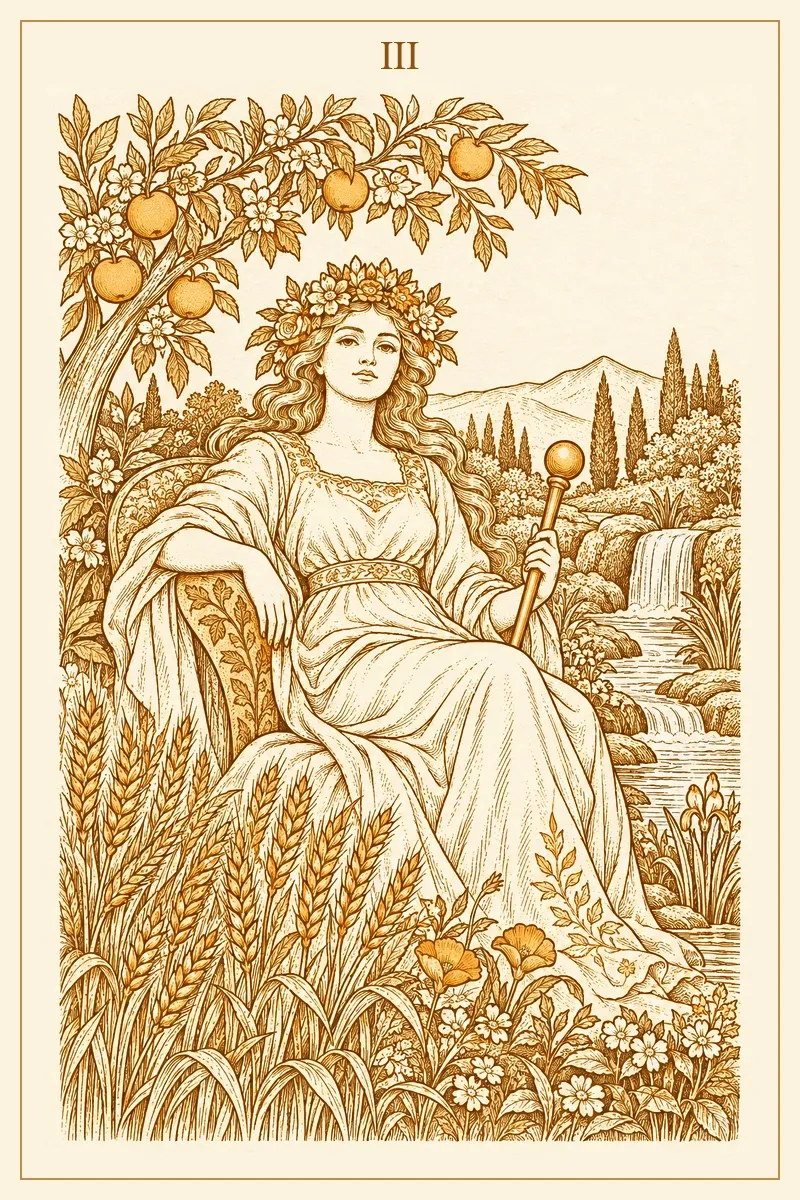
The Empress leans back in a cushioned chair in a ripe garden, crowned with flowers and holding a golden scepter, with fruit hanging over her, wheat at her feet and a small waterfall behind. Next to The High Priestess she turns quiet knowing into open care. The pair can describe someone learning to trust their own judgment in love again after a relationship that taught them to doubt it, and it supports nurturing a connection that has already proved steady. The Empress tarot meaning describes her broader themes of abundance and care.
With The Devil: a pattern that needs naming
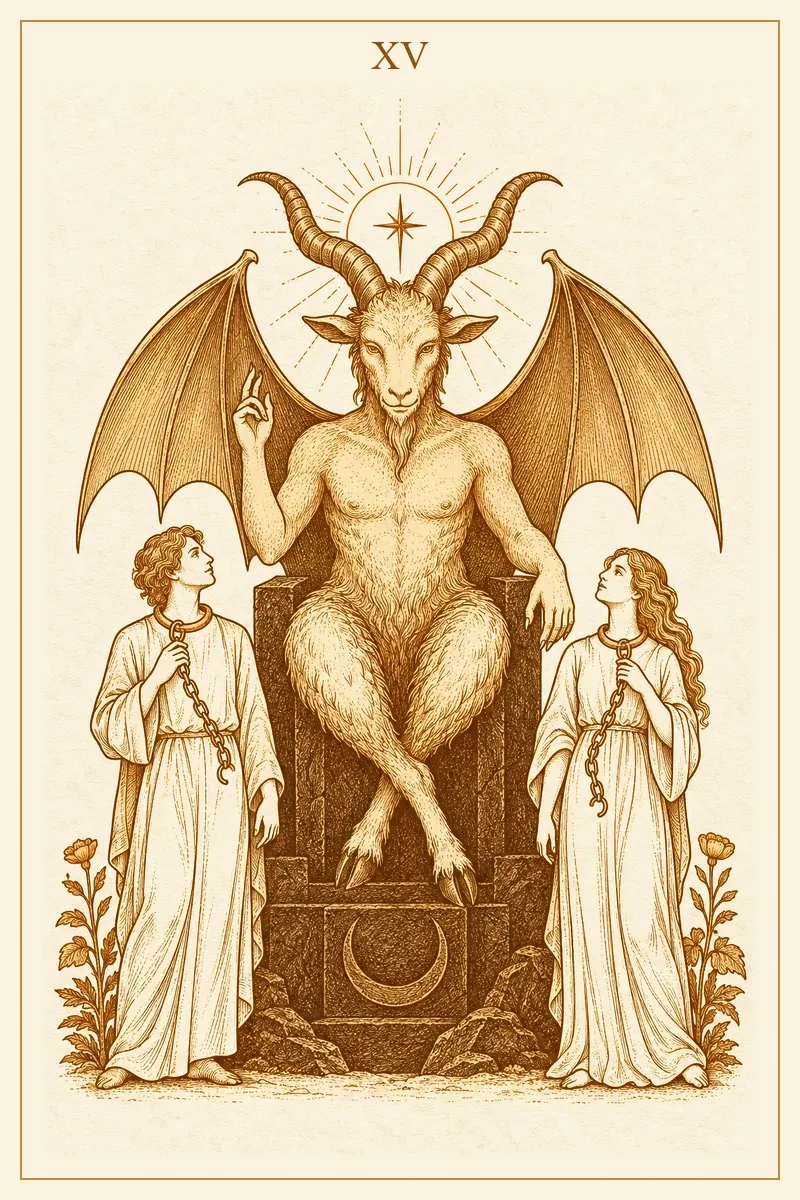
The Devil shows a horned, goat-headed figure with bat wings seated on a dark stone block carved with a crescent, while two robed people stand beside him with loose chains around their necks, holding the chains in their own hands. With The High Priestess, especially reversed, the pairing points to something unspoken that has a grip on the relationship: a compulsion, a dependency, or a secret that shapes how two people treat each other. It proves no particular wrongdoing; the loose chains are a reminder that a pattern can be put down. The Devil tarot meaning looks at attachment and release in more depth.
Other combinations to know
- With the Three of Swords: you sense a painful truth before anyone says it, and knowing early lets you prepare rather than be blindsided.
- With The Fool: a pull toward something new that you cannot fully explain; she supplies the knowing, he supplies the nerve to follow it.
- With The Lovers: a choice of the heart where your values already know the answer.
- With The Magician: card I beside card II; what you have been sensing is ready to be said and acted on.
- With The Hierophant: private feeling meets public commitment, often a question about making the relationship official.
- With the Seven of Swords: a stronger hint of concealment than either card gives alone; check facts calmly before drawing conclusions.
- With The Hermit: a deliberate inward season that clarifies what you want from love.
- With the Page of Cups: a shy crush or a tentative message from someone who finds it hard to say things outright.
The Between the Columns spread
This five-card spread borrows its positions from the card's picture and works for one relationship or for your love life as a whole. Lay two cards side by side for the columns, one between them for the book, one below for the crescent, and one at the bottom for the water.
- The dark column, what I sense: the impression you have but cannot prove.
- The light column, what I know: the facts you have actually seen or heard.
- The closed book, what is not ready to be said: the truth still forming, on either side.
- The crescent, what is still changing: the part of the situation that needs more time.
- The still water, how to wait well: a calm next step while things become clear.
Compare the first two positions before anything else. When they agree, intuition and evidence point the same way. When they disagree, the third card often explains the gap. Keep the fifth card's advice small enough to do this week.
Worked example (hypothetical): the friend who might be more
This example is invented to show how the spread works. Imagine someone who has been close friends with a coworker for about a year. Lately their conversations run longer and there have been a few lingering looks, but nothing has been said. The question: "Is there something between us, and should I say anything?"
- What I sense: The High Priestess, upright.
- What I know: Six of Cups, upright.
- What is not ready to be said: Two of Swords, upright.
- What is still changing: Ace of Cups, reversed.
- How to wait well: Temperance, upright.
The High Priestess in the first position confirms that the sense of something more is a genuine perception rather than wishful thinking, though it cannot say whether the coworker feels the same. The Six of Cups as the known facts shows an easy friendship with shared memories and real affection: solid ground, and exactly what the querent is afraid of losing.
The Two of Swords in the closed-book position describes a stalemate, a decision held off, possibly by both people, because naming it would change things. The Ace of Cups reversed suggests a feeling held in rather than gone. Temperance recommends a gradual approach: mixing a little more openness into ordinary time together, such as suggesting a plan outside work, and seeing how it is received.
The spread says neither "confess tonight" nor "never." The feeling is worth honoring, the friendship is the foundation, and one small, clear step will tell the querent more than any number of extra cards.
Listening practices for the days after the reading
The High Priestess rewards attention more than action. These habits keep her advice practical.
- Keep two lists. On one side, what you sense about the person or the relationship; on the other, what you have actually seen or heard. Add to both for a week before you decide anything.
- Sleep on the big message. If a text or confession still feels true the next morning, it is probably worth sending.
- Ask one open question. "How have you been feeling about us lately?" invites more than a yes or no and gives a reserved partner room to answer.
- Train the quiet sense. The exercises in building intuition for tarot reading work as well for reading people as for reading cards.
Frequently asked questions
Does The High Priestess mean someone is keeping secrets in my relationship?
Not necessarily. She points to something not yet visible, often a feeling still forming or a matter the other person has not found words for. Deliberate deception is only one possibility, and it is suggested more strongly by heavier neighbors such as The Moon or the Seven of Swords, and by real-life patterns.
What does The High Priestess reversed mean in love?
Reversed, she most often shows intuition that is being ignored, anxiety mistaken for intuition, or privacy that has hardened into secrecy. It is an invitation to check what you sense against what you know and to speak more openly, not a sign that the relationship is doomed.
What if I keep drawing The High Priestess about the same person?
A card that returns again and again usually means the reading has already given its answer and you are hoping for a different one. The repeated message is likely "you know more than you are admitting" or "this needs more time." Rather than drawing again, write down what you think the card has been trying to tell you.
What does she mean if I am questioning my relationship?
She suggests that your questions come from perception, not paranoia: something in the dynamic has shifted, and part of you registered it before you could explain it. She does not tell you to stay or leave. She asks you to sit with what you know, gather a little more clarity, and then talk about it honestly.
Can The High Priestess tell me what my partner is thinking?
Neither this card nor any other can confirm what someone else thinks, when something will happen, or how it will end. The High Priestess can help you notice what you have been sensing and decide what to ask, but the answer about another person's mind comes from that person.
Letting the book open in its own time
The High Priestess in love asks for something harder than action: to trust what you notice, keep watching, and let the truth arrive instead of dragging it into the light. When you have a question of your own, you can begin a Veil Soul reading and give yourself room to listen.