Ask the Ten of Pentacles about love and it answers in decades, not weeks. Upright, the card means a relationship that is turning into a shared life with roots: commitment, a home, money handled together, and a place in each other's families, whether those families are born or chosen. Reversed, it points to the same household under strain, through money that nobody talks about, pressure from relatives, a couple held together mainly by property or habit, or two people who picture different futures.
This page reads the card for romance alone. Its general meaning, including career, money and astrology, is covered in the complete Ten of Pentacles guide, so what follows stays with couples, singles and the question of a shared future. One limit up front: tarot cannot tell you what another person privately feels, promise a proposal or fix a date. What it can do is show what you are building together and which part of the foundation needs attention.
- Upright: commitment with structure, a shared home, family acceptance, love that feels safe and lasting.
- Reversed: money conflict, in-law or family pressure, staying for security, mismatched plans for the future.
- Feelings: serious intent; they see you as part of their long-term life.
- Yes or no: yes for questions about commitment and stability; reversed, not until the practical conversation happens.
- Relationship future: durable and grounded, built on shared plans rather than intensity.
- Timing: slow; months and years rather than days.
- Advice: build for the long view, and include the people around you.
Grapes, dogs and a child's hand: the scene as a love story
Ten of Pentacles: a family gathered in one courtyard
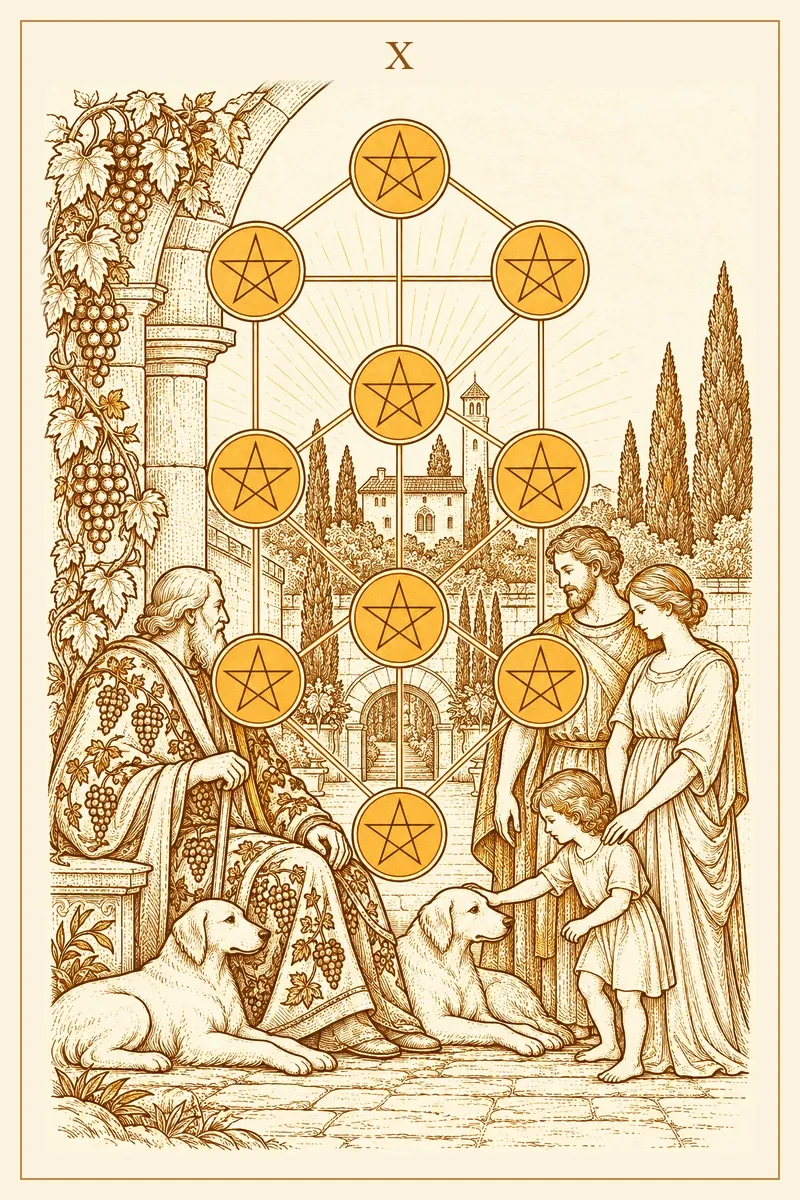
The scene is a paved courtyard framed by a stone arch. At the left, a white-bearded elder sits on a carved bench with a staff in one hand, wrapped in a long robe printed with bunches of grapes and vine leaves, while a living vine heavy with fruit climbs the column above his head. A pale dog lies at his feet and a second rests in the middle of the flagstones. On the right stand a younger bearded man and a woman in a draped dress; her hand rests on the shoulder of a small barefoot child, who leans forward to pat the second dog on the head. Ten gold coins float above them, joined by thin lines into the shape of the Tree of Life. Beyond the courtyard, a walled garden with a smaller arched gate and a short flight of steps leads toward a villa with a bell tower among tall cypresses.
Read as a love story, the details are quietly specific. The elder's robe repeats the vine on the wall: what he wears is what he spent his life growing, which is the card's idea of wealth in a relationship. The couple are not posing or embracing; they are simply standing together in a place that holds them, the way partners stand once the courtship has become a life. The child's hand on the dog is trust learned at home, the sense that this place and these people will still be here tomorrow. And no one in the picture looks up at the coins. Security, once it is real, sinks into the background, and love can get on with ordinary days.
Upright: the relationship starts building a house
Moving in, marrying, merging accounts
The clearest upright message is practical commitment. The relationship is ready for, or already moving into, the structures that make love durable: a shared lease or mortgage, an engagement, a wedding, a joint account, a will that names each other. The card does not care much for grand gestures. It looks at whether the plans are truly shared and whether both people are willing to do the paperwork as well as the romance. Readers who want to compare it with the other cards that point toward a wedding can look through these tarot cards that mean marriage; the Ten is the one most interested in what happens after the ceremony.
Being welcomed by each other's people
The Ten puts more than two people in the frame, so it speaks to meeting the family: the first holiday together at a parent's house, a partner being invited to a cousin's wedding, two sets of friends slowly merging into one group. Upright, those meetings go well, or at least go honestly. The card describes being folded into a larger network, with its rituals, its old jokes and its expectations, and feeling that you belong there.
A long partnership taking stock
For couples who have been together many years, the upright Ten is a card of recognition. It asks you to look at what the relationship has actually made: a home, children perhaps, friendships kept up for decades, traditions you invented together, the ways you have cared for each other's parents. Long relationships tend to count problems more carefully than gifts, and this card reverses that habit for a moment.
Single, and clear about the life you want
If you are not in a relationship, the Ten rarely means someone is about to arrive. More often it describes what you are looking for: a partner whose idea of a good life fits yours over the long run, someone who wants roughly the same home, the same pace and the same place for family. It can also point to meeting someone through a familiar circle, such as relatives, old friends or a community you have belonged to for years. And it reminds you that the household you already have, with friends, siblings or a pet waiting at the door, counts as part of your wealth.
Blended families and families you choose
Nothing in the card requires a traditional arrangement. Stepchildren, an ex who is still a co-parent, two dads, a group of friends who spend every holiday together, a couple who decided not to have children and pour their care into nieces, nephews and neighbors: all of these fit under the arch. What the card asks is whether the arrangement is stable, cared for and welcoming to everyone who lives inside it.
Reversed: cracks in the foundation
The money talk that keeps getting postponed
Reversed, the first thing to check is money. One partner earns far more and the other feels it in every decision, debts were never disclosed, or the couple share a home without any clear agreement about who pays for what. The card does not say the relationship is failing. It says the practical base is unspoken, and unspoken money tends to turn into resentment about something else.
In-laws, inheritance and the family script
The reversed Ten can bring relatives into the reading in a heavier way: a parent who disapproves, siblings arguing over a house, pressure to marry within a tradition, to live near home or to raise children a particular way. Sometimes one partner has been cut off from their family, and the gap shapes the relationship more than either person admits. The question is where the couple's own agreements end and inherited expectations begin.
Staying for the house, not the person
Here the structure has outlived the warmth. A couple keeps the home, the shared friends and the holiday routine going because ending it would cost too much, financially or socially, while the affection that built it has gone quiet. The card is not a verdict either way. It asks whether there is still love in the house or only a house, and whether that can be addressed honestly while there is still goodwill on both sides.
The quiet house after a season ends
The reversal can also describe a household that has to find a new shape: children leaving home, a parent who lived with you passing away, a move that scattered old friendships. The routines that once held the relationship are gone, and the couple has to discover who they are together when the house is quieter. This is a turning point rather than an ending.
Two different pictures of the future
Finally, the reversed Ten can point to a mismatch in long-term wants: one person wants children and the other does not, one dreams of a house near family and the other of a life abroad, one wants to marry and the other sees no need. These differences rarely resolve on their own, and the card advises naming them early.
Ten of Pentacles as feelings, a yes or no, and where the relationship is heading
What they feel. If you asked how someone feels about you, the upright Ten suggests serious, settled intent. They may not be dramatic about it, but they are thinking about a shared future, perhaps already picturing you at their family's table. Reversed, the feelings may be real but tangled with obligations, family opinions or worries about money that make them hesitate to commit. Either way, the kind response is to talk plainly about the practical future you might share instead of waiting for them to announce it.
Yes or no. Upright, the card is a steady yes for questions about commitment, moving in, marriage or whether a relationship is stable. Reversed, the answer is closer to "not until the practical conversation has happened": the yes waits on money, family or plans being talked through.
The relationship's future. As a picture of where things are going, the upright Ten is among the most reassuring cards in the deck for anyone who wants lasting love. It describes a future built on shared plans and steady care rather than intensity. Remember that it shows a direction, not a guarantee; the coins in the picture were placed one at a time.
Timing. Pentacles move slowly and tens complete a cycle, so the card speaks in months and years. If you need a time frame, read it as "when the groundwork is done," not as a date on the calendar.
The Ten of Pentacles, position by position
In the past, the card often describes the family you grew up in and what it taught you about money, home and loyalty, which still shapes how you love. In the present, the household is being built right now, and the question is whether both of you are tending it on purpose. As advice, it says to make choices that will still make sense in ten years and to include the people around you in your plans. As an obstacle, it can name family expectations, financial entanglements or a structure that has become heavier than the relationship it was meant to support. For the other person, it describes someone dependable, family-minded and thinking long term. In hopes and fears, it holds both the wish for a secure, rooted life and the fear of being tied down by it. As an outcome, it points to a partnership that becomes a real home, with roots that reach beyond the two of you.
Cards that share the household
The cards around the Ten show what kind of home is forming: one full of feeling, one bound by vows, one shaken and rebuilt, or one that keeps growing.
Ten of Cups: the feeling and the form
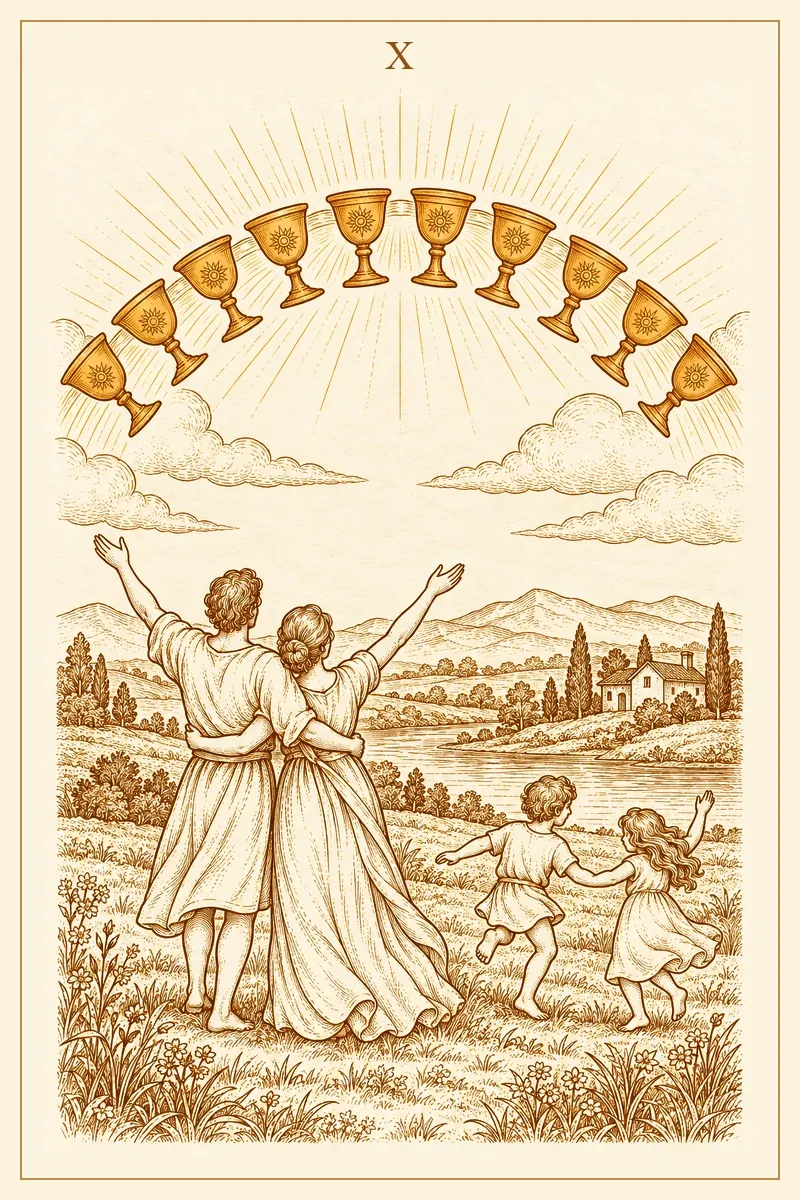
In the Ten of Cups, a couple seen from behind stand with their arms around each other and their free hands raised toward an arc of ten gold cups across the sky, while two small children dance hand in hand nearby and a river winds toward a house in the hills. The Ten of Cups is the joy of a happy home; the Ten of Pentacles is the structure that lets that joy last. Together they make one of the warmest pairings a couple can draw: emotional contentment with practical ground under it. The Ten of Cups meaning covers its own side of the story.
The Hierophant: vows, ceremony and tradition
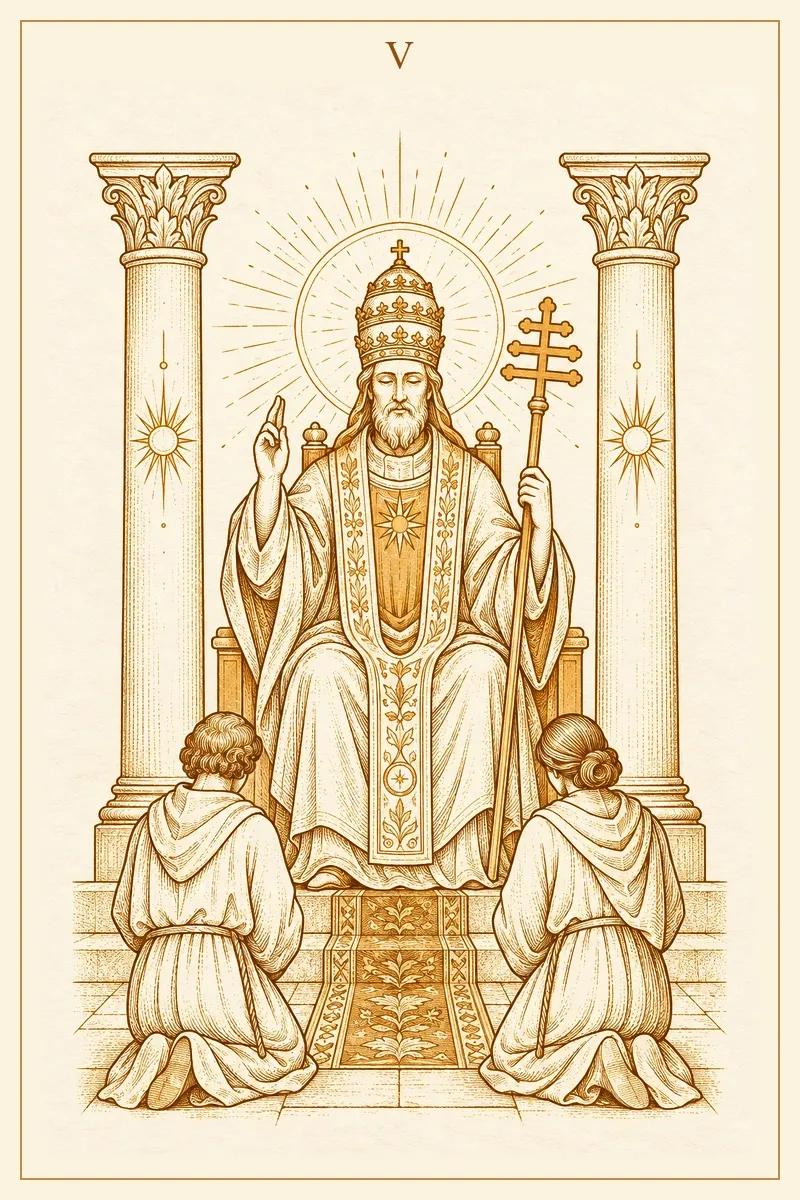
The Hierophant sits enthroned between two columns, wearing a triple crown, one hand raised in blessing and the other holding a triple cross, while two figures in hooded robes kneel before him on a patterned carpet. Beside the Ten, it points to formal commitment within a tradition: a religious or cultural wedding, family customs, the blessing of elders. Upright, the tradition gives the love its shape. If either card is reversed, check whether the custom still fits the two people inside it. More on the card is in The Hierophant meaning.
The Tower: a shock to the walls
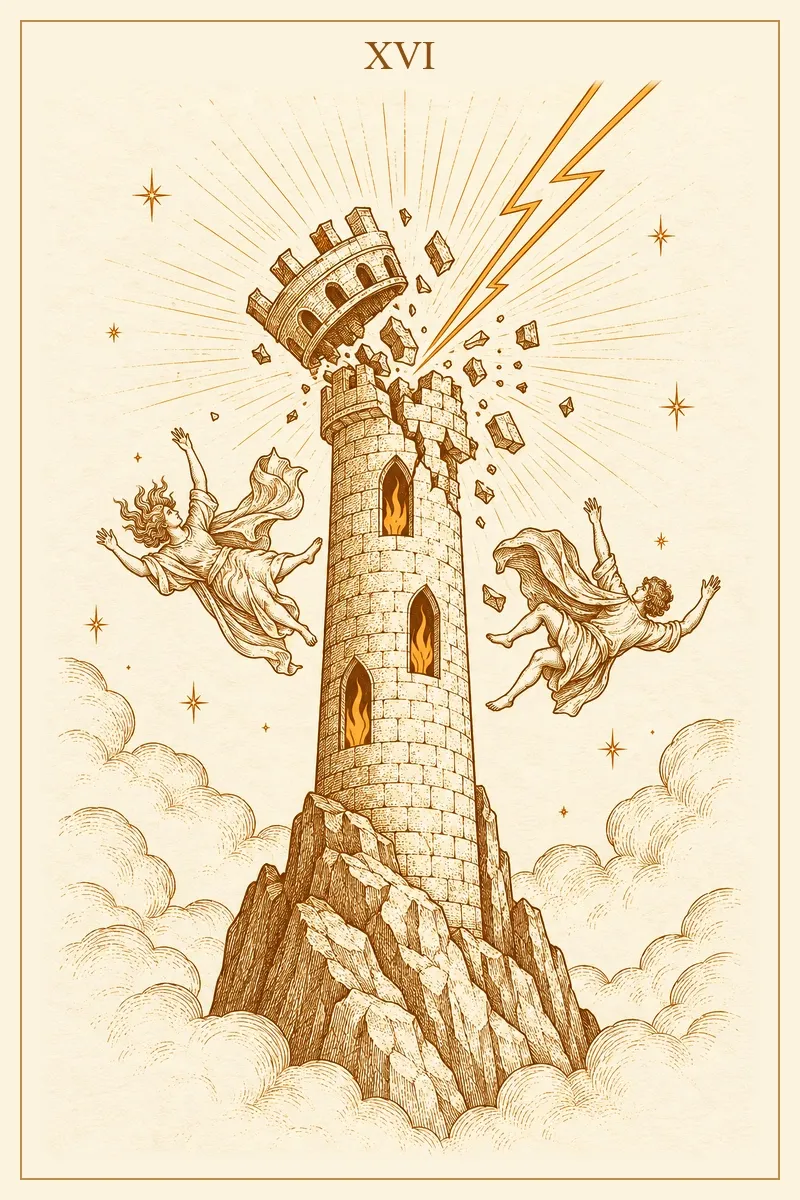
In The Tower, a bolt of lightning knocks the crown off a stone tower on a rocky peak, flames show in its windows and two figures fall through the air. Paired with the Ten, it describes sudden upheaval reaching the household: a job loss, a health scare, a family secret coming out. The Ten adds that what was built carefully tends to survive the blow better than expected, though some part of the old arrangement may need rebuilding. The Tower meaning explains how this card works on its own.
The Empress: a household that keeps growing
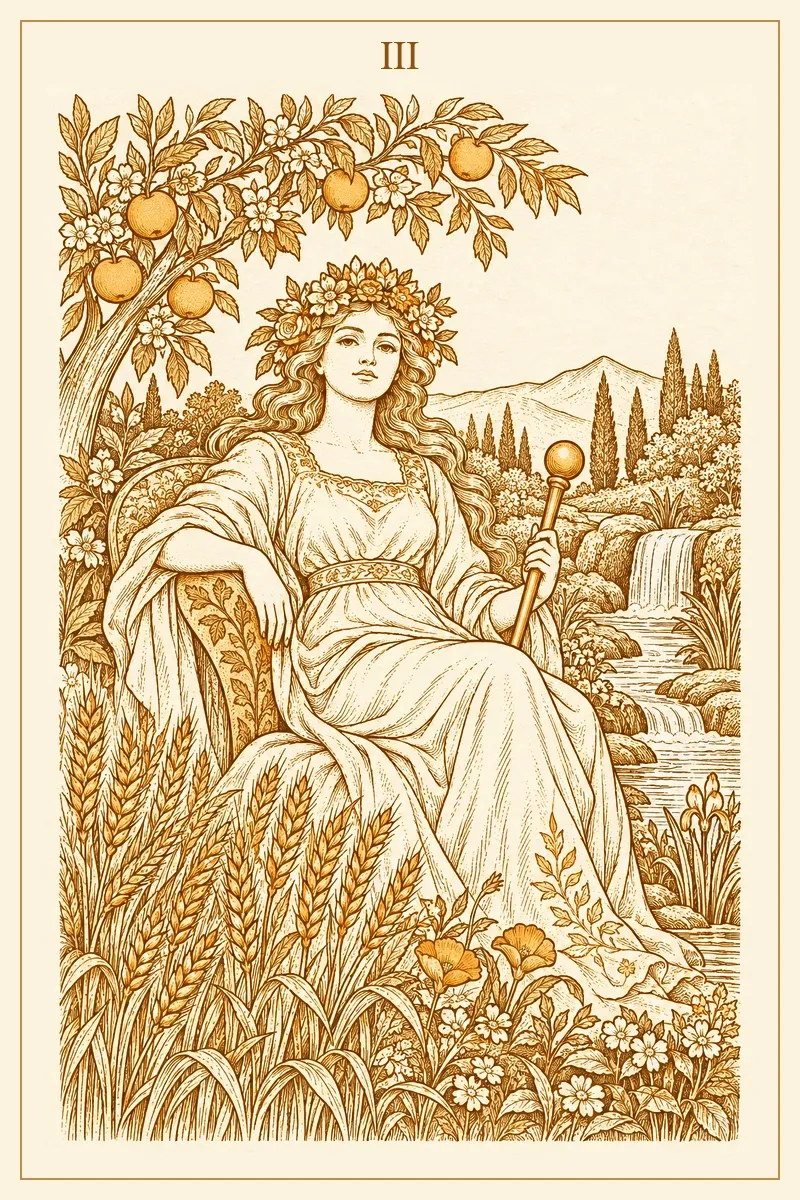
The Empress sits among ripening wheat beneath a fruit tree, crowned with flowers and holding a golden scepter, with a waterfall and cypresses behind her. With the Ten, the household is expanding: a pregnancy, an adoption, a garden, a family business, or simply a home that has become a place where people gather. It is a fertile, generous pairing. The Empress meaning goes deeper into her themes of nurture and abundance.
Other pairings in brief
- Two of Cups: romance kept alive inside a long commitment; the household has not swallowed the couple.
- Death: one chapter of family life closing so another can begin, such as an empty nest or the end of caring for a parent; rarely literal.
- Five of Pentacles: a couple that has come through hardship together, or a lean season testing the household now.
- The Hermit: one partner needing quiet within a busy family life; give it room without reading it as distance.
- Four of Pentacles: security held too tightly; money or control standing in for trust.
Not a wedding forecast, not a bank balance
"It means we will get married." The Ten favors commitment, but it describes the quality of a shared life rather than a ceremony. Some couples who draw it never marry and still build exactly what the card shows.
"It's only about money." The coins are real, and the card does care about finances. But in love its main subject is what money supports: a home, time together, the ability to look after each other.
"Once you have it, you're done." The two dogs are a reminder that a home needs daily attention. A relationship that rests on what it has already built can drift, however solid the walls look.
The Courtyard spread: six cards for a shared future
This layout borrows its positions from the card's details. Shuffle while thinking about the life you and a partner are building, or the one you hope to build, and lay six cards in two rows of three. If you want other layouts for couples and new connections, there are more in these love tarot spreads.
- The vine on the arch: what each of you brings that can grow over time.
- The elder on the bench: what your families taught you about love, money and home.
- The couple: the relationship as it stands today.
- The child's hand: what you are building that will outlast this year.
- The two dogs: the everyday care the relationship needs now.
- The garden gate: where this path leads if you keep going as you are.
A worked example (invented): an engagement and two families' expectations
This reading is made up to show the method; Nadia and Sam are not real people. They have been together four years and got engaged last spring. Sam's large family expects a big wedding in his hometown; Nadia's family is small and scattered, and she is anxious about the cost. They have never sat down with their finances together. Nadia asks: "What will help our marriage start on solid ground?"
The vine: Knight of Pentacles. What they bring is reliability. Both are steady, patient people who keep their promises, and that is the right material for a long road.
The elder: The Hierophant. The families' lessons come in the form of tradition. Sam grew up with ceremonies that matter deeply to his parents, and the card suggests Nadia's worry is less about the wedding itself than about being absorbed into a script she did not write.
The couple: Two of Cups. The relationship itself is in good health. Affection and respect run both ways, which makes the harder conversations easier to have.
The child's hand: Ten of Pentacles upright. The card lands in its own position, describing what they are building: a household meant to last, with room for both families.
The dogs: Four of Pentacles. The daily care that is missing is openness about money. Each of them is keeping their finances private, and the wedding budget has become a stand-in for that silence.
The gate: Six of Pentacles. The path leads toward fairness: a plan in which both families contribute in ways they can afford, and the couple decides together where the money goes.
Read together, the cards say the love is sound and the foundation needs one practical conversation. A sensible next step would be an evening with their numbers on the table before any venue is booked, followed by a talk with Sam's parents about which traditions matter most and which can be adapted. The Ten does not promise a perfect wedding; it points to a marriage that starts with fewer secrets.
What to do when the Ten keeps turning up
- Write down, separately, what "a good life together in ten years" looks like to each of you, then compare the lists.
- Have one calm conversation about money: income, debts, savings and what each of you considers fair.
- Name one family tradition you want to keep and one you would like to change.
- If you are single, describe the household you want to live in, not just the partner you want to meet.
- Choose one small daily ritual, such as a shared breakfast or an evening walk, and protect it.
Frequently asked questions
Does the Ten of Pentacles mean marriage?
It sits naturally beside engagements and weddings, and it supports formal commitment, but its focus is the shared life that follows. A long partnership without a wedding can embody the card just as fully.
What does the Ten of Pentacles reversed mean in love?
It points to strain in the foundation: money conflict, family or in-law pressure, a relationship held together by security or habit, or different plans for the future. It usually asks for an honest conversation rather than predicting a breakup.
Is the Ten of Pentacles about inheritance or money in a relationship?
Sometimes, especially when property, a family business or a shared home is involved. When it is, the card asks the couple to talk openly about how those resources affect them, rather than treating money as separate from love.
Is the Ten of Pentacles a good card if I'm single?
Yes. It describes the kind of lasting life you are looking for and can point to meeting someone through family or a familiar community. It also recognizes the household and relationships you already have.
What is the difference between the Ten of Pentacles and the Ten of Cups in love?
The Ten of Cups is the feeling of a happy home: joy, emotional fulfillment, a sense of being loved. The Ten of Pentacles is the structure that holds that feeling over time: the home, the finances, the family network. A strong long-term relationship tends to need both.
Can the Ten of Pentacles tell me if my partner will propose?
No card can reveal another person's private decisions or set a date for them. The Ten can show whether the relationship has the stability and shared direction that commitment rests on, and it can suggest what to talk about if you want to know where your partner stands.
Love that becomes a place
The Ten of Pentacles describes love that has turned into somewhere to live: a courtyard where the people you care about can rest. Whether you are building that home or repairing one, the next step is usually practical and shared. When you want to look at your own situation, start a reading and see which part of your foundation the cards bring forward.