Of all the court cards, the Knight of Pentacles is the one most likely to still be around in ten years. In a love reading, upright, the Knight of Pentacles stands for loyalty that grows slowly and lasts: a partner, a date or a side of you that commits carefully, keeps promises and shows care through routine, practical help and time rather than grand declarations. Reversed, the same steadiness stiffens into a rut, a stubborn refusal to change, or a commitment that gets weighed for years and never made.
The card's general meaning, from work and money to health, is covered in the Knight of Pentacles tarot card meaning; here the focus stays on relationships. A word on limits first: tarot cannot tell you what another person privately feels, promise that a relationship will last or set a date for a proposal. What it can do is show the pace and quality of the care in a connection, and where that care needs attention.
- Upright: slow, loyal, practical love; trust built from kept promises.
- Reversed: routine without warmth, stubbornness, work crowding out love, or commitment postponed again and again.
- Feelings: serious, sincere and long-term, though rarely spoken aloud.
- As a person: dependable, reserved, wary of sudden change, devoted once decided.
- Yes or no: yes, on a longer timeline than you might like; reversed, not until something shifts.
- Timing: months and seasons rather than days.
- Advice: value consistency, and say out loud what you have been showing.
The knight who stopped in the field
Knight of Pentacles: a coin held close, a horse at rest
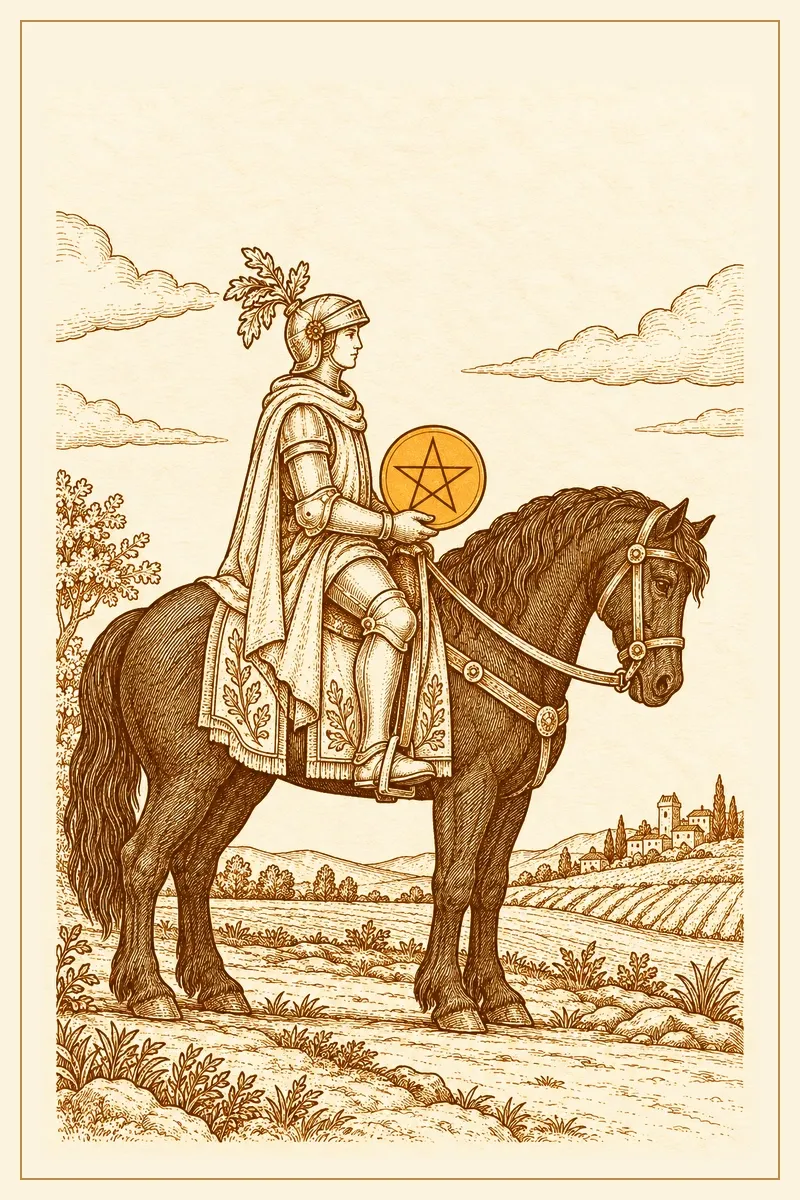
The card shows an armored knight on a dark, heavy horse that stands completely still on a dirt track among low plants. A sprig of oak leaves rises from the top of his helmet, and the same leaves are stitched along the cloth draped over the saddle. He holds a large gold coin bearing a five-pointed star close to his chest, just above the reins, and looks straight ahead over the horse's head. Behind him on the right, striped fields run toward a small hill town with towers and tall cypresses; a leafy tree stands at the left edge, and soft clouds drift across a wide sky.
Knights are usually the movers of a tarot suit, and in this deck the other three are shown on the move: one walking, one leaping, one at full gallop. This one has stopped, and in love that stillness is the whole message. He is not frozen; the horse is calm and the rider sits easily, like someone who has chosen where to be. The coin is kept close, neither raised as an offering nor tossed away, the way you hold something you intend to look after for a long time. The furrowed fields say that the hard, invisible work of a relationship has already been done or is being done now. The town in the distance is a life that could be built together, and he is in no hurry to gallop toward it.
Upright in love: devotion you can set a clock by
Upright, the Knight of Pentacles favors love that is proven over time. What that looks like depends on where you stand.
If you are single
For a single reader, the Knight rarely predicts a whirlwind. More often it points to someone who is already part of your routine, at work, at the gym or in a neighborhood group, and who is easy to overlook because they are consistent rather than dazzling. It can also describe how you are approaching dating: methodically, without forcing it, willing to wait for a good fit instead of filling a gap. That patience is a strength as long as you are still meeting people.
Dating someone who moves slowly
In the first months, this card often describes a person who messages at predictable times rather than all day, plans the next date before the current one ends and says little about feelings while doing a great deal. If you are used to intense beginnings, this can read as low interest. Look at what they do instead: they turn up, they remember, they make room in their week. For this Knight, that is what interest looks like.
Inside a committed relationship
For couples, the upright Knight describes a relationship whose strength is reliability: bills paid, appointments remembered, the car fixed before it breaks down, a partner who can be counted on in a crisis. It is the card of being able to plan a life with someone. Its quiet question is whether that reliability is being noticed and thanked, or simply assumed.
Long partnerships and the work nobody sees
Over many years, a good deal of love turns into logistics: school forms, aging parents, the tax return, the long drive to a relative's house. The Knight honors that work as love rather than as a lesser substitute for romance. If you are the one carrying it, the card may be asking you to let your partner see what you do. If your partner carries it, it may be asking you to look again at what you have been calling distance.
Choosing steady over fireworks
Sometimes the Knight turns up when someone is weighing a kind, dependable person against the memory of a more thrilling but less stable love. The card does not tell you to settle. It asks you to compare what each kind of love actually gave you over a year, not over a single evening, and to notice whether calm feels boring or simply unfamiliar.
Is the Knight you, your partner or the person you're seeing?
Court cards often stand for people, and the Knight of Pentacles has a recognizable character in love: patient, private, practical, loyal and a little set in their ways. This person tends to research a decision before making it, from a restaurant to a commitment, and would rather under-promise than let someone down. Gender and age do not matter here; the card describes a way of loving. For how the four ranks of the court differ, the overview of court cards in tarot is a useful companion.
Loving a Knight of Pentacles partner works best when you ask directly. Hints get missed, but a clear request, such as "I would like us to talk about moving in by spring," gets considered seriously and usually answered with a plan. What frustrates this partner is pressure without information; what frustrates the people who love them is waiting without a timeline. Naming both needs prevents most of the friction.
If the card seems to describe you, ask yourself two questions. Is your caution protecting a relationship you value, or protecting you from risks every relationship carries? And do the people you love know how you feel, or only what you do for them?
Reversed in love: when the horse will not move
Reversed, the Knight keeps his patience but loses its purpose. Five patterns are worth knowing in love readings.
A routine that has gone stale
The first reversed meaning to check is stagnation: the same evenings, the same conversations and the same weekend plans, repeated long after anyone enjoyed them. Nothing is wrong exactly, but nothing is growing either. The card asks what one change, small enough to actually make, would remind you both why you chose this life.
Stubbornness on one side or both
Here patience has hardened into refusal. One partner will not budge on where to live, how to spend the holidays or who does which chores, and calls it principle. Sometimes both are dug in. The real question is whether either of you is still willing to be persuaded.
Present in body, absent in attention
Sometimes the reliability is intact but the warmth has drained out of it. The dishes get done and the birthday gets remembered, yet nobody really asks how the other is doing. It is easy to miss, because the relationship looks fine from the outside. It asks whether the routine still carries love, or only habit.
Work first, love whenever there is time
The Knight's diligence can tip into overwork. A partner who is building a business, chasing a promotion or saving for a house may give the relationship only tired leftovers, telling themselves it is all for the future. The reversed card points out that the future is made of present evenings, and some of those belong to the relationship.
Thinking about commitment for years
The hardest reversed reading is the commitment that is always being weighed and never made: the engagement that waits for better finances, the move-in date pushed to next year once more. Caution can sound like wisdom while working like avoidance. The card asks for a decision, or at least an honest timeline, rather than another season of consideration.
Knight of Pentacles as feelings, commitment questions and timing
How they feel. Upright, the Knight suggests feelings that are serious and stable, even when they are not put into words. This person is thinking about a future, not a fling. Their care shows in what they do rather than what they say: they turn up when they said they would, remember the practical detail you mentioned once, and plan their weeks with you in them. What they rarely do is announce it. Reversed, the feelings may be real but stuck, held back by caution, fatigue or a habit of putting other things first. The reversed Knight can also describe someone who likes you and is quietly waiting for a certainty that will not arrive on its own, about money, timing or whether they are ready.
What to do with that. Read their actions before their words. If you need the words too, ask one plain question at a calm moment; this Knight answers that far better than pressure for a declaration.
Will they commit? The Knight is one of the court cards most closely tied to long-term commitment, and readers traditionally connect it with marriage or moving in together. The catch is pace. Commitment arrives after careful thought, and pushing tends to slow it down. For other cards linked to that step, see tarot cards that indicate marriage.
Yes or no. Upright, a slow yes. Reversed, "not yet," or "not without a change on someone's part."
Getting back together. If you are asking about an ex, the upright Knight points to a reconciliation earned through consistent behavior over time, not through one emotional conversation. Reversed, it suggests the old patterns are still in place.
Timing. Pentacles are the slowest suit and this knight is its most deliberate rider, so think in months and seasons. Progress shows up as routines that become shared: a regular night together, a key to each other's door, a joint account.
Position by position in a love spread
In the past, the Knight describes a period of steady effort that built what you have now; the question is whether it was appreciated at the time. In the present, the steadiness is current, and the reading turns on whether it is alive or merely habitual. In the future, it points toward a season of patient building rather than sudden change. As advice, it says to keep your word, slow down and let actions add up. As the obstacle, it names caution that has turned into stalling. In the place of the other person, it describes someone loyal and practical who shows love by doing. In hopes and fears, it often holds both the wish for a dependable partner and the worry that dependable means dull. As the outcome, it suggests a relationship that lasts because both people keep choosing it, a hopeful result even if not a dramatic one.
Eight cards that speed up or settle the Knight
The cards beside the Knight show whether his steadiness is being matched, challenged, brought to a close or deepened.
Queen of Pentacles: a home that holds you both
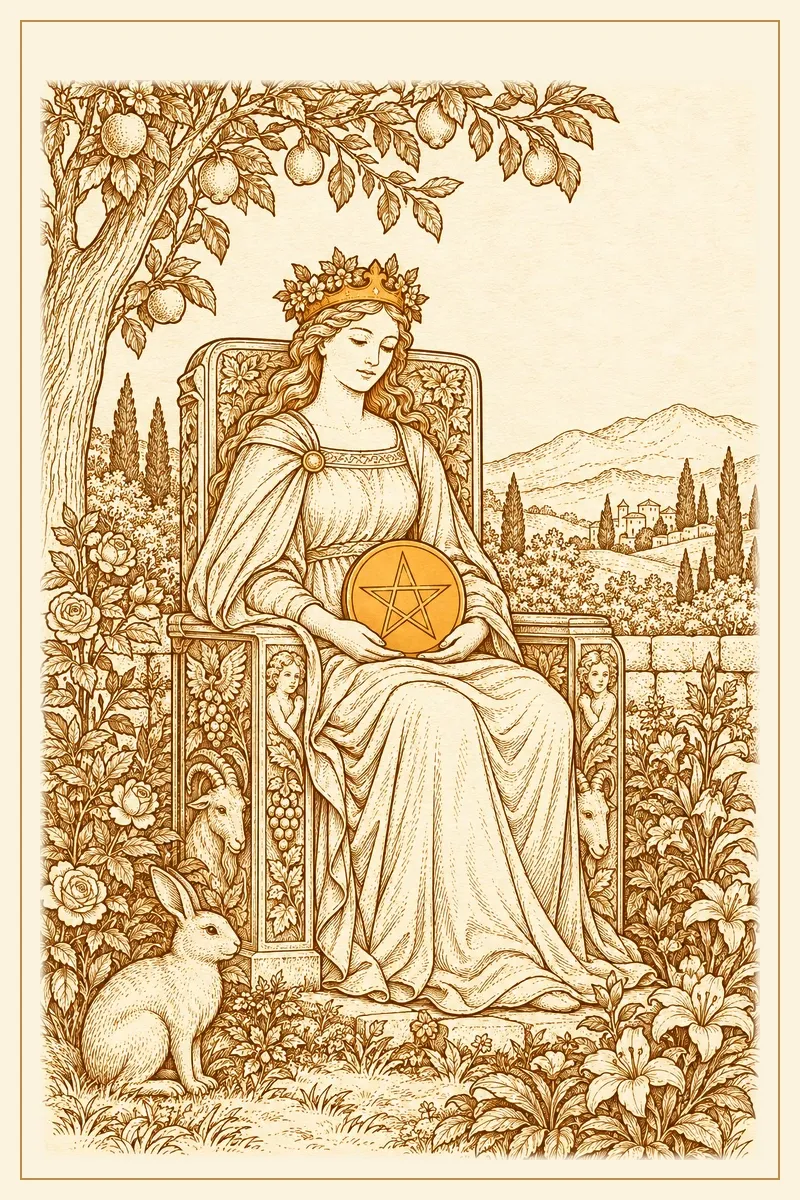
The Queen of Pentacles sits on a carved stone throne decorated with goat heads, small cherubs and bunches of grapes, under a tree heavy with fruit. A gold crown ringed with leaves and flowers rests on her long hair, she cradles a gold coin in her lap and gazes down at it, and a rabbit sits among roses and lilies near her feet. Beside the Knight, she describes reliability that has become a warm home: two people who look after each other in ways that are both practical and tender. The Queen of Pentacles meaning explores her kind of care in full.
Knight of Wands: two riders, two speeds
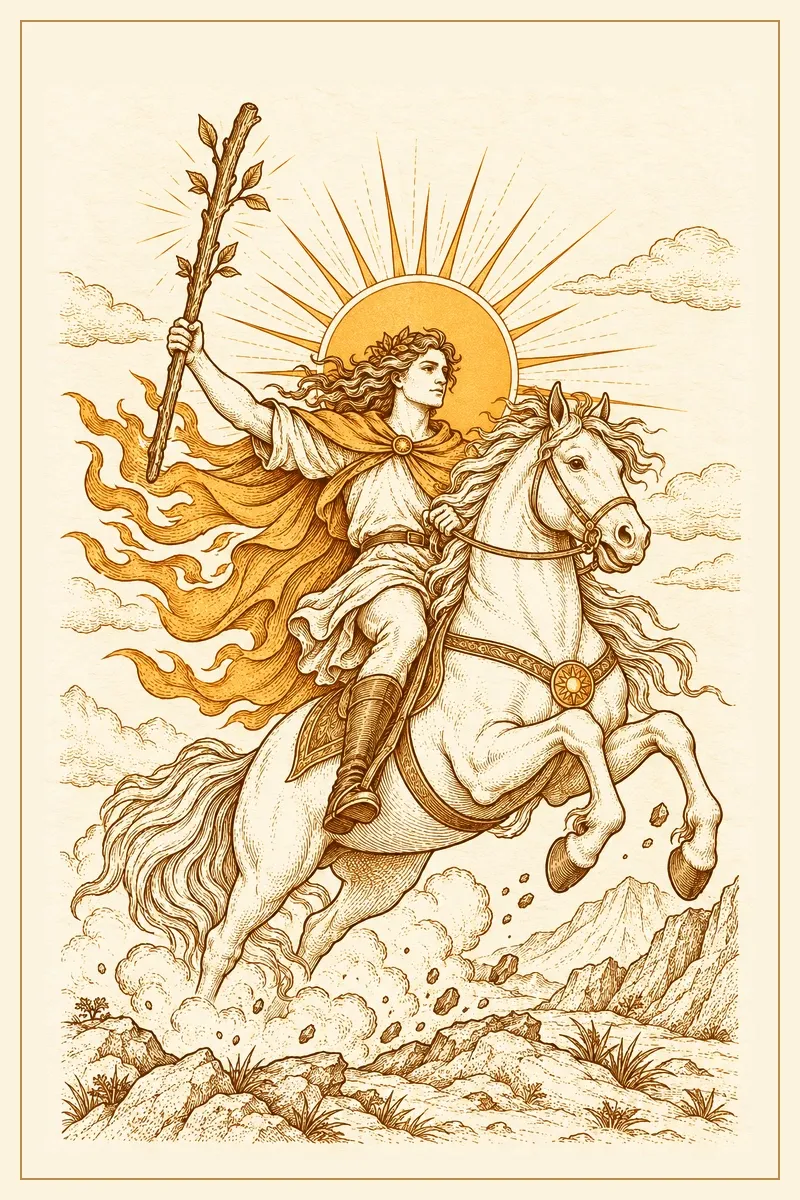
The Knight of Wands rides a white horse that leaps across rocky ground, his flame-edged cloak flying and a leafy staff raised high against a blazing sun. Next to the still Knight of Pentacles, it describes a couple whose rhythms clash: one partner wants to wait and plan, the other wants to move now. Neither is wrong. The work is to agree on a shared pace rather than letting the faster or slower one decide by default. The Knight of Wands meaning describes that fiery speed.
Death: the close of a long, steady chapter
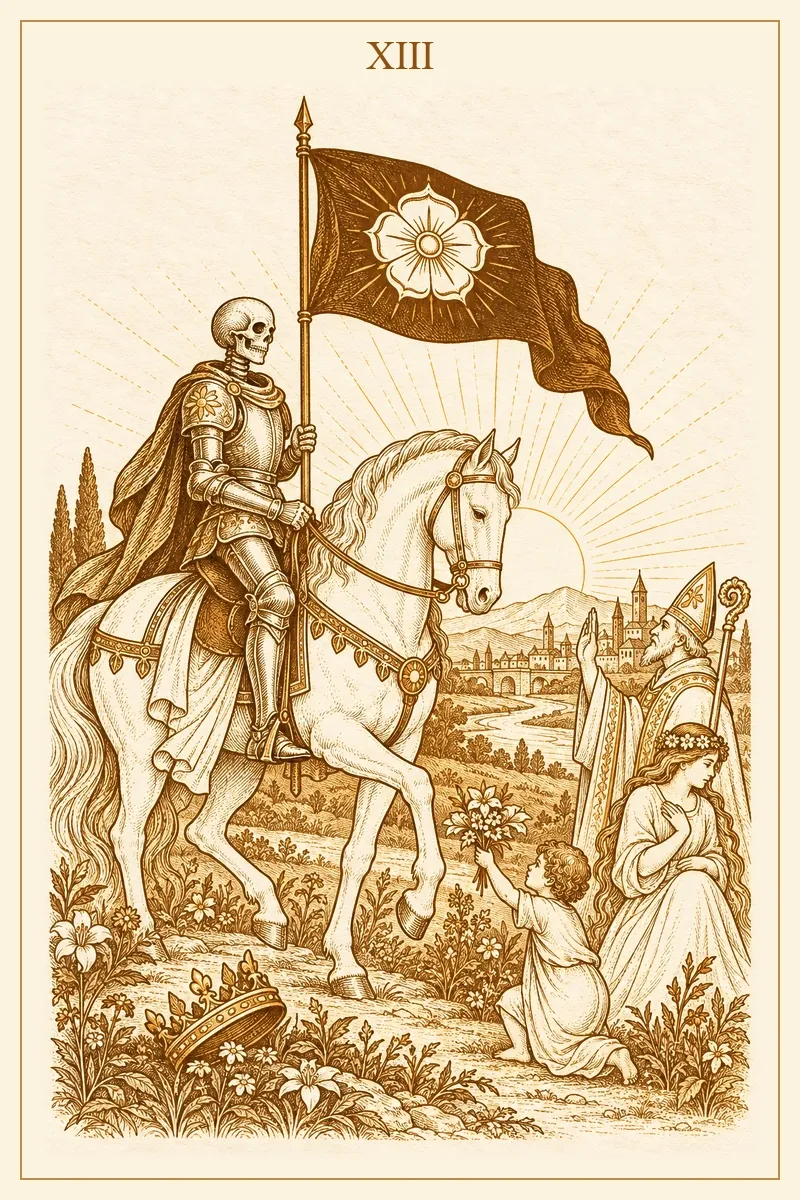
In Death, a skeleton in armor rides a pale horse and carries a dark banner marked with a white rose. A crown lies fallen among the flowers, a child holds up a bouquet, a woman kneels with a hand on her chest, and a bishop raises one hand, his crozier in the other, while the sun sits low on the horizon beside a distant towered town. With the Knight, this pairing can mark the honest end of a relationship that was reliable for years, or the end of one way of being together so that another can begin. Read the Death card meaning for its themes of transformation.
The Hanged Man: stillness on purpose
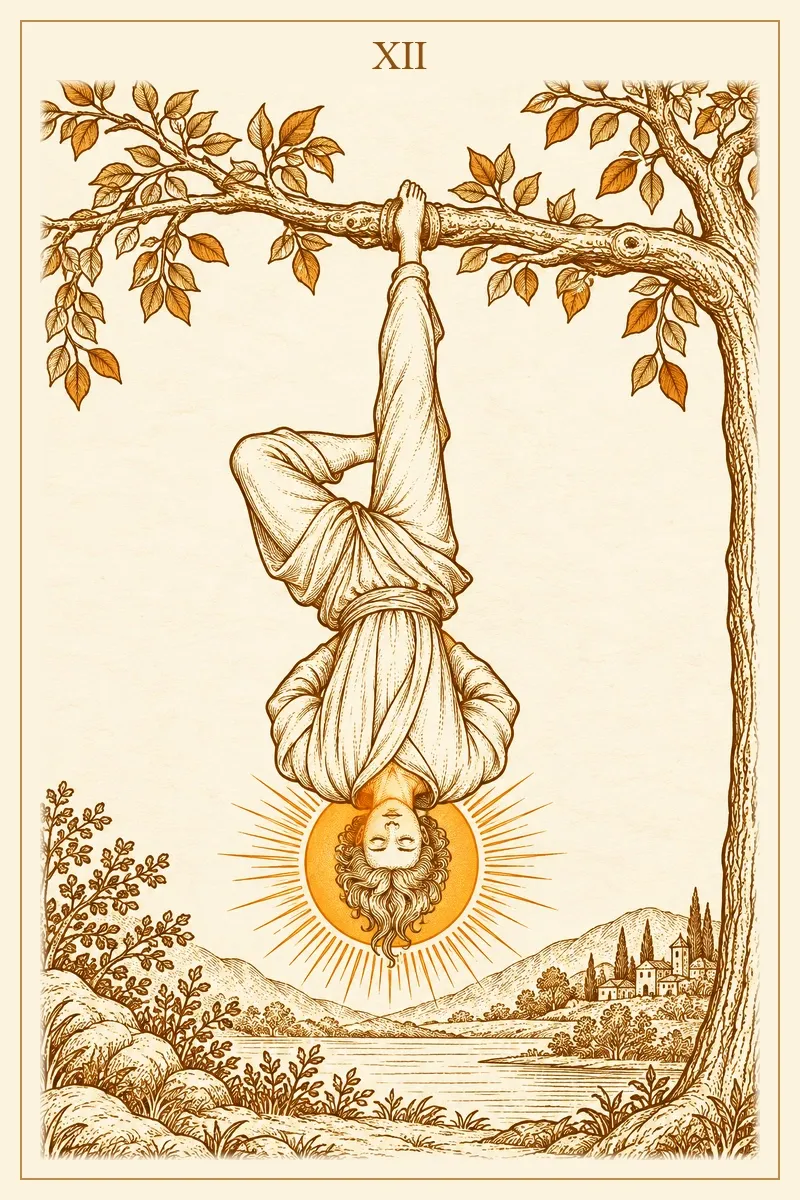
The Hanged Man hangs upside down by one ankle from a leafy branch, the other leg bent behind him, eyes closed and a ring of light around his head, above a calm lake and a village among cypresses. Paired with the Knight, it doubles the message of waiting: this is a time to let a question rest, look at the relationship from a new angle and avoid forcing a decision. The risk is waiting so long that the pause becomes the answer. The Hanged Man meaning explains the value of a chosen pause.
Four more pairings at a glance
- Two of Cups: steady love that has kept its romance, with reliability and affection in the same relationship.
- Eight of Pentacles: both partners doing the daily craft of a relationship with care and attention.
- The Empress: a nourishing, rooted partnership, sometimes with plans for a family.
- The Hermit: a steady partner who also needs regular solitude; healthy when both agree on it, strained when one claims all the quiet while the other carries all the routine.
What people get wrong about this Knight in love
"He is boring." The Knight is not unromantic; his romance simply runs over years. Remembering how someone takes their coffee for a decade is a form of devotion, even if it never makes a good story.
"Stillness means he cannot move." On the card, the horse is at rest, not tied up. The Knight chooses to wait, and he can choose to ride. The reversed card is where that choice has been lost.
"It is all about money." Pentacles do touch on income and property, but in love the Knight's deepest gift is constant attention.
"Nothing is happening." Look again at the plowed fields. Much of the Knight's love happens before anything is visible: saving, preparing, getting to know someone properly.
The Furrow spread: five cards for a slow-building love
This layout takes its positions from the picture on the card. Shuffle with a relationship in mind, new or long-standing, and lay five cards in a line. If your question needs a different shape, there are more love tarot spreads to choose from.
- The coin held close: what you most want to protect in this relationship.
- The resting horse: where patience is serving you.
- The planted hooves: where patience has turned into stalling.
- The plowed fields: work already done that you may be undervaluing.
- The far rooftops: what steady effort could build if both of you keep it up.
Compare the second and third cards first; together they show where to keep waiting and where to act. Read the fifth as a direction, not a promise.
A hypothetical reading: the move-in date that keeps slipping
This example is invented to show the spread at work; Dana and Sam are not real people. Dana, 34, has been with Sam for four years. They live ten minutes apart, spend most weekends together and have talked about moving in for two years, but each time Sam says it makes more sense to wait until his contract is renewed or the lease runs out. Dana asks: "Why does our next step keep getting postponed, and what can I do about it?"
The coin held close: Four of Pentacles. What Dana most wants to protect is security, and the card hints that Sam may want the same thing in a different form: keeping his own space and savings intact until he feels certain.
The resting horse: Four of Wands. Patience has served them well. They already have a real home life, with friends who know them as a couple and celebrations they share. The waiting has not been empty.
The planted hooves: Knight of Pentacles reversed. The card this whole post is about lands in the stalling position, upside down. Caution has become a habit, and "next year" has become the default answer rather than a plan.
The plowed fields: Page of Cups. The undervalued work is emotional: small, tender gestures they still make for each other. The feeling is there; it just rarely gets talked about directly.
The far rooftops: Justice. Steady effort could lead to a clear and fair agreement, with terms both of them have said out loud.
Read together, the cards suggest the obstacle is not a lack of love but a lack of a way to decide. A sensible next step would be for Dana to ask Sam for one focused conversation: what would need to be true for him to feel ready, and by when could they look at it again? The reading cannot say whether Sam will agree, only that a clear question is more likely to get a clear answer than another season of waiting.
Practical ways to work with the Knight's pace
- Write a list of what your partner, or someone you are dating, has actually done for you over the past year, in concrete terms. The list may be longer than you expected.
- If you are the steady one, say one feeling out loud this week instead of only showing it.
- Pick one routine you share and change a single detail: a new place, a new time, a new question over dinner.
- If a decision has been postponed more than twice, agree on a date to talk about it again, and keep that date.
- Try five minutes of deliberate stillness each day for a week, somewhere you would normally rush through, and notice what your body wants to do instead.
Frequently asked questions
Does the Knight of Pentacles mean my relationship is boring?
No. It describes love that is steady and built over time, which can feel quiet to someone used to intensity. Quiet and boring are not the same thing; the reversed card is where routine has truly lost its warmth.
What does the Knight of Pentacles reversed mean in love?
Usually patience that has turned into something less healthy: a stale routine, stubbornness, overwork crowding out the relationship, warmth missing from the reliability, or commitment postponed indefinitely. It asks for a change or a decision; it does not predict that the relationship will end.
Is the Knight of Pentacles a good sign for marriage?
Often, yes. It is closely tied to long-term commitment and a shared practical life. Expect the timeline to be careful rather than quick.
Can the Knight of Pentacles describe my partner?
Yes, when your partner is dependable, practical and slow to put feelings into words but consistent in showing up. The card values that character without dismissing your need to hear love said out loud as well.
How is the Knight of Pentacles different from the Knight of Cups in love?
The Knight of Cups rides forward at a walk in a winged helmet, holding out a golden cup: the romantic who declares feelings and courts openly. The Knight of Pentacles stays put with his coin held close: the partner who shows love through constancy. Lasting relationships tend to need both, the willingness to say it and the willingness to keep doing it. When both knights appear in one reading, ask which of the two is missing from your relationship right now.
Can this card tell me when they will commit?
No card can read another person's private intentions or set a date for their decision. The Knight can show whether the care in a relationship is steady and mutual, and it can point to the conversation that might give you a real answer.
Plowed ground and a patient harvest
The Knight of Pentacles reminds you that love can be measured in years of small, kept promises. If you want to look at your own relationship this way, begin a reading and see where your steady effort is leading.