Care you can taste and touch is what the Queen of Pentacles brings to a love reading. Upright, the Queen of Pentacles describes warm, grounded love that shows itself in practical ways: a meal kept warm, a home that feels safe, steady affection, and money and time shared generously and sensibly. As feelings, she points to someone fond and protective who shows it by looking after you. Reversed, the same care tips out of balance into overgiving, control dressed up as help, or a caretaker who has stopped looking after themselves.
Her general meaning, from work and money to health, is laid out in the Queen of Pentacles tarot card meaning, so this page stays with romance and partnership. One honest limit before we begin: tarot cannot read another person's private feelings, guarantee that a relationship will last or tell you when someone will commit. It can show what kind of care is moving between two people, and where that care is flowing freely or getting stuck.
- Upright: nurturing, embodied love; a partner who makes life feel looked after.
- Reversed: giving until empty, care with strings attached, comfort without closeness.
- Feelings: fond, protective and quietly committed, expressed through deeds more than speeches.
- As a person: generous, sensible, sensual, good with a budget and a kitchen alike.
- Yes or no: a warm yes upright; reversed, yes only if the giving becomes mutual.
- Timing: gradual, like a garden; weeks and seasons rather than days.
- Advice: let love be practical, and let yourself receive as well as give.
A rabbit at her feet: why this Queen is a love card
Queen of Pentacles: a coin held in both hands, a garden wall behind
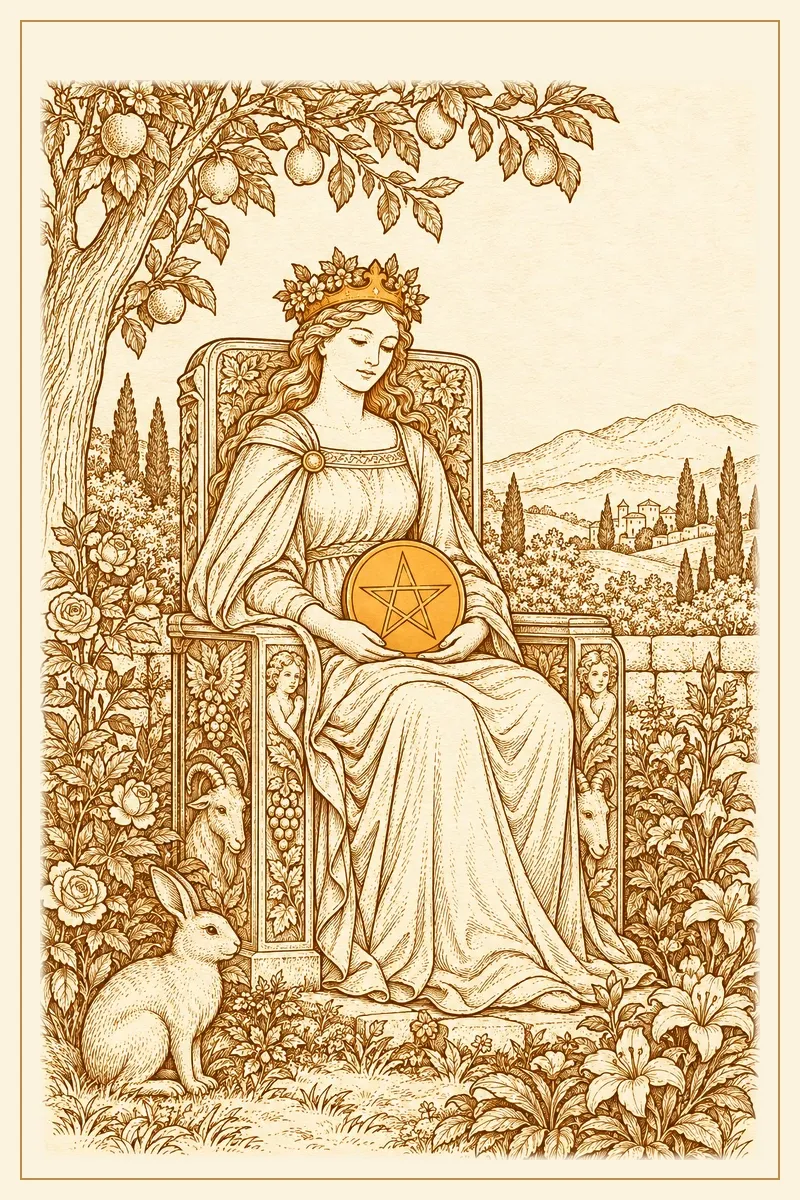
On the card, the Queen sits outdoors on a tall carved stone throne beneath a fruit tree whose branches hang just above her head. A gold crown rests over a wreath of leaves and small blossoms, and her long, wavy hair falls loose over a simple gown and cloak. She holds a large gold coin marked with a five-pointed star in her lap with both hands, and her eyes are lowered to it. Goat heads are carved low on the throne, grapes hang beneath a carved bird with outspread wings, and small childlike figures are carved at the ends of the armrests. Roses grow on the left side of the picture and lilies open on the right, and in the lower left corner a rabbit sits upright in the grass, turned toward her. Behind the throne a low stone wall marks the edge of her garden; beyond it, cypress trees, a small town on a hill and soft mountains.
Read as a picture of love, the scene is about hospitality. Everything in it has been tended, and the wall is kept low rather than built high. The rabbit matters most. A rabbit is a nervous animal that bolts at the first sign of danger, yet this one sits calmly beside her. That is the Queen's gift in a relationship: she makes it safe for tender things to come close. The lowered gaze tells you how she loves, with patient, specific attention to what is in front of her. And the low wall suggests that her warmth has an edge to it. She is generous inside a boundary, and that boundary is part of what keeps the garden alive.
Upright: the shapes her care takes in a relationship
Upright, the Queen favors love that you can feel in daily life. How that plays out depends on where you are.
Single, and making a life worth sharing
For a single reader, the Queen can describe a season of building a full, comfortable life rather than waiting for one to arrive with a partner. You cook properly for yourself, keep a home you like coming back to and look after your health and savings. That tends to make dating easier, because you are inviting someone into a life rather than asking them to supply one. She can also point to the kind of person worth noticing: the one who asks whether you ate, sends the recipe they promised and helps you move without being asked twice.
Early dating: noticed in the small things
In the first months, this card shows interest expressed through attentiveness. The person you are seeing remembers you dislike cilantro, brings an umbrella because the forecast changed, or offers to cook instead of booking another restaurant. If you are used to intense messages and big declarations, this can feel almost too quiet; read the care itself as the message. Upright, the Queen suggests someone who is thinking about your comfort, which is often a sign they are thinking about a future.
A couple who run a home together
For partners who share a household, the upright Queen describes a relationship that works as a shelter: meals, routines, a budget both people understand, a space that feels like rest. Her question is whether the work behind that shelter is shared and seen. A smooth-running home often hides one person quietly doing a lot; in a good position, the card shows that work seen and fairly divided.
Love through a hard season
When a relationship is carrying something heavy, such as an illness, a new baby, a job loss or an aging parent moving in, the Queen describes love as provision. One partner keeps the household running so the other can recover or simply get through the week. The card honors that as real love, while reminding the provider that a season of caretaking should change hands now and then.
Touch, comfort and the body
Pentacles is the suit of the senses, and this Queen is at ease in her body. In love she can describe physical affection that is relaxed and nourishing rather than performed: a hand on the back while passing in the kitchen, a long hug at the door, intimacy that feels safe. If a relationship has lost its physical warmth to stress and schedules, her presence suggests that comfort, rest and unhurried time together are where closeness returns.
Who carries the Queen: you, your partner or someone new?
Court cards often describe people, and in love the Queen of Pentacles has a recognizable character: warm, capable, down to earth, generous with food, time and help, careful with money and slow to make a fuss. Gender and age are irrelevant; the card describes a way of caring. If you want to see how the four court ranks differ, the guide to court cards in tarot explains how a queen differs from a page, knight or king.
Loving a Queen of Pentacles partner means noticing what they do and saying so. These partners rarely ask for thanks, so appreciation can go unspoken until resentment fills the gap. The other half is letting them be cared for in return. Many people with this temperament find it easier to cook for someone than to accept a meal, so keep offering.
If the card seems to describe you, two questions are worth asking. Who looks after you, and do you let them? And is your giving a choice you would still make if nobody noticed, or has it become the way you try to earn a place in someone's life?
Reversed: an overtended garden, or one left to grow wild
Reversed, the Queen still cares, but the care has lost its balance. Four patterns are worth telling apart in a love reading.
Giving until you are empty
The first reversed meaning to check is depletion. One partner cooks, organizes, remembers, soothes and pays, and has nothing left by evening. The love is real, but the giver is running on reserves, and often nobody, including the partner, still asks how they are. This reversal does not ask you to love less. It asks you to put something back into your own soil before the whole garden suffers.
Care with strings attached
Sometimes help becomes a way of steering. Every favor carries an invisible bill, or one partner manages the other's diet, money or schedule "for their own good" without being asked. Even when the motive is worry, the person on the receiving end feels managed instead of loved. The question here is whether your help leaves the other person freer or smaller.
Comfort without closeness
A relationship can be beautifully provided for and still lonely. The house is warm, the meals are good and the bills are paid, yet nobody talks about anything that matters. Comfort has replaced intimacy, and routine has taken the place of curiosity about each other. The reversed Queen asks you to sit at the table you have set and actually talk.
Money and home as a battleground
Because Pentacles touches money and property, the reversed Queen can point to love strained by practical disagreements: spending habits, who pays for what, whose home rules apply, a renovation that has become a referendum on the relationship. Underneath, these fights are usually about feeling secure and valued, and naming that need calms them faster than another spreadsheet.
Queen of Pentacles as feelings, yes or no, reconciliation and timing
How they feel. Upright, the Queen suggests affection that is fond, protective and steady. This person wants you to be well and is likely to show it by looking after you rather than by saying it. Reversed, the feelings may still be warm but tangled with exhaustion, resentment over uneven effort or a need to be needed.
What to do with that. If their care is reaching you, name what you notice and thank them in plain words; if it looks tired or one-sided, offer to carry something for them before you ask for more.
Yes or no. Upright, a warm yes, especially to questions about building something lasting. Reversed, a conditional yes: the answer improves once the giving runs both ways.
Getting back together. If you are asking about an ex, the upright Queen favors a reconciliation built on changed daily habits rather than one emotional night. Reversed, it suggests the old imbalance, one person carrying the relationship, would likely return unless something concrete changes first.
Timing. Like everything in Pentacles, her timing is gradual. Think of a garden: weeks and seasons of tending before anything is ready to pick.
The Queen in each position of a love spread
In the past, the Queen points to a season of care that shaped where you are now, perhaps a time one of you held everything together; the reading asks whether that effort was ever acknowledged. In the present, the warmth is active, and the question is whether it is sustainable for the person providing it. In the future, she suggests a more settled, nourishing chapter, through a partner with her qualities or through you growing into them. As advice, she says to show love practically and to look after your own needs while you do. As the obstacle, she names overgiving, smothering or care used as control. In the place of the other person, she describes someone who will love you by looking after you. In hopes and fears, she can hold both the wish to be truly cared for and the worry of becoming the one who does all the caring. As the outcome, she describes a relationship that feels like a home both people want to come back to.
Four cards that change what her care means
A neighboring card can show whether the Queen's care is matched, out of balance, idealized or in need of rest.
King of Pentacles: two providers at one table
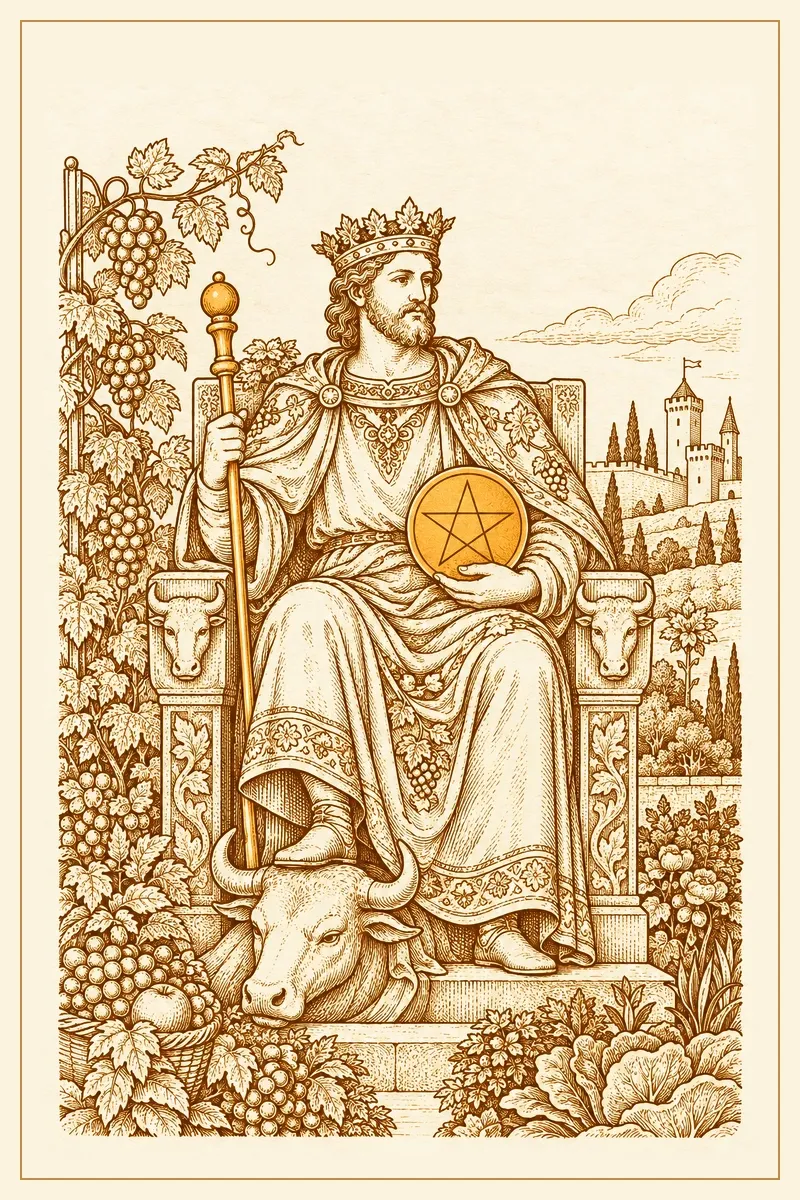
The King of Pentacles sits on a throne carved with bull heads, a gold-topped scepter in one hand and a coin resting in the other, with grapevines climbing around him, a bull lying at his feet and a castle on the hill behind. Beside the Queen, he describes a partnership in which both people bring stability: shared financial goals, a home built on purpose and two adults who can rely on each other. The risk is a couple so good at managing life that they forget to enjoy it. The King of Pentacles meaning covers his style of steady authority.
Six of Pentacles: is the giving balanced?
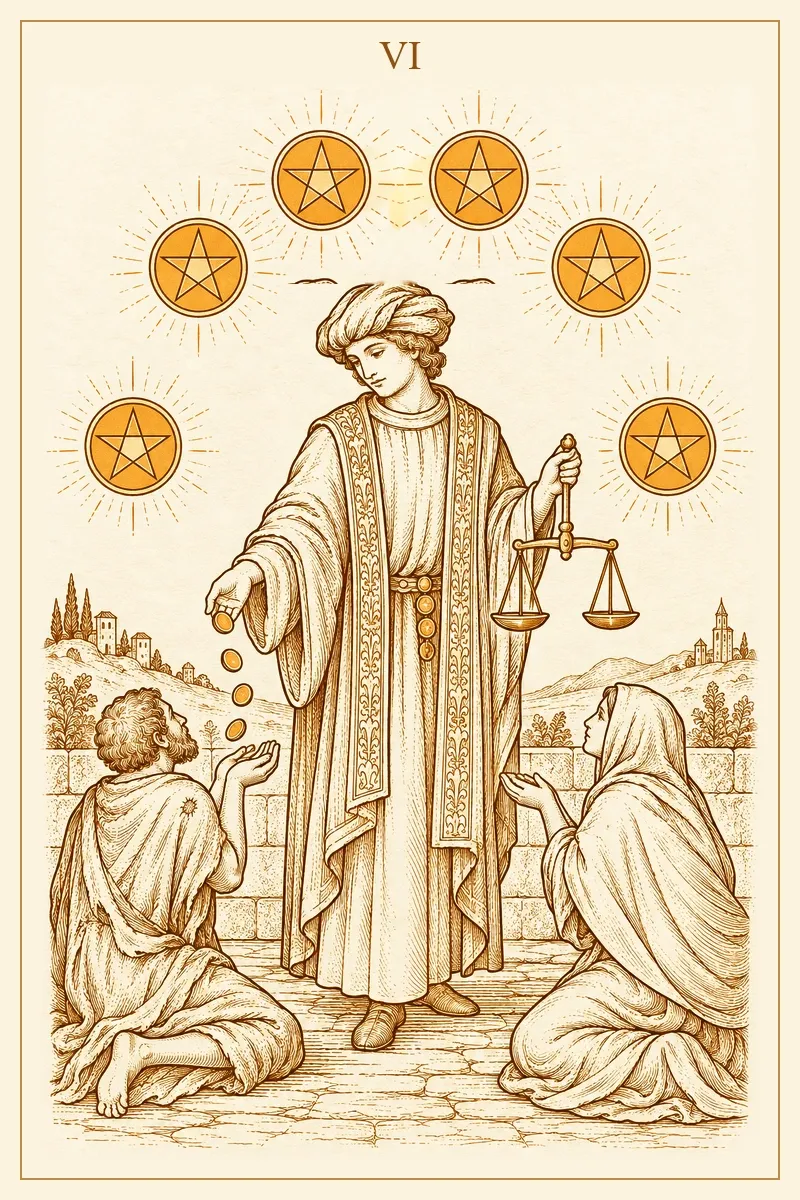
In the Six of Pentacles, a merchant in a turban drops coins into the open hands of one kneeling figure while holding a balanced pair of scales, and a second figure kneels on the other side, waiting. Six radiant coins circle above them. With the Queen, this card asks a direct question: who gives and who receives in your relationship, and does that ever switch? It can describe generosity that is healthy and mutual, or one partner permanently cast as the provider. The Six of Pentacles meaning explores giving and receiving in balance.
The Empress: abundance and the hands that tend it
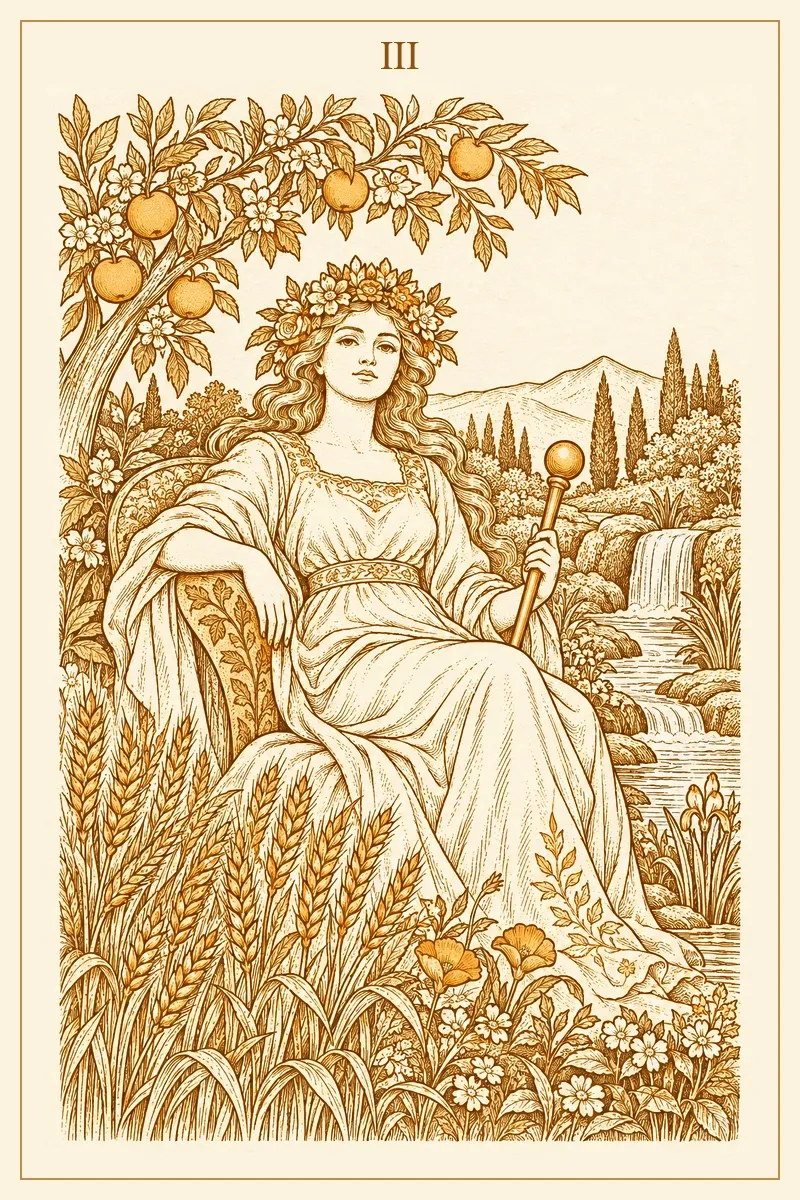
The Empress leans back on a cushioned seat in a field of ripe wheat, crowned with flowers, holding a golden scepter, with an apple tree above her and a waterfall running behind. Paired with the Queen, she doubles the nurturing theme: a relationship rich in warmth, pleasure and growth, and sometimes plans for a family. The difference is useful. The Empress is abundance that grows by itself; the Queen is the person who tends it. Together they describe love that is both effortless and well cared for. Read the Empress tarot meaning for her themes of fertility and creativity.
Four of Swords: the caretaker's rest
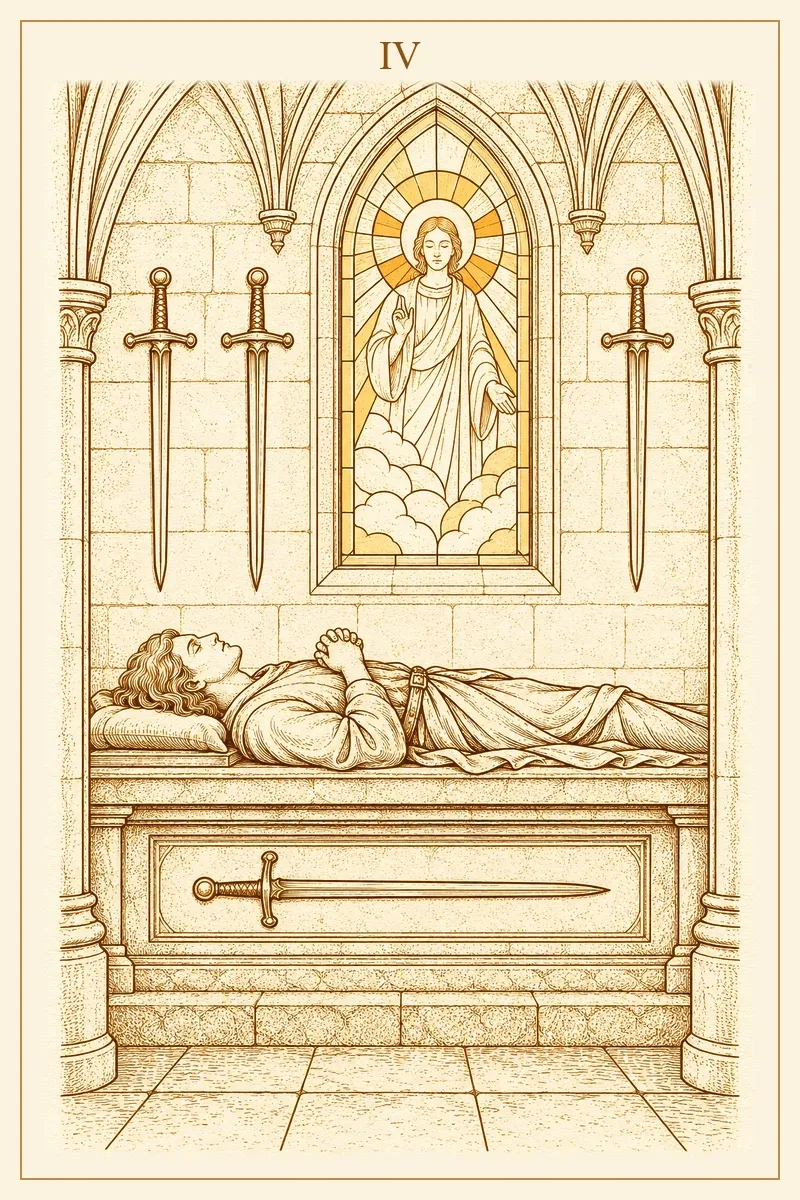
In the Four of Swords, a figure lies with hands folded on a stone tomb in a quiet chapel, three swords hanging on the wall, one carved along the side of the tomb and a stained-glass window glowing above. Beside the Queen, it is an unmistakable instruction to rest. The person who keeps everyone fed and steady needs time off duty, and the relationship is strong enough to survive it. The Four of Swords meaning explains why recovery is part of the work, not a break from it.
Other pairings in a sentence
- Knight of Pentacles: loyalty and care together; a slow, reliable relationship with a warm home at its center.
- Ten of Pentacles: the household grows into a family life, with in-laws, traditions and long-term plans.
- Three of Cups: love that opens outward to friends and chosen family around a shared table.
- Five of Pentacles: care offered during hardship; making warmth when money or health is thin.
- The Tower: a sudden upheaval that tests whether the shelter you built can hold.
Misreadings that shortchange her
"She is just domestic." The Queen is rooted in home, but her care reaches money, health, work and community. Reducing her to housekeeping misses the competence that makes her love so steadying.
"She means the woman in the relationship." The card describes a way of caring, not a gender. In same-sex couples, in relationships where the man does the cooking and in friendships alike, the Queen is whoever is doing this kind of tending.
"She gives without limits." Look again at the stone wall behind her garden. Her generosity works because it has a boundary, and the reversed card is what happens when that boundary falls.
The Orchard Wall spread: five cards for the care between you
This spread borrows its positions from the card's picture. Think of one relationship, current or hoped for, shuffle and lay five cards in a row. If your question calls for a different layout, there are more tarot spreads for love to choose from.
- The coin in her lap: what you are tending most carefully in this relationship.
- The fruit overhead: what the relationship already gives you that you may be taking for granted.
- The rabbit in the grass: what needs to feel safe before it can come closer.
- The stone wall: the boundary that protects your care from turning into depletion.
- The town on the hill: the shared life this care could build if it keeps flowing both ways.
Read the third and fourth cards together first; they show how closeness and limits support each other. Take the fifth as a direction to walk in, not a promise.
An invented example: dinner every night, and a lonely kitchen
This reading is made up to show the spread in use; Rosa and Theo are not real people. Rosa, 38, has lived with Theo for six years. She plans the meals, handles the bills, remembers his mother's birthday and keeps the apartment running while Theo works long hours. She feels lonely in a home she built. Her question: "Why do I feel unseen when I am the one holding everything together?"
The coin in her lap: Queen of Pentacles reversed. The card the article is about lands upside down in the place of what she is tending. Rosa is caring for the household so thoroughly that her own needs have slipped out of the picture.
The fruit overhead: Two of Cups. What the relationship already offers is genuine mutual affection. The bond itself is not the problem; the care around it is lopsided.
The rabbit in the grass: Page of Cups. What needs safety is a tender, slightly awkward conversation about feelings, which neither of them has risked in a long time.
The stone wall: Nine of Wands. The boundary Rosa needs is a firm limit on how much she carries alone. She is tired and on guard, and the card suggests saying so before she reaches the end of her strength.
The town on the hill: Ten of Cups. If the care starts to flow both ways, it could build the warm, shared family life both of them say they want.
Taken together, the cards point less to a failing relationship than to an unspoken imbalance. A sensible next step would be for Rosa to name two specific tasks she wants Theo to take over, and to ask for one evening a week that is about the two of them rather than the household. How Theo answers is his to choose; what the cards suggest is that asking plainly is more likely to bring closeness than giving and waiting to be noticed.
Small ways to practice her kind of love
- Cook one thing for someone you love this week with full attention, and notice how giving feels without rushing.
- Let someone do one thing for you, and say thank you instead of "you didn't have to."
- Write down everything you did for the household last week. If the list is long and one-sided, choose one item to hand over.
- Schedule one hour of rest that nobody else depends on. If refilling yourself feels hard, a few self-care tarot spreads can help you notice what you need.
Frequently asked questions
Is the Queen of Pentacles a good card for love?
Yes. Upright, she is one of the most supportive court cards for love, describing warmth, loyalty and a relationship that feels like a safe home. Her one caution is balance: the care needs to flow in both directions.
What if the Queen of Pentacles shows up reversed in a love reading?
Usually care that has lost its balance: giving until you are drained, help that turns into control, a caretaker whose own needs go unmet, comfort without real closeness or money tension. It asks for adjustment, not for the relationship to end.
Does the Queen of Pentacles mean pregnancy?
Readers often connect her with fertility and family life, so she may appear when children are on your mind. Tarot cannot confirm or predict a pregnancy, though. A test and a conversation with a doctor are the reliable route, and the card is better read as a reflection of how ready you feel to nurture.
Can the Queen of Pentacles represent a man or my partner?
Yes. She stands for a style of caring, not a gender. If your partner shows love through cooking, practical help, physical comfort and sensible planning, the card may well describe them.
How is the Queen of Pentacles different from the Queen of Cups in love?
The Queen of Cups loves through emotional attunement: listening, empathy and sensing what is unsaid. The Queen of Pentacles loves through practical care: food, shelter, touch and help. Many relationships need both, and when they appear together they describe a partner who can hold your feelings and your everyday life at once.
Can the Queen of Pentacles tell me if someone loves me?
No card can read another person's mind or guarantee their commitment. The Queen can reflect the kind of care you are seeing or longing for, and help you notice whether it is mutual, which is often the more useful answer.
A garden worth coming home to
The Queen of Pentacles reminds you that love is often proved in the ordinary hours, at the table, in the kitchen and in the hands that help. If you would like to look at the care in your own relationship, start a reading and see what is ready to grow.