Keep a tarot deck squared, flat and closed in — a cloth bag, a lined box or a wrapped scarf — somewhere dry, dark and close to room temperature, and handle it with clean dry hands. Cleanse it when the cards start to feel stale to you rather than on a fixed schedule: sort the deck back into its original order, air it by an open window, and give the edges a dry wipe. Everything beyond that is preference, and none of it makes a reading more accurate, because tarot reflects your own thinking back to you; it cannot confirm what another person intends, name a date or settle an outcome.
A deck is a physical object you will touch thousands of times. Hand oil, humidity, dust and pressure do real damage: edges darken, the finish turns tacky, corners soften, and a warped card begins to land face-up on its own. Almost all of it is preventable with habits that take seconds.
What follows covers where to keep a deck, how to handle it, what cleansing is actually for, and a short reading for the moment you wonder whether a tired deck should be retired.
At a glance, this is the whole of tarot card care:
- Container: a cloth bag, a lined box or a wrapping cloth — anything closed and a little larger than the deck.
- Place: a drawer or closed shelf that stays dry, dark and near room temperature.
- Position: lying flat and squared, never leaning on edge or loose in a bag.
- Hands: clean and dry, no hand cream, no food at the reading surface.
- Shuffle: the gentlest method your cardstock will take.
- Cleansing: a sort, some moving air and a dry wipe when the deck feels stale or many hands have been on it.
- Replacing: only once wear has started to bias your draws.
What a deck actually needs from you
Two forces wear cards out: friction and moisture. Friction comes from shuffling, from cards sliding against each other in a loose bag, and from the same fingertip pressing the same corner at every draw. Moisture comes from the air, from damp palms and from the glass you set beside the spread. Every habit below reduces one or the other.
There is a second kind of care that has nothing to do with cardstock. A deck kept in a chosen place, in a cloth you like, inside a routine you repeat, is a deck you reach for more often — and reaching for it often is what turns seventy-eight pictures into a vocabulary you can read without looking anything up.
Four ways to store a tarot deck
Any closed container that fits the deck without squeezing it will protect the cards. What differs is how much shock it absorbs and what opening it feels like at the start of a reading.
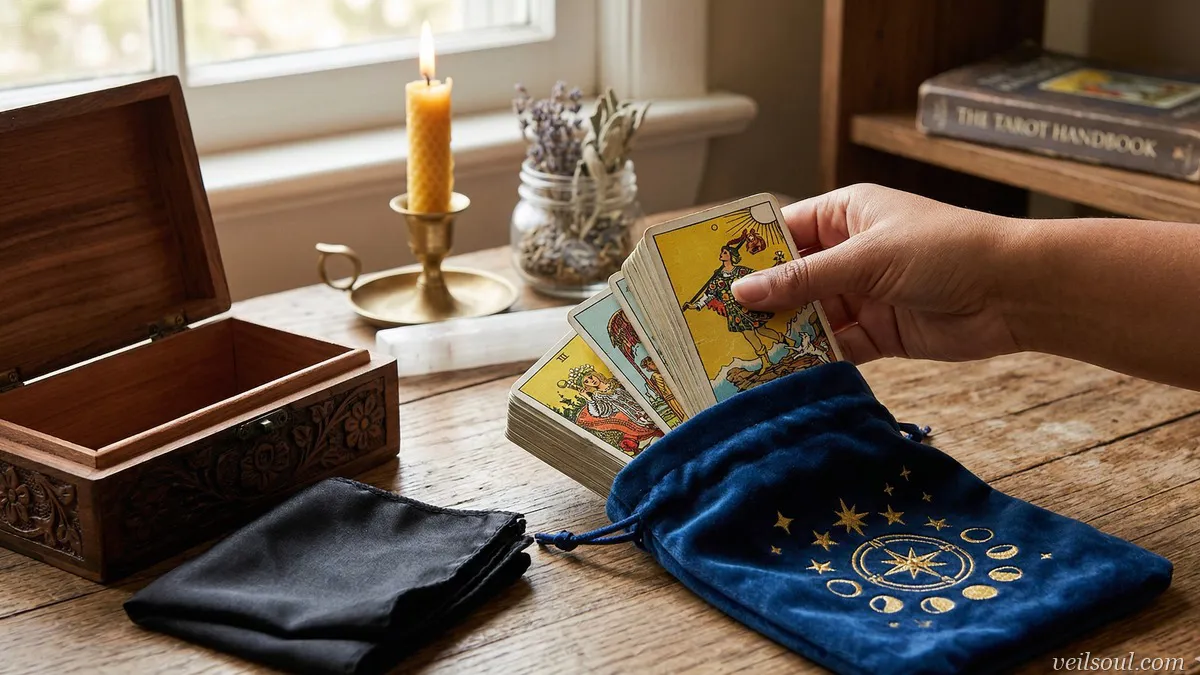
A cloth bag or pouch
A fabric pouch is the common choice because it does everything adequately and weighs nothing. Silk, cotton, linen and velvet all work; natural fibers breathe, so a humid afternoon does not stay trapped against the cards. Synthetic bags are not harmful, though they hold damp longer.
Size decides more than material. Pick a pouch a centimeter or two wider than the deck on each side: a tight bag flexes the cards every time you pull them free, which is the most common source of a permanent crease, and a bag that is much too big lets the deck shift until it stops sitting square. A clean scarf gathered with a ribbon does the job as well as anything sold for the purpose.
A wooden or card box
A box gives the best protection against being sat on, dropped or buried under a bag, and many readers find that lifting a lid marks the start of a reading better than untying a cord.
Cedar resists damp and insects; pine, walnut and bamboo are all fine. Avoid interiors that are heavily lacquered or freshly treated, since a sealed box concentrates the smell and the cards pick it up. If the box is unlined, lay a cloth inside so the deck cannot slide and chip its corners against the wood.
An oversized box has a problem of its own: cards rattling inside a hard shell round their corners faster than cards resting in a snug pouch. Fill the spare space with a folded cloth and the box becomes the safest option there is.
A wrapping cloth
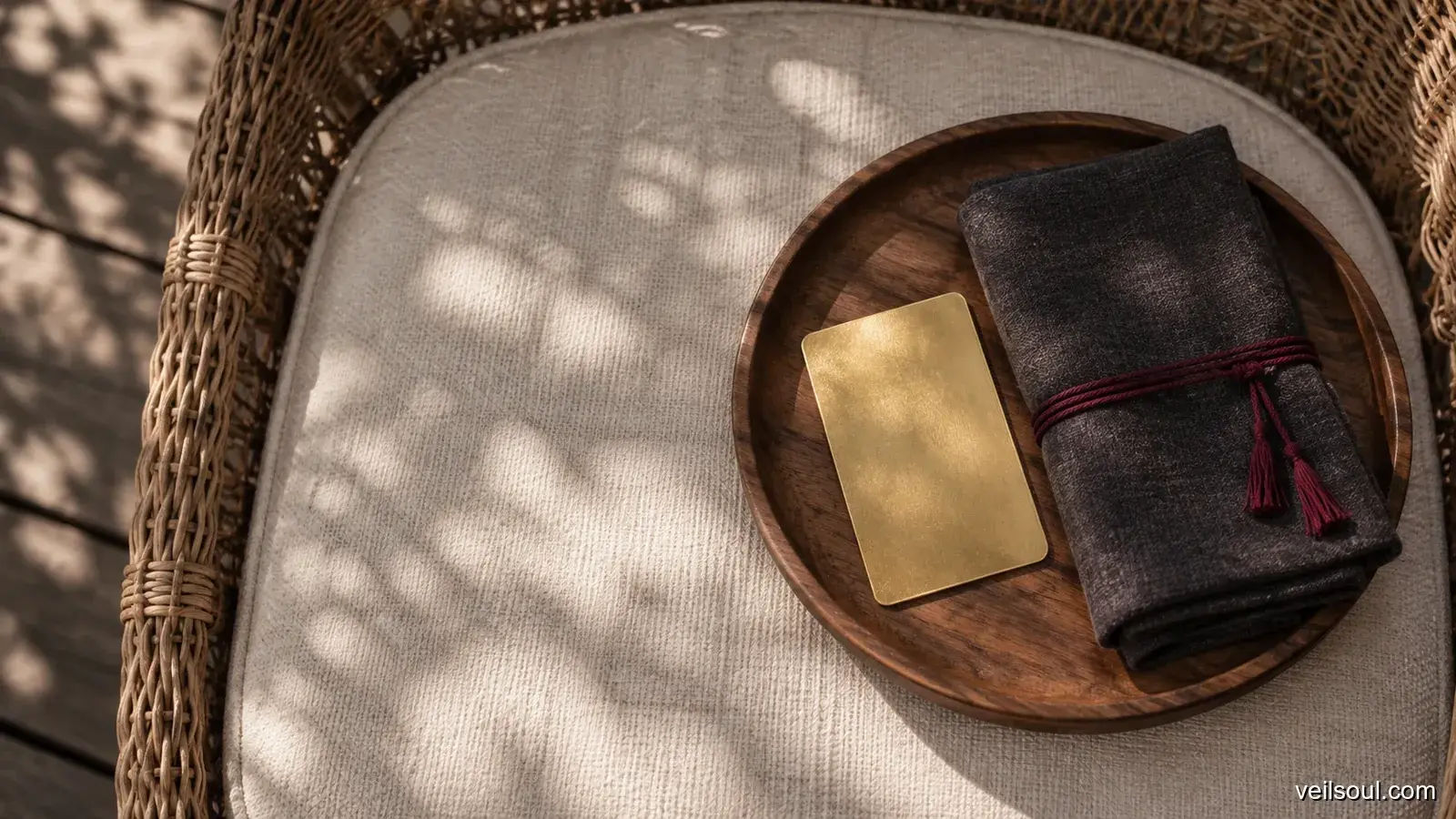
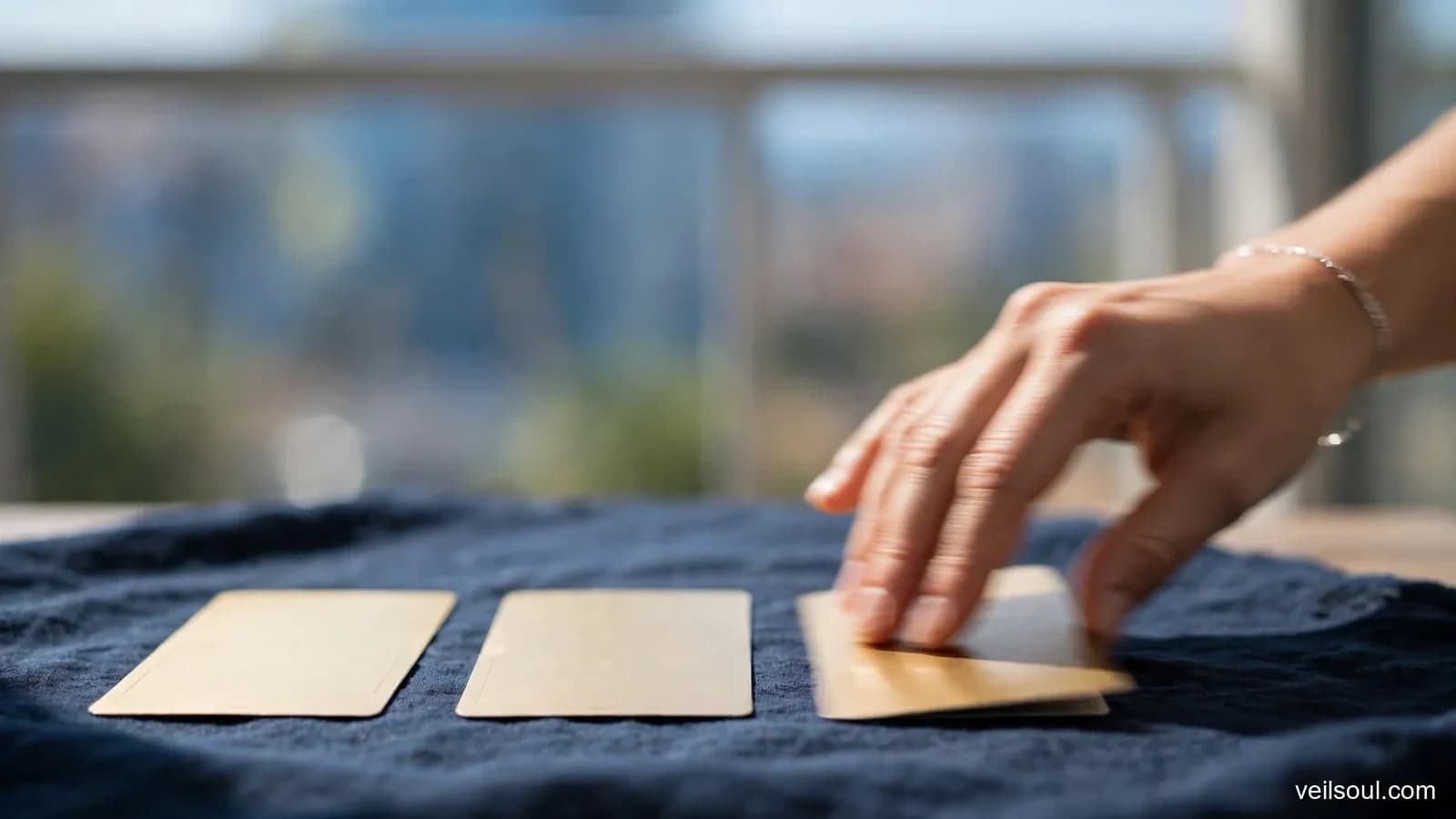
Wrapping is one of the oldest storage habits in tarot and the only one that does two jobs: a cover while the deck rests, a reading surface once it is unfolded. It also protects the backs during a table wash.
Black silk is the traditional choice and is often described as holding whatever the deck has gathered, though any natural fabric in a color you like does the same practical work. Lay the squared deck in the middle, fold the near edge over it, fold the sides in, then roll the rest and tie it loosely: a cord pulled tight leaves a line across the card edges within a year, and the line never comes out.
The box it came in
There is no rule against the box your deck arrived in, and it has one advantage nothing else offers: the little booklet stays with the cards instead of going missing in a drawer. Sturdy two-piece boxes outlast most pouches.
Thin tuck boxes are the weak case. The flap tears, the lid stops closing, and the deck collects dust from then on. When that happens, slide the whole tuck box into a cloth bag rather than throwing it out.
Where you keep it matters more than what you keep it in
A perfect pouch on a sunny window sill will lose to a plain box in a drawer. Choose the spot first:
- Out of direct sun. Ultraviolet light fades printing ink, and the card left on top takes it first. One summer in a bright window costs a deck visible contrast.
- Dry, but not bone dry. Damp warps cards and glues them together; very dry air near a radiator makes the laminate brittle so the edges chip. Ordinary indoor conditions are right, which is why a living room drawer beats a bathroom shelf or an attic.
- Away from liquids. One spill ends a deck, and no drying trick recovers it. Keep drinks off the reading surface entirely rather than at arm's length.
- Flat, not on edge. A deck stored standing slowly leans, and the lean sets into the cards.
- Away from heat. A car in summer, a ledge above a radiator and a laptop bag all reach temperatures that soften the finish.
In practice that points to a bedside drawer or a closed shelf away from the window. Pick one place and keep the deck there, because a deck that lives somewhere different every week spends its life in your bag.
Handling: the habits that decide how long a deck lasts
Clean, dry hands
Wash and dry your hands before you shuffle, and skip hand cream beforehand. Lotion is a common culprit in a worn deck: the oil wicks into the cut edge of each card and darkens it for good. Food is another, and a snack beside the cards leaves marks that no cleaning step will lift. Hold cards by their edges when you deal rather than pressing a thumb into the middle of a face, since one repeated contact point is what makes a single card identifiable years later.
Shuffling without punishing the cards
The method you use decides most of the wear. An overhand shuffle and a pile deal put almost no stress on a card. A riffle bends every card to its limit, which thick or gold-edged stock will not tolerate for long. A table wash puts no bend in the cards but is abrasive on the backs unless you work on a cloth. If your deck is thick, textured or gilded, choose one of the gentler options described in the guide to shuffling tarot cards and stay with it.
Shuffle over a table rather than your lap, so a dropped card lands on something flat. If a shuffle needs force, it is the wrong shuffle for that deck.
Bends, sticky cards and small repairs
A bent card can be improved, not cured. Lay it bend-side up under a stack of heavy books for a night or two and it will come back far enough to stop announcing itself during a shuffle. A crease that goes through the laminate is permanent, and a creased card is the one that keeps turning up because you can feel it.
Stickiness is usually humidity or residue. Fan the deck out and leave it in moving air for an hour, then wipe each sticky face with a dry microfiber cloth. Never use water, alcohol or a cleaning wipe: the laminate lifts, and a lifted card is worse than a dirty one.
Warped cards are also the ones that slip out mid-shuffle, which is worth knowing before you read meaning into the moment; the piece on cards falling out of the deck runs through the ordinary explanations first.
Cleansing: what it is for and how often it helps
Cleansing covers two different things that often get spoken of as one: the physical dust and residue, and the mental reset between readings. Both are worth doing. Neither changes what a card means.
Cleaning the cards themselves
Dust gathers between cards, drags the shuffle and dulls the faces. Fan the deck, wipe each side of the stack with a dry microfiber cloth, and run a soft brush along the edges. The whole job takes five minutes and only needs doing once or twice a year for a deck kept closed in.
The energetic reset, plainly described

The methods readers use are simple: sorting the deck back into its original order, leaving it open to night air, setting it on a window sill in its bag under a full moon, passing it through incense smoke at a distance, or knocking the stack once on the table before a draw.
What they share is a pause and a decision — the last reading is finished, the next one begins clean. Whether you understand that as energy moving or as attention resetting, the effect is the same: you stop carrying the previous question into the next one. For the mechanics of each method, follow the guide to cleansing a tarot deck. If you would rather the reset had more shape to it, there are longer cleansing rituals for tarot built around the moon and the turn of a season.
Two cautions, because both of these damage decks every year. Salt draws moisture and should never touch a card; if you use it, the deck stays sealed in its bag beside the bowl. Smoke leaves residue at close range, so keep a hand's width between the cards and anything burning, and air the deck afterward.
How often a deck needs it
There is no correct interval, and a deck does not spoil while you are not looking. Useful moments are these: after a heavy reading, after other people have handled the cards, when you come back from a long break, and when your draws start to feel flat. A deck used by one person and kept in its bag can go months without anything at all.
Breaking in a new deck
New cards stick together, jump out of the stack and refuse to riffle for the first few weeks. That is the finish, not an omen, and it settles with use. Shuffle a new deck far more than a reading needs before you decide you dislike how it handles.
The familiar rituals for a new deck — going through the cards in order once, keeping it beside the bed for a few nights, saying out loud what you want to use it for — are ways of paying attention to seventy-eight images you have not met yet. If you want a slower version, the guide to connecting with your tarot deck sets out a longer introduction.
Traveling with a deck
Cards survive travel well as long as they are not loose. A padded pouch or a small hard case keeps them from bending against everything else in a bag, and a rubber band around the deck is the one thing to avoid: it bites into the edges and leaves a mark within days.
- Carry it with you. A checked bag goes through unheated holds and rough handling; cabin luggage does not. Security scanners do not harm printed cards.
- Watch the temperature. A deck on a car dashboard in summer, or against a cold window all night, warps from the swing rather than the heat itself.
- Keep a travel deck. If your main deck is expensive or oversized, a cheap second deck takes the trips, and many readers end up preferring the small one on trains.
- Bring the cloth. A folded cloth gives you a clean surface on a cafe table or a hotel bedspread.
Keeping a deck for decades
Decks that last are the ones used in rotation and checked occasionally. If you own several, moving between them spreads the wear; a single deck read daily shows its age in two or three years no matter how carefully you treat it.
Card sleeves are the one genuine trade-off. They stop spills, fingerprints and edge wear almost completely, and they double the thickness of the deck and turn the shuffle into something stiffer. Sleeve a deck you want to keep as an object, and leave your working deck bare.
Count the deck twice a year while you dust it, because a missing card is easier to find in the week it goes astray than a year later. If you keep notes on your readings, that record also shows how a deck has read for you over time; the practice described in keeping a tarot journal makes the history easy to look back on.
When a deck is worn out
Even with careful handling, decks reach the end of their working life, and that is an ordinary thing rather than a failure. The signs that matter are the ones that affect a reading:
- Specific cards are identifiable by touch, which quietly biases what you draw.
- Shuffling has become difficult because the cards warp, stick or slide unevenly.
- The printing has faded enough that details you read from are hard to see.
- Cards are torn, creased through or missing.
A retired deck does not need a ceremony and does not need to be destroyed. Keep it as a record of the years you read with it, use it as a study deck you can write on, or pass it to someone who is learning and will not mind soft corners.
Choosing what comes next is a separate question, and cardstock, finish and size decide how a replacement ages far more than the artwork does — the same argument made in the guide to choosing your first tarot deck, which applies just as well to your fifth.
A three-card check-in for a deck you are unsure about
Physical wear is easy to judge. The harder question sounds like "this deck feels dead to me," and that is usually about the reader rather than the cardstock. A short reading is a fair way to look at it, as long as the decision stays yours.
The positions
- What this deck still does well. The part of your practice that is working, whether or not you have noticed it lately.
- What has gone flat. The specific thing that has drained out: the routine, the questions you ask, your attention, the time of day you read.
- What would actually change if I replaced it. An honest look at whether a new deck solves the problem or postpones it.
A worked example
Suppose you ask: "I have read with this deck for four years and lately nothing lands. Is it the deck or is it me?" In the first position comes the Eight of Pentacles, in the second the Four of Cups, and in the third The Hermit.
The Eight of Pentacles in the opening position describes what four years built: a deck you know by feel, where a familiar card lands differently than it did in your first month because you have met it in so many contexts. That accumulated fluency is the real asset, and it does not transfer to a new deck on the day it arrives.
The Four of Cups in the second position points at attention rather than at the object. It is usually read as a cup offered and not noticed, boredom sitting on top of something available. Here it suggests the flatness is in how the readings are approached: the same three questions, in the same five minutes, at the end of a tiring day.
The Hermit in the third position answers the replacement question with a pause rather than a purchase. Read less often for a few weeks, alone and without time pressure, and see what returns.
Taken together, this draw does not say "retire the deck." It says the cards are fine and the practice needs air. Another reader could take the same three cards somewhere else entirely, which is the point: the spread sharpened the question instead of answering it.
Frequently asked questions
How do I cleanse tarot cards?
Start with the physical: fan the deck, wipe it with a dry microfiber cloth, and leave it in moving air for an hour. Then pick one reset you will actually repeat, such as sorting the deck back into order, a night by an open window, or a knock on the stack before you draw. Do it after a difficult reading, after other hands have been on the cards, or when your draws feel stale, and keep liquid, salt and close smoke away from the cards.
Can other people touch my deck?
Yes, if you want them to, and nothing is ruined if they do. Some readers like the person they are reading for to shuffle, because it brings them into the question; others keep the deck to themselves because extra hands make cards sticky. Both are preferences rather than rules. If letting someone handle your cards would leave you uneasy for the whole reading, keep a second deck for that.
Does a deck have to be wrapped in black silk?
No. Black silk is traditional and silk is genuinely good fabric for the job, but a cotton bandana, a linen bag or a wooden box protects the cards just as well. Choose whatever makes you want to take the deck out.
Can I store crystals with my tarot cards?
You can, with one practical caution: a hard stone resting against a stack presses a dent into the top cards, and a rough one scratches the finish. Keep the stone in its own small pouch, or beside the box rather than in it. Clear quartz and selenite are the usual companions, though selenite is soft and can leave a powdery residue.
Can I clean a stain off a card?
Rarely, and gently. A dry microfiber cloth lifts surface marks, and a plastic eraser used very lightly on a laminated back will sometimes take off a pencil line. Water, solvents and wipes cloud the coating, which looks worse than the stain did. If the mark makes that card recognizable in the stack, a replacement is the honest answer.
What should I do with a deck I no longer use?
Keep it, give it away or retire it to a box; no obligation is attached. A worn deck makes a good study deck precisely because you no longer mind marking it. If a deck carries memories you would rather not revisit, putting it out of reach is a legitimate choice.
Does a well-cared-for deck give more accurate readings?
Care protects your cards and your concentration, not your accuracy. A clean, flat deck shuffles randomly and does not tip you off about which card is coming, which keeps your draws honest. No amount of silk or moonlight, though, lets tarot read another person's private thoughts, fix a date or guarantee an outcome. A reading organizes your own thinking, and the interpretation stays yours.
A deck that is easy to pick up
Good care comes down to a closed container, a dry dark place, clean hands and a gentle shuffle, then leaving the rest alone. The rituals you add on top are worth keeping if they make you want to sit down with the cards.
If your deck is wrapped and waiting, this is a good evening to use it: try a reading, note what the first card asks of you, and put the cards back in their place afterward.