Outnumbered but standing on higher ground: the Seven of Wands means defending something you have earned while others push against it. Upright, the 7 of Wands is courage under pressure, conviction and the stamina to hold your position. Reversed, the defense is wearing thin: you feel worn down or outnumbered, you are close to giving way, or you are guarding so hard that every question sounds like an attack.
The card describes a stance, not an outcome. Tarot cannot tell you whether a rival will back off, what a manager or partner privately thinks, or on which date a dispute will end. What the Seven of Wands can do is show you the shape of the pressure you are under and hand you a useful question: is this ground worth holding, and how long can you hold it well?
- Upright keywords: standing your ground, courage, conviction, perseverance, competition, protecting what you built, holding a boundary.
- Reversed keywords: exhaustion, feeling outnumbered, giving in, overdefensiveness, losing ground, a deliberate retreat.
- Yes or no: yes, if you are willing to keep defending it; reversed, a qualified no, or "not without rest and support."
- Element and astrology: Fire; Mars in Leo, the third decan of Leo (roughly August 12 to 22).
- Traditional title: Lord of Valor, in the Golden Dawn system.
- Suit and number: Wands, seven; the point in the suit where success has to be defended rather than celebrated.
A lone defender on a split ridge: what card VII shows
The young man and his leafy staff
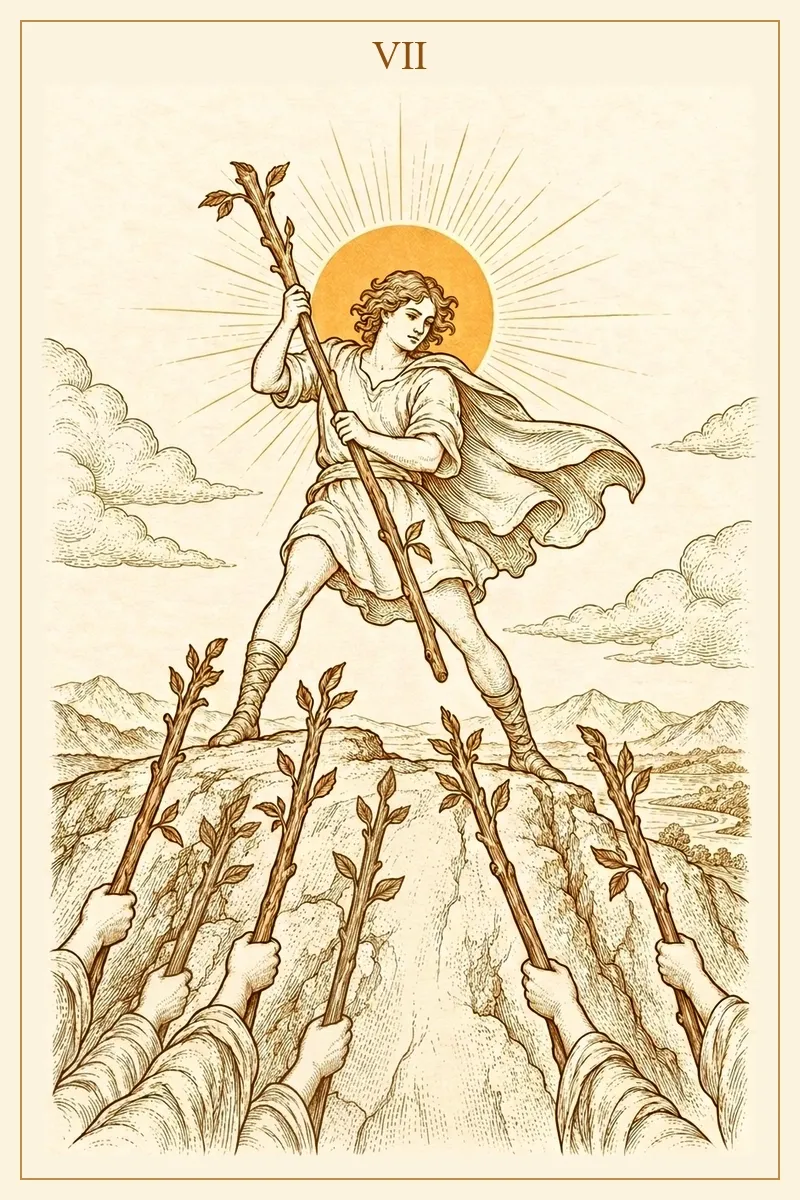
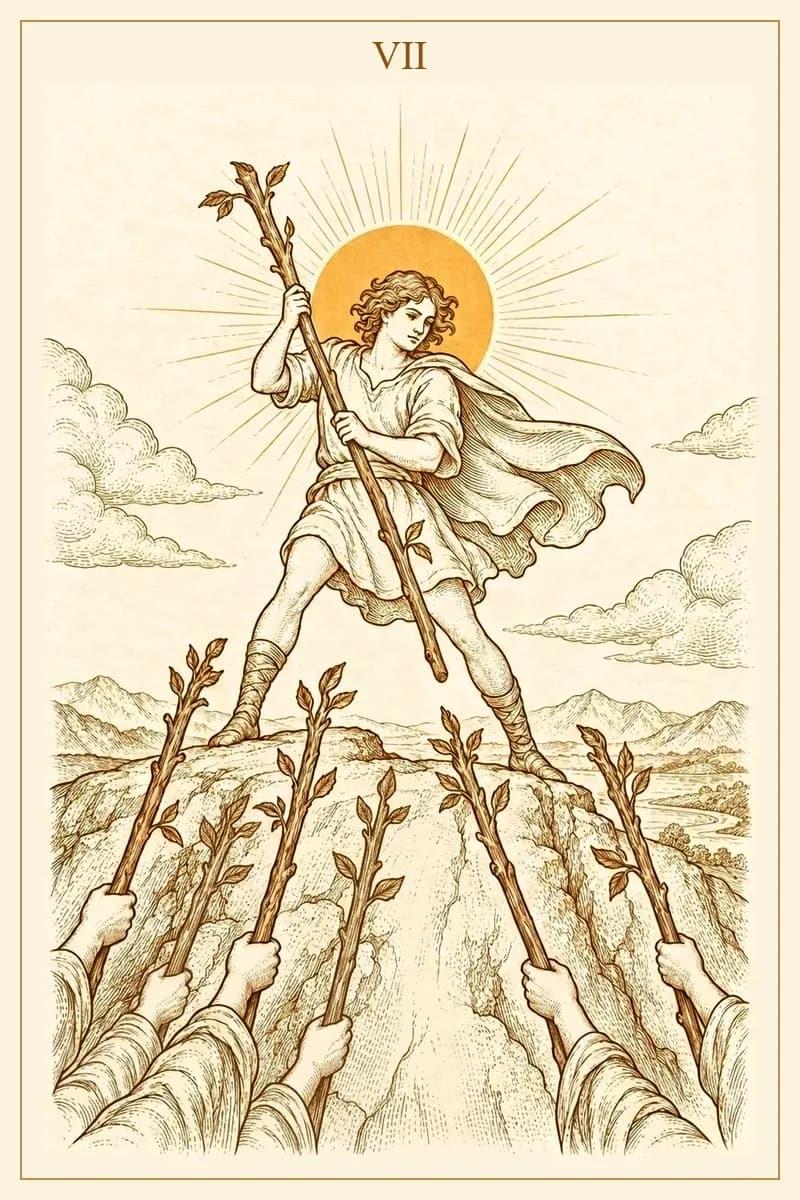
A young man with loose, curly hair stands at the top of a rocky ridge, framed by a golden sun whose fine rays fan out behind his head. He wears a short belted tunic, and a long cape whips out to the right as if the wind is coming up the slope. His legs are planted wide, one foot on each side of a crack that runs down the middle of the rock. He grips a single leafy staff diagonally with both hands, one high and one low, the way you hold a pole to block or push rather than to strike.
His face is turned down toward the slope, watching what is coming up at him. The sun behind him reads like a halo of conviction: whatever he is defending, he believes in it.
Six staves from below, and the crack under his feet
From the bottom edge of the card, six more staves rise toward him, each held by a hand and a sleeved forearm, four from the left and two from the right. We never see the people holding them, only their reach. That matters in a reading: the challenge in the Seven of Wands can be faceless, a crowd of opinions, a stack of demands or a voice in your own head, rather than one clear enemy.
The ridge is the other half of the meaning. He has the high ground and its perspective, but the rock beneath him is split, and only his wide stance keeps him upright across the gap. Behind him lie calm hills, distant mountains and a winding river. The peace is right there, one step back. The card asks whether to hold the ridge or take that step, and it does not answer for you.
Lord of Valor: Mars in Leo and the number seven
In the Golden Dawn system, which shaped many modern decks, the Seven of Wands is titled Lord of Valor and assigned to Mars in the third decan of Leo. Leo is fixed fire: pride, visibility and the wish to be recognized for what you create. Mars is the planet of drive, competition and self-defense. Put together, they describe someone whose pride is at stake and who is ready to fight for it. The best of that combination is courage and loyalty to your own work; the shadow is a temper that takes every challenge personally.
The number seven adds a test. Each Minor Arcana seven follows the balance of a six and asks something harder of it. In Wands, the suit of will, seven tests conviction: the question is no longer "can I win?" but "do I still believe in this enough to keep standing here?"
Between the Six and the Nine: the Seven in the Wands story
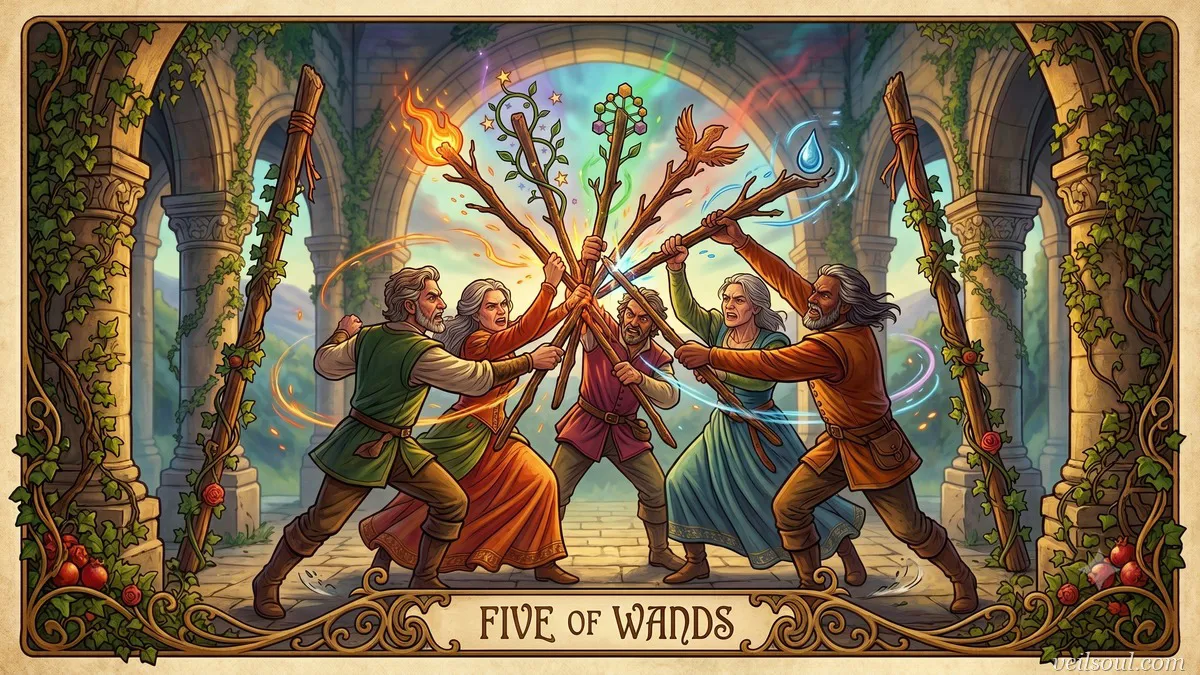
The Wands cards read like a short story about ambition. The Five of Wands is a scuffle with no clear sides. In the Six of Wands someone rides out of that scramble crowned with laurel, and the Six of Wands meaning post covers what public recognition brings. The Seven is the morning after the parade. Success has made you visible, and visibility draws challengers: people who want the same role, people who doubt you earned it, people who push just to see whether you will move.
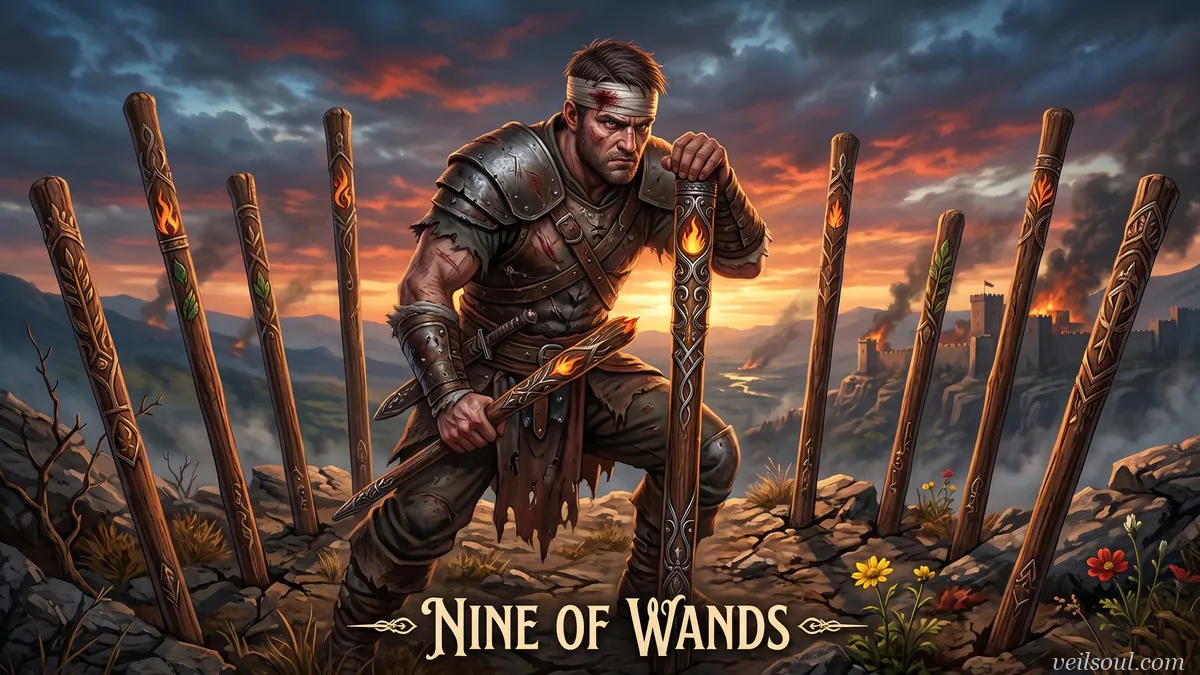
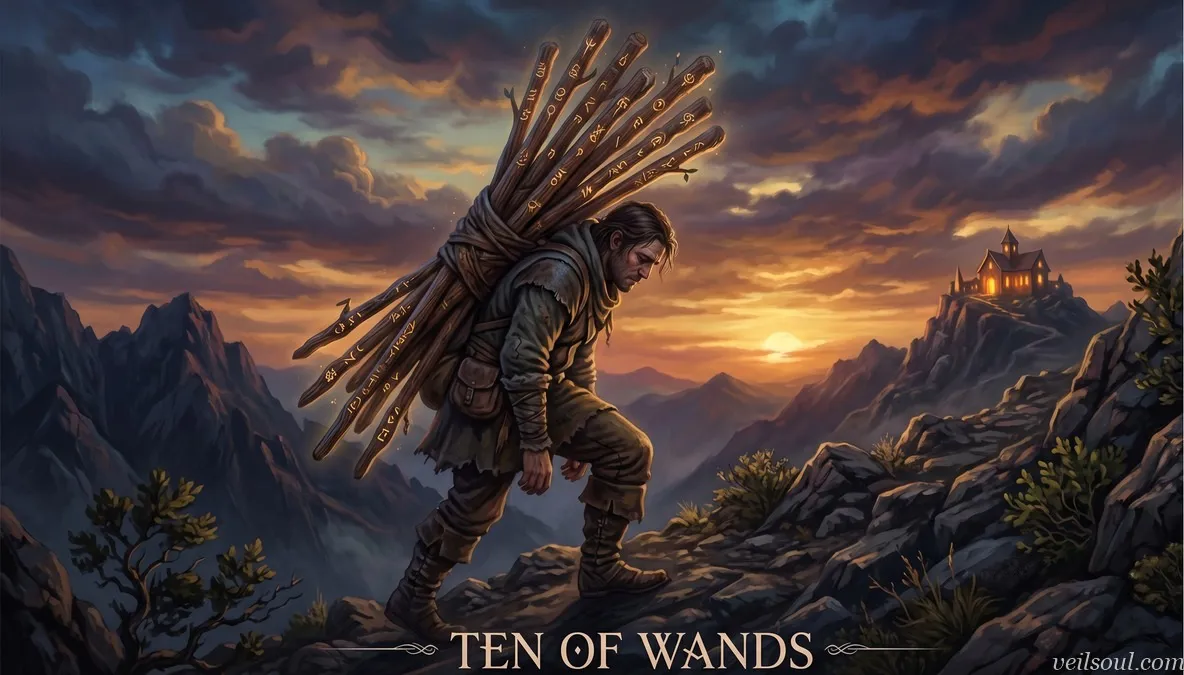
What follows shows where a defense can lead. The Eight of Wands releases the tension into fast movement once the ridge is secure, a turn traced in the Eight of Wands meaning post. The Nine of Wands shows a later defender, bandaged and wary, and the Ten of Wands carries every fight ever picked. Handled well, the Seven leads to momentum; handled stubbornly, to the Nine and the Ten.
Seven of Wands upright: standing firm on ground you earned
Upright, the Seven of Wands says you are being challenged and that your position is worth defending. You have something real to protect: a project you built, a decision you made carefully, a role you worked for, a value you live by. You may be outnumbered, yet you hold the better ground. Stay where you are rather than compromise simply because the pushing is uncomfortable.
What holding your ground looks like
- Restating a boundary calmly the third time someone tests it.
- Defending a piece of work in a review with evidence instead of apology.
- Keeping a price, a deadline or a plan when others push for a discount or a shortcut.
- Staying with a belief or a lifestyle choice when family or friends keep questioning it.
- Competing openly for a role, a client or a place, instead of withdrawing before the contest begins.
Courage without a guaranteed win
The card freezes the fight in the middle; nobody has won yet. So the upright Seven is less a promise of victory than a statement about character: you have what it takes to stand here, and standing here is right for now. Know exactly what you are defending, keep your footing on both sides of the crack, and spend your strength on the challenges that matter rather than on every hand that reaches up.
Seven of Wands reversed: when the defense gives way, hardens or steps aside
Reversed, the Seven of Wands keeps the same scene but tips its balance: the defender's arms are tiring, his grip is too tight, or the hands below are winning. In practice the reversed card points to one of four situations, and the surrounding cards, along with your own honesty, tell you which one fits.
Worn down: too tired to keep defending
The first reading to consider is exhaustion. You have held a position for a long time, at work, in a family conflict or in a relationship where you keep explaining yourself, and the energy is running out. You may still believe you are right, yet you cannot find the strength to say it again. This is not a failure of character. A defense cannot run on willpower alone; it needs rest, allies and a narrower front.
Overdefended: treating every question as an attack
The second reading is the opposite problem. The staff is gripped so tightly that ordinary feedback feels like a siege: a colleague's question sounds like a challenge, a partner's suggestion like criticism. This defensiveness can be rooted in a time when you really did have to fight for your place. Look again at the hands: how many are actually pushing, and how many are simply reaching out?
Pushed off the ridge: losing ground to pressure
Sometimes the pressure simply wins. You gave in to keep the peace, let someone else take the credit, agreed to terms you knew were wrong, or let a boundary slide because holding it felt too lonely. It can also mean being undermined out of sight, through talk behind your back or a decision made without you. The card does not shame you. It asks what you would need to stand up again, whether information, support or a clearer statement of your position, and whether the ground is still worth reclaiming.
Stepping down on purpose: a retreat you choose
Not every reversed Seven is a loss. It can mark the moment you decide a fight is no longer yours: the argument that will never be settled, the role you kept only because someone else wanted you in it, the online quarrel that eats your evenings. Stepping off the ridge toward the quiet valley can be the wisest move in the reading. The difference from being pushed is agency: a retreat you choose leaves you your energy, while a surrender you drift into leaves resentment.
Three questions sort out which reading applies. Do I still believe in what I am defending? Is the pressure as large as it feels? If I stopped defending this today, would I feel relief or regret? Relief points to a chosen retreat; regret, to a position you need help holding.
Who holds the other six staves? The challenge in each area of life
Because the challengers on this card have no faces, it helps to ask where the six staves come from in your own situation. The answer changes with the area of life.
Love: outside pressure, jealousy or a tested boundary
In a relationship reading, the upright Seven of Wands can show a couple defending their bond against outside pressure: a family that disapproves, friends who take sides, a rival who keeps hovering, a long-distance arrangement that others call unrealistic. It can also show one partner standing firm on a value or boundary that the other keeps testing. For a single reader, it can mean competition for someone's attention, or holding to your standards when it would be easier to settle.
Reversed in love, the card can show someone too tired to keep fighting for a relationship that still matters, or a fight kept alive long after its reason has gone, with every conversation turning into a contest. As a read on how another person feels about you, upright it suggests someone protective and committed who still feels they must prove themselves; reversed, someone cornered, wary or worn out. Treat that as a mood worth talking about, not a verdict.
Work: rivals, reviews and a role others want
At work, the upright Seven is the card of competition and visibility: defending a project against budget cuts, pitching against other agencies, or protecting a role others now want because you made it look worthwhile. Prepare: bring numbers, examples and allies, and decide in advance which points you will not concede. Reversed, the pressure may be wearing you down, you may be close to handing over something you should keep, or you may be bracing for attacks that are not coming.
Money: requests, negotiations and saying no
In a money reading, the upright card asks you to protect your resources: hold your rate, refuse a loan you cannot afford to make, keep your savings plan when others treat it as available. Reversed, it can show giving in to demands you should resist, or an unexpected cost that feels like one more staff pushing at you. Look at the numbers and set your limits before the next request arrives.
Health and energy: advocating without burning out
For well-being, the upright Seven can describe advocating for yourself: asking questions until you understand, keeping a routine others find inconvenient, protecting your rest. It is not medical guidance; for anything physical, the right ally is a qualified professional. Reversed, it points to the fatigue of fighting alone and suggests accepting help before the struggle drains what it was meant to protect.
Beliefs and the inner critic
Sometimes all six hands belong to you: doubts rising from below while you hold on to a belief, a spiritual practice or a creative vision. "Who do you think you are." "This will never work." Upright, the card asks you to keep your footing and let those voices reach without pushing you off. Reversed, it can show spiritual or creative fatigue, and asks you to tell honest growth, a belief you have truly outgrown, apart from giving in to pressure.
Stand, bend or step down? Yes, no and timing
As a yes-or-no card, the upright Seven of Wands leans yes, with a condition: you can get or keep what you are asking about if you are prepared to defend it. "Will I keep this role?" "Can this relationship survive the pressure?" It can, and it will take effort.
Reversed, the answer leans no, or "not as things stand." Either your strength is too low for the fight right now, or the fight itself is no longer worth it. Draw one more card and ask what would change the answer: rest, an ally, a clearer boundary or letting go.
On timing, this is not a fast card. It describes a standoff, and standoffs last a while: expect the pressure to continue until you either secure your position or decide to move.
Allies and warnings: five cards beside the Seven of Wands
The cards around the Seven tell you whether the defense will hold, grow into something stronger or need to pause. These five change the reading the most.
With Strength: quiet resolve wins the standoff
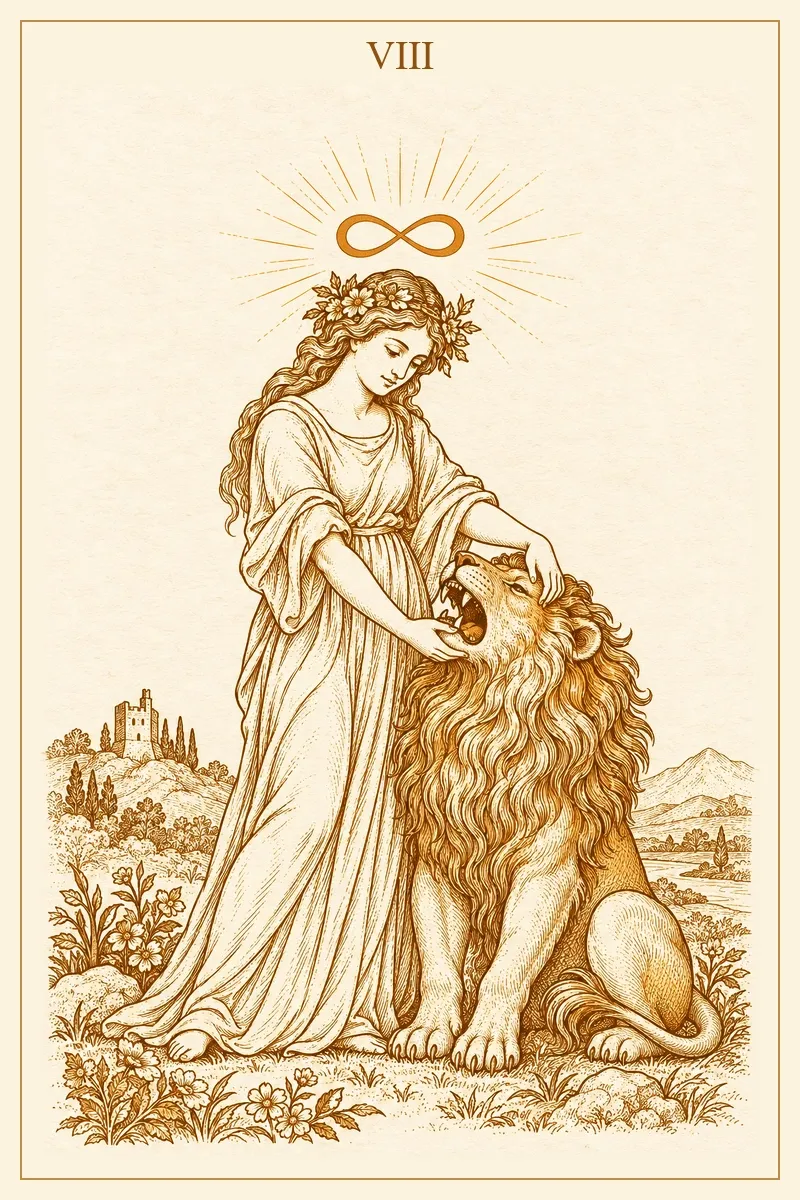
Strength is courage that does not need force. Beside the Seven of Wands, it softens the fight: you hold your ground through patience and composure rather than by out-shouting anyone, which is good news for a tired defender. The Strength tarot meaning post explores that kind of inner power.
With The Emperor: authority under challenge
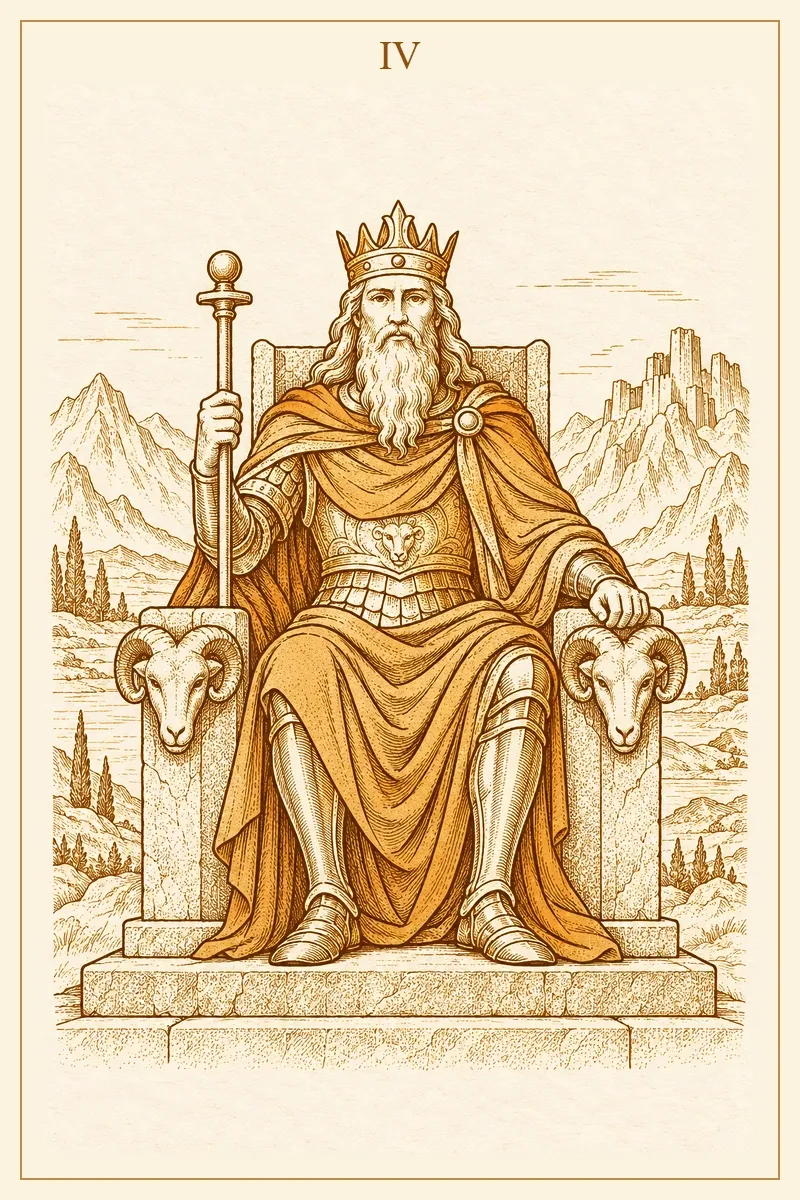
The Emperor stands for structure and leadership. With the Seven of Wands, your authority, or a structure you built, is being questioned, and it can hold if you lead from clear principles rather than wounded pride. The pair can also show you challenging an Emperor figure: a boss, an institution, a parent. The Emperor tarot meaning post covers the healthy and rigid sides of that authority.
With The Chariot: from holding ground to moving forward
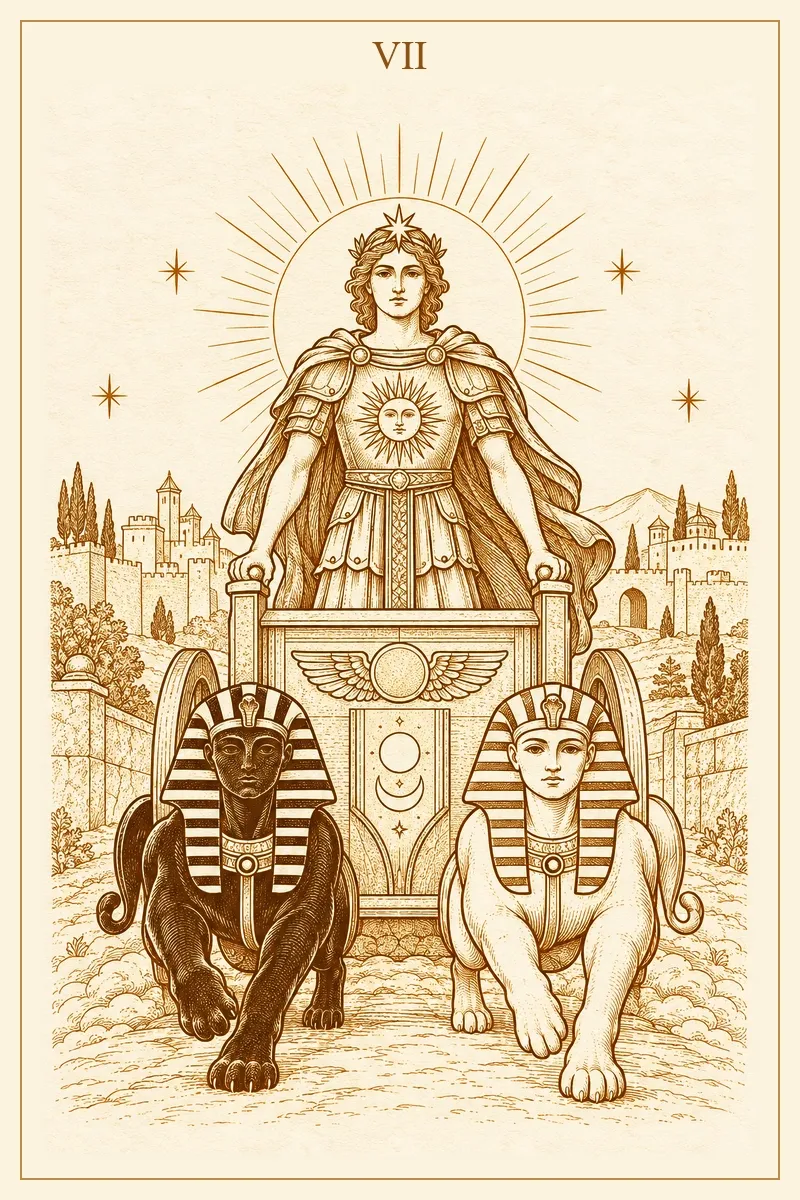
The Chariot is willpower turned into motion. Next to the Seven, the stand you are taking becomes a launch point: once the ridge is held, you drive on from it. At work the pair can mark pushback that ends in a clear win and a new direction, the kind of drive the Chariot tarot meaning post describes.
With the Nine of Wands: a defense that has gone on too long
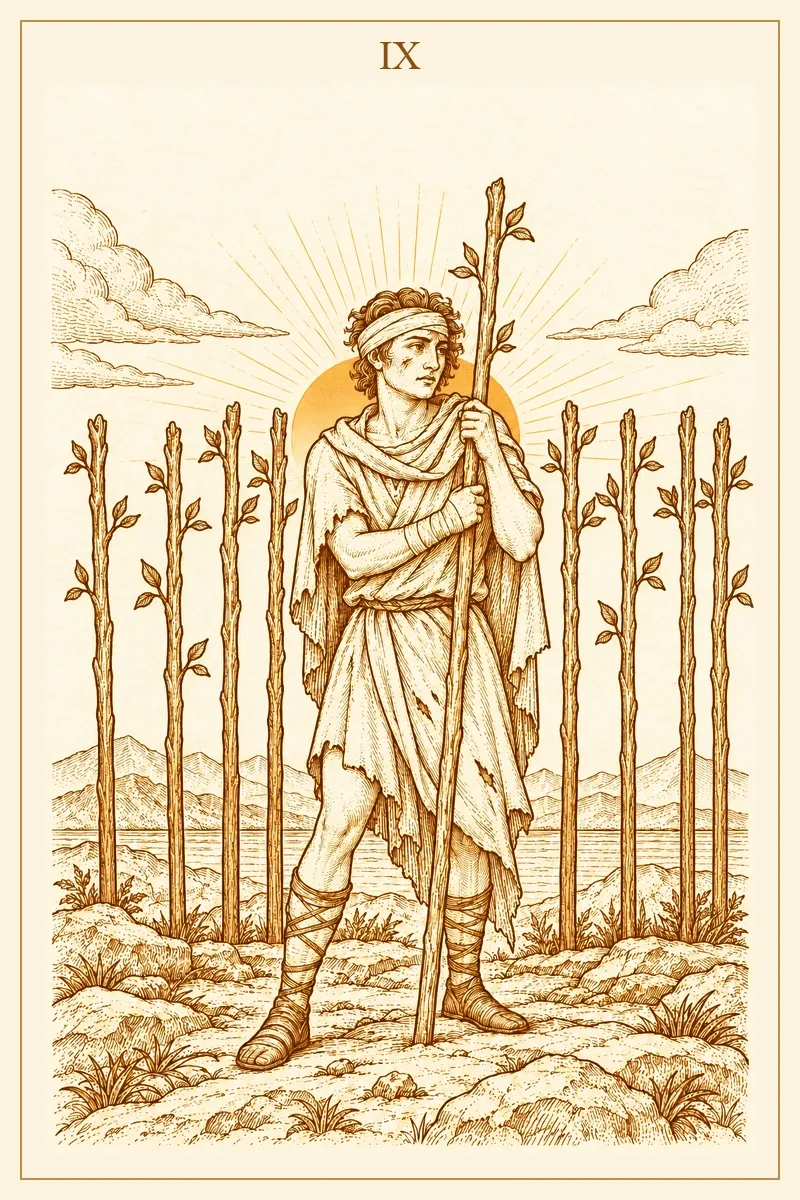
The Nine of Wands is the Seven's tired future, a wounded, watchful fighter still guarding a line of staves. Together they describe a prolonged struggle: you are tougher than you think, and you need rest before the last push. The Nine of Wands meaning post looks at that last stand.
With the Four of Swords: put the staff down for a while
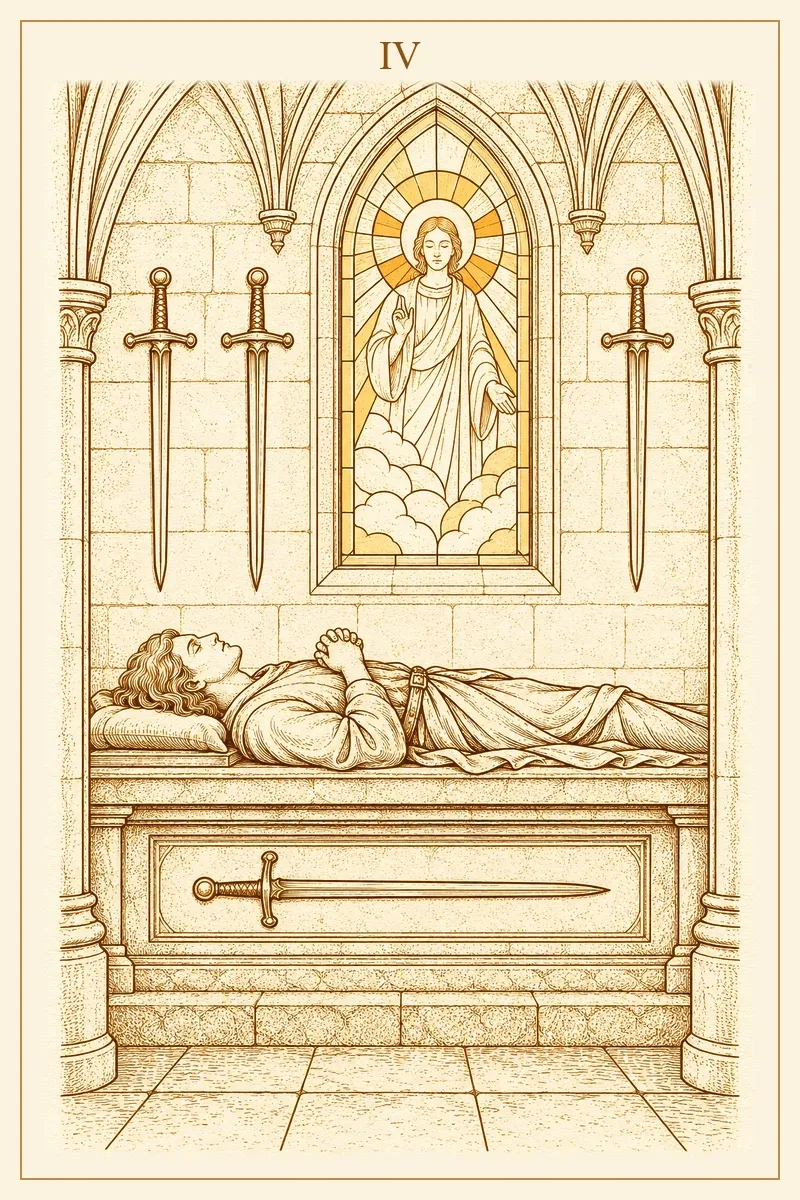
The Four of Swords means rest and recovery. With the Seven of Wands, it calls a pause: step back, recover and return when you can think clearly. It is one of the clearest signs that a reversed Seven means a chosen, healthy retreat, and the Four of Swords meaning post explains how to rest without giving up.
The Ridge spread: five cards for ground you are defending
This layout turns the picture on the card into questions. Use it when you are under pressure and unsure whether to hold, adjust or let go. Shuffle with the situation in mind and lay the cards in a shallow arch, with the first card at the top.
- The ground: what you are actually defending. After you read this card, name it in one sentence.
- The rising staves: where the pressure comes from and what it wants.
- Your footing: the strengths, facts and allies that keep you steady.
- The crack: where you are vulnerable, overdefended or running out of energy.
- The valley behind: what opens up if you hold, and what opens up if you step back.
A worked example: the newsletter someone else wants to run
Question: "I built our team's newsletter from nothing over two years. My manager now wants to hand it to a new marketing group. Should I fight to keep it?"
The ground: the Seven of Wands upright. The card landing in its own position is a strong hint that the reader is defending something earned, not just clinging; the newsletter's visibility is exactly why it is being claimed.
The rising staves: the Knight of Swords. A new group with a plan, moving fast before anyone asked the person who built the thing. Less malice than speed.
Your footing: the Three of Pentacles, craft and collaboration. The strongest ground is the record: issues shipped, readers kept, colleagues who contributed. Evidence, not emotion, will hold here.
The crack: the Nine of Swords, late-night worry. Here the card suggests the reader may be treating the decision as a verdict on their worth, and that fear makes the defense louder than it needs to be.
The valley behind: the Ace of Wands. Something new opens either way. Together the cards suggest a calm, evidence-based case for keeping editorial control, a defined role offered to the new group, and the recognition that the energy freed once this is settled wants a fresh project. What the spread leaves is a plan for one meeting rather than a war.
Holding your ground this week: five practical moves
- Name the ground in one sentence. "I am defending my right to decide what goes in the newsletter" is easier to hold than a vague sense of being pushed.
- Count the staves. Written down, the crowd can shrink to one or two real challenges.
- Choose what you will not concede, and what you can. Giving on small points saves strength for large ones; the guide to setting boundaries with tarot has prompts for deciding where your lines sit.
- Find one ally. The card shows one person against six; real life rarely demands that.
- Schedule rest before you need it, so that tiredness does not make the decision for you.
Frequently asked questions
What does the Seven of Wands reversed mean?
A defense under strain: exhaustion, feeling outnumbered, giving in, or a defensiveness that treats ordinary questions as attacks. It can also mean a deliberate retreat from a fight that no longer serves you.
Is the 7 of Wands a yes or no card?
Upright, yes with effort: you can keep or win what you want if you are willing to defend it. Reversed, it leans no for now.
What does the Seven of Wands mean for how someone feels about me?
Upright, someone loyal and protective who may feel they must prove themselves; reversed, someone cornered or depleted. Use it to open a conversation, not to close one.
What is the difference between the Seven of Wands and the Five of Wands?
The Five is a scramble where no one holds the high ground. The Seven has a clear defender with the advantage of position, protecting something specific.
Which zodiac sign goes with the Seven of Wands?
Leo: the Golden Dawn assigns it Mars in the third decan of Leo, roughly August 12 to 22.
Can the Seven of Wands tell me if I will win a conflict?
No card can guarantee the outcome of a dispute or read another person's intentions for you. The Seven shows your stance and the pressure around you, which helps you decide whether and how to keep standing. For legal or financial disputes, a qualified professional is the right advisor.
Plant the staff, then choose how long to stay
The Seven of Wands asks for courage, and also for judgment: knowing which ridge is yours to hold and when the valley behind you is the better place to be. If you are facing pressure over something you care about, draw your own cards in a Veil Soul reading and start with the ground position of the Ridge spread.