
Card Combination
Meaning of The Magician and Four of Swords Combination: The Musician Who Must Stop Playing
Active mastery confronting mandatory rest
Picture a virtuoso who has just walked off stage mid-concerto — not from choice, not from failure, but because the body simply stopped. The hands still know the fingering. The score still lives in perfect recall. Every instrument on the table remains polished and ready. But the performer is horizontal, eyes on the ceiling, and the hall has gone quiet whether they wanted it to or not. This is the essential portrait of The Magician meeting the Four of Swords: a character built for motion, paused by something stronger than willpower.
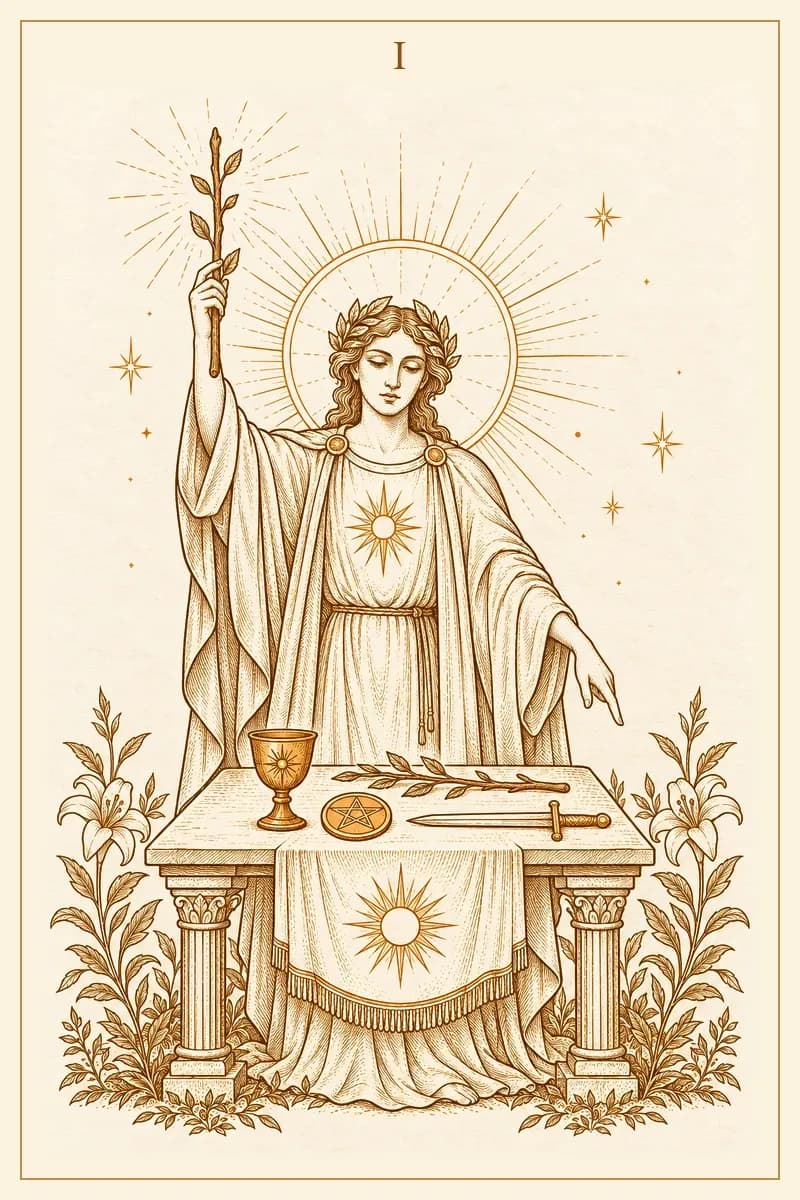
The Magician is the archetype of deliberate action. One hand reaching upward, one pointed at the earth — he is the living conduit between potential and execution. His table holds all four suits: wand, cup, sword, pentacle. He is the composer who writes in any key, the conductor who leads any section. His defining quality is that he does not wait for conditions to be perfect. He makes conditions workable with what he has.
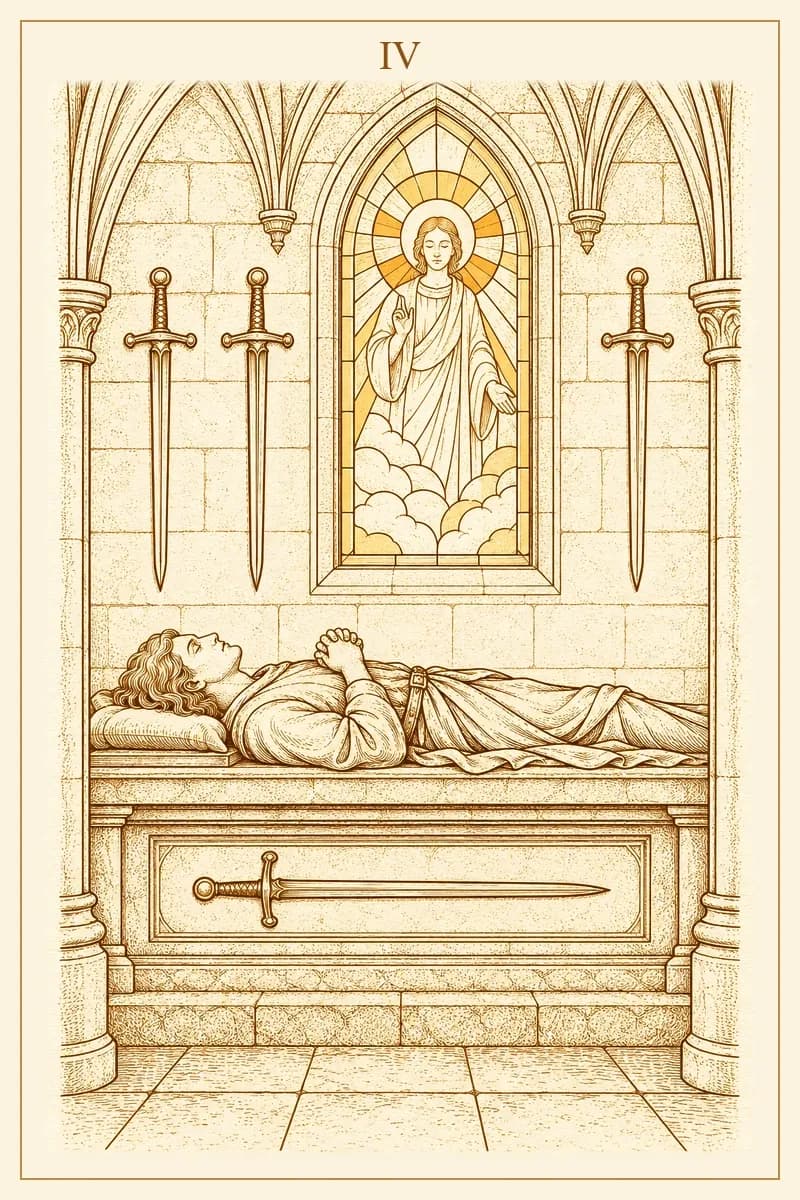
Four of Swords enters this scene like a physician who steps onto the stage and quietly insists the concert is over for now. The figure on the card lies carved in stone — not dead, but deliberately still. Three swords hang on the wall; one rests beneath the reclining figure. The message is not defeat. It is a prescribed pause, the silence a musician needs after months of touring before they can hear themselves clearly again.
The Core Tension
The Magician believes rest is what happens between performances. Four of Swords believes rest is itself a form of mastery — that the pause between phrases is as much a part of the composition as the notes. These two positions are incompatible in the short term, and that is exactly where the tension lives.
A musician who cannot stop playing eventually loses the ability to hear what they are playing. Tempo collapses, dynamics flatten, articulation blurs. The Magician's great vulnerability is the assumption that capability requires constant demonstration. When Four of Swords arrives, it is not questioning his skill. It is pointing out that the instrument — the body, the mind, the emotional system that executes the brilliance — needs to be set down. The silence between movements is not wasted time. It is what makes the next movement audible.
Love & Relationships
In relationships, this combination appears when one person's energy and initiative — the Magician's native mode — has been running so continuously that the connection has lost its resonance. A relationship always being orchestrated by one person's strategy begins to sound less like music and more like someone practicing scales alone.
Four of Swords here invites the more active partner to genuinely stop conducting — not as a tactic, but as a real rest. This allows the other person space to contribute their own phrase to the composition. It also reveals whether the relationship carries momentum of its own when one person stops supplying all of it. Sometimes what appears is beautiful. Sometimes it is silence — and that information matters.
Career & Purpose
Professionally, this pairing describes someone extraordinarily productive yet approaching the point where continued output will undermine quality. The technical fluency is intact — the fingers still find the right notes. But the interpretive depth has thinned. Work produced at this pace may be correct without being compelling.
This combination is a directive to schedule the rest that will not schedule itself. The Magician will not stop voluntarily; Four of Swords knows this, which is why it sometimes engineers the pause through illness or forced circumstance. The wiser response is to recognize the signal before the body enforces it.
Shadow Side
The Magician's shadow here is using perpetual activity as avoidance — keeping the music so loud that nothing quieter can be heard. If stillness is never allowed, certain truths never surface: doubts about direction, exhaustion reframed as passion, performance disconnected from genuine feeling. Noise masquerades as productivity for a surprisingly long time.
Four of Swords' shadow is using rest as permanent retreat. The carved figure grows comfortable in its horizontal position. Recovery extends past restoration into withdrawal — not because more time is genuinely needed, but because re-entering action has begun to feel too uncertain. Rest that stops being temporary becomes avoidance in a different costume.
Action Steps
- 1Protect three consecutive hours of complete non-performance this week: no planning, no reviewing, no work-adjacent consumption. Set the instrument down and let the hall go quiet on your own terms, before circumstance does it for you.
- 2Identify one question about your current direction that you have been moving too fast to sit with. Write it down without answering it. Let it exist as an open chord that asks for resolution rather than one you have already resolved.
- 3When you return to action after the rest, play the opening phrase more slowly than feels natural. Notice whether the reduced tempo changes what you are able to hear in your own work.
Related Pairings
Continue through published pairings that share The Magician or Four of Swords.
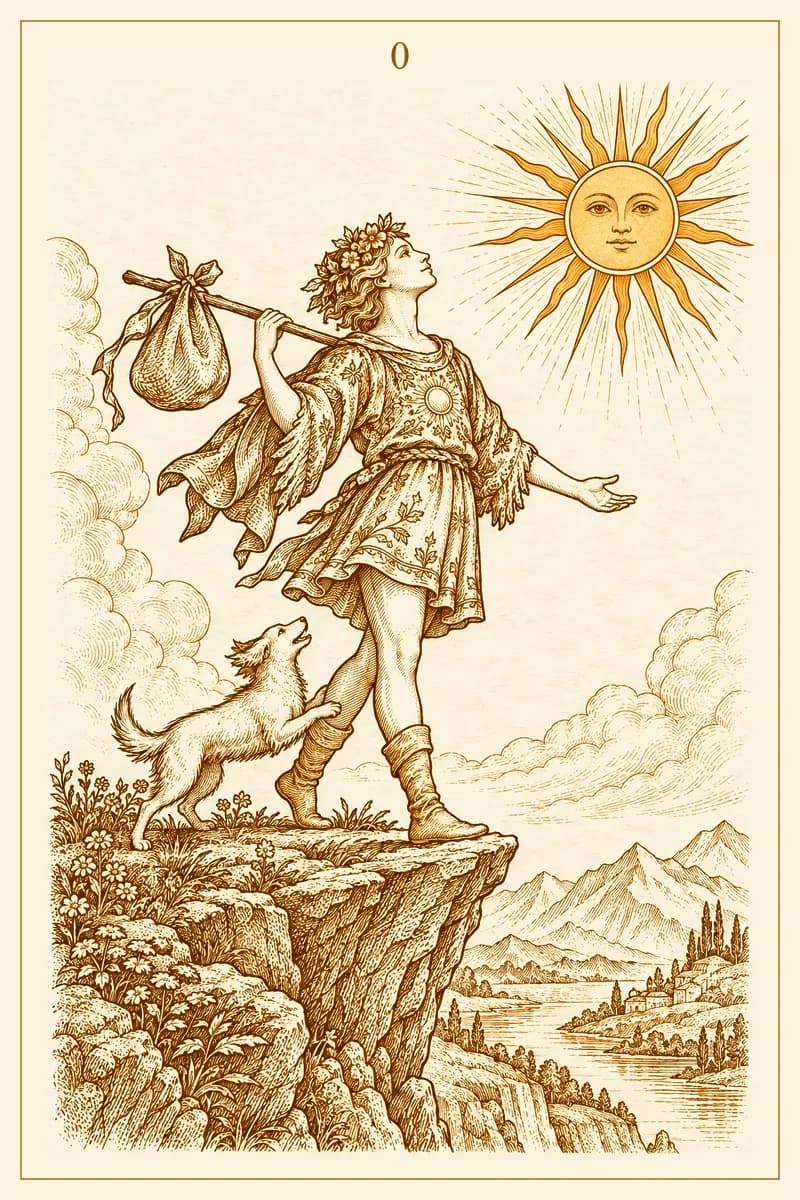
Spontaneous manifestation
Meaning of The Fool and The Magician Combination: Spontaneous Manifestation
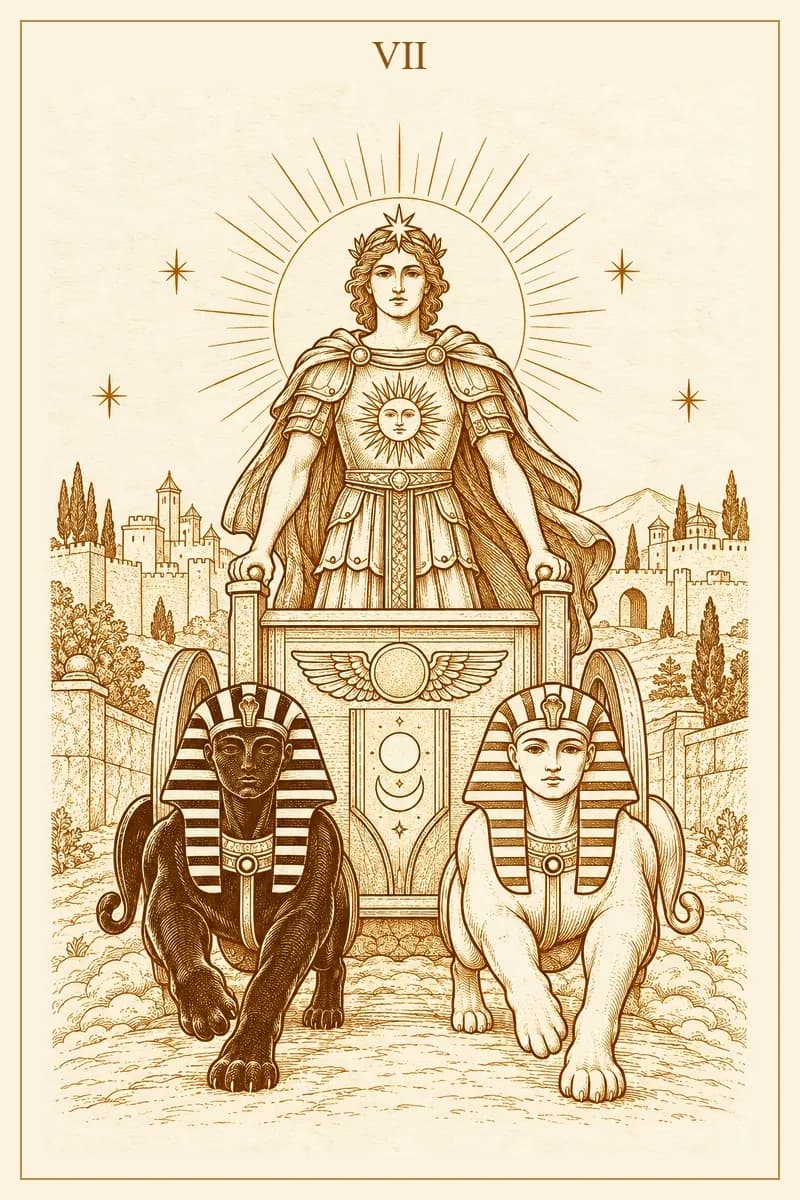
Disciplined stillness
Meaning of The Chariot and Four of Swords Combination: Strategic Rest
Full awareness under pressure
Meaning of The Magician and The Chariot Combination: Precision at Full Speed
Conscious confinement
Meaning of The Devil and Four of Swords Combination: Captivity Needs Rest
Will versus compulsion
Meaning of The Magician and The Devil Combination: Willpower on a Leash
Strategic retreat
Meaning of The Emperor and Four of Swords Combination: Strength in Stillness
✦ Bring it to the cards ✦
Bring The Magician and Four of Swords into your own reading
Use this pairing as a starting point, then let a spread listen to the situation that is actually yours.
Begin a contextual reading