Loading your view
The page is gathering the latest information.
The page is gathering the latest information.
belief under trial
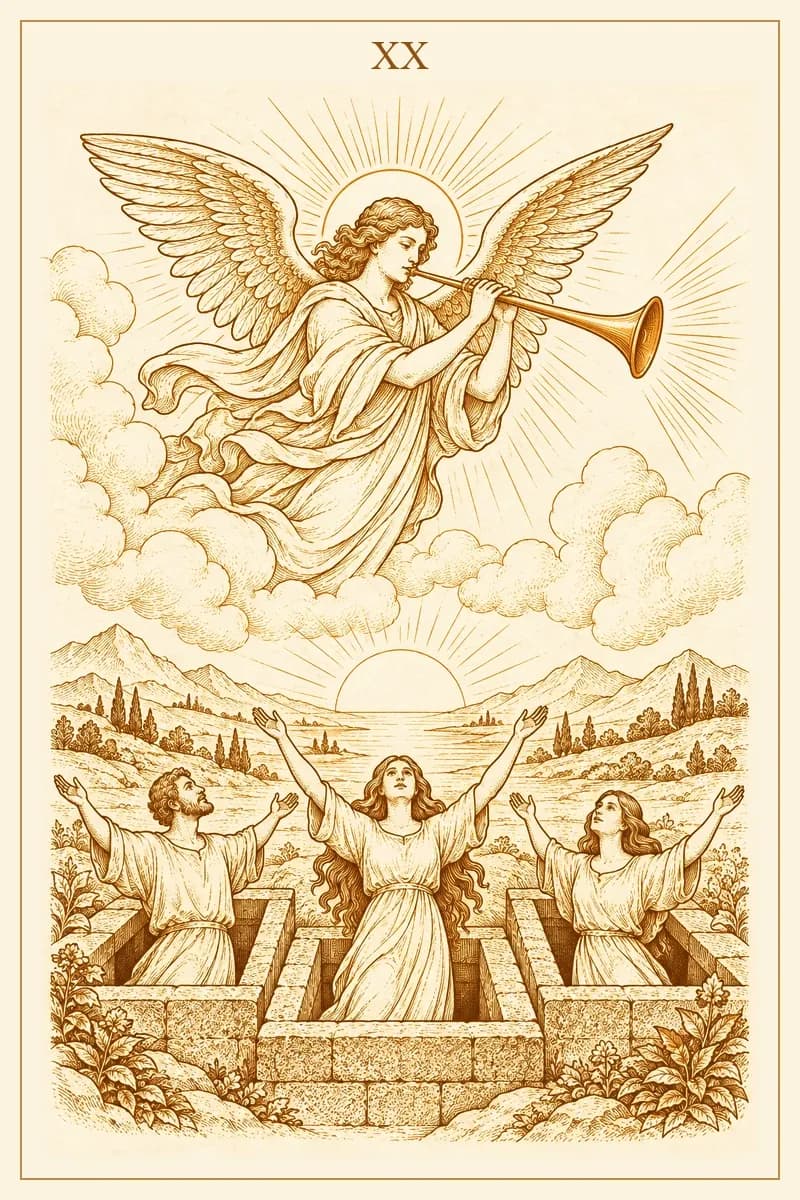
The test results are back. For years — maybe decades — you have been operating on a diagnosis you received from someone else: a parent, a religion, a culture, a school of thought that told you who you were and how the world worked. You followed the treatment plan. You arranged your life around it. And now Judgement stands in the doorway with a second opinion, and The Hierophant is watching to see what you do with it.
This is not a comfortable combination. It is a medically significant one. Not every inherited belief is wrong. Not every tradition deserves to be dismantled. But the conjunction of these two cards demands that you stop taking the old prescription on faith and actually examine whether it is still serving the body it was meant to heal.
The trumpet has sounded. The question is whether you can hear it over the noise of everything you have always been told.
The Hierophant holds the past — its wisdom and its dead weight together, without sorting them. Judgement is the sorting. It is the moment of honest assessment after a long period of accumulation, the doctor who finally says: some of this was good medicine, and some of it was making you sick.
The tension here is not between tradition and rebellion. Many people read Judgement as a call to overthrow everything, but that misses the card's nuance. Judgement does not destroy systems — it evaluates them. It applies a rigorous, honest standard to what has been built and asks: does this deserve to continue? The Hierophant material that survives that inquiry becomes something stronger, more consciously held. What doesn't survive was never yours to begin with.
The danger is refusing to undergo the evaluation at all. The structures of the Hierophant can insulate against the call of Judgement — doctrine as a defense mechanism, institutional belonging as a reason not to listen to the horn. That is the trap this combination is warning you about.
In relationships, this pairing often marks a pivotal reassessment. A long-term partnership may have been built on shared beliefs — religious, moral, cultural — and something has shifted. One person has heard the horn and the other is still asleep, or both have heard it and drawn different conclusions about what it means.
This does not automatically signal the end of a relationship. What it signals is the unavoidability of honesty. The beliefs that underpinned your partnership need to be examined together, not deferred. Couples who do this work — who sit down with the second opinion and read it honestly — often emerge with a relationship that is more deliberately chosen and therefore more stable.
For those who are single, this combination can indicate that you are still choosing romantic partners based on criteria you inherited rather than criteria you have consciously developed. The type you pursue, the relationships you avoid, the standards you hold — how much of that was handed to you, and how much did you actually decide?
Professionally, The Hierophant and Judgement together often appear during major career reckonings: the moment you realize that the career path you chose, or that chose you, needs to be reexamined against what you now know about yourself. Institutional careers are particularly activated here — long service within a single organization, a professional identity that has been built according to established hierarchies.
This combination can also appear when the institution itself is under scrutiny — an organization facing an internal reckoning, an industry being called to account. If you hold authority within a system, you are being asked to evaluate that system honestly rather than defend it reflexively. Those who lead well here are those who can distinguish between what the institution was built to do and what it has actually been doing.
The shadow of this pairing is judgment in the colloquial sense — the tendency to evaluate others' beliefs and traditions with a severity you do not apply to your own. Judgement is a card of self-reckoning first. When its energy is projected outward onto other people's doctrines, it becomes self-righteous rather than discerning.
There is also the shadow of endless deferral. The Hierophant provides excellent reasons to postpone the reckoning: the timing isn't right, the community isn't ready, the structure is too important to disturb. These reasons can be valid. They can also be sophisticated avoidance. The diagnostic image holds: a patient who keeps finding reasons not to read their own test results.
Keep or share this combination reference
Continue through published pairings that share The Hierophant or Judgement.

authority meets doctrine

driven reckoning

abundance versus doctrine
bondage meets awakening

Sacred Rebellion
earthly authority transcended
✦ Bring it to the cards ✦
Use this pairing as a starting point, then let a spread listen to the situation that is actually yours.
Begin a contextual reading