
Card Combination
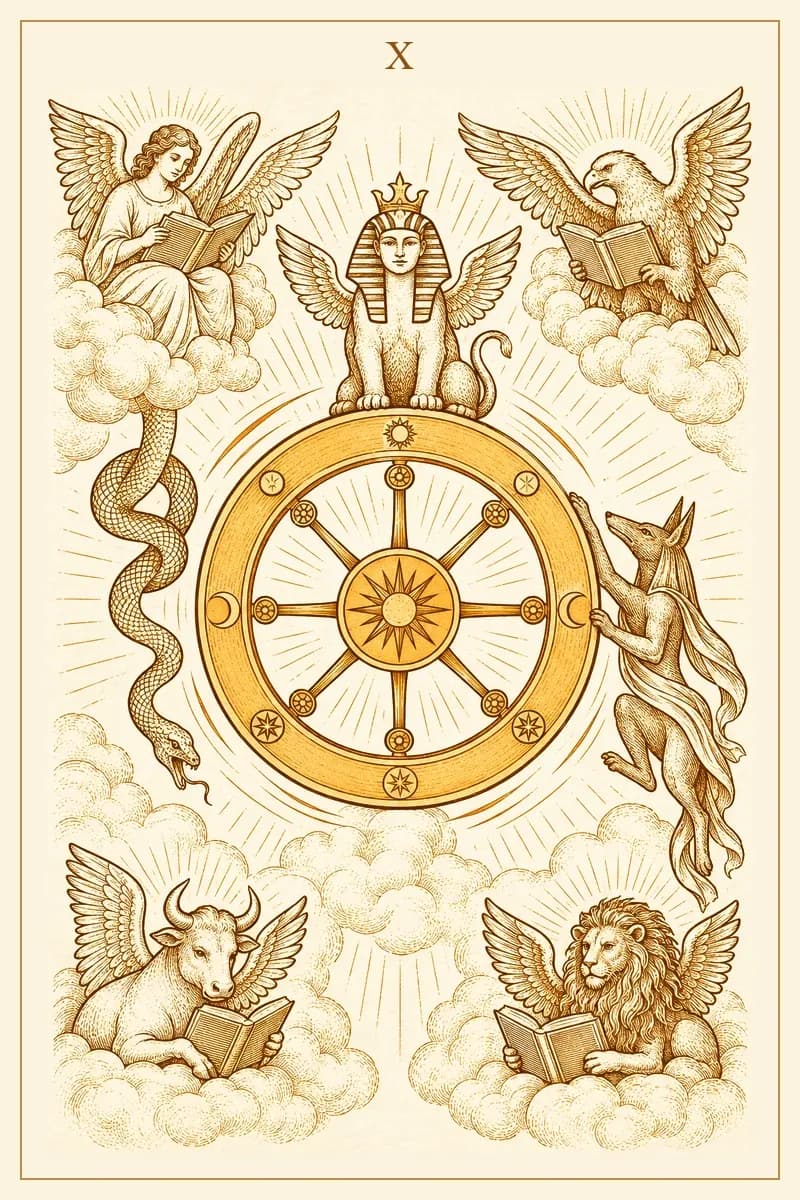
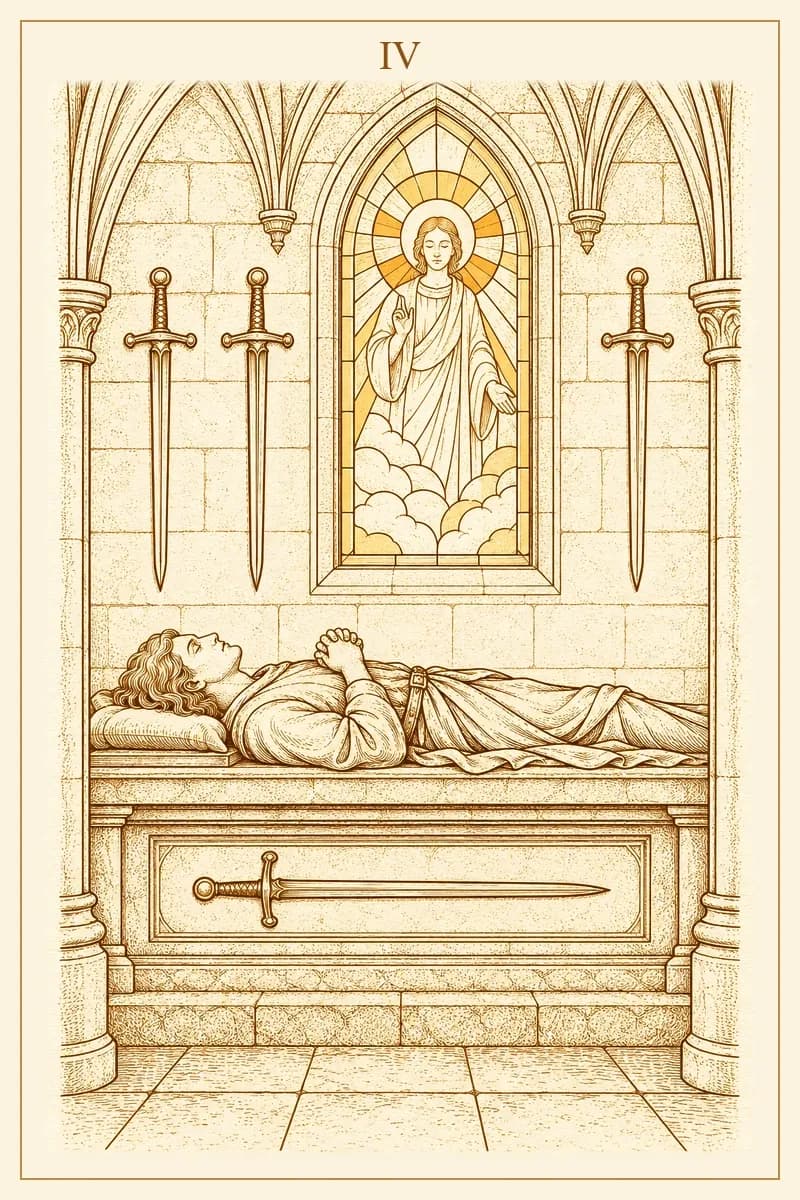
Meaning of Wheel of Fortune and Four of Swords Combination: Rest Inside the Cycle
Deliberate stillness
In music, the rest is not silence. It is a note with a specific duration — it holds the space between sounds so that what follows lands with the right weight. A composer who removes all the rests ends up with noise. The Wheel of Fortune and the Four of Swords together are making exactly this argument: not every moment in a cycle is the moment for movement. Some positions in the rotation exist specifically so that you can hear what comes next.
Most people encounter the Wheel of Fortune as a card about change — things turning, fortunes shifting, timing arriving. What gets less attention is that the wheel is not asking you to sprint. It is describing a rhythm. Within any rhythm, there are beats where you push and beats where you let the motion carry you. The Four of Swords identifies one of those carrying beats, and it asks you to recognize it rather than fight it.
The combination is disorienting for action-oriented people precisely because it looks like contradiction. How can fortune be moving and rest be required at the same time? But this is the question the pairing is designed to ask. Momentum and recovery are not opposites — they are two phases of the same cycle. Ignoring recovery does not make the cycle faster. It makes the next phase of action weaker.
The Core Tension
The Wheel of Fortune wants engagement with the turning of things — awareness of cycles, responsiveness to timing, willingness to act when the moment is right. The Four of Swords wants withdrawal, quiet, the deliberate lowering of stimulation and output.
The tension between them is real but not irresolvable. The wheel is not asking you to be constantly active. It is asking you to be appropriately positioned at each phase. The Four of Swords is telling you what phase you are in: a recovery phase, a consolidation phase, the part of the cycle where the inner work happens and the outer work pauses.
What makes this combination specifically challenging is the anxiety that comes with rest when you believe the wheel does not stop. If fortune is turning, does resting mean missing the moment? The answer the cards give together is no — but it requires that you trust the phase rather than override it. Premature action during a recovery phase does not accelerate the cycle. It enters you into the next phase depleted, which shapes what you can actually do when the wheel reaches a more active position.
Love & Relationships
This pairing in romantic readings often marks a period of necessary quiet after intensity. A relationship that has moved through conflict, change, or early-stage acceleration may be signaling that it needs stillness — not distance, but a different kind of attention, one that does not require constant forward motion to feel alive.
For people who are between relationships, the same logic applies: the space between connections is itself part of the cycle, and filling it reflexively does not honor what you actually need from the next chapter. The Four of Swords is asking you to use this interval rather than escape it.
There is also a version of this in long-term partnerships where one or both people have been running at high intensity and the relationship itself needs a different quality of presence — less event-driven, more attentive to the ordinary texture of shared life.
Career & Purpose
Professionally, this combination appears when the pace of a project, role, or career phase has exceeded sustainable capacity. The Wheel of Fortune indicates that the cycle is still active — this is not a dead end or a stalled position. The Four of Swords indicates that how you navigate the next quarter or two matters less than how you recover your baseline.
The failure mode this pairing warns against: pushing through a recovery phase because you fear stopping means falling behind. A depleted person entering an active career moment performs significantly below their actual capability. The rest is not a detour. It is preparation.
For leaders responsible for others, this combination also appears when a team needs recovery that the leader has been reluctant to authorize. Granting that recovery is itself a form of strategic action.
Shadow Side
The shadow of this combination is avoidance dressed as self-care. The Four of Swords can become an indefinite pause — a permanent retreat from risk that never actually concludes in restoration and return. If rest becomes a position rather than a phase, the wheel's movement stops feeling like opportunity and starts feeling like threat.
The other shadow is the opposite: using the wheel's motion as a reason to override genuine exhaustion. Not everything that feels like impatience is timing. Sometimes the wheel is in a rest phase and anxiety is telling you it is not.
Action Steps
- 1Identify one area where you are pushing through genuine depletion and name what you are afraid would happen if you stopped for three days.
- 2Schedule one block of deliberate, low-input rest — not entertainment, not productivity disguised as relaxation, but actual stillness — and treat it as a non-negotiable appointment.
- 3When the anxiety about the turning wheel arises, ask once: is this a real signal that action is needed, or is it the discomfort of recovery doing its work?
Related Pairings
Continue through published pairings that share Wheel of Fortune or Four of Swords.

Control vs fate
Meaning of The Chariot and Wheel of Fortune Combination: Control Meets Chance
Disciplined stillness
Meaning of The Chariot and Four of Swords Combination: Strategic Rest

Control vs cosmic flux
Meaning of The Emperor and Wheel of Fortune Combination: When Control Meets the Spin

Conscious confinement
Meaning of The Devil and Four of Swords Combination: Captivity Needs Rest
Cycles of abundance
Meaning of The Empress and Wheel of Fortune Combination: Cycles of Abundance
Strategic retreat
Meaning of The Emperor and Four of Swords Combination: Strength in Stillness
✦ Bring it to the cards ✦
Bring Wheel of Fortune and Four of Swords into your own reading
Use this pairing as a starting point, then let a spread listen to the situation that is actually yours.
Begin a contextual reading