Loading your view
The page is gathering the latest information.
The page is gathering the latest information.
complete accounting
The curtain has already gone up. The audience is seated. The lights are on the stage, not just the wings, and somewhere backstage you realize that this performance has no rehearsal left — only the thing itself, the live version, with all its weight and its permanence. That is where this combination places you: mid-scene, mid-reckoning, with the full house watching.
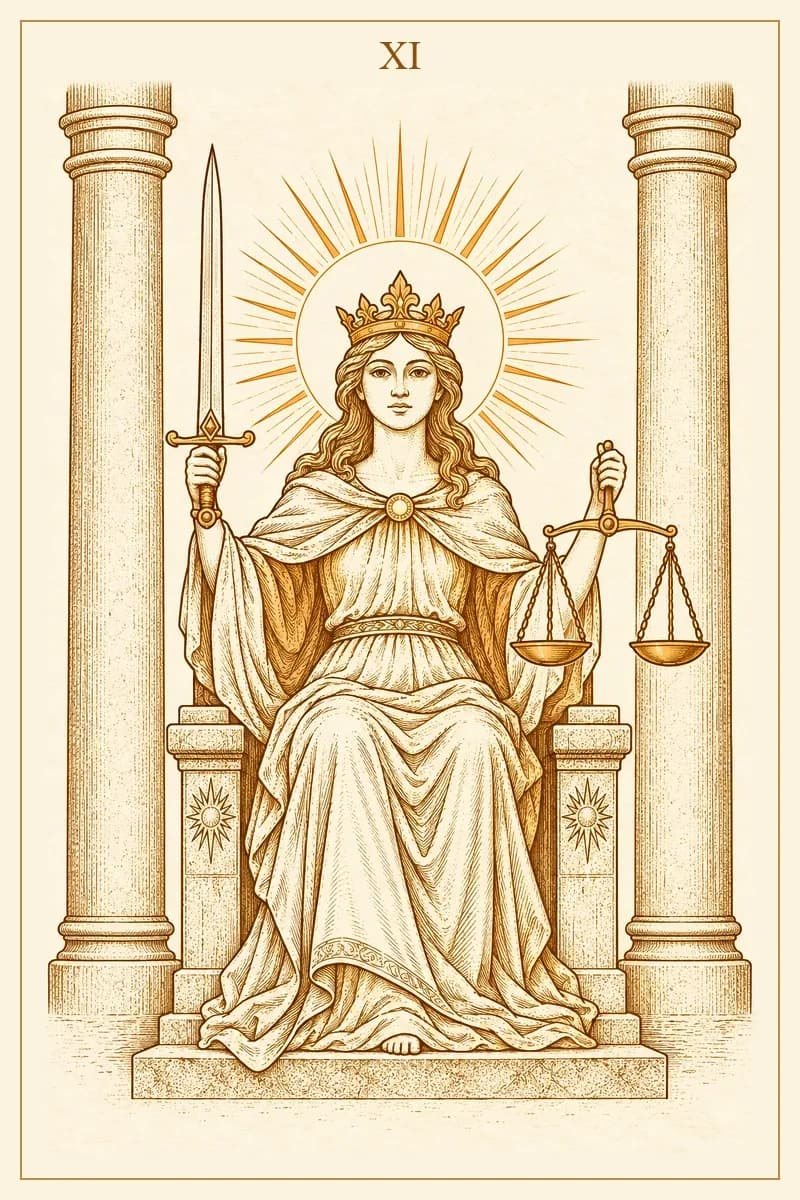
Justice and Judgement are the two great accounting archetypes of the Major Arcana. One works horizontally, measuring present causes against their effects. The other works vertically, reaching back through the whole arc of a life and calling it to attention. When both appear in a reading, the message is not gentle: something large is being finalized. The books are being closed.
This does not mean catastrophe. What it means is consequence — the kind that is proportional, lasting, and real. Whatever choices have accumulated in the background of your life, they are no longer background.
Justice is a scales. It measures this against that — a clean, bilateral exchange. Judgement is a trumpet blast that wakes the dead from their graves. These are not the same instrument, and when they play simultaneously the result is not harmony but something more demanding: full-spectrum accountability.
The tension here is the gap between partial honesty and complete honesty. Most people can admit to their mistakes in a limited way — acknowledging the surface error while leaving the deeper pattern unnamed. Justice might permit that partial acknowledgment. Judgement will not. Judgement insists on the whole record: not just what you did last week, but what pattern that action belongs to, what it says about the arc of your choices across time.
If you are drawn to softening your self-assessment right now, this combination is asking why. The full accounting is not optional.
In romantic matters, this combination is one of the most clarifying pairings in the deck — and one of the most demanding. It often appears at the end of long entanglements, when the relationship has accumulated enough history to require a genuine audit rather than another round of surface-level conversations.
If you are in a relationship, this pairing is calling both people to step back from their assigned roles — the wronged party, the one who tried harder, the one who never got enough credit — and look at the full, honest record of what actually happened between you. Not the story you've refined over months of telling it to friends. The actual record.
For those who have recently ended a significant relationship, Justice and Judgement together are not an invitation to re-litigate. They are an invitation to finally understand what drove the whole arc, so you don't repeat it. That understanding is a kind of freedom — but it requires sitting with the parts of the story where you were the problem.
Professionally, this combination appears around major transitions: the end of a career chapter, the resolution of a long-running dispute, the completion of a project that required sustained commitment. There is a finality to this energy that makes it particularly relevant when something is genuinely concluding — a contract ending, a business partnership dissolving, a long-delayed decision finally being made.
Under this influence, decisions made now will stick. Agreements reached now will be durable. The weight of Judgement gives Justice's precision a kind of permanence that lighter combinations don't carry.
If you are in a situation where someone's professional legacy — yours or another's — is being evaluated, expect that evaluation to be comprehensive. The trumpet has sounded; partial resumes won't be sufficient.
The darkest expression of this combination is judgment without mercy. Both Justice and Judgement can, at their worst, become instruments of condemnation rather than discernment. When this pairing manifests in its shadow, it looks like a person who has appointed themselves the final arbiter of another's worth — and who mistakes the certainty of their verdict for the accuracy of it.
There is also a specific paralysis that can emerge: the weight of a complete accounting can feel so heavy that the person simply refuses to do it. Better to keep the books in disorder than to see the final number. This avoidance is the shadow version of both cards — Justice deferred indefinitely, Judgement treated as a threat rather than a completion.
The other shadow here is rehearsed regret — going over the same old failures with such ritualistic regularity that it becomes a performance of accountability rather than actual accountability. The trumpet should sound once. After that, you rise.
Keep or share this combination reference
Continue through published pairings that share Justice or Judgement.

earned victory
driven reckoning

authority meets accountability

bondage meets awakening

abundance under judgment
earthly authority transcended
✦ Bring it to the cards ✦
Use this pairing as a starting point, then let a spread listen to the situation that is actually yours.
Begin a contextual reading