
Card Combination
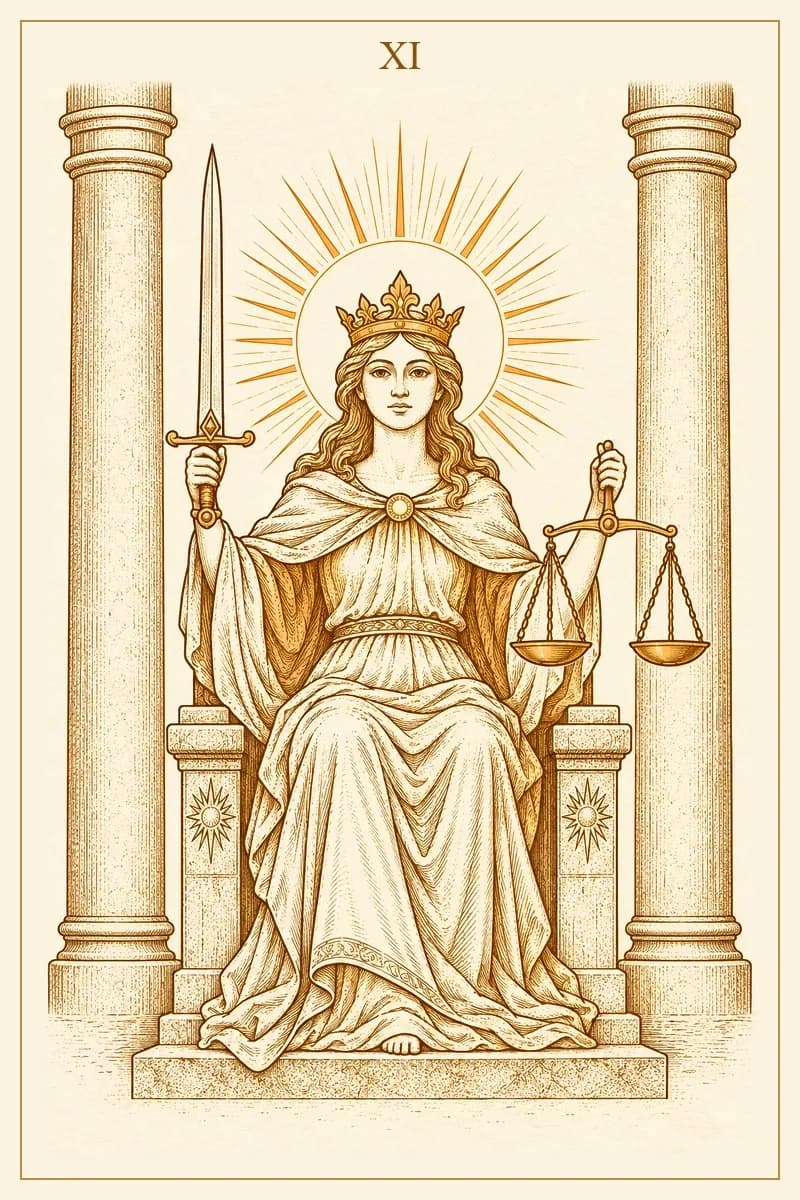
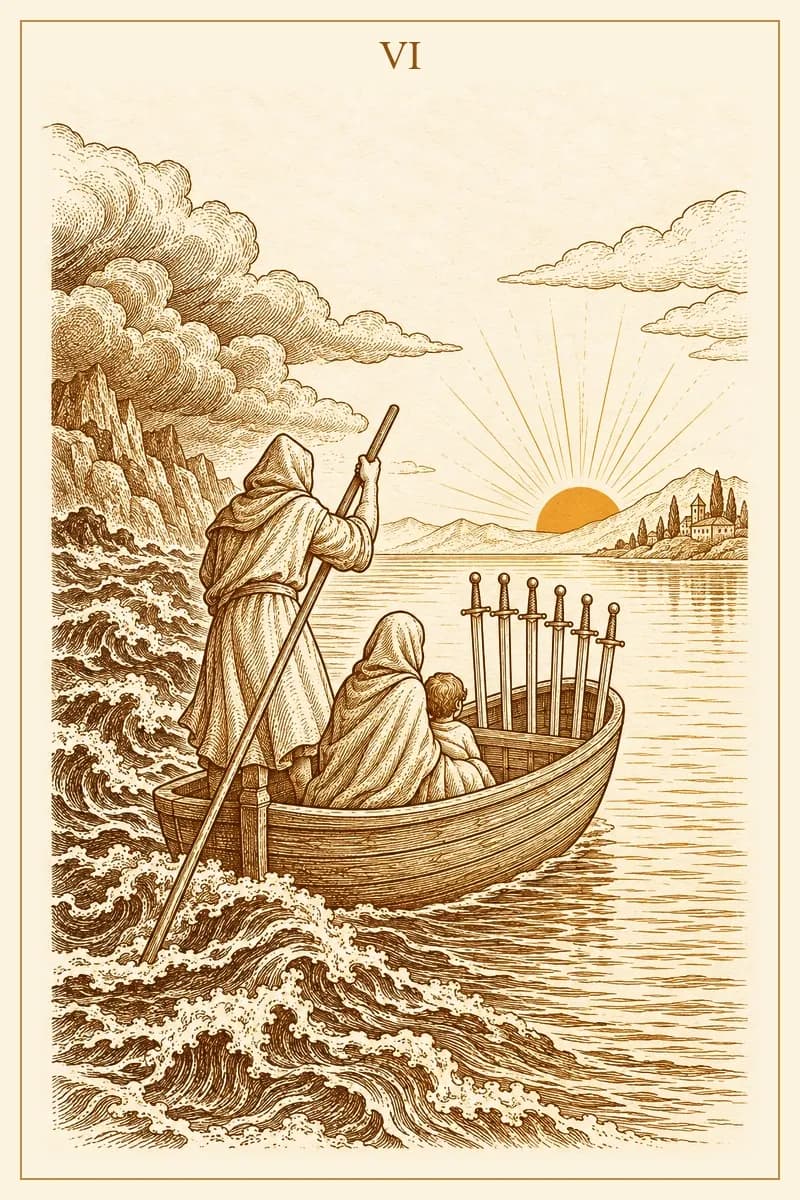
Meaning of Justice and Six of Swords Combination: Earned Passage
Earned departure
Some crossings cannot be made with old debts still unpaid. The river between where you are and where you need to be has weight — it measures what you carry, and what you have settled. That is the architecture of this combination: a doorway that opens only after the load has been properly balanced.
Two cards that rarely sit comfortably together. Justice demands precision, reckoning, an exact accounting of cause and effect. The Six of Swords wants motion — quiet, deliberate, away from turbulence toward calmer water. The friction between them is real. You cannot simply sail off. Something must be resolved first, or it will follow you across every horizon you try to reach.
The Core Tension
Justice operates on an absolute principle: what has been set in motion produces consequences, and those consequences must land somewhere. The Six of Swords, by contrast, is the card of transition — a boat moving through low mist, passengers facing forward, past already receding behind them. When these two forces collide, the question becomes structural: are you moving on, or moving away? The difference matters enormously. Moving on requires that the foundation behind you hold. Moving away is an attempt to outrun the settling.
The core tension here is between accountability and relief. Justice will not permit a departure built on unresolved imbalance. The scales must read level — not perfect, not painless, but balanced — before the crossing is legitimate. This is not punishment. It is the architecture of honest transitions: if a wall is not plumb before you build on it, the whole structure tilts over time.
Love & Relationships
In a relationship context, this pairing often surfaces when someone has been considering leaving — or has already left — but the emotional accounting hasn't been completed. There may be guilt carried without being named, blame distributed unevenly, or an apology that was never made in either direction. Justice here is not asking you to stay. It is asking whether the departure, if it happens, will be clean or whether it will calcify into something harder over the years.
For those still in a relationship, this combination can point to a period of necessary renegotiation. A pattern has run long enough that it has created visible imbalance. The Six of Swords suggests both parties are tired, and relief is genuinely needed. But Justice insists that the renegotiation happen consciously, not through drift. Quietly withdrawing from an issue does not resolve it.
Career & Purpose
Professionally, Justice and the Six of Swords often appear when someone is weighing a career transition — leaving a role, a company, or a professional identity that no longer fits. The advice embedded here is practical: before you go, settle what is outstanding. Relationships left damaged, agreements left incomplete, feedback left unexpressed — these don't stay behind. They follow as professional reputation, as your own recurring patterns, as unfinished psychological architecture that reasserts itself in the next environment.
This pairing also shows up when a workplace situation has reached a point of reckoning. Something has been conducted unfairly — resources distributed unjustly, credit misallocated, someone overlooked. The Six of Swords indicates movement is coming regardless. Justice says that movement will carry more integrity, and produce more durable outcomes, if the imbalance is named before everyone disperses.
Shadow Side
The shadow of this combination is the departure that masquerades as resolution. You can arrange everything to look settled — draw clean lines, make the right statements, appear measured and accountable — while the actual emotional or ethical reckoning remains untouched beneath the surface. This is the boat that crossed but still carries its cargo. The Six of Swords can enable sophisticated avoidance when Justice's influence is resisted rather than integrated.
There is also a shadow on the Justice side: using the demand for accountability as a reason never to move. Some people use the language of fairness to anchor themselves in situations long past their use. The scales become a cage. If every departure requires perfect resolution before it is permitted, no one ever leaves anything.
Action Steps
- 1Identify one unresolved piece of business — a conversation, a commitment, an acknowledgment — that you have been postponing because moving on seemed easier than completing it.
- 2Map the actual weight of what you are carrying versus what legitimately belongs to you; some of the load you've been hauling is not yours to resolve.
- 3Take one concrete step toward the crossing: not running from it, not deferring it further, but moving through it with your eyes open and your accounting current.
Related Pairings
Continue through published pairings that share Justice or Six of Swords.

Freedom demands reckoning
Meaning of The Fool and Justice Combination: Freedom Demands Reckoning
Undirected leap meeting deliberate passage to calmer waters
Meaning of The Fool and Six of Swords Combination: The Leap and the Crossing

Accountability of will
Meaning of The Magician and Justice Combination: Skill Under Scrutiny
Directed transition — using skill and will to navigate away from turbulence
Meaning of The Magician and Six of Swords Combination: Skill Meets Passage

Truth revealed
Meaning of The High Priestess and Justice Combination: Truth Revealed
Intuition as navigator
Meaning of The High Priestess and Six of Swords Combination: The Inner Navigator
✦ Bring it to the cards ✦
Bring Justice and Six of Swords into your own reading
Use this pairing as a starting point, then let a spread listen to the situation that is actually yours.
Begin a contextual reading