Loading your view
The page is gathering the latest information.
The page is gathering the latest information.
Earned transformation
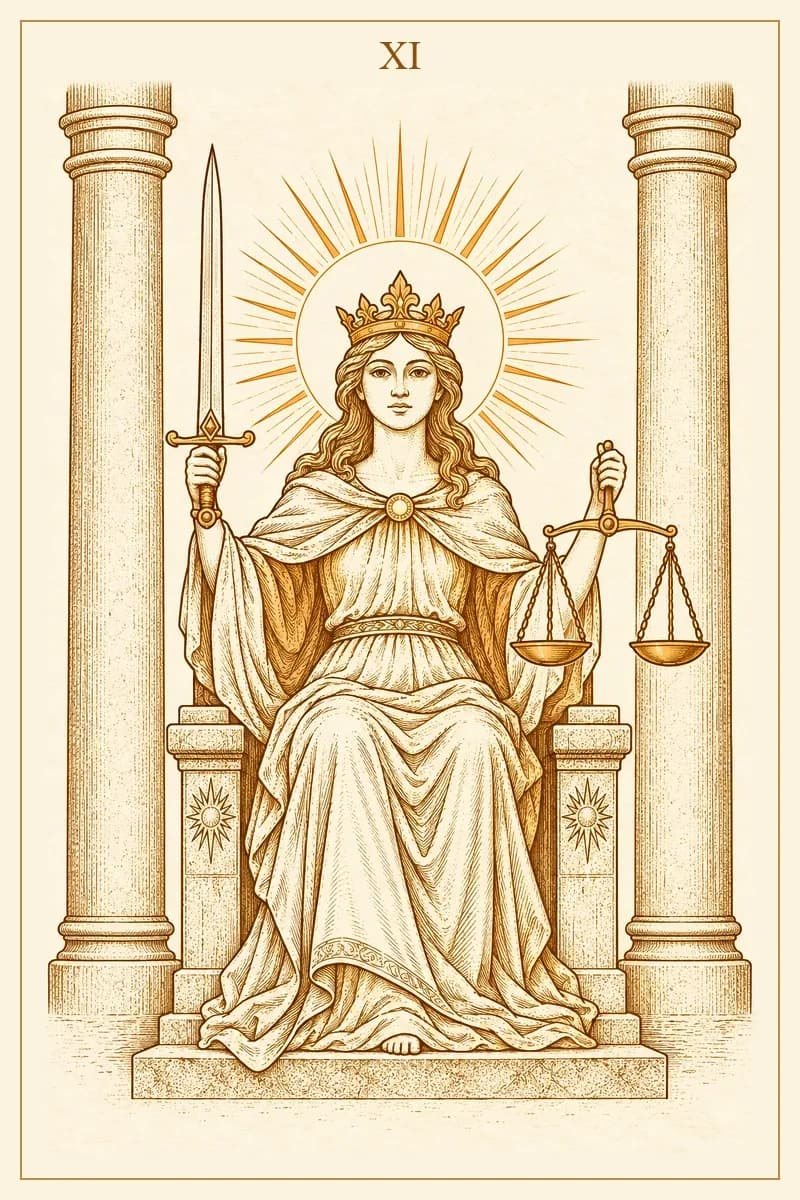
Not everything that ends was wrong. Not every loss is punishment. But some endings arrive precisely because something was out of balance for long enough that the only correction available is complete removal — the way a surgeon does not reach for aspirin when the organ itself has failed. Justice and Death together are that surgical moment: clear-eyed, necessary, and irreversible.
Justice is the diagnosis. It has been weighing things — perhaps longer than you have noticed — and it has come to a conclusion. Death is the procedure that follows the diagnosis. It does not arrive as chaos; it arrives as the logical extension of what Justice has already determined. Together they represent the portion of cause and effect that most people would prefer to skip: the part where the reckoning actually lands.
What makes this pairing remarkable is its lack of cruelty. Neither card is vindictive. Justice does not gloat; Death does not linger. They are instruments of a kind of cosmic calibration, moving through a situation with professional detachment and leaving behind something that is, whatever its difficulty, finally accurate.
The tension between Justice and Death is the tension between knowing and completing. Justice illuminates: here is the imbalance, here is what has been owed, here is what the record shows. But illumination without action is just a spotlight on a problem. Death provides the completion — the actual severance, the genuine close, the point after which what was true before is no longer operative.
What they pull against each other about is timing and consent. Justice can be satisfied with acknowledgment — you see the truth, you name it, that has value. Death requires more than acknowledgment; it requires the thing to actually stop. The friction arises when someone understands what needs to end but continues to manage, maintain, and prop up the very structure that Justice has already ruled on.
The medical frame is apt: knowing you need surgery and scheduling the surgery are two different acts. This combination pushes you toward the second one.
In relationships, this pairing tends to appear at genuine endings — not temporary rifts or rough patches, but the kind of conclusion that both people have been circling without committing to. Justice has been reviewing the history: what was promised, what was delivered, what the actual pattern has been beneath the surface story. Death indicates that the review is complete.
This does not always mean the relationship ends. It can also mean that a particular version of the relationship — the one built on avoidance, on imbalance, on one person carrying what two people should share — must end for anything real to survive. The couple that emerges from this transit may be unrecognizable to who they were before it, but they will be operating on honest terms.
For those in the midst of actual breakups, this combination is oddly stabilizing. It suggests the ending is not arbitrary or cruel — it is the correct outcome of a real accounting. That does not make it painless, but it makes it coherent.
Professionally, Justice and Death together often mark the end of a role, a project, a working relationship, or an approach that no longer holds up under honest review. Perhaps a position has been held past the point of genuine fit. Perhaps a business model has been maintained through optimism when the numbers have been telling a different story for years.
The medical diagnosis metaphor extends here: delayed treatment rarely improves outcomes. Whatever needs restructuring in your professional life — a contract, a partnership, a direction — the window for managed, intentional change is open now. Waiting further means the change arrives on less favorable terms.
There is also an opportunity embedded in this pairing. Death in this context is not merely subtraction. The clearing that follows a Justice-informed ending creates space that was previously occupied by something out of balance. What you build in that space can be built accurately, without the structural compromises of the old arrangement.
The shadow of Justice and Death together is the performance of closure. There is a version of this combination that looks like transformation from the outside while remaining entirely unchanged underneath — someone who announces an ending, processes it publicly, then quietly reconstitutes the same dynamic with new names on the doors.
Justice requires actual truth-telling, not the appearance of it. Death requires actual ending, not symbolic gesture. The shadow asks: are you closing the door or closing the door while leaving the window open?
The other shadow is hardness — using this combination's clarity as license for ruthlessness, as if fairness requires no tenderness in its execution.
Keep or share this combination reference
Continue through published pairings that share Justice or Death.

earned victory
driven transformation

authority meets accountability

Forced Liberation

abundance under judgment

Hidden Transformation
✦ Bring it to the cards ✦
Use this pairing as a starting point, then let a spread listen to the situation that is actually yours.
Begin a contextual reading