
Card Combination

Meaning of The Fool and Five of Swords: Before and After the Battle
pre-conflict innocence meeting the hollow victory
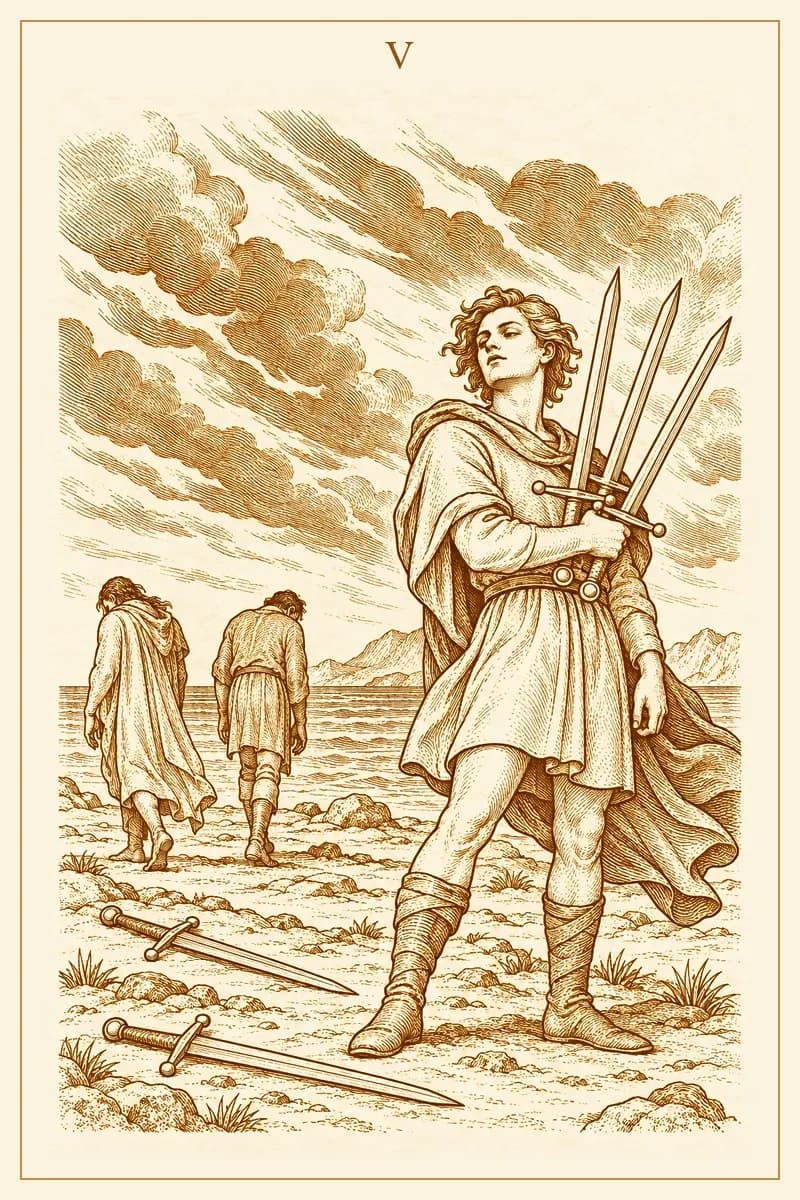
The general who won the battle and the recruit who hasn't seen one yet are both technically on the winning side. The difference is visible in their faces. The Five of Swords' victor holds three swords with a smile that isn't triumph — it's the particular expression of someone who won by methods that cost them the respect of the people walking away. Two swords lie on the ground. Two figures retreat with slumped shoulders. The battle was won, and something else was lost.
The Fool stands outside the battlefield entirely. No sword, no stake in the fight, no understanding of what it costs to win the way the Five of Swords wins. The Fool's innocence isn't ignorance of conflict — it's the specific condition of someone who hasn't yet been forced to choose between winning and keeping what winning is supposed to protect.
When these two cards appear together, they describe the full distance between someone who doesn't yet know what conflict costs and someone who has just paid the price.
The Core Tension
The Five of Swords is the deck's clearest depiction of pyrrhic victory: the win that costs more than it gains. The figure holding the collected swords hasn't technically lost — the swords are in hand, the opponents are walking away — but the victory is hollow. What was won is less than what was destroyed to win it. The relationships, the trust, the collegial ground that existed before the fight — all sacrificed for tactical advantage.
The Fool has no experience of this particular transaction. The Fool hasn't yet been in a situation where winning required losing something else. The Fool's openness to conflict is the same as the Fool's openness to everything: untested, unconditioned, free of the specific weight that the Five of Swords carries.
Together, they map the territory between the state before you know what conflict really costs and the state immediately after you've paid that price. The combination asks whether the price was necessary and whether the Fool's pre-conflict perspective offers any useful information about what was sacrificed.
Love & Relationships
The Five of Swords in romantic readings describes the fight that was won at the relationship's expense: the argument where being right mattered more than being kind, the victory that proved the point and damaged the connection. This is the relationship aftermath where one person holds the swords and the other is walking away.
The Fool alongside this introduces the possibility that the fight wasn't necessary — that the Fool's openness could have met the situation without the weaponry. Whether this is naive or wise depends on whether the conflict addressed something real or was the Five of Swords' competitive instinct applied to territory that didn't need conquering.
Career & Purpose
The Five of Swords at work is the colleague who wins the political battle and loses the collaborative relationship: the presentation that undermined a peer, the credit claimed at someone's expense, the promotion achieved through methods that the team noticed. The Fool is the perspective that asks whether the battle needed fighting in those terms.
This combination appears in professional readings when the cost of a recent victory is becoming apparent. The swords are in hand; the allies are fewer. The Fool's energy offers the possibility of a different approach to the next conflict — but only if the Five of Swords' competitive pattern is recognized as a pattern rather than a necessity.
Shadow Side
The Five of Swords' shadow in this combination is the warrior who can no longer see any other way to engage. Every interaction becomes a battle; every conversation has a winner and a loser; the swords are always being collected. The Fool's openness is perceived as weakness rather than a different mode of engagement, which guarantees that the Five's pattern continues.
The Fool's shadow is the refusal to acknowledge that conflict exists. Some situations genuinely require the willingness to fight. The Fool who encounters the Five of Swords and maintains total openness may not be demonstrating wisdom — the Fool may be demonstrating the kind of undefended presence that the Five of Swords interprets as an invitation to take more swords.
Action Steps
- 1Identify one recent victory that cost more than it gained. Name specifically what was sacrificed — not the abstract concept but the actual relationship, trust, or goodwill that was lost.
- 2Find one current conflict where the Fool's openness could replace the Five of Swords' competitive approach. Not every disagreement needs a winner. Test whether this one does.
- 3Look at where your pattern of engagement in conflict has become automatic. The Five of Swords fights because fighting is what the Five does. Ask whether the current situation actually requires swords or whether a different instrument would serve better.
Related Pairings
Continue through published pairings that share The Fool or Five of Swords.

Reckless Momentum
Meaning of The Fool and The Chariot Combination: Reckless Momentum
costly victory
Meaning of The Chariot and Five of Swords Combination: Winning at a Cost

Innocence Meets Appetite
Meaning of The Fool and The Devil Combination: Innocence Meets Appetite
Toxic Power Games
Meaning of The Devil and Five of Swords Combination: Toxic Power Games

Structured Freedom
Meaning of The Fool and The Emperor Combination: Structured Freedom
pyrrhic authority
Meaning of The Emperor and Five of Swords: Winning at What Cost
✦ Bring it to the cards ✦
Bring The Fool and Five of Swords into your own reading
Use this pairing as a starting point, then let a spread listen to the situation that is actually yours.
Begin a contextual reading