
Card Combination

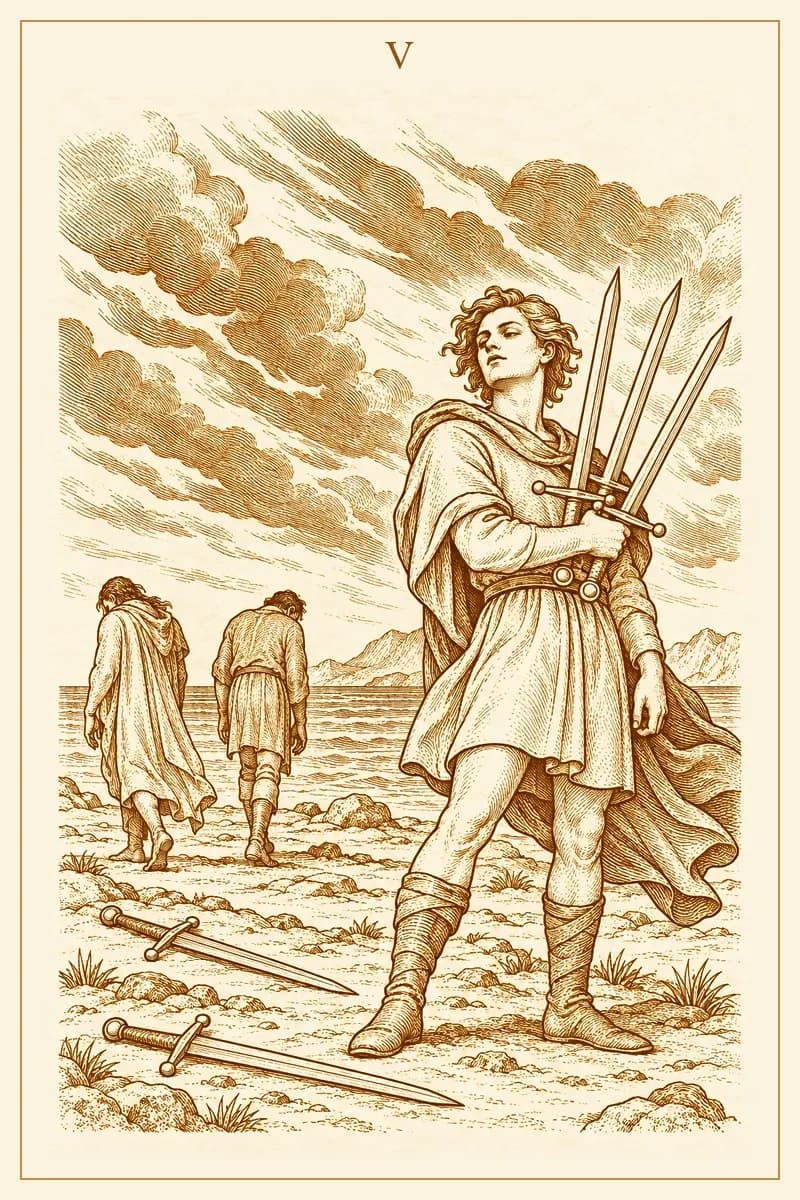
Meaning of The Emperor and Five of Swords: Winning at What Cost
pyrrhic authority
The scoreboard reads in your favor. The other team is walking off the field. The swords are yours — three of them, gathered up and carried away while your opponents retrieve what little remains. You won. And standing there in the silence after the final whistle, something feels profoundly wrong.
That is the atmosphere the Emperor and Five of Swords generate together. Authority claiming victory through methods that undermine the very foundation that authority was meant to protect. The Emperor is at his best when his power serves something larger than itself — order, stability, protection. The Five of Swords enters that equation and corrupts the motive. The win is real. The cost is also real. This combination does not let you look away from either.
What you are dealing with is not a question of whether you have power. Clearly, power is present. The question this pairing insists on raising is what that power is actually being used for — and what the people on the losing end of it think of you now.
The Core Tension
The Emperor's identity is built on legitimate authority. Structure, rules, hierarchy — these are the instruments through which he exercises control, and ideally, through which he creates security for those under his protection. The Five of Swords does not operate within that framework. It plays outside the rules, exploits weaknesses, takes more than is strictly necessary, and leaves the field littered with the consequences of a win that cost too much.
Together they create a figure who has the Emperor's power but is using it in the Five of Swords' manner: dominance for its own sake, victory as a performance, authority wielded to diminish rather than to build. The tension lies in the gap between what power is designed to accomplish versus what it has become in practice. This is the coach who wins every game and loses every player. The executive who hits every target and empties every room they enter.
Love & Relationships
In romantic relationships, this combination often surfaces when a power imbalance has become the defining feature of the dynamic. One person is setting all the terms, winning every argument, controlling the pace and direction of the relationship — and justifying it through some version of "I know what's best" or "I'm just being realistic."
The Five of Swords in love is not simply conflict. It is conflict where someone is keeping score. The Emperor's presence here means that score-keeping has been elevated to a system. Past grievances are catalogued. Victories are remembered. The other person is slowly being trained to stop engaging honestly because engaging honestly means losing.
If this is you on either side of that dynamic — the one keeping score or the one whose voice has gone quiet — this pairing is a direct signal that the current structure is not sustainable. Love is not a territory to be held. It does not work under military occupation.
Career & Purpose
Professionally, the Emperor and Five of Swords point to environments or individuals where competition has turned corrosive. The driven leader who undercuts colleagues to protect their position. The organization that wins market share through practices it would not want publicized. The manager who takes credit, assigns blame downward, and calls it leadership.
Short term, this approach can produce measurable results. That is precisely what makes it dangerous — it works long enough to feel validated. But the Five of Swords always leaves wreckage, and the Emperor is standing in it. Talent leaves. Trust erodes. The authority that once commanded respect starts requiring enforcement.
If you are in a workplace where this energy is dominant, this combination is less about your own behavior and more about your proximity to someone else's. The question is whether you are participating, enabling, or simply witnessing — and what each of those positions is costing you.
Shadow Side
The Emperor's shadow is the tyrant: someone who has confused control with care and domination with protection. The Five of Swords accelerates that shadow, stripping away any remaining pretense. What is left is naked aggression wearing the costume of authority.
The specific shadow danger here is self-justification. Every choice made in this energy comes equipped with a rationale. The rules don't apply because the stakes are too high. The other person deserved it. Someone had to make the hard call. These stories are coherent. They are also the stories that prevent any genuine reckoning with what has actually happened.
Action Steps
- 1List the last three conflicts where you came out ahead and honestly assess whether anyone was left worse off than the situation required.
- 2If you are in a competitive environment, identify one place where you could pull back slightly without losing ground — then do it, just to prove to yourself that you can.
- 3Have a direct conversation with someone you have recently beaten in any context — work, relationship, negotiation — and listen to their account of what happened without defending your position.
- 4The Emperor and Five of Swords do not celebrate victory. They interrogate it. You may have all the swords, but authority that can only maintain itself by taking from others is not authority — it is a countdown. The real test of power is not how many conflicts you win. It is who is still standing beside you when the winning is done.
Related Pairings
Continue through published pairings that share The Emperor or Five of Swords.

structured forward momentum
Meaning of The Emperor and The Chariot: Authority in Motion
costly victory
Meaning of The Chariot and Five of Swords Combination: Winning at a Cost

authority versus control
Meaning of The Emperor and The Devil: When Authority Becomes a Cage
Toxic Power Games
Meaning of The Devil and Five of Swords Combination: Toxic Power Games
control vs release
Meaning of The Emperor and The Hanged Man: When Control Meets Surrender
outer vs inner authority
Meaning of The Emperor and The Hermit: Command Meets Solitude
✦ Bring it to the cards ✦
Bring The Emperor and Five of Swords into your own reading
Use this pairing as a starting point, then let a spread listen to the situation that is actually yours.
Begin a contextual reading