
Foundations · 12 min
The court family
The sixteen court cards as four ranks in four suits: what each rank adds, and how a court can be a person, a part of you, or an approach to take.
In this lesson you will
- Name what each rank adds: Page, Knight, Queen and King.
- Combine a rank with a suit to describe any court card.
- Read a court as a person, a part of yourself, or an approach.
A reading about your new job turns up a King, and your first thought is your manager. Maybe. But a court card can also describe a part of you, or a way of handling the situation, and often that is the more useful reading.
Four ranks
The 16 court cards are four ranks, each appearing in all four suits. Like the numbers, the ranks follow a path, from first curiosity to full responsibility. Learn what each rank adds, and you have a quarter of every court card already.
| Rank | Mode | In a sentence |
|---|---|---|
| Page | Learning, messages, curiosity | Someone starting out and eager to learn |
| Knight | Action, pursuit, movement | Someone on the move, sometimes too fast |
| Queen | Inner mastery, care, receptivity | Someone who holds and nurtures |
| King | Outer mastery, direction, responsibility | Someone who leads and decides |
Then add the suit. A Queen cares; a Queen of Cups cares through feeling, and a Queen of Pentacles through practical support. The rank tells you how a court acts, and the suit tells you where.
Warm up
A quick look back before the new material. Recalling helps you remember.
Warm-up
Using the number arc and the suit, what would you expect the Five of Wands to be about?
Warm-up
Your question is about an argument with a coworker: what was said, and how to decide what to do next. If the Ace of Swords appeared, why would it fit this territory?
Look first


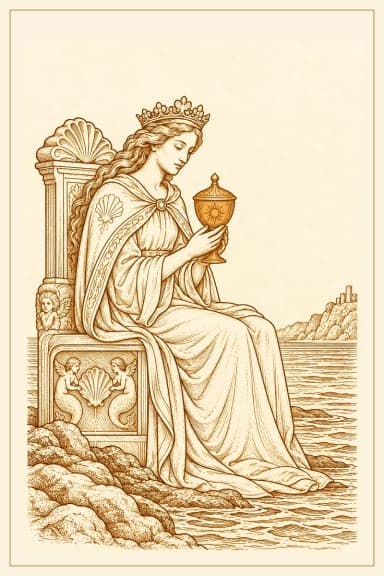
Look at these three court cards before reading on. Which one is still, which is moving, and which seems to be learning something?