
Card Combination
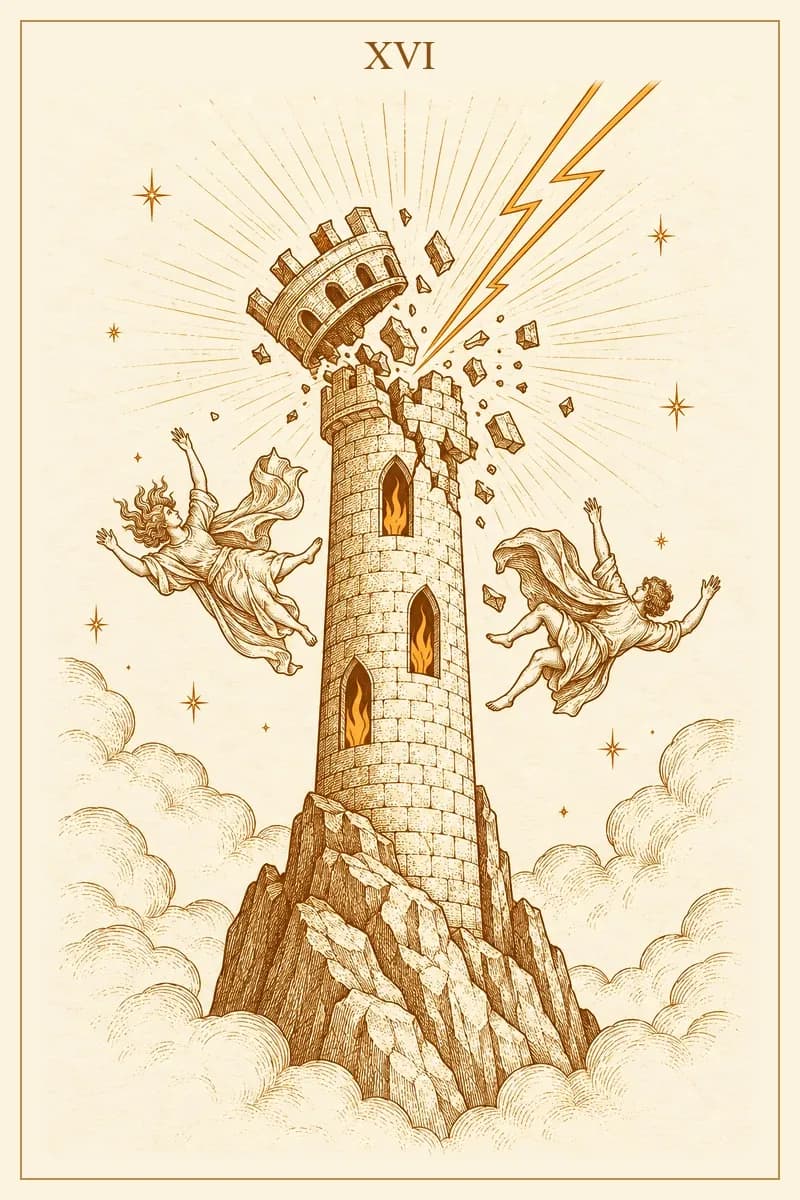
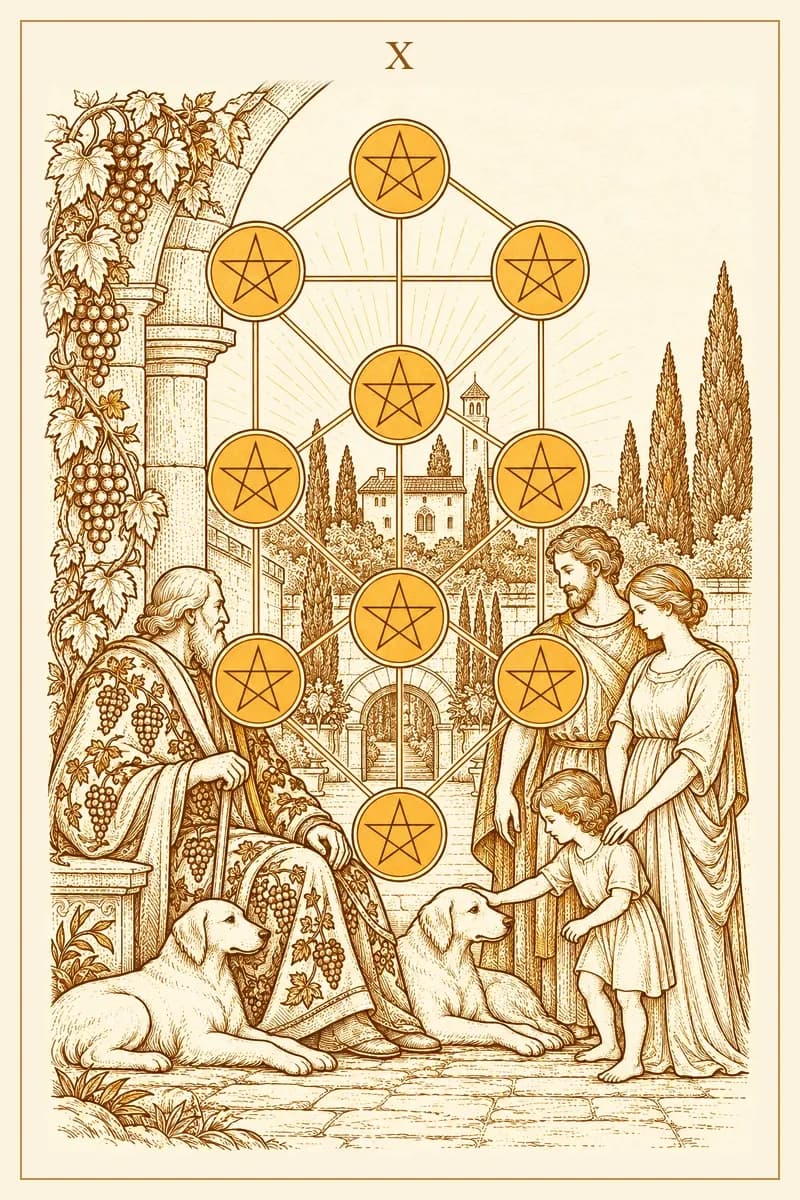
Meaning of The Tower and Ten of Pentacles Combination: The Dynasty Shattered
Legacy under fire
Picture a manor house that has stood for three generations — stone walls worn smooth by family hands, a crest above the doorway, roots sunk deep into the land. Now picture the moment lightning finds it. Not a slow decay. Not a quiet sale. A single, searing bolt that cracks the foundation and sends the chimney crashing into the courtyard below. That is what The Tower and the Ten of Pentacles ask you to hold at the same time: the permanence of what was built, and the violence of its unbuilding.
Most people fear The Tower because it destroys. Most people love the Ten of Pentacles because it endures. When these two cards appear together, the message is neither pure catastrophe nor pure comfort — it is something far more specific. It says that what is falling apart was real, was earned, was worth grieving. The lightning does not hit empty fields. It hits the house you actually lived in.
This combination carries the particular ache of inherited loss: a business that crossed generations, a family home forced onto the market, a financial safety net shredded in a single season. But within the rubble of a legacy, the Ten of Pentacles leaves one stubborn truth standing — bloodlines outlast buildings, and what was built once can, in time, be built again.
The Core Tension
The Ten of Pentacles is architecture frozen in time. It is the family crest, the trust fund, the grandmother's house — security so deep it feels geological. The Tower is the earthquake that reminds you geology is not permanent.
Together, they create a tension between continuity and rupture. The Ten of Pentacles insists that the past has value, that legacy matters, that what your family accumulated deserves protection. The Tower insists that protection is an illusion. Neither card is wrong. The tension between them is the entire point.
This pairing tends to surface when a long-stable structure — financial, familial, or institutional — meets an event it was never designed to survive. A recession that wipes out a family business. A patriarch's death that unravels the estate. A revelation that reframes the story of how the dynasty was built in the first place. The question this combination asks is not "why did this happen?" but "who do you become when the inheritance is gone?"
Love & Relationships
In relationships, The Tower and Ten of Pentacles often signals a rupture at the foundation level — not a fight, but a structural fracture. A family's disapproval that finally becomes impossible to ignore. A shared financial crisis that exposes incompatibilities neither partner wanted to examine. A divorce that dismantles not just the marriage but the family compound, the joint accounts, the carefully arranged future.
For couples, this pairing warns against conflating the relationship with the security it provides. If the house is the relationship and the relationship is the house, then any threat to financial stability becomes a threat to love itself. The invitation is to locate the bond beneath the structure — to ask whether what you share would survive if all the material scaffolding fell away.
For singles, this combination often appears after a long-term relationship ends and leaves an entire future blueprint in ruins. The grief here is architectural: you are not just mourning a person, you are mourning the floor plan.
Career & Purpose
Professionally, this is the combination of the family business in crisis. A forced restructuring that guts three decades of growth. A succession plan collapsed by sudden death or scandal. A market shift that makes an entire business model — one that worked beautifully for a generation — suddenly obsolete.
If you are employed by or have inherited a legacy institution, this pairing is a direct warning: what sustained the enterprise before will not sustain it now. The Ten of Pentacles tends to resist change precisely because it has so much to lose. The Tower does not negotiate. Adaptation here is not optional — it is the only available architecture.
Shadow Side
The shadow of this combination is the refusal to let the ruins be ruins. When legacy and loss combine, the temptation is to rebuild the exact same structure on the exact same broken ground — to restore the dynasty as it was rather than create what is actually needed now. The Ten of Pentacles, at its worst, is nostalgia calcified into policy. Paired with The Tower, this impulse prolongs the damage and prevents any genuine rebuilding.
There is also a subtler shadow: shame. Losing a legacy — especially one tied to family identity — can feel like a personal failure across generations. Carrying that weight silently compounds the collapse.
Action Steps
- 1Separate the institution from the people — identify one relationship within the crumbling structure that you want to preserve, and invest in it directly rather than through shared assets.
- 2Conduct a single honest inventory: list what was genuinely lost, what is still intact, and what you have been calling "intact" to avoid facing its damage.
- 3Before rebuilding anything, ask whether the original blueprint still fits who you are now — and give yourself permission to draw new plans entirely.
Related Pairings
Continue through published pairings that share The Tower or Ten of Pentacles.

Controlled force shattered
Meaning of The Chariot and The Tower Combination: Momentum Meets Collapse
Ambition versus legacy
Meaning of The Chariot and Ten of Pentacles Combination: Drive Meets Dynasty

Sudden audit of attachment
Meaning of The Devil and The Tower Combination: Chains Shattered by Fire
Gilded imprisonment
Meaning of The Devil and Ten of Pentacles Combination: The Golden Cage

Authority meets collapse
Meaning of The Emperor and The Tower Combination: When the Fortress Falls
Structured legacy
Meaning of The Emperor and Ten of Pentacles Combination: Lasting Legacy
✦ Bring it to the cards ✦
Bring The Tower and Ten of Pentacles into your own reading
Use this pairing as a starting point, then let a spread listen to the situation that is actually yours.
Begin a contextual reading