
Card Combination

Meaning of The Hierophant and Knight of Swords Combination: Doctrine Under Fire
Doctrine under fire
Armies have two kinds of generals: the one who studies every precedent before moving a single battalion, and the one who reads the terrain once and charges. Put them in the same command tent and you get either military genius or catastrophic insubordination. That is the energy this card pairing brings to a reading — deep institutional knowledge locking horns with the impulse to cut through delay and act.
The Core Tension
The Hierophant occupies the slow, structured end of the tarot. He is the keeper of tradition — the figure who validates through ceremony, who asks you to follow the established path because countless generations tested it and found it sound. His authority does not shout. It waits, robed and still, confident that time will confirm what the institution already knows.
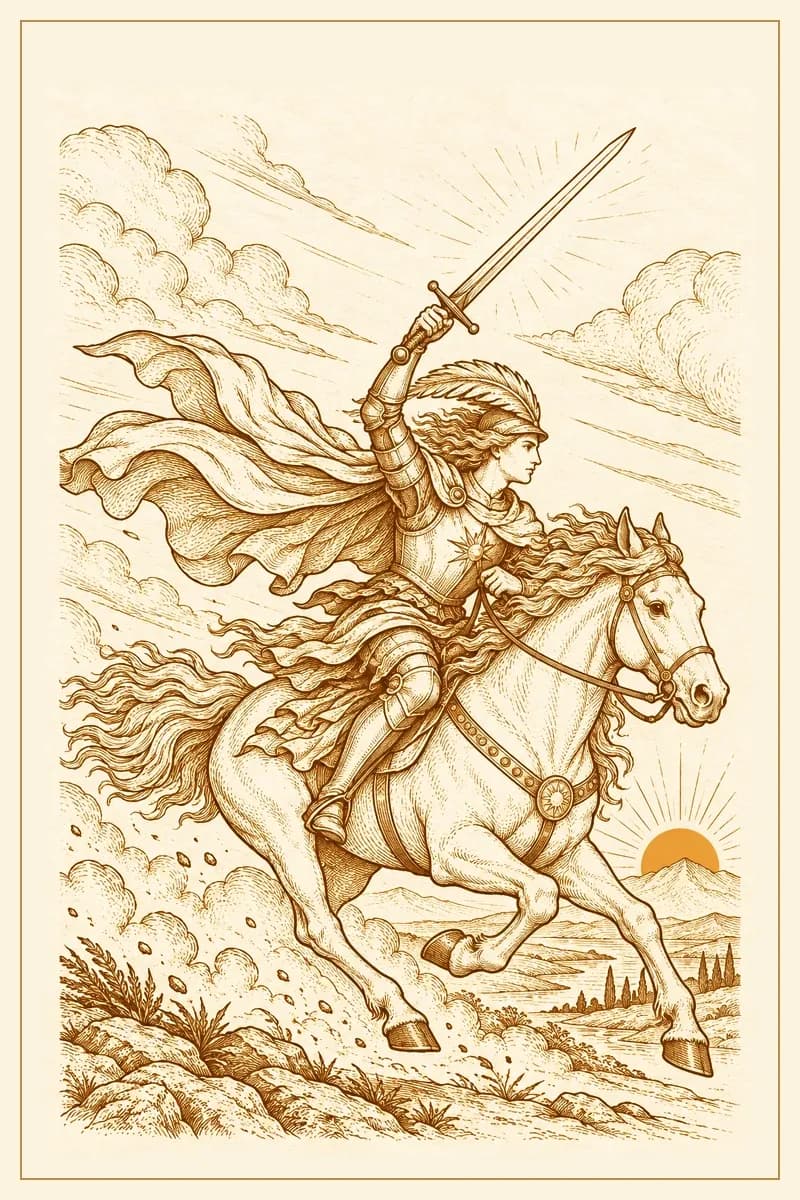
The Knight of Swords is the opposite of stillness. He rides at full gallop, sword forward, eyes fixed on whatever lies ahead. He is not reckless for the sake of thrill — he genuinely believes that speed is a form of integrity, that hesitation is its own kind of harm. If a truth needs saying, say it now. If an obstacle needs clearing, clear it today.
Together, these two create a war-strategy problem: Do you hold the established defensive line, or do you break formation and press forward? The Hierophant argues that the protocol exists for good reason. The Knight argues that the situation has already moved past the protocol. Both are frequently right. The difficulty is that they cannot both be obeyed at the same time.
Love & Relationships
In romantic readings, this pairing often appears when someone is caught between what their relationship structure demands and what their heart insists must be said or done immediately.
The Hierophant energy in a relationship might be a shared commitment to how things are handled — slow conversation, family approval, respecting a timeline. The Knight of Swords energy wants to bypass all of that: say the hard thing now, make the decision tonight, stop pretending the problem can wait another week.
For single people, this combination can point to attraction to someone whose values or background differ sharply from the expectations of family or community — the classic conflict between who you are supposed to be with and who you are actually drawn to.
The key question here is not whether the Knight's urgency is wrong. Sometimes it is absolutely correct that a conversation has been avoided too long. The question is whether charging forward will destroy something that needed more care to dismantle, or whether the delay itself is the real damage.
Career & Purpose
Professionally, this pairing shows up most clearly in organizations where established process meets urgent pressure. You may be the person who knows the correct channels, the right forms, the approved timeline — and you may be surrounded by someone (or several someones) who believe that waiting for approval is indistinguishable from failure.
The Hierophant position: procedure protects everyone. Skip the protocol and you expose the project, the team, or yourself to consequences that the protocol was designed to prevent. The Knight position: the window closes while the forms are being routed to the correct desk.
If you are in a leadership role, this pairing is a warning to examine whether your structure is genuinely protective or merely comfortable habit. If you are in an execution role, it is a reminder that breaking from protocol has costs that compound — and that winning the argument today may cost you the credibility to argue next time.
Shadow Side
The darkest version of this pairing is the zealot who charges forward in the name of truth and leaves scorched earth behind. The Knight of Swords, unchecked, does not slow down to notice collateral damage. The Hierophant, unchecked, becomes institutional capture — the rule for the rule's sake, the tradition that has outlived its usefulness but cannot be questioned because questioning itself is treated as heresy.
Watch for signs that urgency is being used to bypass accountability. Watch equally for signs that tradition is being used to avoid necessary discomfort.
Action Steps
- 1Before acting on the Knight's impulse, identify one specific reason the existing protocol was created. If the reason no longer applies, that is your argument for moving faster. If it still applies, factor it into your plan.
- 2Before deferring to the Hierophant's caution, identify the real cost of the delay. If the cost is discomfort or friction, slow down. If the cost is a closing window or a person being harmed, speak now.
- 3Find the one person in your situation who has navigated both demands successfully — who moved fast and maintained credibility. Study how they did it.
- 4Doctrine and urgency are not natural enemies, but they do not naturally cooperate either. This pairing demands that you develop the capacity to hold both — to know when the structure is protecting something real, and when it is simply protecting itself. The Knight of Swords will always find a way forward. The Hierophant ensures that the path forward does not leave the essential things in ruins.
Related Pairings
Continue through published pairings that share The Hierophant or Knight of Swords.
Sacred rebellion
Meaning of The Fool and The Hierophant Combination: Tradition Meets Freedom
Unconditioned openness encountering aggressive intellectual momentum
Meaning of The Fool and Knight of Swords Combination: Reckless Meets Relentless

Structured mastery
Meaning of The Magician and The Hierophant Combination: The Cathedral You Build Yourself
Deliberate strategy confronting unrestrained speed
Meaning of The Magician and Knight of Swords Combination: Strategy Meets the Charging Cavalry

Inner and outer doctrine
Meaning of The High Priestess and The Hierophant Combination: Inner and Outer Doctrine
Speed versus depth
Meaning of The High Priestess and Knight of Swords Combination: Speed Meets Depth
✦ Bring it to the cards ✦
Bring The Hierophant and Knight of Swords into your own reading
Use this pairing as a starting point, then let a spread listen to the situation that is actually yours.
Begin a contextual reading