
Card Combination

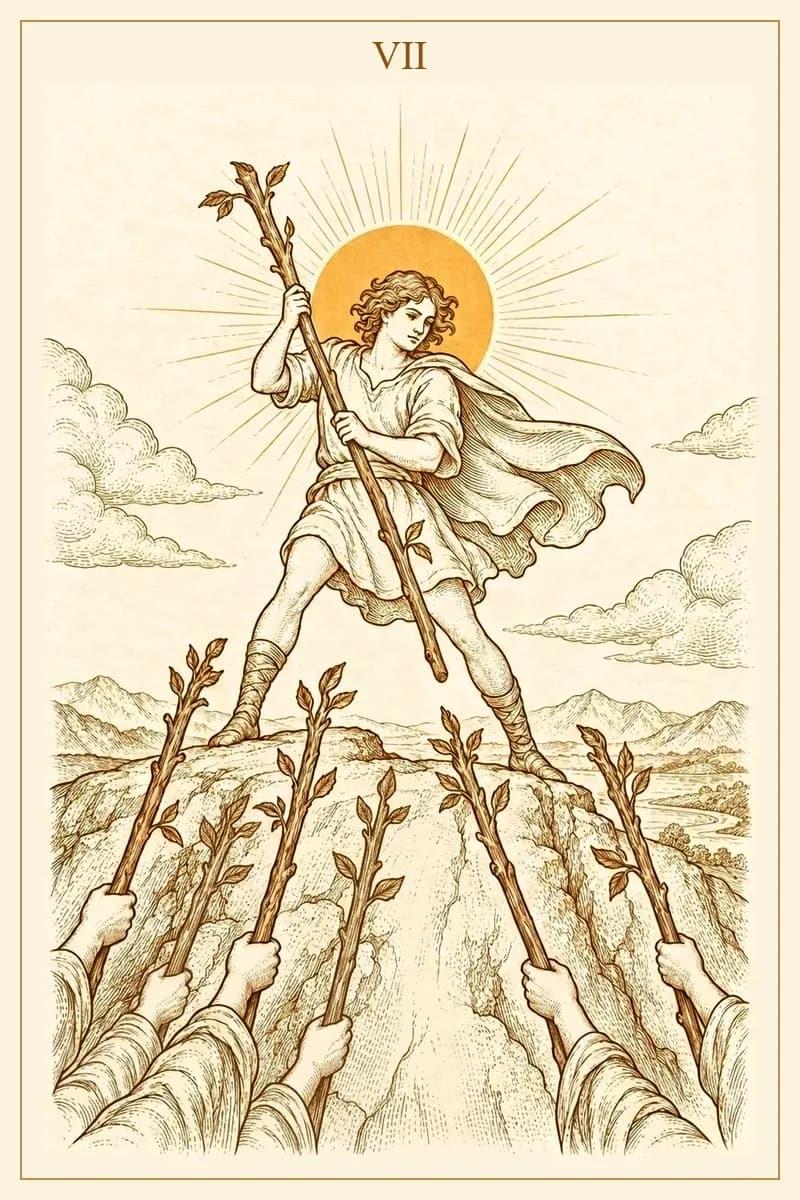
Meaning of The Hierophant and Seven of Wands Combination: Defended Doctrine
Doctrine under siege
The strongest walls are not built by people who fear attack. They are built by people who believe so completely in what stands inside that they will pour every stone, every hour, every ounce of certainty into keeping it upright. That is the paradox at the center of this combination: the more fiercely you defend a position, the more you must ask whether the defense itself has become the point.
The Hierophant holds doctrine. It carries centuries of accumulated wisdom, institutional weight, and the quiet confidence of a tradition that has outlasted many challenges. The Seven of Wands stands on high ground and fights — not from aggression but from the conviction that what it holds is worth protecting. Together these cards describe a person or situation where traditional beliefs, established methods, or orthodox values are being tested from multiple directions simultaneously, and the person at the center is choosing to hold the line.
The structural image is apt: think of a medieval cathedral under renovation, scaffolding on every face, critics arguing it should be demolished and replaced, and the master architect refusing to hear it. The foundation is sound. But the architect has not slept in weeks.
The Core Tension
The Hierophant and Seven of Wands share a commitment to position-holding, which makes them natural allies — and that is exactly the problem. Two energies that both resist change, stacked together, can calcify into stubbornness so complete that no new information penetrates. The tension is not between these two cards but between them and the world they are facing.
The real question this pairing raises: is the position being defended because it is genuinely worth defending, or because defending it has become the primary source of identity? A cathedral is not a home. A doctrine is not a person. At some point, even the most righteous defense must reckon with what it is actually protecting.
Love & Relationships
In relationships, this combination often surfaces in long-term partnerships where one or both partners are holding firm to ideas about how love, commitment, or family should look. There may be external pressure — from family, from cultural expectations, from a partner who wants the relationship to evolve — and someone is planting their feet.
This is not necessarily wrong. Standing by genuine values in the face of external opinion takes real integrity. But the Seven of Wands asks a sharper question: is the defense of the relationship itself actually nurturing it? Fortresses keep people out. Sometimes they also trap the people inside. A weekly ritual, an honest conversation with the right questions, or simply naming the pressure aloud can provide more structural stability than any amount of positional stubbornness.
Career & Purpose
Professionally, this combination appears when someone with experience, credentials, and institutional backing is being challenged — by newcomers, by market shifts, by colleagues who prefer a different approach. The Hierophant says the established method has proven value. The Seven of Wands says hold your ground. The architecture holds, for now.
What to watch: the fight can become its own career. Endless defensive maneuvering against a changing landscape drains energy that could be redirected toward genuine contribution. If you find yourself spending more time justifying your approach than actually executing it, something has shifted. Defending a position from a place of strength looks different from defending it out of fear that the ground is shifting underfoot.
Shadow Side
The shadow here is orthodoxy as armor. The Hierophant's traditions and the Seven of Wands' defensive posture can combine into a fortified refusal to examine the foundation itself. What began as principled conviction can harden into a structure where questioning the walls feels like a betrayal of everything inside them.
There is also a social shadow: the person defending traditional ground can become isolated. Other people — even those who once agreed — gradually stop engaging when every conversation becomes a battle for the same hill. The architecture remains standing, but the building empties out.
Action Steps
- 1Write down the core belief or position you have been defending, then ask whether you would hold it if no one was challenging it — the answer reveals whether this is conviction or reaction.
- 2Identify one genuine challenger and engage with their actual argument rather than your prepared rebuttal; understanding does not require agreement.
- 3Find one place where the structure you are protecting could be updated or improved without compromising its foundation, and make that change voluntarily.
- 4The Hierophant and Seven of Wands together describe the architecture of conviction: load-bearing walls of tradition meeting sustained external pressure. The structure can hold, and sometimes it absolutely should. The cost of holding it, however, must be counted honestly — the sleepless architect is still an architect, but a rested one builds better. Know what you are protecting and why, or the defense will eventually become the structure itself.
Related Pairings
Continue through published pairings that share The Hierophant or Seven of Wands.
Sacred rebellion
Meaning of The Fool and The Hierophant Combination: Tradition Meets Freedom
Unexpected defense
Meaning of The Fool and Seven of Wands Combination: Standing Ground You Didn't Plan to Defend

Structured mastery
Meaning of The Magician and The Hierophant Combination: The Cathedral You Build Yourself
Skilled defense under pressure
Meaning of The Magician and Seven of Wands Combination: Defending What You've Built

Inner and outer doctrine
Meaning of The High Priestess and The Hierophant Combination: Inner and Outer Doctrine
Certainty under pressure
Meaning of The High Priestess and Seven of Wands Combination: Hold Your Ground with Inner Knowing
✦ Bring it to the cards ✦
Bring The Hierophant and Seven of Wands into your own reading
Use this pairing as a starting point, then let a spread listen to the situation that is actually yours.
Begin a contextual reading