
Card Combination
Meaning of The Hierophant and Five of Wands Combination: Doctrine Under Fire
Plan versus terrain
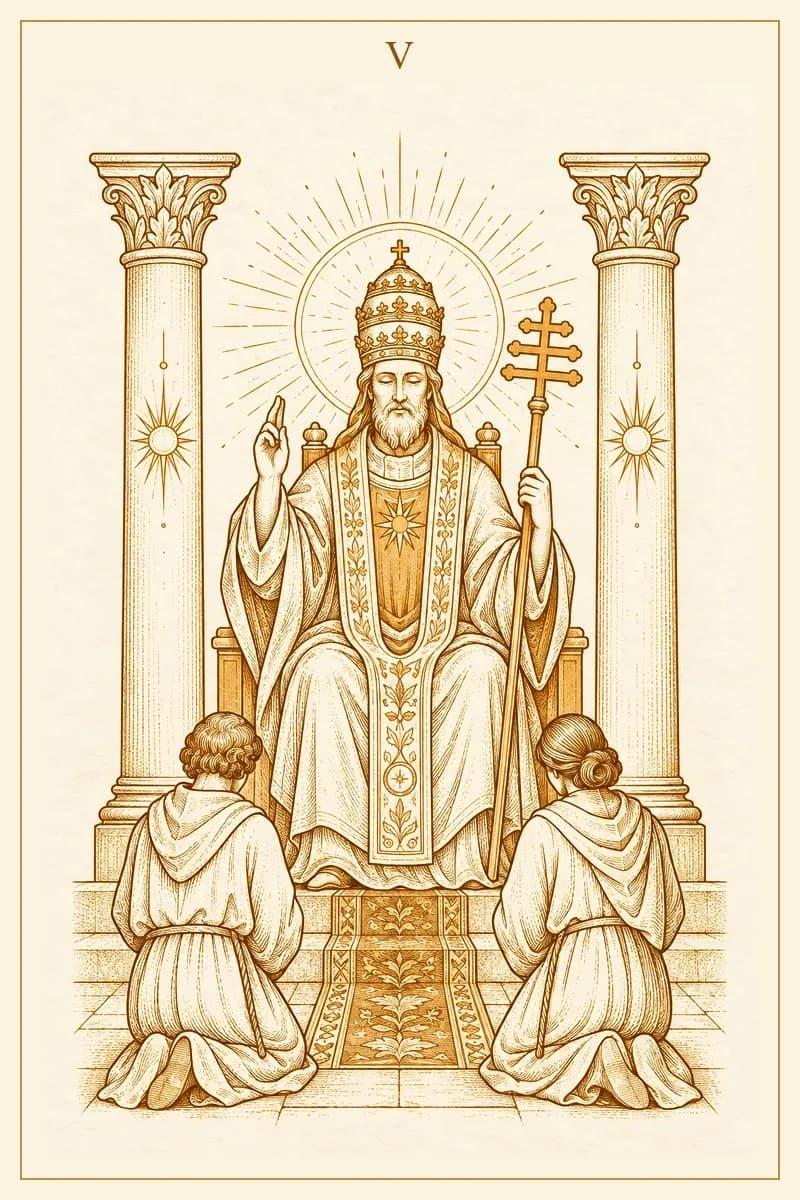
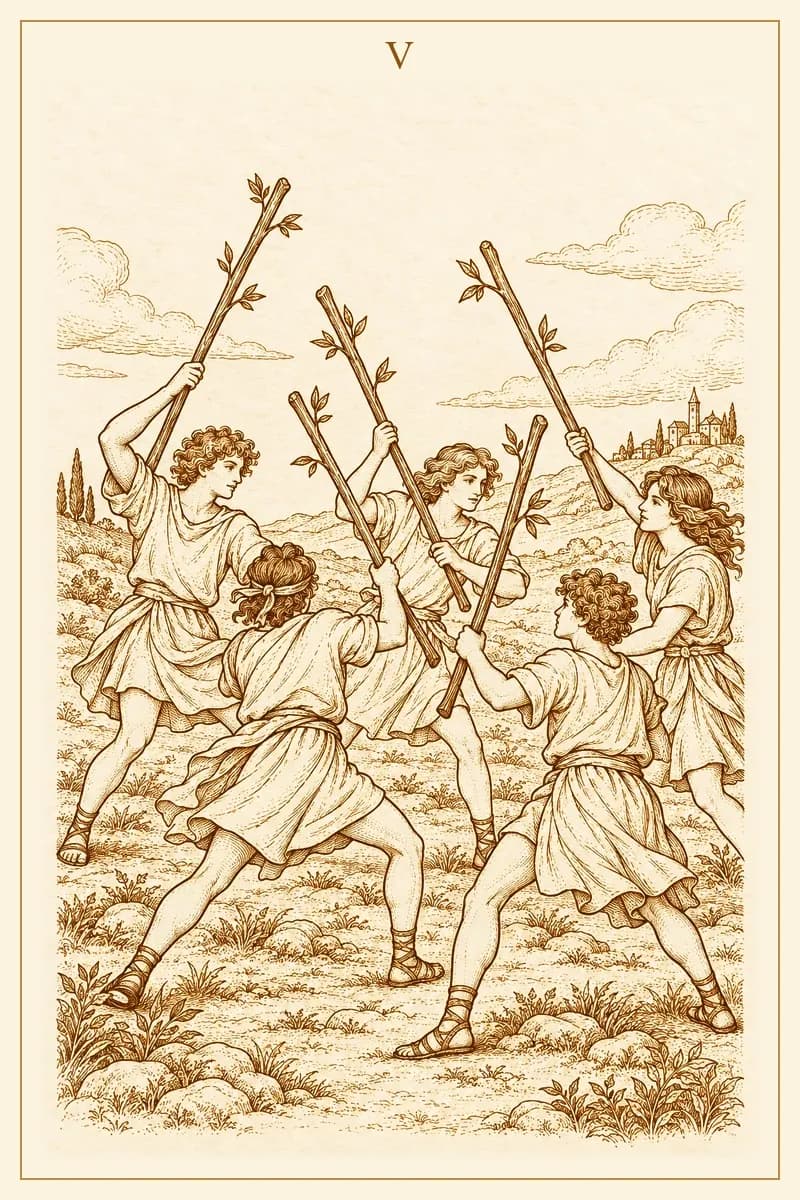
Every war begins with someone insisting they know the right way. The Hierophant carries the doctrine — the established position, the sanctioned interpretation, the tradition backed by centuries of institutional weight. The Five of Wands carries the chaos of a field where nobody has agreed to stop fighting yet. Put them together and you get a battlefield where the argument is not merely tactical but theological: whose version of truth gets to win?
This combination does not describe peaceful difference of opinion. It describes the friction that erupts when an authority structure meets a situation it cannot simply absorb or dismiss. The Five of Wands is scrappy, competitive, and resistant to being organized. The Hierophant wants everything organized, classified, and assigned to its proper place within the hierarchy. Neither card backs down easily.
What emerges from this collision is almost always productive, even when it is painful.
The Core Tension
Military strategy illuminates this pair. A general with an established battle plan encounters terrain that doesn't match the map. The doctrine says advance through the valley; the valley, it turns out, is full of ambushes. The question is whether the general trusts the doctrine or trusts what is actually happening in front of them.
The Hierophant represents the battle plan — the accumulated wisdom of how conflicts like this are supposed to be handled. The Five of Wands represents the messy actual terrain: the competing voices, the unexpected resistance, the refusal of circumstances to conform to the approved model. This pair asks whether you can hold onto what is genuinely valuable in your tradition while adapting to what is genuinely new in your situation.
The answer is never "abandon everything" and never "ignore the terrain." It is always a negotiation.
Love & Relationships
In romantic contexts, this pairing signals a relationship where values are being contested rather than shared. One person may hold firm religious, cultural, or family expectations around partnership; the other may be pushing back — not out of malice but because their lived experience doesn't match the doctrine they're being handed.
This can show up as arguments about commitment timelines, family involvement, the "right" way to structure a partnership, or whose background and traditions take precedence. The Five of Wands energy here is not destructive by nature — conflict can clarify what people actually need rather than what they think they're supposed to need.
The danger is when the Hierophant energy hardens into non-negotiable ultimatums. When tradition becomes a weapon rather than a resource, the Five of Wands chaos tends to intensify rather than resolve.
Career & Purpose
Professionally, this combination appears when someone is challenging an institutional way of doing things — questioning the official process, pushing back on management decisions, or advocating for a different approach against significant resistance. The five figures in the Five of Wands are not attacking each other; they are all fighting to have their method heard.
The Hierophant suggests that the institution in question has genuine authority and experience behind it. This is not simply bureaucratic inertia — there are real reasons the established approach exists. But the Five of Wands insists those reasons need to be tested rather than assumed.
If you are the one doing the challenging, do your homework. Institutional wisdom doesn't yield to loud objection alone; it yields to better-argued alternatives. If you represent the institution, consider whether what looks like insubordination might actually be signal rather than noise.
Shadow Side
The shadow of this pairing is ideological rigidity meeting pointless aggression. The Hierophant's shadow is the institution that has confused its own preservation with the protection of truth — fighting to maintain authority not because it serves people but because losing authority feels intolerable.
The Five of Wands' shadow is conflict for its own sake: challenging systems not to improve them but to prove something about oneself, to feel powerful in opposition, to avoid the harder work of actually building something better.
When both shadows activate together, you get endless culture war energy — combatants defending positions long after the original question has been forgotten, more invested in not being wrong than in being right about anything that matters.
Action Steps
- 1Identify one belief or rule you've been defending mostly out of habit — then ask what it would actually cost you to examine it honestly.
- 2If you are in a conflict with an authority or institution, articulate what you are genuinely asking for in one clear sentence before your next interaction.
- 3Look for one person involved in a dispute you're part of whose position you actually understand, even if you disagree with it — start there.
- 4The Hierophant and Five of Wands force the question that every tradition eventually has to answer: does this still hold? The doctrine meets the pushback, the established order meets the scramble, and something has to give — or more accurately, something has to be renegotiated. The pair does not promise easy resolution, but it promises that the fight, if engaged honestly, will clarify something that was fuzzy before.
Related Pairings
Continue through published pairings that share The Hierophant or Five of Wands.

Authority meets doctrine
Meaning of The Emperor and The Hierophant Combination: Two Pillars of Order

Contested momentum
Meaning of The Chariot and Five of Wands Combination: Drive Through the Storm
Abundance versus doctrine
Meaning of The Empress and The Hierophant Combination: Nature Meets Doctrine

Toxic competition
Meaning of The Devil and Five of Wands Combination: Toxic Competition
Sacred rebellion
Meaning of The Fool and The Hierophant Combination: Tradition Meets Freedom
Order versus chaos
Meaning of The Emperor and Five of Wands Combination: Order Confronting Chaos
✦ Bring it to the cards ✦
Bring The Hierophant and Five of Wands into your own reading
Use this pairing as a starting point, then let a spread listen to the situation that is actually yours.
Begin a contextual reading