
Card Combination

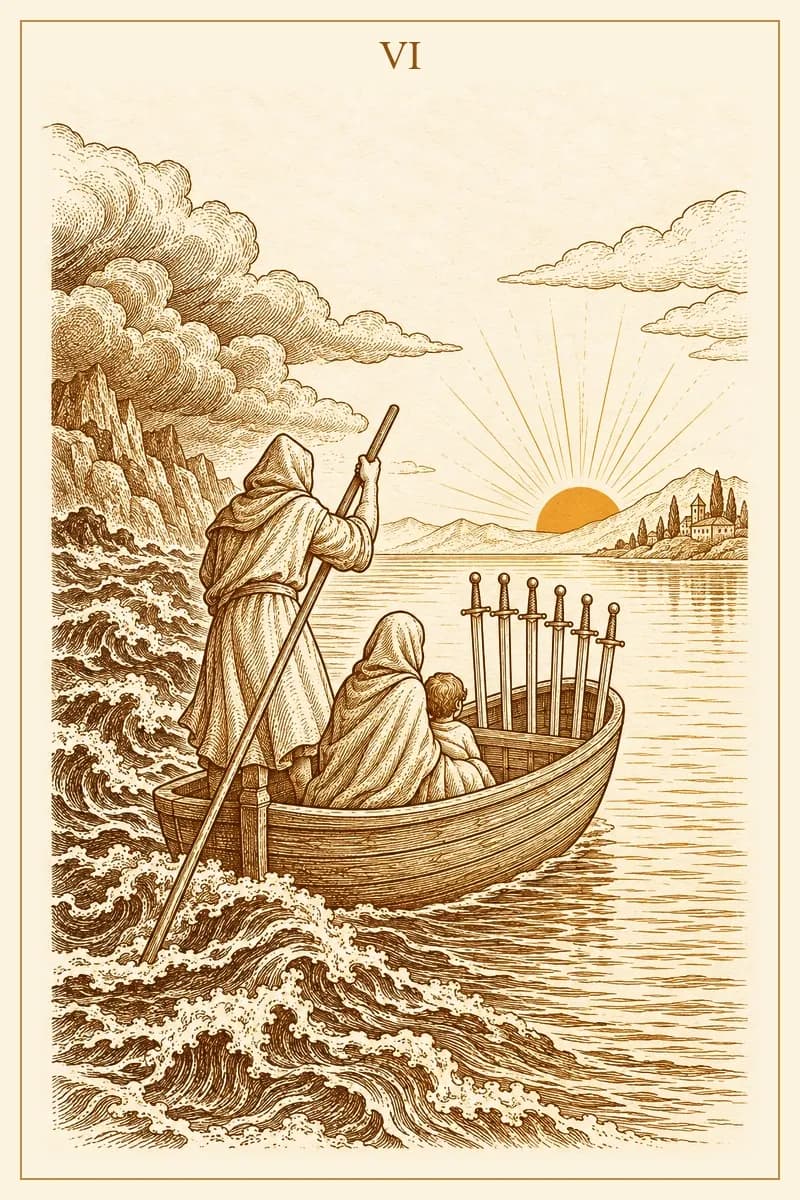
Meaning of The Hermit and Six of Swords Combination: Leaving With What You Know
Deliberate departure
Wisest moves often look like retreat. An architect who demolishes a load-bearing wall without understanding the structure above it isn't being bold — they're being reckless. But one who studies every joint, every point of stress, every crack that has been plastered over for years, and then decides which walls have to come down — that person looks like they're doing nothing right up until the moment the whole design becomes clear. Doing nothing and preparing to move are not the same thing. They rarely look different from the outside.
That gap between appearance and reality sits at the center of The Hermit and Six of Swords together. The Hermit studies. Six of Swords moves. The question is whether the study was complete enough to make the movement sound.
Most transitions fail not because people chose the wrong destination, but because they left before they understood what they were actually carrying. The grief that hadn't been named. The pattern that repeated in three different jobs. The belief about love that was installed in childhood and never examined. Six of Swords can move any of these things across the water — and The Hermit is the only force in the deck honest enough to insist on looking at the cargo before departure.
The Core Tension
A building's foundation has to be assessed before renovation, not during. You cannot reroute load-bearing elements while people are standing on the floor above. This is the structural problem inside this pairing: The Hermit's work is interior and slow; Six of Swords' movement has a current that pushes whether you're ready or not.
Life doesn't always grant the hermit's full study period before the boat has to leave. The transition is happening — a job has ended, a relationship has run its course, a city has stopped fitting who you are. The question these two cards ask is not whether to go. It's whether you've done enough inner work to know what you're building toward, or whether you're simply fleeing toward quieter water with the same blueprint you've always used.
There is a version of Six of Swords that is a genuine departure: deliberate, informed, carrying only what's actually useful. There is another version that is a sophisticated avoidance — moving to a new place, a new person, a new role, while the unexamined thing travels invisibly in the hull.
Love & Relationships
In relationships, this pairing sometimes signals a necessary ending that has been long considered. The Hermit's lantern has been turned inward; you've been honest with yourself about what the relationship is and isn't; now Six of Swords says the crossing is possible, even if not painless.
More often, though, it surfaces mid-relationship as one partner's need to withdraw and recalibrate before the dynamic can shift. Not a breakup — a renovation. Temporary structural work. If both people understand this, it holds. If only one person understands, the boat feels very small and the water very wide.
Watch for relationships where withdrawal is genuinely productive versus ones where it's become the default response to difficulty. The architecture metaphor holds: you can only delay structural assessment for so long before the building decides for you.
Career & Purpose
Professionally, Hermit plus Six of Swords describes the person quietly planning a departure or pivot. The lantern has been burning for months in private — reading, studying, mapping the next structure — while the surface life continues. This is not duplicity; it is preparation.
The risk is overthinking the foundation assessment until momentum dies. At some point the survey has to end and the crossing has to begin. The best builders know when the blueprint is good enough to break ground, even knowing that adjustments will come later. Perfectionism disguised as diligence is still a reason not to move.
Shadow Side
Leaving with the hermit's wisdom sounds ideal. The shadow is that the hermit's wisdom is sometimes comfortable with staying inside the question indefinitely. Six of Swords has a boat and a destination; The Hermit has a lantern and a cave. When the cave wins, the crossing never happens — the person processes their transition for years without ever actually making it.
The other shadow: moving without the hermit's preparation. Taking the boat before understanding why this particular turbulence kept finding you. Calmer water is real and available. The unexamined thing in the hull is also real, and it will make its own turbulence in time.
Action Steps
- 1Draw a two-column list: what you've genuinely understood about yourself through this difficult period in one column, and what you've been avoiding understanding in the other — the second column is what needs the lantern before you move.
- 2Identify one concrete thing you can do to advance the transition rather than continuing to prepare for it — preparation and movement are not the same wall.
- 3Name the destination in specific terms, not aspirational ones: not "somewhere better" but what, precisely, better would look like in your daily life six months from now.
Related Pairings
Continue through published pairings that share The Hermit or Six of Swords.

Solitary wandering
Meaning of The Fool and The Hermit Combination: Solitary Wandering
Undirected leap meeting deliberate passage to calmer waters
Meaning of The Fool and Six of Swords Combination: The Leap and the Crossing

Visible craft, hidden depth
Meaning of The Magician and The Hermit Combination: Mastery Behind Closed Doors
Directed transition — using skill and will to navigate away from turbulence
Meaning of The Magician and Six of Swords Combination: Skill Meets Passage

Inner lantern
Meaning of The High Priestess and The Hermit Combination: Inner Lantern
Intuition as navigator
Meaning of The High Priestess and Six of Swords Combination: The Inner Navigator
✦ Bring it to the cards ✦
Bring The Hermit and Six of Swords into your own reading
Use this pairing as a starting point, then let a spread listen to the situation that is actually yours.
Begin a contextual reading