
Card Combination
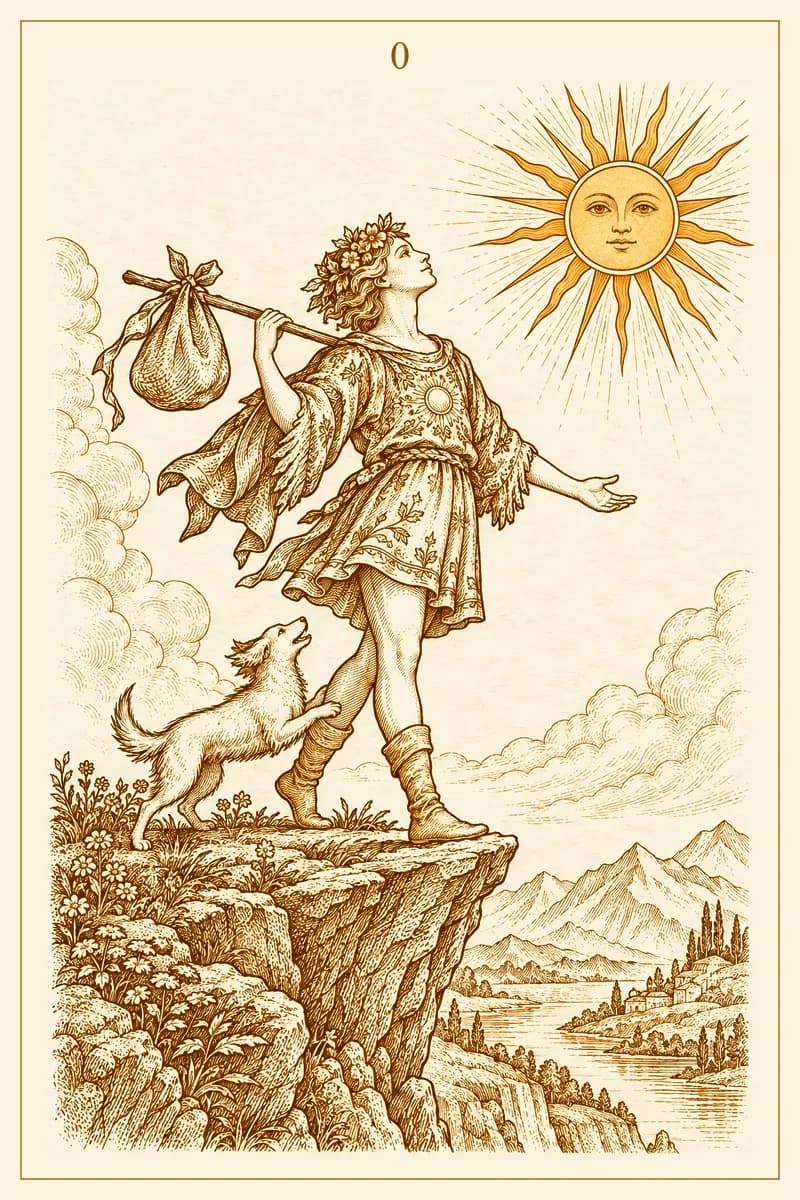
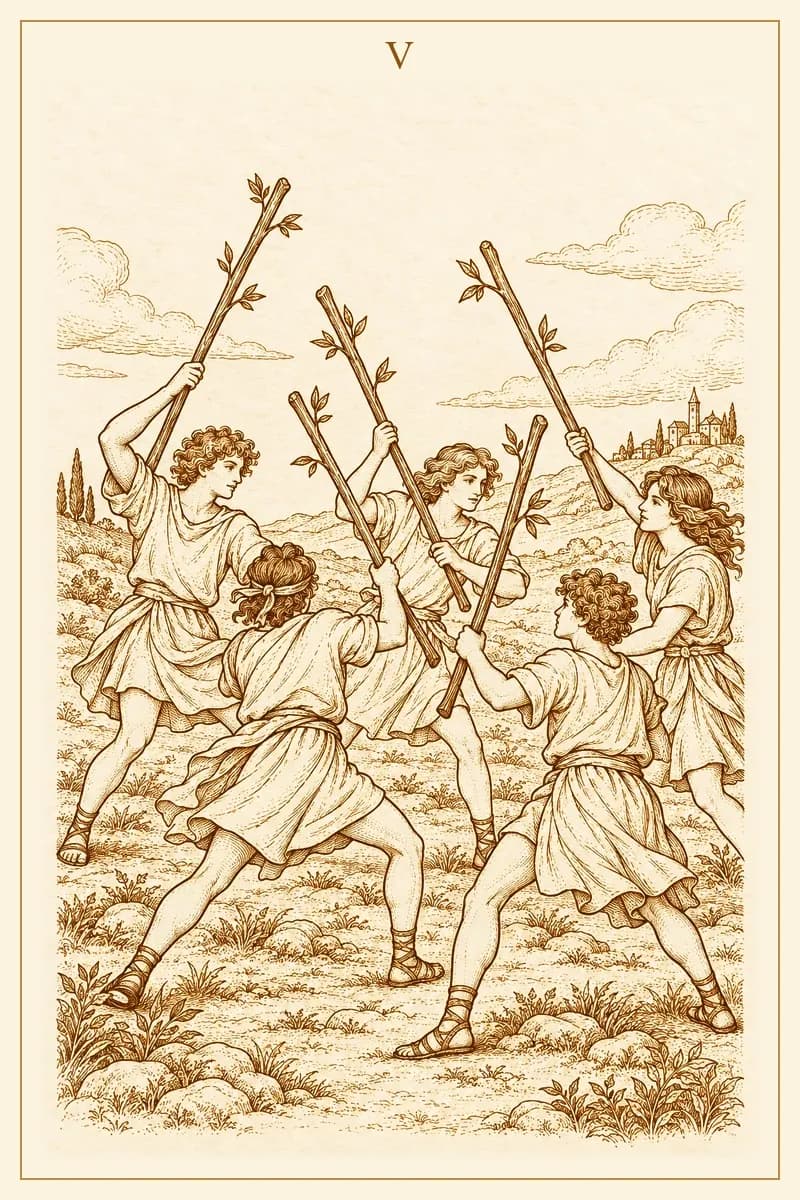
Meaning of The Fool and Five of Wands Combination: Creative Friction
Innocence meets rivalry
The sound hits first — five sticks cracking against each other like a hand of cards slapped down too hard on a table. Everyone at this game has a tell. One leads with volume, another with speed, a third with sheer stubbornness. The fourth player bluffs. The fifth hasn't decided yet whether winning matters. And then, from somewhere outside the circle, a figure wanders in holding nothing, betting nothing, reading no one's hand because he doesn't know the rules.
The Fool arrives at the Five of Wands the way a child arrives at a poker table: without stakes. He has no chips to protect, no reputation to defend, no memory of the last round's losses. The five competitors have been locked in their pattern so long that the friction feels structural, like the game itself requires it. They've forgotten that someone could simply sit down and ask what they're playing for. The Fool doesn't ask because he's clever. He asks because he genuinely doesn't know.
The Core Tension
Every poker game depends on shared agreement about what the chips represent. Remove that agreement and the bluffs stop working — not because the players lose skill, but because the audience has changed. The Fool is that audience. He watches the Five of Wands bicker and clash with the unreadable expression of someone who hasn't bought in to the premise. This destabilizes everything. The loud one can't intimidate someone who isn't keeping score. The fast one can't outmaneuver someone who isn't moving toward a goal. The stubborn one can't outlast someone who doesn't recognize the contest.
The core tension here is between investment and detachment. The five wands represent genuine creative friction — people who care deeply enough about their ideas to fight for them. The Fool represents the terrifying possibility that none of those ideas require a fight at all. Both positions are partially right. Ideas that no one defends die quietly. But ideas defended through ego alone become territories rather than discoveries, and territories must be guarded forever.
Love & Relationships
This pair shows up when a relationship has too many voices and not enough listening. Perhaps you and your partner have entered a phase where every conversation becomes a minor tournament — who had the worse day, who carries the heavier load, who remembered and who forgot. The Five of Wands isn't cruelty; it's the exhausting sport of two people who care enough to compete but have lost track of why they started.
The Fool's medicine here is disarmament through genuine confusion. Not strategic vulnerability — actual openness. One person stops tallying points long enough to say something unguarded, something that doesn't fit the established rules of engagement. The remark that ends the argument is rarely the sharpest one. It's the one that makes both people realize they've been playing a game neither of them invented.
Career & Purpose
Five talented people in a room, each with a different vision, each convinced their approach is the strongest hand. Meetings loop. Slack threads multiply. The project stalls not from lack of ideas but from surplus — too many strong opinions generating heat without direction. This is the Five of Wands at its most familiar in professional life: creative chaos that flatters itself as collaboration.
The Fool enters as the new hire, the outside consultant, or simply the person willing to say the obvious thing that everyone else considers beneath the conversation. His contribution isn't brilliance. It's the absence of allegiance. He hasn't committed to any faction, so he can see the shape of the whole table. The practical move when this pair appears at work: bring in a perspective that owes nothing to the existing debate. The solution often lives in the space between the arguments, visible only to someone who never joined one.
Shadow Side
The shadow falls when innocence becomes a performance used to avoid real engagement. The Fool who wanders into conflict and refuses to take a position isn't always wise — sometimes he's just absent. Detachment worn as a personality trait rather than a genuine state produces its own kind of damage: the teammate who won't commit, the partner who floats above every disagreement with a serene smile while the house fills with unresolved friction.
The other shadow is romanticized chaos. The Five of Wands can seduce you into believing that constant friction is a sign of vitality. It isn't. A poker game where no hand ever resolves, where the betting round never closes, is not exciting — it is stalled. If you find yourself addicted to the argument, if the creative tension has become the only energy source in the room, the game has replaced the goal.
Action Steps
- 1Identify one conflict you're sustaining because leaving it would mean admitting you don't care about winning as much as you thought
- 2Name the unspoken rule in a recurring argument — the hidden premise everyone is defending — and test whether it still holds
- 3Start one creative project with zero competitive framing: no audience, no comparison, no scoreboard, just the work and your undefended attention
Related Pairings
Continue through published pairings that share The Fool or Five of Wands.

Reckless momentum
Meaning of The Fool and The Chariot Combination: Reckless Momentum
Contested momentum
Meaning of The Chariot and Five of Wands Combination: Drive Through the Storm

Innocence meets appetite
Meaning of The Fool and The Devil Combination: Innocence Meets Appetite
Toxic competition
Meaning of The Devil and Five of Wands Combination: Toxic Competition

Structured freedom
Meaning of The Fool and The Emperor Combination: Structured Freedom
Order versus chaos
Meaning of The Emperor and Five of Wands Combination: Order Confronting Chaos
✦ Bring it to the cards ✦
Bring The Fool and Five of Wands into your own reading
Use this pairing as a starting point, then let a spread listen to the situation that is actually yours.
Begin a contextual reading