
Card Combination
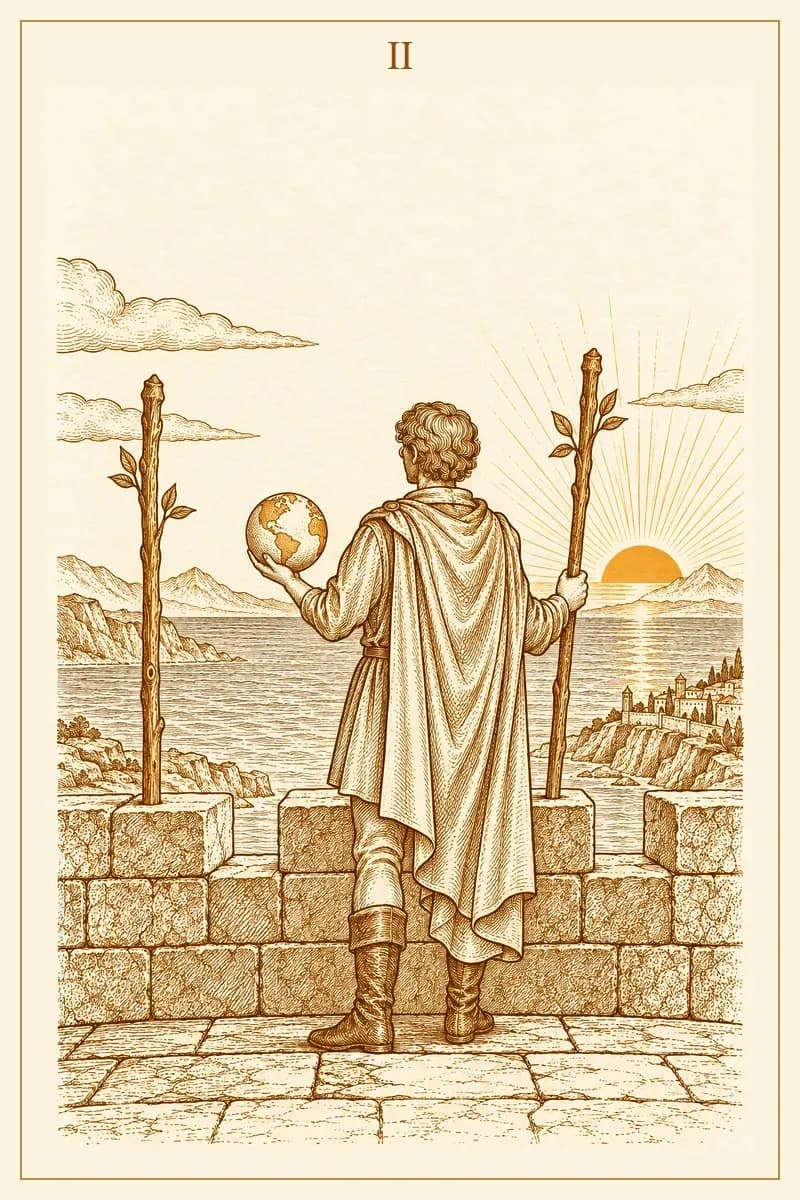
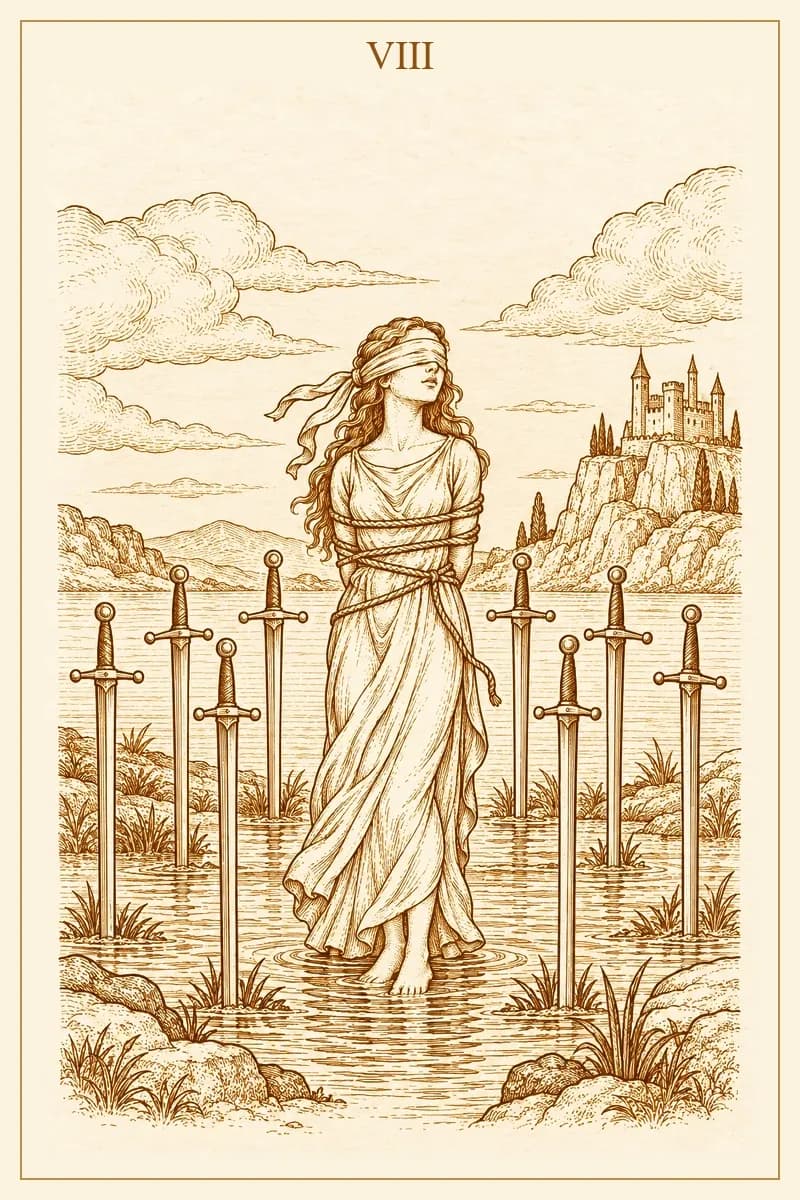
Two of Wands and Eight of Swords Tarot Combination: Vision Trapped Behind Lines
Strategic vision imprisoned by mental constraints and perceived helplessness
The general stands on the ridge, the entire battlefield visible below — troop positions, supply lines, the enemy's exposed left flank. The strategy is obvious. A flanking maneuver through the eastern valley would end this campaign by nightfall. She can see it with absolute clarity. And she cannot move a single unit, because her own command staff has convinced her that every available path is mined.
The Core Tension
The Two of Wands is the war room — the elevated position from which you can see the whole theater of operations. It is the strategist's gift: vision that spans beyond the immediate skirmish to the broader campaign. You know where you want your forces to go. You can see the terrain, identify the objectives, and calculate the logistics required to reach them.
The Eight of Swords is the intelligence report that says every road is compromised. Mines on the eastern approach. Snipers covering the western route. Ambush positions along the northern corridor. According to the briefing, there is no safe passage anywhere. The strategist who trusted her own eyes five minutes ago now defers to the report, even though something about the intelligence feels wrong — too comprehensive, too perfectly discouraging, as if the enemy wrote it themselves.
This is the core tension: you have strategic vision and operational paralysis simultaneously. The map is accurate. The fear is not. Most of the mines on those roads are imaginary — planted not by an external enemy but by your own anxiety, past failures, and the voices of people who warned you against advancing.
Love & Relationships
You know exactly what kind of relationship you want. You have mapped the territory — your values, your non-negotiables, the qualities that matter in a long-term partner. The Two of Wands has given you genuine romantic clarity. But the Eight of Swords has you standing at the edge of the dance floor, convinced that every possible approach will end in rejection, humiliation, or another painful pattern repeating.
For couples, this combination often appears when one or both partners can see how the relationship needs to evolve but feel trapped by established dynamics. You know the conversation that needs to happen. You can script it in your head. But every time you approach it, the mental swords close in — what if they leave, what if it starts a fight, what if honesty makes things worse.
The strategic truth: the conversation you are avoiding is the flanking maneuver that ends the stalemate. The discomfort of having it is temporary. The cost of avoiding it compounds daily.
Career & Purpose
Professionally, you are a strategist stuck in a foxhole. You have plans — maybe a business concept, a career pivot, a proposal that could change your department's direction. The Two of Wands confirms that your strategic thinking is sound. The map you have drawn is based on real observation, not wishful thinking.
But you are not executing. Applications sit in draft folders. Pitch decks remain on your desktop. Resignation letters get written and deleted. The Eight of Swords has you convinced that the job market is hostile, that your qualifications are insufficient, that the timing is wrong, that someone more experienced will outflank you.
Challenge the intelligence report. How much of your hesitation is based on confirmed threats and how much is based on assumed ones? A general who refuses to advance because the enemy might have reinforcements will lose the campaign to inaction alone. Reconnaissance requires movement — send a small probe before committing the full force. Apply to one position. Send one email. Test one assumption.
Shadow Side
The shadow is the general who falls in love with the planning phase because planning feels productive without carrying the risk of actual engagement. The Two of Wands becomes a permanent headquarters — comfortable, elevated, full of beautiful maps that never get muddy. The Eight of Swords provides the perfect excuse to stay there: advancing is too dangerous, so more planning is needed.
This creates an identity built around potential rather than action. You become the person who always has a brilliant strategy and never deploys it. Over time, the strategy itself becomes stale — the battlefield shifts while you are still studying yesterday's terrain.
Watch for the weaponization of caution. There is a difference between prudent risk assessment and using analysis as a barricade against vulnerability. If you have been "gathering information" for months without acting on any of it, your intelligence operation has become your prison.
Action Steps
- 1Separate real threats from phantom ones. Draw two columns on a piece of paper. In the left column, list every reason you have not acted on your plan. In the right column, mark each reason as "confirmed" (based on direct evidence) or "assumed" (based on fear, rumor, or past experience). Act against one assumed threat this week by testing whether it actually exists.
- 2Send a scouting party. Choose the smallest possible action that moves you toward your strategic goal. Not the full campaign — one reconnaissance mission. One email, one conversation, one application. Gather real intelligence to replace the imaginary briefing your anxiety has been delivering.
- 3Set a deployment deadline. Pick a specific date within the next two weeks and commit to making one decisive move by then. Tell someone about the deadline. A strategy without a timeline is a daydream in uniform. The battlefield does not wait for generals who refuse to leave the ridge.
Related Pairings
Continue through published pairings that share Two of Wands or Eight of Swords.

✦ Bring it to the cards ✦
Bring Two of Wands and Eight of Swords into your own reading
Use this pairing as a starting point, then let a spread listen to the situation that is actually yours.
Begin a contextual reading