
Advanced · 14 min · Free preview
History and myths
Where tarot really comes from: an Italian card game, the Marseille pattern, the occult revival and the Golden Dawn, and a simple way to tell the record from the myths.
In this lesson you will
- Trace the deck in four stages, from the fifteenth-century Italian game to the 1909 Waite–Smith deck.
- Check a claim about tarot's origin by comparing the date of the claim with the oldest evidence.
- Explain why Strength and Justice change places between older decks and the Waite–Smith deck.
A deck box in a shop promises “the lost wisdom of ancient Egypt”, and a video says the Major Arcana were written as a secret book of the Kabbalah. Both sound old and serious, and both are easy to repeat. This lesson gives you one habit that sorts the record from the romance: ask when a claim first appears, and compare that date with the oldest cards that survive.
What the oldest cards tell us
Among the oldest tarot cards that survive are packs painted by hand, with gold leaf, for the ruling families of Milan in the middle of the fifteenth century; today they are called the Visconti–Sforza decks. Italian records from 1440 on, in Florence and Ferrara, call such packs carte da trionfi, cards of the triumphs. They were an ordinary four-suited pack with an extra series of picture cards that beat, or triumphed over, the rest. The English word trump comes from the same idea.
These cards were made for a trick-taking game, a distant cousin of whist and bridge. Nothing in the fifteenth-century record ties them to fortune-telling. Reading the cards is first recorded about three centuries later, in Bologna around 1750, and spread from Paris in the 1780s; most of what is said about tarot's “ancient” secrets is younger still.
Warm up
A quick look back before the new material. Recalling helps you remember.
Warm-up
Someone tells you that The Fool and the other Majors are pages from an ancient Egyptian book of wisdom. What does the history say?
Warm-up
In the Waite–Smith order that the VeilSoul deck follows, which numbers do Strength and Justice carry?
Look first
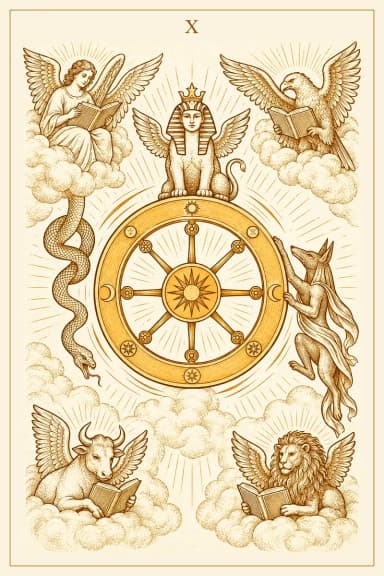
Before reading on, look at the Wheel of Fortune. Which figures on it look as if they come from ancient Egypt, and does that tell you where the card itself comes from?
Remember
- Tarot began as a fifteenth-century Italian card game with trumps; using the cards for divination is first recorded in the eighteenth century.
- The Egypt origin and the Hebrew-letter design are claims of 1781 and after; check any claim by dating it against the oldest cards.
- The Waite–Smith deck carries Golden Dawn choices, such as Strength at VIII, which you can use as a named tradition.
Sources: original VeilSoul text · A. E. Waite, 1911 (public domain) · the 1909 Waite–Smith imagery (public domain) · VeilSoul card pages