
Card Combination
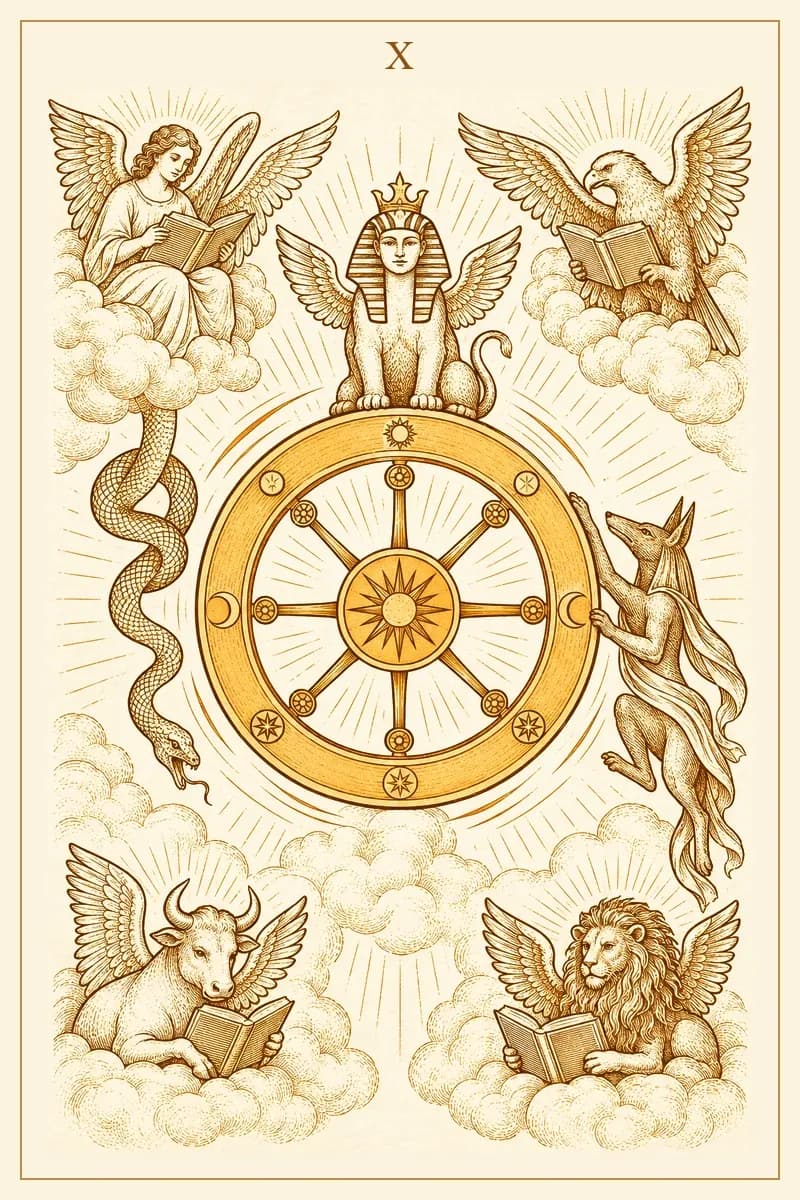
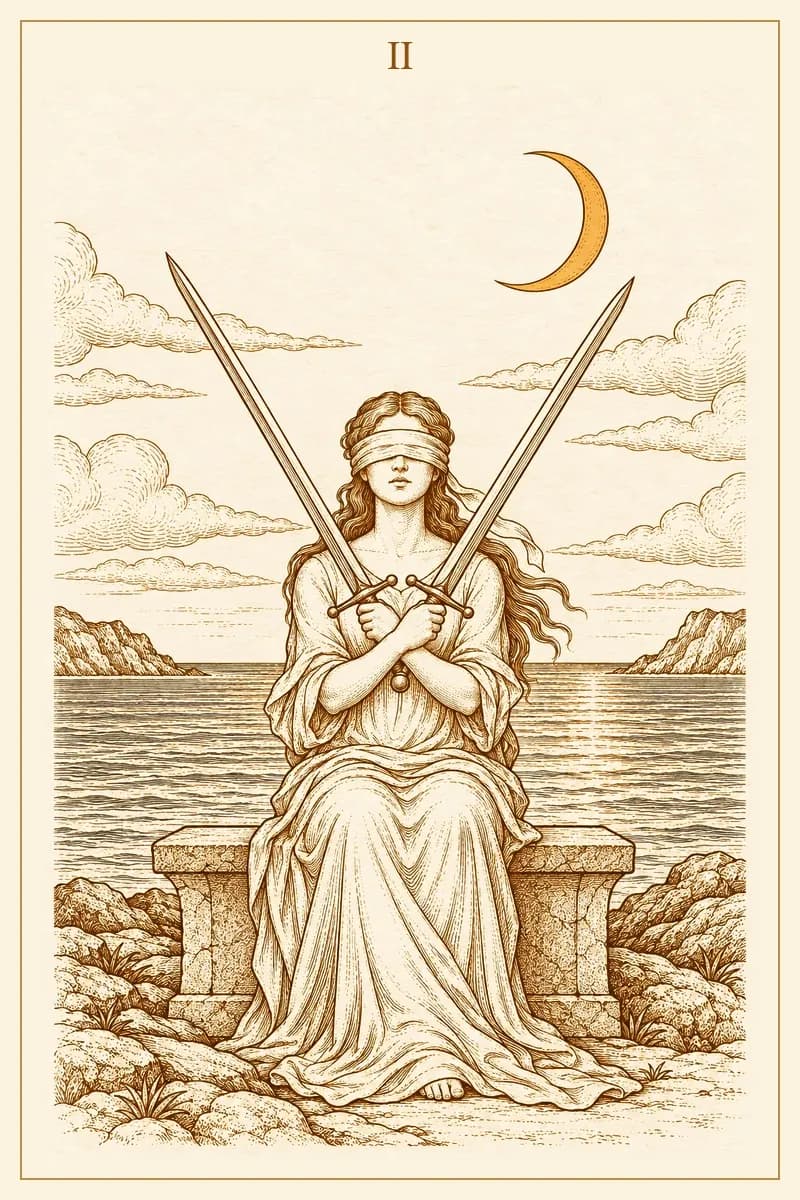
Meaning of Wheel of Fortune and Two of Swords Combination: The Cost of Standing Still
Paralysis at change
The stage has been reset behind you. New scenery, different lighting, altered props—everything in the wings has shifted while you stood center stage, arms crossed, eyes closed, waiting for a cue that you yourself were supposed to give. The audience watches. The script has moved on. And you are still holding a position you stopped believing in three scenes ago.
That is the experience at the heart of this combination: change has already happened around you, but inside the theater of your own decision-making, the curtain has not moved. The Two of Swords is an expert at freezing action. The Wheel of Fortune is an expert at refusing to wait. When they appear together, they describe a standoff between external momentum and internal stasis—and the standoff is not stable.
A frozen posture on a moving stage is not neutral. It is a choice. Specifically, it is the choice to let time make your decisions for you, which is its own kind of decision—one made by avoidance rather than agency.
The Core Tension
The Two of Swords does not lack intelligence. The figure in the card holds two blades, suggesting real capability, real analytical power. The blindfold is not ignorance—it is a chosen filter, a way of blocking out information that would force a conclusion the holder is not ready to reach. The Wheel does not negotiate with this arrangement. It turns anyway, indifferent to whether the figure has opened its eyes.
The core tension is not between two equally weighted options. It is between the comfort of not knowing and the cost of pretending not to know while everything around you reorganizes. When the Wheel brings change—new circumstances, closed doors, opened ones, shifted relationships—the Two of Swords becomes increasingly untenable as a position. The longer you hold the blindfold in place, the more the wheel's movement becomes a verdict rather than an opportunity.
There is a specific kind of suffering produced by this combination: the suffering of someone who can see the water rising but has convinced themselves that if they simply stay still, the flood will not quite reach them.
Love & Relationships
In relationships, this pairing often marks a period where one or both people know something needs to be addressed but have erected an elaborate structure of avoidance around it. The wheel has turned: circumstances have shifted enough that the old equilibrium is visibly gone. Both parties can feel it. But the swords are crossed, the peace is false, and the conversation is still not happening.
If you are single and holding this combination, the pattern is often about a person or a possibility you are neither committing to nor walking away from. The wheel keeps pushing the situation forward—circumstances are developing, time is passing, other people are making moves—while you stay suspended in that comfortable space of uncommitted potential. The Two of Swords makes this feel safe. The Wheel makes it expensive.
Career & Purpose
Professionally, this combination appears when someone recognizes that a significant change in their environment—a restructure, a market shift, an opportunity closing, a new direction emerging—requires a decision, and then proceeds to avoid making it. The analysis gets longer. More information is gathered. The decision gets deferred to the next meeting, the next quarter, the next time things feel clearer.
The Wheel has no patience for this process. It does not pause the industry while you complete your deliberation. The decision you are trying not to make is often simpler than you have made it: stay or go, invest or withdraw, commit or redirect. The complexity you have built around it is real, but it is also, in part, constructed to justify the delay.
The work this week is to name what you already know but have been performing uncertainty about.
Shadow Side
The shadow of this combination is something that masquerades as wisdom: the idea that patience and inaction are the same thing, and that waiting is a form of control. There are situations where holding still is genuinely strategic. This is not one of them. The Wheel has already moved. Holding still now does not preserve options; it eliminates them as they drift past.
There is also a subtler shadow—the relief that comes from framing paralysis as being careful. It feels responsible. It feels measured. It is often neither. The Two of Swords can be seductive precisely because it looks like discernment from the outside. Only the person holding the blades knows that the blindfold went on to block something specific, not to achieve some broader clarity.
Action Steps
- 1Name the decision you have been avoiding in the clearest possible language—one sentence, no qualifications—then identify what specific fear is driving the delay.
- 2List what you have already lost or will lose by the end of the month if nothing changes; make the cost of inaction as concrete as the fear of action.
- 3Choose one small, reversible step in the direction you already know is right, and take it before you talk yourself back into the suspended position.
Related Pairings
Continue through published pairings that share Wheel of Fortune or Two of Swords.

control vs fate
Meaning of The Chariot and Wheel of Fortune: Control Meets Chance
Blocked momentum
Meaning of The Chariot and Two of Swords Combination: Stalled Drive

control vs cosmic flux
Meaning of The Emperor and Wheel of Fortune: When Control Meets the Spin

Willing blindness
Meaning of The Devil and Two of Swords Combination: Frozen Chains
cycles of abundance
Meaning of The Empress and Wheel of Fortune: Cycles of Abundance
Forced decision
Meaning of The Emperor and Two of Swords Combination: Authority Meets Stalemate
✦ Bring it to the cards ✦
Bring Wheel of Fortune and Two of Swords into your own reading
Use this pairing as a starting point, then let a spread listen to the situation that is actually yours.
Begin a contextual reading