
Card Combination

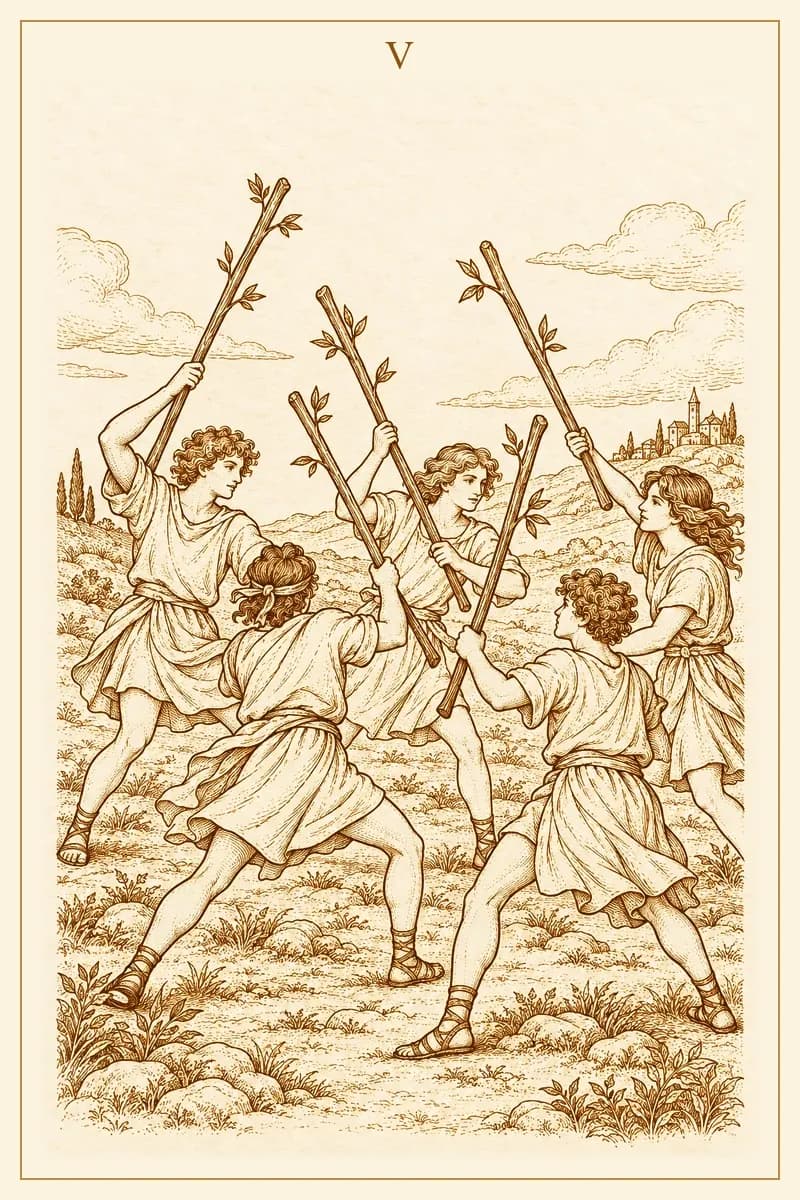
Meaning of Temperance and Five of Wands Combination: Controlled Conflict
Controlled conflict
The most disciplined surgeon still needs the fever to locate the wound. Without inflammation, the body cannot signal where healing must begin — and without conflict, patience becomes nothing more than elegant avoidance dressed in virtue. The paradox cuts deeper than comfort allows.
A physician who treats only symptoms never cures disease. Temperance holds the diagnostic chart with steady hands, measuring each variable, titrating the dose with precision that borders on obsession. Five of Wands is the patient thrashing on the table, every limb fighting a different battle at once, vital signs spiking in five directions simultaneously. One card whispers "moderation." The other screams that moderation is a luxury no one in this room can afford. The tension between them is not a flaw in the reading. It is the reading itself, scrawled in urgent red ink across the chart.
The Core Tension
Temperance operates through synthesis. It pours fire into water and expects gold. Five of Wands operates through friction — five separate wills colliding without a referee, each convinced their strategy is the only viable one. Together, they produce a paradox that functions like a clinical trial: the hypothesis of harmony tested against the hard reality of disorder.
The diagnostic question is not whether peace or conflict wins. It is whether you can hold a scalpel steady while the operating room catches fire around you. Temperance does not eliminate the chaos of Five of Wands. It metabolizes that chaos into something the body can actually use. Think of it as controlled inflammation — the immune response that destroys tissue precisely so that genuine repair can follow. The fever is not the enemy. The fever is the intelligence of the organism working overtime to identify what needs to be cut away and what deserves to be preserved.
Love & Relationships
Relationships under this pairing resemble a couple arguing about the thermostat while the house slowly floods from a burst pipe neither has inspected. The disagreements feel petty, surface-level, almost theatrical in their repetition. But the attending physician sees what the patients cannot: every small fight is a symptom of a deeper misalignment neither person has bothered to name out loud.
Temperance insists that love requires calibration — giving exactly as much as you receive, adjusting the mixture until both people feel seen and neither feels depleted. Five of Wands insists that love is a contact sport where someone always gets elbowed and pretending otherwise is dishonest. The prescription here is not to stop fighting. It is to fight about the right things with the right tools. Arguments about dishes are really arguments about respect. Arguments about time are really arguments about priority and where each person ranks in the other's life. Name the actual diagnosis honestly and the surface symptoms resolve on their own, like a fever breaking once the infection is addressed.
Career & Purpose
In professional settings, this pairing reads like a hospital ward during shift change — everyone has a treatment plan, no one agrees on the dosage, and the patient's chart keeps getting revised by competing hands. Five of Wands brings competitive energy that looks like dysfunction from the outside but often produces unexpected innovation when properly channeled. Temperance insists on protocol, integration, and the long-term outcome rather than the short-term victory that feels good but solves nothing.
The workplace tension here is between those who want to move fast and break things and those who want to measure twice before cutting once. Neither approach is inherently wrong. The critical error comes from treating one as disease and the other as cure. A skilled diagnostician recognizes that both impulses serve the organism in different ways at different stages. The team needs someone willing to provoke disagreement and challenge assumptions, and someone willing to synthesize those disagreements into a coherent treatment plan that everyone can follow. The meeting that feels like chaos may be the exact consultation the project needed all along.
Shadow Side
The shadow of this pairing is the anesthetic smile. Temperance, when threatened by Five of Wands chaos, can become pathologically calm — the doctor who tells you everything is fine while your labs tell a dramatically different story. This false equilibrium poisons more thoroughly than open conflict ever could, because it removes the very signals the body needs to identify where healing must happen.
On the other side, Five of Wands can use Temperance's patience as a punching bag, escalating every minor friction into a full-blown crisis because the calm presence feels like tacit permission to rage without consequence. The shadow diagnosis is precise and uncomfortable: using someone else's stability as your excuse to remain unstable. Watch for the pattern where one person always plays healer and the other always plays wound. That arrangement is not balance. It is codependency wearing a lab coat.
Action Steps
- 1Identify one recurring conflict you have been treating with patience alone, and write down the actual diagnosis — the root cause beneath the symptom you keep managing week after week
- 2Choose one disagreement you have been avoiding and enter it deliberately, but set a time limit of fifteen minutes to argue your position before switching entirely to listening
- 3Notice where you confuse suppression with balance — if your calm requires someone else to stay silent, that is sedation, not healing, and the prognosis will only worsen
Related Pairings
Continue through published pairings that share Temperance or Five of Wands.

Controlled momentum
Meaning of The Chariot and Temperance Combination: Controlled Drive Meets Measured Pace
Contested momentum
Meaning of The Chariot and Five of Wands Combination: Drive Through the Storm

Controlled patience
Meaning of The Emperor and Temperance Combination: When Command Meets the Slow Cure

Toxic competition
Meaning of The Devil and Five of Wands Combination: Toxic Competition
Fertile balance
Meaning of The Empress and Temperance Combination: When Abundance Learns to Flow
Order versus chaos
Meaning of The Emperor and Five of Wands Combination: Order Confronting Chaos
✦ Bring it to the cards ✦
Bring Temperance and Five of Wands into your own reading
Use this pairing as a starting point, then let a spread listen to the situation that is actually yours.
Begin a contextual reading