
Card Combination

Meaning of Justice and Five of Wands Combination: When the Referee Enters the Brawl
Conflict meets accountability
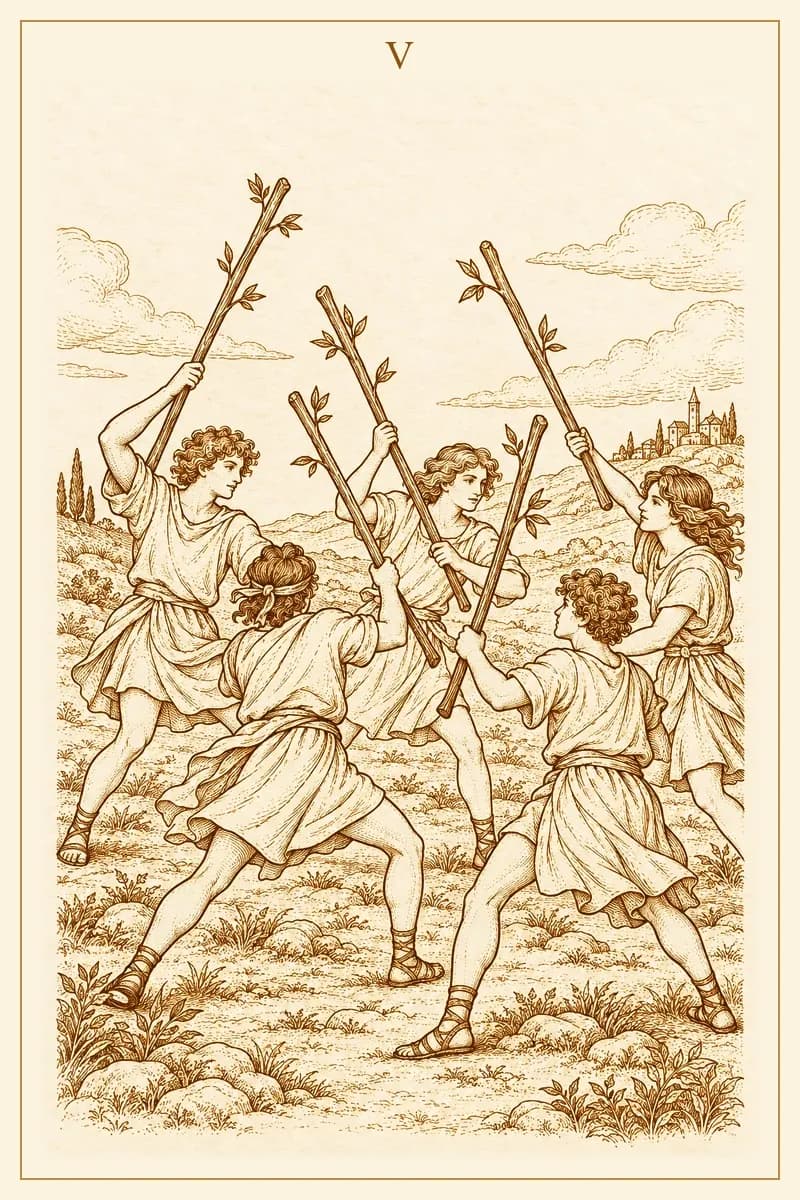
The whistle blows mid-play. Everyone on the field freezes — sticks raised, cleats dug into turf, voices still mid-shout. Justice has just walked onto the pitch where the Five of Wands was already in full chaos, and the energy shifts immediately. Not because the conflict is over, but because now it has to be accounted for.
This is the signature of these two cards together: friction that can no longer be ignored. The Five of Wands brings a field of competing wills — five people pushing five different agendas, none of them necessarily wrong, all of them convinced they're right. Justice arrives not to pick a winner, but to examine the game itself. Were the rules followed? Who was playing fair? What consequences are actually warranted here?
The result isn't peace. It's clarity — which is sometimes harder to sit with.
The Core Tension
Justice is a card of impartiality, of cause and effect operating without sentiment. The Five of Wands is deeply personal: elbows out, voices raised, each player fighting for their stake. When these two energies collide, the central question becomes whether the conflict you're in has legitimate standing — or whether you've been fighting simply because fighting became a habit.
The tension here isn't between good and evil. It's between competing legitimate claims and the scale that has to weigh them. Someone wins on points, not on volume. That means the loudest voice in the room may not be the one Justice favors. This combination asks you to examine what you're actually fighting for — and whether the fight, evaluated coldly, is one you'd still choose.
Love & Relationships
In relationships, this pairing often appears when two people have been stuck in a cycle of low-grade conflict — the kind that doesn't erupt into crisis but never fully resolves. Each argument feels like a continuation of the last. Each grievance carries a list of prior grievances attached.
Justice entering this dynamic doesn't smooth things over. It pushes toward a genuine reckoning: what has each person actually contributed to this pattern? Not in a blame-assignment sense, but in a balance-sheet sense. If the score is genuinely lopsided — one partner consistently absorbing costs the other doesn't acknowledge — that imbalance will surface now.
For singles, this combination can appear around situations where someone from the past resurfaces, or where a decision made long ago about relationships is now producing visible consequences. The Five of Wands suggests the internal debate is still live; Justice suggests it's time to reach a verdict.
Career & Purpose
Professionally, this is the combination of contested resources and formal process. A promotion is being disputed. A project has multiple teams claiming ownership. Credit for an outcome is unclear. The Five of Wands captures the competitive scramble; Justice points toward the mechanism — policy, performance review, documented evidence — that will ultimately determine the outcome.
If you're in this situation, the most important move is to ensure your work is on record. In a field of competing elbows, Justice doesn't reward the sharpest one — it rewards the clearest case. Documented contributions, consistent performance, and a track record of fairness in your own conduct will matter more than aggressive positioning.
There is also a cautionary note here: if you've been part of a chaotic or ethically blurry situation at work, Justice signals that the audit is coming. Not as punishment — but as recalibration.
Shadow Side
The shadow side of this combination is self-righteous conflict. The Five of Wands can make every scuffle feel like a moral stand. Justice can become a tool to rationalize winning — invoking fairness only when fairness favors you.
Watch for the tendency to reframe every competitive loss as injustice, or every competitive win as proof of virtue. The scale is not a mirror for your preferences. It may weigh against you in ways that are genuinely fair, and recognizing that requires a kind of ego flexibility that the heat of the Five of Wands makes difficult.
There's also a risk of paralysis. If you're waiting for the situation to be perfectly just before you act, you may wait indefinitely. Justice here is directional, not absolute — it points toward a more honest engagement with the conflict, not toward a guaranteed resolution.
Action Steps
- 1Identify the one contested issue currently taking up the most mental energy, and write down both sides of it as if you were an outside referee — then notice which side holds more actual weight.
- 2Before escalating any dispute at work or at home, verify that your own conduct in that dispute is something you'd be comfortable having reviewed.
- 3Stop rehearsing arguments and start gathering evidence — documented facts, specific examples, clear timelines — because that's what the scale here will actually respond to.
Related Pairings
Continue through published pairings that share Justice or Five of Wands.

Earned victory
Meaning of The Chariot and Justice Combination: Victory Demands a Price
Contested momentum
Meaning of The Chariot and Five of Wands Combination: Drive Through the Storm

Authority meets accountability
Meaning of The Emperor and Justice Combination: Authority Meets Accountability

Toxic competition
Meaning of The Devil and Five of Wands Combination: Toxic Competition
Abundance under judgment
Meaning of The Empress and Justice Combination: Abundance Under Judgment
Order versus chaos
Meaning of The Emperor and Five of Wands Combination: Order Confronting Chaos
✦ Bring it to the cards ✦
Bring Justice and Five of Wands into your own reading
Use this pairing as a starting point, then let a spread listen to the situation that is actually yours.
Begin a contextual reading