
Card Combination
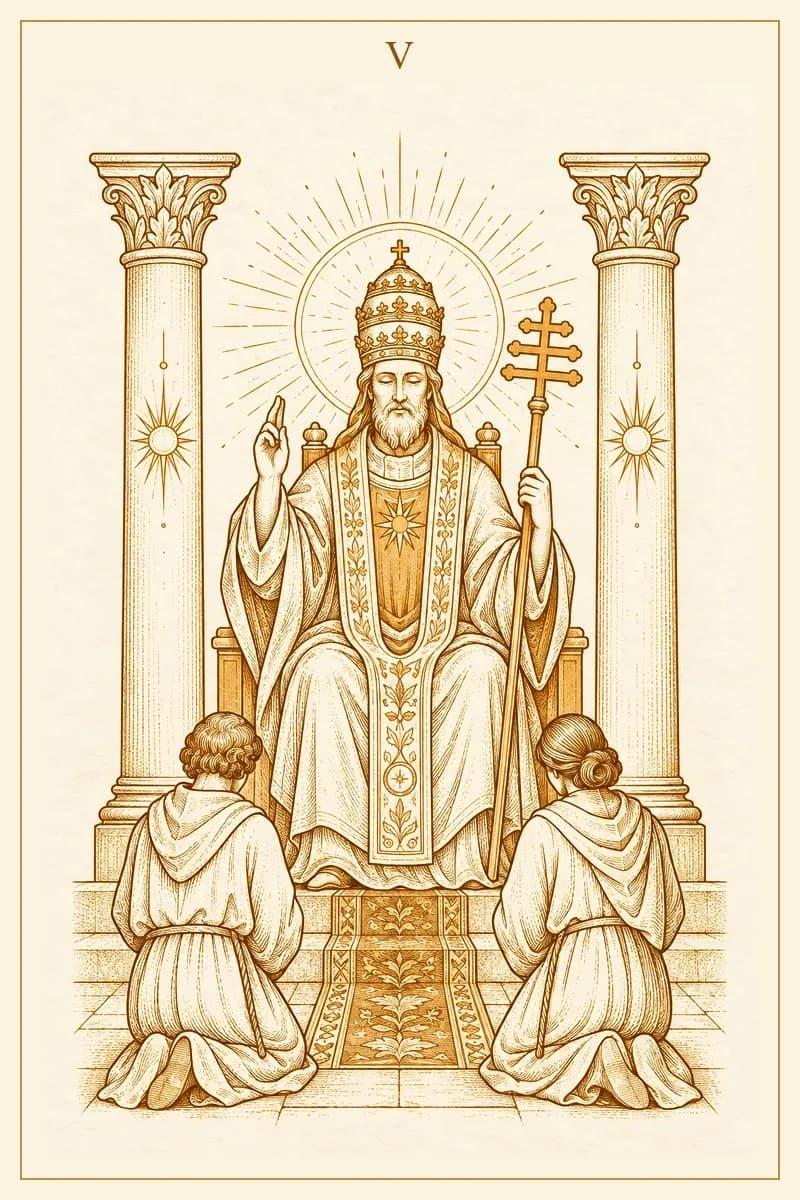
Meaning of The Hierophant and Five of Pentacles Combination: Outside the Institution
Exclusion and belonging
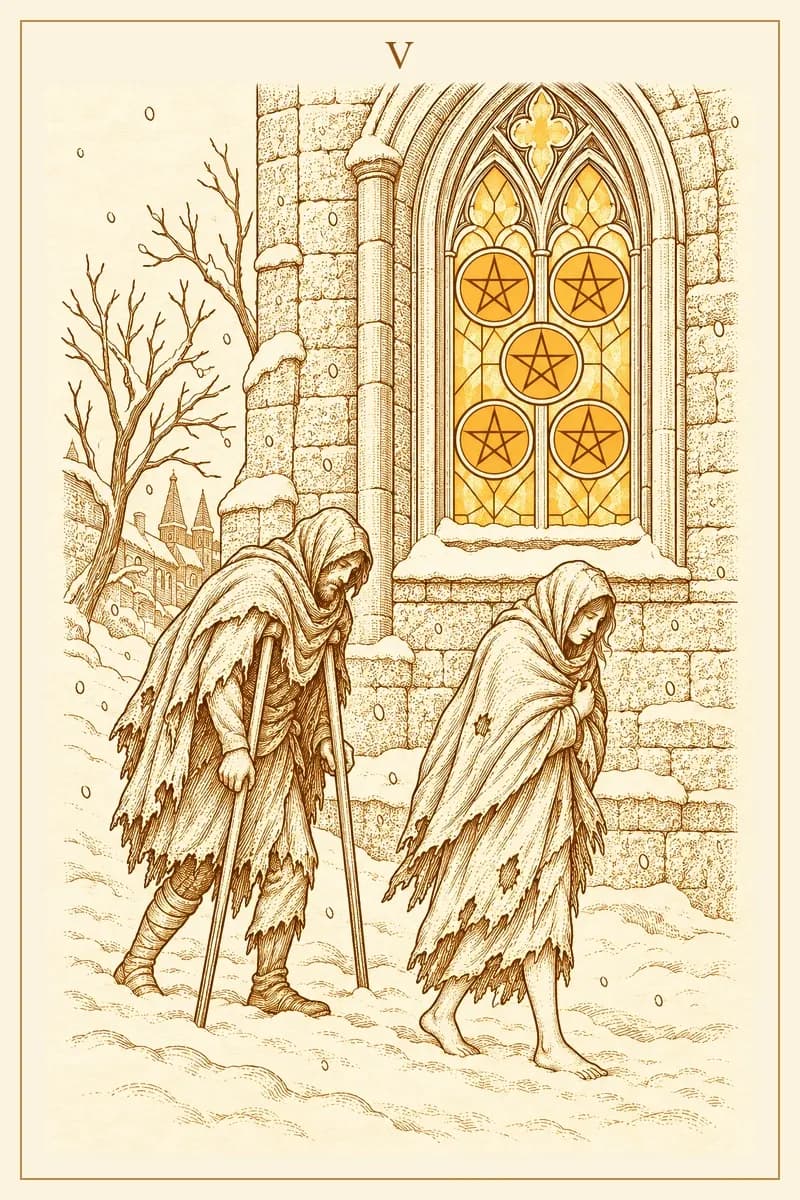
Imagine a cathedral at midnight. Inside: warmth, candlelight, the organ humming a low chord that you can feel in your sternum. Outside: two figures moving through snow, hunched against the cold, passing beneath a stained-glass window that blazes with color and light. The music reaches them through the stone wall — beautiful and remote. That image is the Hierophant and Five of Pentacles distilled into a single frame.
The Core Tension
The Hierophant holds the keys to institutional belonging. He represents the systems we build to transmit wisdom, provide structure, and — in theory — care for members of the community. Religion, education, healthcare, professional guilds: all of these carry a Hierophant energy. They promise that if you follow the right path, speak the right language, and meet the required criteria, you belong.
The Five of Pentacles knows what happens when those criteria cannot be met.
Think of it in musical terms. An orchestra represents one of the highest expressions of coordinated human effort — rigorous, beautiful, hierarchical. But access to that world requires years of expensive training, the right instruments, the right mentors, the right auditions. A gifted musician without those entry points does not get to play in the orchestra. She may hear the music from outside the concert hall, may even understand it better than some of the players inside, but the institution cannot reach her where she is.
This is the pairing's central question: when a person is in need, does the institution's door open or does its stained-glass window merely illuminate them from above?
Love & Relationships
In romantic and family relationships, this pairing often describes a situation where one partner — or one family — embodies institutional values (stability, respectability, tradition) while the other is experiencing material or emotional poverty that those values do not address.
A family may have strong religious or cultural expectations of how a partner should look, earn, or present. A person going through financial collapse, job loss, or housing instability may find that those expectations function as barriers rather than support structures. The institution of family, in this case, has not extended its warmth to include the person who needs it most.
This can also appear in relationships where emotional need goes unmet because vulnerability does not fit the established code. "We don't talk about money problems." "Strong people handle things themselves." "We don't air our difficulties outside the family." These are Hierophant-shaped walls that the Five of Pentacles figure cannot climb through.
Career & Purpose
Professionally, this pairing highlights structural exclusion. The organization has its hierarchy, its credentialing system, its approved pathways. The person experiencing the Five of Pentacles — financial hardship, job insecurity, a gap in their resume — cannot access the organization's resources because they do not fit the accepted profile.
This manifests in hiring processes that filter out candidates based on credentials that have no bearing on ability. In professional networks where access is predicated on already having access. In training programs whose cost makes them available only to people who are already stable enough to afford them.
For someone in this position, the reading is not hopeless. It is honest. The institution may not be coming to you. That is worth acknowledging directly, without the comforting fiction that merit alone determines outcome. The question becomes: what non-institutional paths exist, and which of them lead somewhere real?
Shadow Side
The shadow of this pairing falls most heavily on the institution itself. An organization — religious, civic, corporate — that maintains its grandeur while the people it nominally serves stand outside in the cold has failed at something fundamental. The shadow does not belong only to the Five of Pentacles figure. It belongs to the Hierophant who has chosen ceremony over contact.
For the individual, the shadow is the internalized belief that exclusion is deserved. That if you were good enough, disciplined enough, worthy enough, the doors would open. This pairing asks you to examine that belief carefully, because institutional doors often stay closed for reasons that have nothing to do with your worth.
Action Steps
- 1Map the institutions in your life — professional, financial, spiritual, social — and identify which ones are genuinely accessible to you right now and which require you to already be okay before they will help you.
- 2If you have institutional access that someone near you does not, consider one concrete way to extend that access rather than simply pointing toward the door from inside.
- 3Write down one thing you stopped seeking because the system said you did not qualify — and ask whether that assessment still holds, or whether it was the institution's limitation rather than yours.
- 4The Hierophant and Five of Pentacles do not resolve neatly. They hold a tension that is genuinely uncomfortable: the gap between what institutions promise and what they actually deliver to people in crisis. Sitting with that discomfort, rather than explaining it away, is where this pairing does its most honest work.
Related Pairings
Continue through published pairings that share The Hierophant or Five of Pentacles.
Sacred rebellion
Meaning of The Fool and The Hierophant Combination: Tradition Meets Freedom
Optimism meets hardship
Meaning of The Fool and Five of Pentacles Combination: Leaping Into the Cold
Structured mastery
Meaning of The Magician and The Hierophant Combination: The Cathedral You Build Yourself
Scarcity and skill
Meaning of The Magician and Five of Pentacles Combination: Scarcity and Skill
Inner and outer doctrine
Meaning of The High Priestess and The Hierophant Combination: Inner and Outer Doctrine
Intuition in scarcity
Meaning of The High Priestess and Five of Pentacles Combination: Wisdom in the Cold
✦ Bring it to the cards ✦
Bring The Hierophant and Five of Pentacles into your own reading
Use this pairing as a starting point, then let a spread listen to the situation that is actually yours.
Begin a contextual reading