
Card Combination
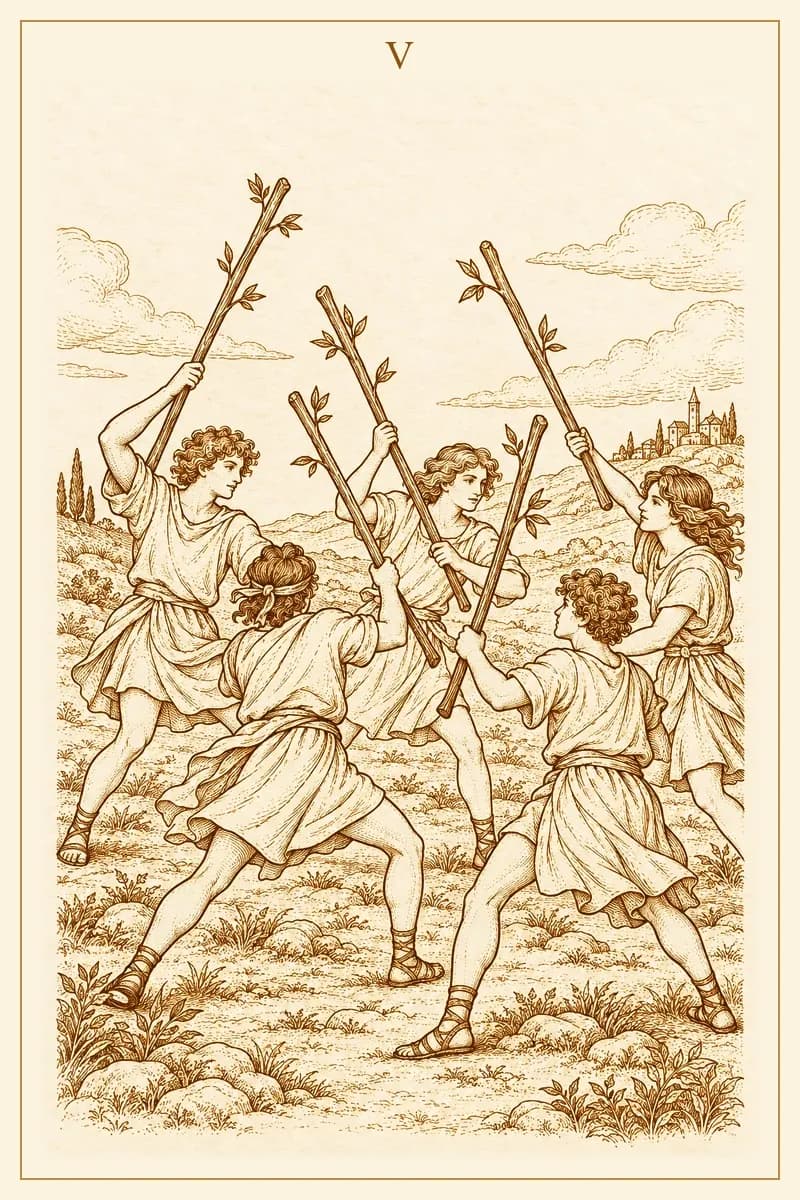
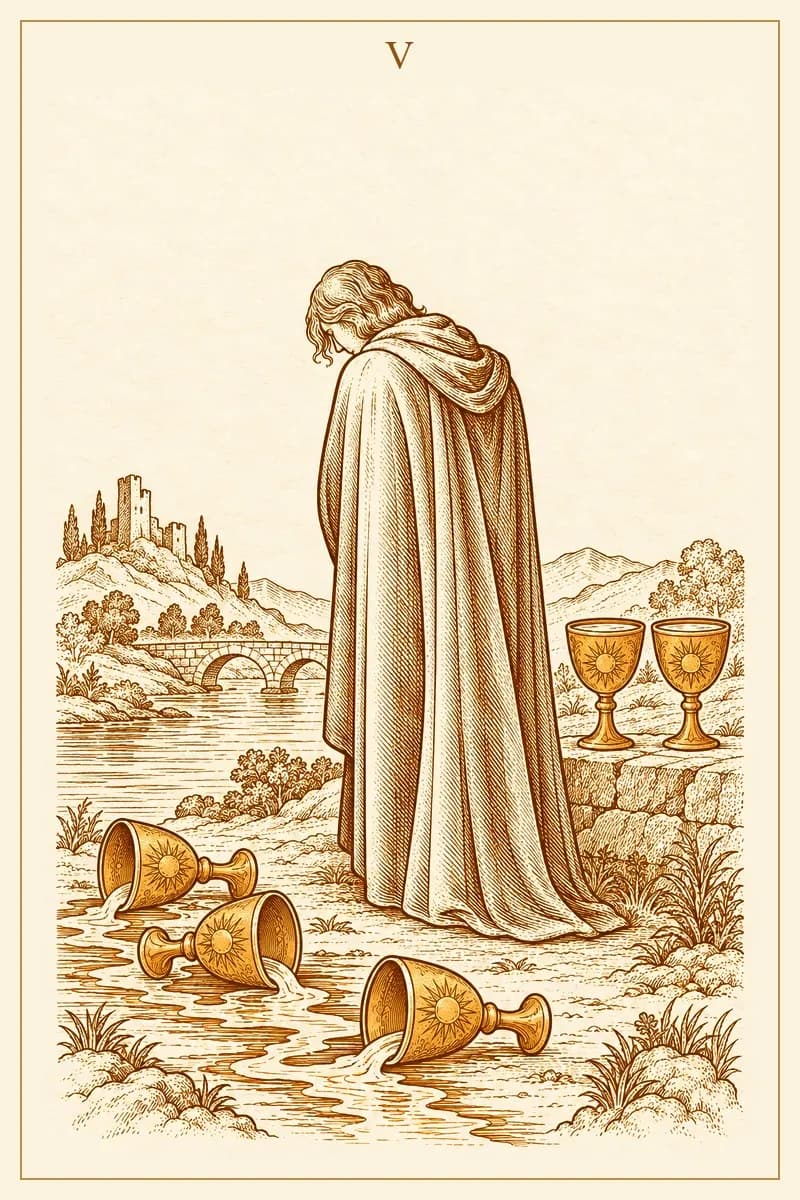
Meaning of Five of Wands and Five of Cups Combination: Grief Inside the Battle
conflict meets grief
The stage is set for chaos — sticks raised, voices sharp, every actor fighting for the spotlight. But in the corner of that same stage, someone has already walked off. They're standing with their back to the crowd, staring at three toppled cups, not hearing the noise behind them. This is what it looks like when two Fives collide: the war is still happening, and the mourning has already begun.
The Core Tension
Two Fives arriving together is not subtle. Numerologically, Five represents disruption — the moment the comfortable Four breaks open and demands change. One Five is challenging. Two Fives is a full pressure system.
The Five of Wands brings friction, competition, and scattered energy. It is the card of people pulling in different directions, of passion curdling into argument, of too many ideas and not enough consensus. It is loud. It is kinetic. It rarely pauses.
The Five of Cups brings loss, regret, and emotional withdrawal. It is the card of what was spilled, what cannot be recovered, of a figure turned away from what remains standing. It is quiet. It is still. It looks backward.
Together, they create a paradox that feels painfully familiar to anyone who has ever fought hard for something they were secretly grieving. The body is in motion — defending, debating, competing — while the heart is already sitting beside the wreckage.
This pairing does not soften either card. They amplify each other's core tension. The fights feel more hollow because you're fighting over something already damaged. The grief feels heavier because you can't stop long enough to fully sit with it.
Love & Relationships
In a romantic reading, this combination often surfaces when a relationship is both actively conflicted and quietly breaking down beneath the surface. Arguments are happening — real ones, with raised voices and competing needs — but the emotional well has already partially drained.
One partner may be fighting to save something while the other has emotionally withdrawn. Or both people are engaged in the conflict while privately mourning a version of the relationship that no longer exists. The fights are real, but so is the grief underneath them.
This pairing can also appear when someone is caught between an active conflict in a current relationship and unresolved loss from a previous one. The old spilled cups are coloring how they show up in the present battle.
What's needed here is not a ceasefire, but a pivot — a moment where the fighting pauses and both people ask what they're actually mourning. The argument on the surface rarely names the wound beneath.
Career & Purpose
Professionally, this combination points to environments full of internal rivalry and unresolved disappointment. Team dynamics may be fractious — competing visions, clashing egos, misaligned goals — while underneath that noise sits a quieter sense that something important has already been lost. A project that was once exciting now feels like it's being fought over rather than built.
This can also describe a person who is expending enormous energy in a competitive professional arena while privately grieving a career path abandoned, a role they didn't get, or work that stopped meaning something.
The warning here is burnout of a specific kind: you keep showing up to the fight, but you stopped believing in the prize several rounds ago.
Shadow Side
The deepest shadow of this combination is the way grief can become weaponized inside conflict. When someone hasn't processed their loss, they fight with it instead — harder, more brittle, less willing to hear another perspective. The unacknowledged Five of Cups energy feeds the Five of Wands with something sharper than competition: it feeds it with desperation.
There is also a risk of paralysis. The conflict demands engagement; the grief demands stillness. Caught between the two, a person may do neither well — showing up to the battle distracted and sitting with the loss without fully letting it move through them.
This combination resists easy resolution precisely because it requires two different kinds of courage simultaneously: the courage to engage honestly in conflict, and the courage to grieve honestly in private.
Action Steps
- 1Name what you're actually mourning. Before the next argument, take ten minutes to write down what you've lost or are afraid of losing. Let the grief be specific — not vague unease, but a real thing. This separates the feeling from the fight.
- 2Find the two standing cups. The Five of Cups always leaves two vessels upright. In your current situation, ask what is still intact, still valuable, still worth protecting. The battle is harder when you can't see what you're still fighting for.
- 3Choose one arena and go fully present. This week, pick either the conflict or the grief and give it your full attention for at least one hour. Splitting focus between both keeps you stuck in neither. Resolution on one front often loosens the other.
Related Pairings
Continue through published pairings that share Five of Wands or Five of Cups.
✦ Bring it to the cards ✦
Bring Five of Wands and Five of Cups into your own reading
Use this pairing as a starting point, then let a spread listen to the situation that is actually yours.
Begin a contextual reading