
Card Combination
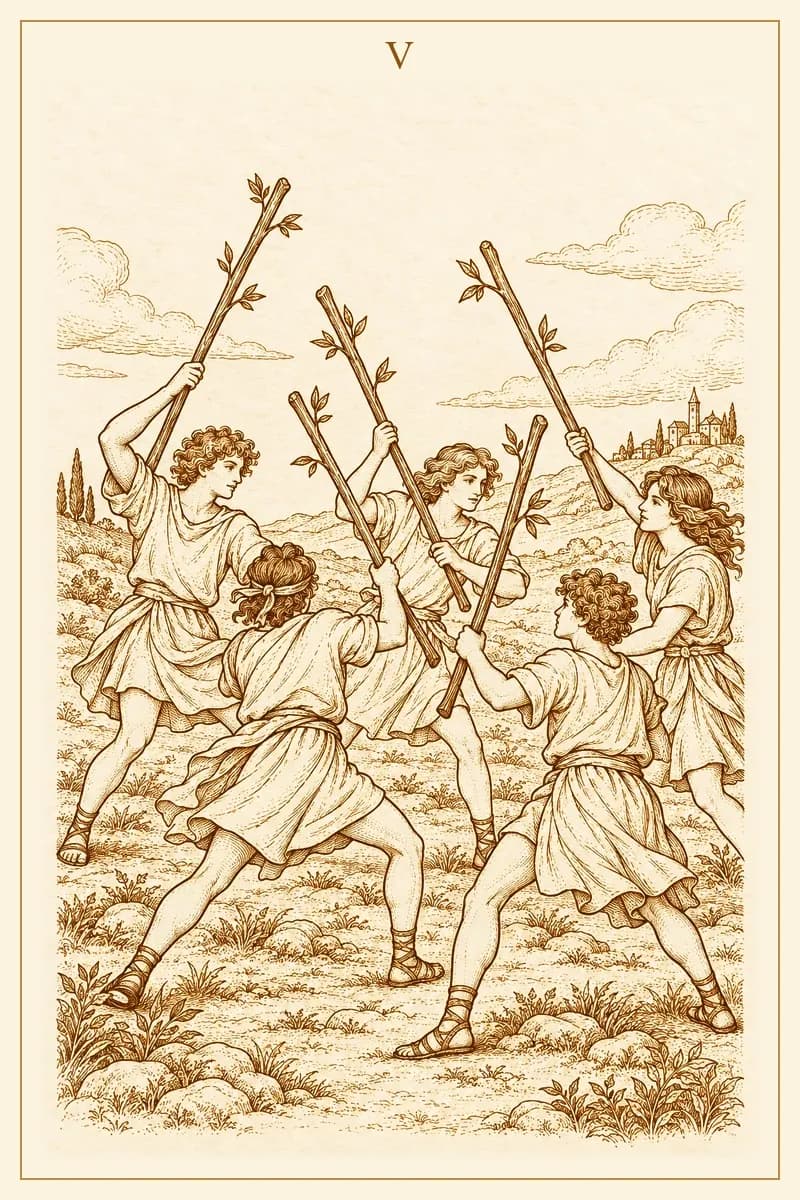
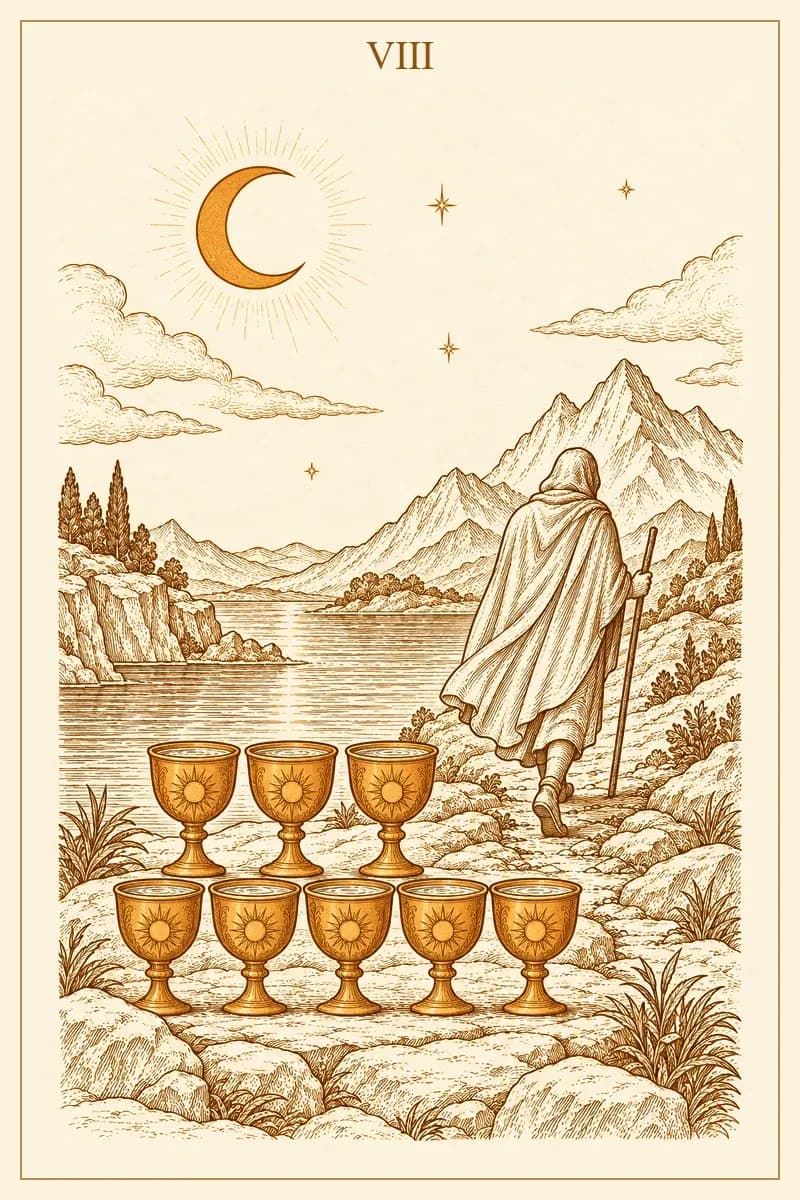
Meaning of Five of Wands and Eight of Cups Combination: Chaos You're Finally Tired Of
exhausted departure
The strangest thing about leaving is how much noise precedes it. You don't walk away from a quiet life — you walk away from one that has been too loud for too long. Five of Wands and Eight of Cups don't meet in crisis; they meet in the exhausted aftermath of one. The fight was never the problem. The problem was realizing, mid-scuffle, that you no longer cared who won.
Picture a theater where every actor is performing a different play simultaneously. Scripts overlap, blocking collides, monologues drown each other out. That is the Five of Wands — not evil, not malicious, simply ungovernable. Now picture one performer setting down their script, walking to the edge of the stage, and stepping off into the dark wings. Not storming off. Not bowing. Just — leaving. That is Eight of Cups. Together, these two cards describe the precise moment when a person stops arguing and starts packing.
The Core Tension
Five of Wands thrives on opposition. It is the energy of competing ambitions, friction between people who all believe they are right, the low-grade static of a group that cannot agree on direction. Alone, this card isn't necessarily destructive — conflict generates heat, and heat can forge something useful. But it requires participants who still want to be in the room.
Eight of Cups is the card of voluntary withdrawal. The figure on the Rider-Waite image doesn't flee — they walk deliberately, staff in hand, moon overhead. There is grief in that posture, but no panic. They have weighed the cups they arranged so carefully and found the weight no longer worth carrying.
When these two forces converge, the psychological picture is specific: someone who has been fighting long enough to understand the fight is structural, not solvable. The conflict isn't about a single argument. It's baked into the terrain. And the Eight of Cups response isn't defeat — it's the lucidity that comes when you stop performing engagement you no longer feel.
Love & Relationships
This combination surfaces in relationships where conflict has become the primary mode of connection. You argue because that is what you do now. The intimacy that once lived underneath the friction has thinned, and both people sense it, though neither may say so directly.
Five of Wands in love can indicate competing needs, jealousy, or two strong personalities that spark rather than settle. But the Eight of Cups alongside it tells a different story: one person has already begun the interior departure. They may still be physically present, still showing up to the arguments — but emotionally, they've started that moonlit walk. This isn't necessarily the death of the relationship. It can be the signal that the theater needs new staging, not new actors.
Career & Purpose
Professionally, this pairing describes environments where internal competition has curdled into exhaustion. Office politics, fractured teams, meetings where the same points circle without resolution — Five of Wands captures that ambient friction. The Eight of Cups alongside it suggests someone is close to disengaging, either by leaving the role entirely or by withdrawing their effort to a maintenance level.
The danger here is quiet. Burnout from conflict rarely announces itself as burnout. It arrives as diminished curiosity, slower emails, meetings attended but not inhabited. If this combination appears in a career reading, pay attention to the gap between how much energy a situation demands and how much you actually have left to give it.
Shadow Side
The shadow of this combination is romanticizing departure without doing the work of discernment. Eight of Cups can become an escape hatch for people who haven't sat with Five of Wands long enough to understand what the conflict is actually teaching. Not every difficult room should be left. Some friction is the texture of growth, not the symptom of a wrong fit.
The question this pairing forces is: are you leaving because the situation is genuinely finished, or because you haven't yet learned to hold your ground without hemorrhaging energy? The theater analogy holds here too — walking off stage mid-performance is sometimes the bravest act, and sometimes it's just stage fright with better justification.
Action Steps
- 1Identify one ongoing conflict in your life and write down, without judgment, what outcome you are actually hoping for — if the answer is "for it to end," that is itself useful information.
- 2Notice where you are still performing engagement: the meetings you attend in body only, the conversations where your responses are mechanical. Log what it costs you to stay present there.
- 3Before making any departure — from a relationship, a role, a commitment — name one thing you would need to believe about the future to make the leaving feel like movement rather than collapse.
Related Pairings
Continue through published pairings that share Five of Wands or Eight of Cups.
✦ Bring it to the cards ✦
Bring Five of Wands and Eight of Cups into your own reading
Use this pairing as a starting point, then let a spread listen to the situation that is actually yours.
Begin a contextual reading