
Card Combination
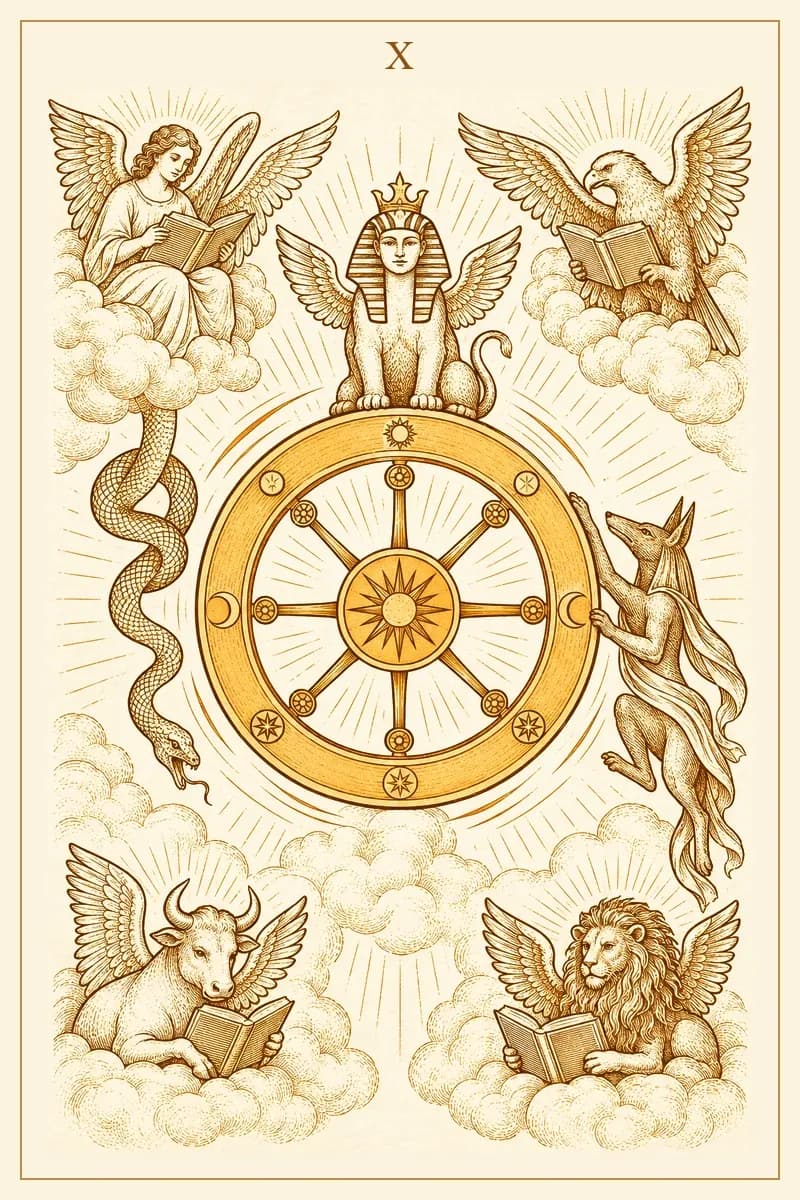
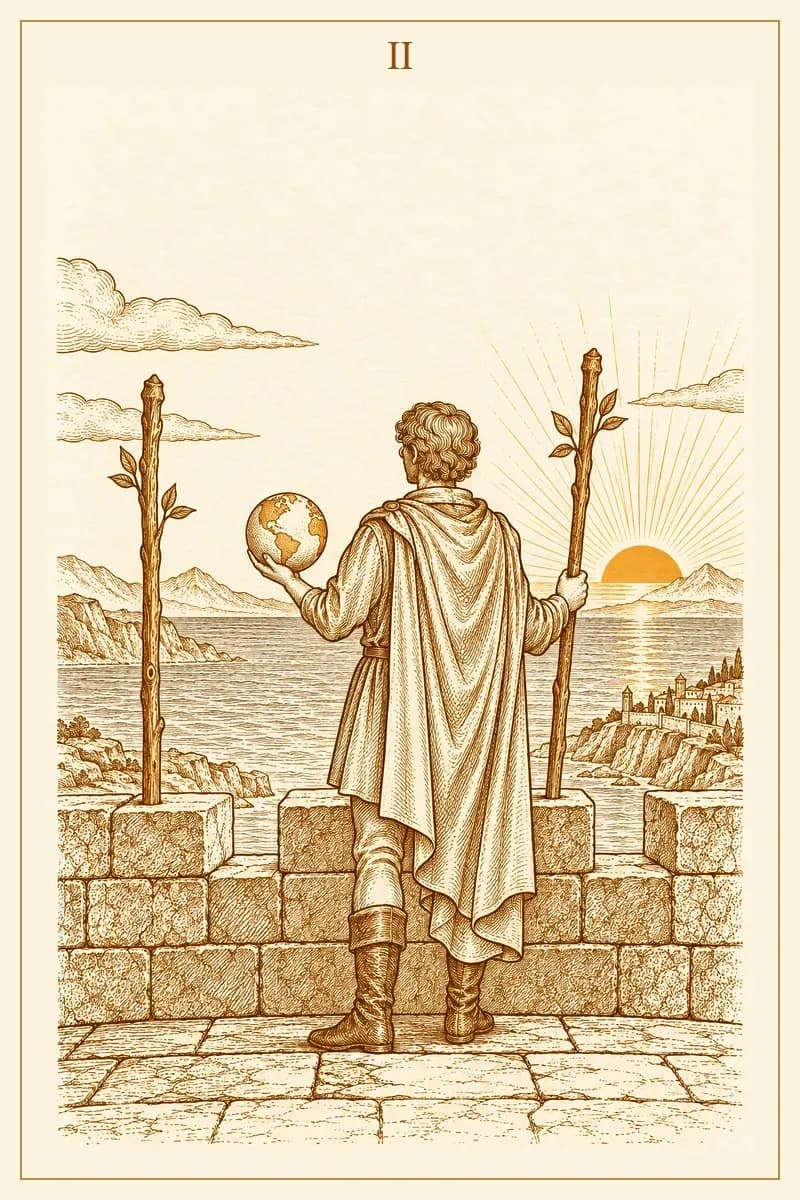
Meaning of Wheel of Fortune and Two of Wands Combination: Vision Under Pressure
Vision under pressure
You are standing on the roof of a half-built structure, blueprints in hand, watching the scaffolding sway in the wind. The foundation is solid — you checked it yourself — but the weather is changing faster than forecast, and the crew is looking at you for a call. This is the moment the Wheel of Fortune and the Two of Wands describe: the long view interrupted by immediate turbulence, and the need to hold both without dropping either.
The Two of Wands is the card of the person who has already committed to a direction. The map is drawn, the horizon is fixed in the mind's eye, the first steps are behind you. It is a card of deliberate ambition, of choosing expansion over safety before the outcome is guaranteed. The Wheel of Fortune arrives at this moment not to derail the plan, but to complicate the timeline and test the depth of the commitment.
These two cards together do not ask whether you should pursue your vision. They ask something harder: whether your vision is solid enough to survive conditions you did not design and cannot fully control.
The Core Tension
The Two of Wands operates in the register of personal agency. It is the architect who has spent months on a design and stands before the finished model knowing exactly what the building will become. Everything is intentional. The Wheel of Fortune belongs to an entirely different register — it is the seismic event, the interest rate change, the unexpected departure of a key collaborator, the sudden opening in a market that did not exist last quarter.
The structural tension of this pairing is between the fixed long-range plan and the shifting short-range ground. An architect designing for earthquake country must account for movement — not by abandoning the design, but by building flexibility into the structure itself. The Wheel does not ask you to abandon your vision; it asks whether your vision has been designed with enough tolerance to absorb surprise.
This is different from the Ace of Wands pairing, which is fundamentally about ignition. The Two of Wands pairing is about endurance. You have already started. The question is whether you can maintain the direction over terrain that keeps rearranging itself beneath you.
Love & Relationships
In relationships, this combination often appears when someone has already made a significant commitment — emotional, practical, or relational — and circumstances begin shifting in ways they did not anticipate. The Two of Wands holds the long-range orientation: this relationship, this person, this shared life being built. The Wheel introduces the disruption: a move, a career change, an illness, a period of external instability that strains what was a clear shared trajectory.
The cards are not predicting failure. They are describing a test of depth. Relationships built on clarity about a shared direction have more material to work with under pressure than those sustained only by proximity and comfort. The Two of Wands asks whether you and the other person have actually articulated where you are trying to go together, because the Wheel is about to stress-test that articulation.
For someone navigating romantic indecision, this combination sometimes points to the need to stop treating long-term thinking as premature. The Wheel is moving whether you have a plan or not. It helps to have one.
Career & Purpose
Professionally, the Two of Wands beside the Wheel of Fortune is a common combination in periods of industry disruption. You have a strategy, a product roadmap, a career trajectory that you have been executing against methodically. Then the market shifts — a competitor changes the playing field, a technology makes your current approach less viable, an organizational restructuring removes the context in which your plan made sense.
The architectural metaphor holds here: great buildings are designed with load tolerance. Great professional strategies have contingencies that do not require abandoning the core intention. The Wheel is asking you to examine your plan for brittleness — not to discard the vision, but to find the elements within it that can absorb change without collapsing.
The specific trap of this combination is revising the strategy so frequently in response to external turbulence that no strategy ever actually gets executed. The Two of Wands counsels holding the line while adapting the details. The Wheel counsels reading the actual direction of change accurately rather than reactively.
Shadow Side
The shadow of this pairing is rigidity disguised as commitment. There is a version of the Two of Wands that has stopped being a vision and become an identity — where changing course feels like personal failure rather than reasonable adaptation. When the Wheel turns and the rigid version of this card shows up, the result is someone who keeps building the same structure long after the site conditions have changed.
The inverse shadow is also present: using the Wheel as justification for abandoning a plan that was actually sound and merely uncomfortable. Conditions shifting is not always a signal to change direction. Sometimes it is simply weather, and the structure was built to handle it.
Action Steps
- 1Write down your core long-range intention in one sentence and test it: if three things in your external situation changed tomorrow, would that intention still hold?
- 2Identify one element of your current plan that relies on conditions staying stable, then map out what you would do if that condition changed.
- 3Separate, as precisely as you can, the parts of your current situation that are genuinely shifting from the parts you are interpreting as unstable because they feel uncertain.
Related Pairings
Continue through published pairings that share Wheel of Fortune or Two of Wands.

Control vs fate
Meaning of The Chariot and Wheel of Fortune Combination: Control Meets Chance
Driven ambition
Meaning of The Chariot and Two of Wands Combination: Willpower Meets Vision

Control vs cosmic flux
Meaning of The Emperor and Wheel of Fortune Combination: When Control Meets the Spin

Chained ambition
Meaning of The Devil and Two of Wands Combination: Ambition in Chains
Cycles of abundance
Meaning of The Empress and Wheel of Fortune Combination: Cycles of Abundance
Authority versus expansion
Meaning of The Emperor and Two of Wands Combination: Empire at the Edge
✦ Bring it to the cards ✦
Bring Wheel of Fortune and Two of Wands into your own reading
Use this pairing as a starting point, then let a spread listen to the situation that is actually yours.
Begin a contextual reading