Loading your view
The page is gathering the latest information.
The page is gathering the latest information.
measured hope
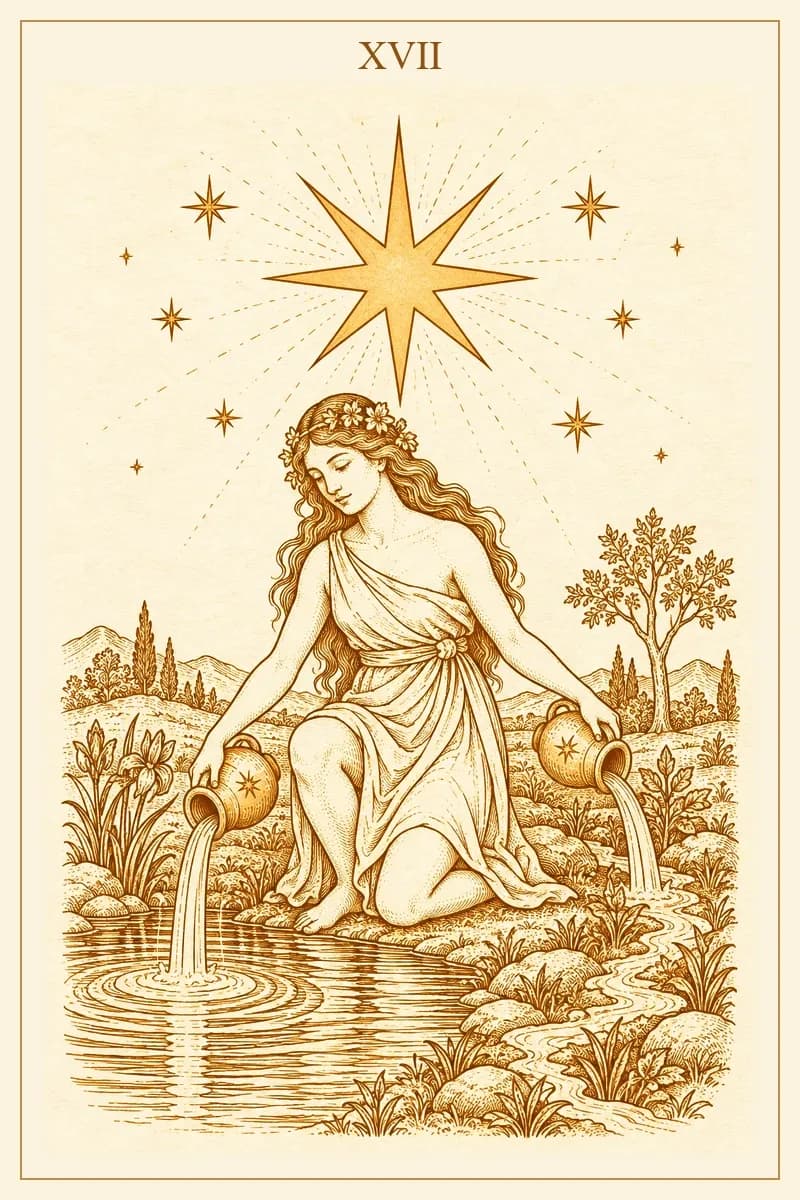
Some recipes demand heat—a hard sear, a rolling boil, the drama of a flambé. Others ask for almost nothing: a slow reduction, a patient simmer, a pinch of something bright stirred in at exactly the right moment. Temperance and The Star belong to the second kind of cooking. One card measures and pours with surgical calm. The other adds a garnish of light so subtle you almost miss it until the whole dish changes.
The contrast matters. Temperance works with what already exists in the pot, adjusting ratios, correcting seasoning, never dumping the whole bottle in at once. The Star, meanwhile, is the ingredient you forgot you needed—the squeeze of lemon that lifts everything, the cold water poured over a stock to clarify it. Together, they do not produce fireworks. They produce something you actually want to eat for the rest of your life.
Temperance is fundamentally about control. It calibrates. It watches the thermometer. It refuses to rush a sauce that needs twenty more minutes. The Star, by contrast, operates on faith. It does not measure; it trusts that the water will find its way to where it is needed. The tension between these two cards lives in the gap between precision and surrender.
You cannot plan hope the way you plan a recipe. But you can create conditions where hope becomes reasonable rather than reckless. Temperance builds the structure—daily habits, moderate responses, careful blending of competing needs. The Star fills that structure with something Temperance alone cannot manufacture: the genuine belief that the reduction will eventually taste right.
The danger is expecting one card to do the other's job. If you try to measure out hope in tablespoons, it evaporates. If you pour optimism into a process without any discipline holding the container, it spills everywhere and feeds nothing.
In relationships, this pairing asks you to become a patient cook rather than a desperate one. Temperance moderates the impulse to force conversations, demand answers, or accelerate intimacy beyond what the connection can hold. The Star adds the willingness to keep showing up even when the results are not yet visible.
For couples, this often looks like a period of quiet rebuilding. No grand gestures. No dramatic reconciliations. Instead: small adjustments made consistently, seasoned with the genuine expectation that the relationship can become nourishing again. For those seeking connection, the message is similar. Stop tasting the sauce every thirty seconds. Let it develop. The flavor you are looking for does not arrive on demand; it arrives when the ingredients have had enough time to stop being separate things and start being one dish.
Professionally, Temperance and The Star combine into a strategy of incremental improvement lit by long-term vision. You are not being asked to overhaul everything. You are being asked to adjust one ratio at a time—workload balance, communication style, the proportion of energy spent on urgent tasks versus meaningful ones—while keeping your eyes on a horizon that still excites you.
This pairing often appears when someone has been grinding without inspiration or dreaming without execution. The correction is not to abandon either mode but to blend them. Measure your daily effort with Temperance's precision. Let The Star remind you why you started cooking in the first place. The professionals who thrive under this combination are the ones who treat their career like a slow-cooked broth: not glamorous in the making, but deeply satisfying when served.
The shadow of this pairing is passivity disguised as patience. Temperance can become an excuse to never commit fully—always adjusting, never serving the dish. The Star can become an excuse to tolerate situations that should have been abandoned, because hope feels better than honest assessment.
Together, their shadow creates a person who waits beautifully. Everything looks balanced. Everything feels optimistic. But nothing actually changes, because neither card, in its shadow form, has the aggression to turn up the heat when the recipe demands it. If you find yourself endlessly refining a situation that never reaches the table, the shadow has you.
Keep or share this combination reference
Continue through published pairings that share Temperance or The Star.

controlled momentum
disciplined hope

controlled patience
bondage versus healing
Fertile balance
control meets healing
✦ Bring it to the cards ✦
Use this pairing as a starting point, then let a spread listen to the situation that is actually yours.
Begin a contextual reading