
Card Combination

Meaning of The Hermit and Eight of Cups Combination: Deliberate Withdrawal
Conscious departure
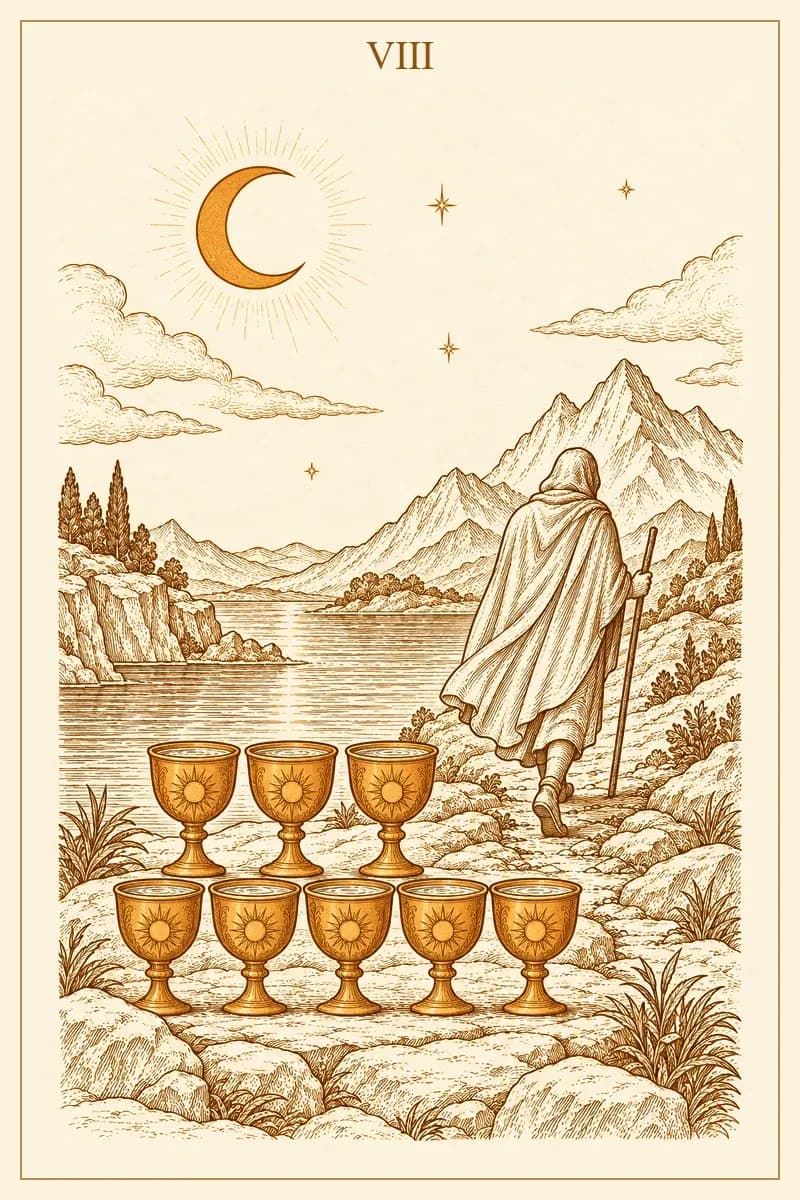
The room still holds the shape of what you left behind—a half-drunk cup on the table, a door pulled shut rather than slammed. There is no drama here, only the specific weight of a choice made after a long time of knowing. The Hermit carries his lantern not to search for something new, but to see the ground beneath his feet clearly. The Eight of Cups tells the same story from the shore: the cups are standing upright, nothing broken, yet the figure walks away in the dark. Both cards share that quality of deliberate quietude. The noise has already been made internally, far from anyone else's witness.
When these two land together in a reading, the atmosphere shifts from question into diagnosis. A physician does not weep over the scan—she reads it, names what she finds, and recommends a course of action. That is exactly the emotional register at work here: not cold, but clear. Something has been examined closely enough that the prognosis is unmistakable. Continuing would not be healing; it would be prolonging a condition already understood to be chronic. The exit is not dramatic because the diagnosis came quietly, over time, in the small hours.
What sets this pairing apart is the quality of the leaving. There is no anger driving the Eight of Cups figure up that hillside, and the Hermit's solitude is not a punishment. Both represent a form of self-triage—recognizing where vital energy is being lost and choosing, with deliberation, to redirect it. The grief is real. So is the steadiness.
The Core Tension
The friction in this combination lives between isolation as medicine and isolation as avoidance. The Hermit's lantern illuminates; the Eight of Cups figure's back is turned. One faces inward with intention, the other departs. Read together, they ask a harder question: are you withdrawing to gain clarity, or using the appearance of reflection to delay a necessary confrontation? A genuine diagnostic process requires honesty about findings—not just the act of going quiet, but the willingness to read what the silence reveals. If solitude is only comfortable and never diagnostic, the two cards are warning against their own misuse.
Love & Relationships
In romantic readings, this combination often surfaces when someone has been the sole caretaker of a relationship's emotional health for long enough that they have quietly depleted. The cups in the Eight are still full—the connection was real—but the figure's body has already decided. Paired with the Hermit, this is rarely an impulsive departure. It follows months or years of internal audit. If you are on the leaving side, the work now is to distinguish between loneliness within the relationship and loneliness as a baseline fear. If you are the one watching someone withdraw, pressing for immediate answers will not help; the diagnosis is being written in private, and demanding to see it early changes nothing except the quality of what gets shared.
Career & Purpose
Professionally, the Hermit and Eight of Cups together appear when a role or project has been outgrown but the exit feels uncomfortable because the position itself is functional—nothing is overtly wrong, the cups are upright. The restlessness is internal. This combination often accompanies a slow-building realization that competence without meaning is its own form of stagnation. The medical parallel holds: a patient can be stable and still require a different treatment protocol. Stability is not the same as recovery. If you have been staying because leaving seems ungrateful or premature, these two cards suggest the timeline is already overdue.
Shadow Side
The risk here is what might be called chronic diagnostic delay—the endless gathering of evidence without arriving at a conclusion. The Hermit can become a figure who prefers the lantern to the destination, circling the same terrain indefinitely under the guise of discernment. The Eight of Cups can be misread as a license to abandon rather than a call to choose consciously. Together in their shadow form, they can rationalize avoidance as wisdom and call perpetual indecision "processing." The test: has the inner work produced any changed behavior, or only more refined language for the same inaction?
Action Steps
- 1Write a single sentence that names what you already know but have not said aloud yet—not a question, a statement. Post it somewhere you will see it twice a day.
- 2Identify one situation where you have been running diagnostics for longer than three months without acting on the findings. Set a date by which a decision—any decision—will be made.
- 3Allow yourself one evening of genuine solitude with no productivity attached to it: no journaling prompts, no self-improvement agenda. Let the Hermit's lantern illuminate without demanding it illuminate anything specific.
Related Pairings
Continue through published pairings that share The Hermit or Eight of Cups.

Solitary wandering
Meaning of The Fool and The Hermit Combination: Solitary Wandering
Deliberate departure meeting unconscious motion
Meaning of The Fool and Eight of Cups Combination: Two Kinds of Walking Away

Visible craft, hidden depth
Meaning of The Magician and The Hermit Combination: Mastery Behind Closed Doors
Purposeful departure from a structure you built yourself
Meaning of The Magician and Eight of Cups Combination: When Skill Demands Abandonment

Inner lantern
Meaning of The High Priestess and The Hermit Combination: Inner Lantern
Wise departure
Meaning of The High Priestess and Eight of Cups Combination: The Wise Departure
✦ Bring it to the cards ✦
Bring The Hermit and Eight of Cups into your own reading
Use this pairing as a starting point, then let a spread listen to the situation that is actually yours.
Begin a contextual reading