
Card Combination

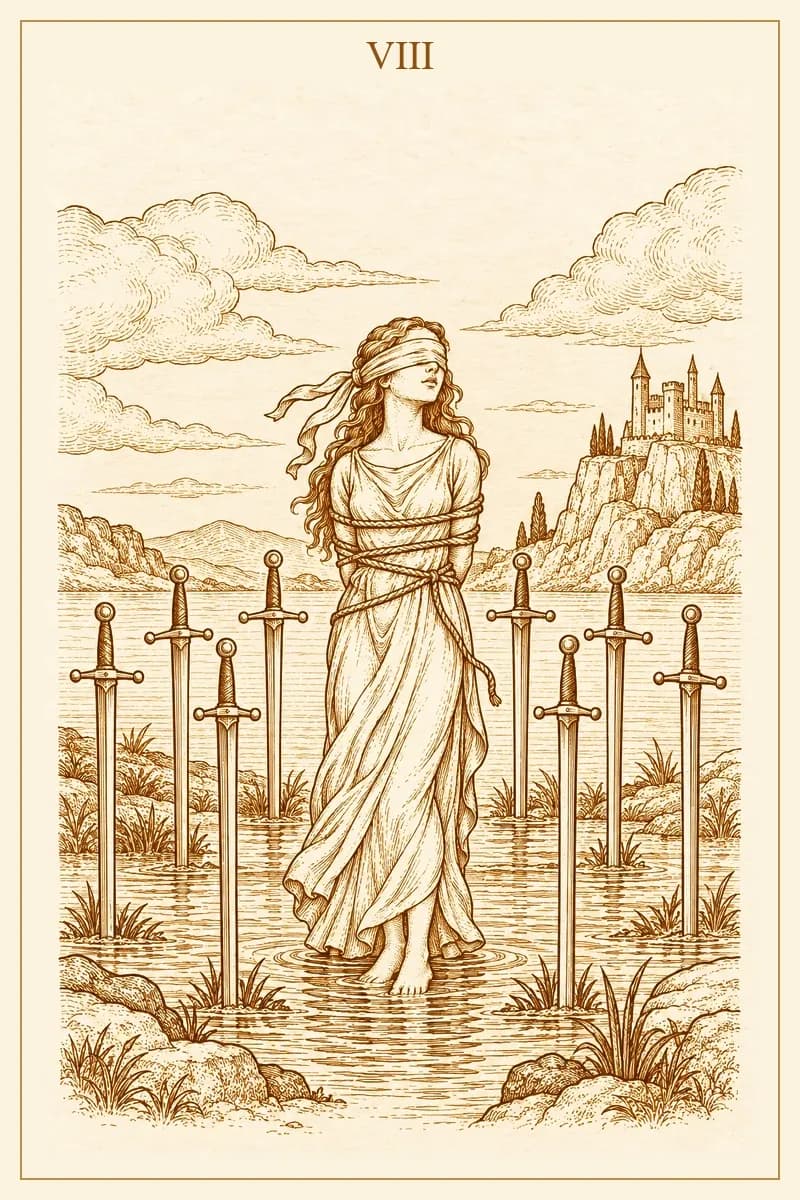
Meaning of The Emperor and Eight of Swords Combination: Trapped by Control
Authority as cage
The rules are clear. The structure is airtight. Every procedure has been documented, every boundary enforced, every deviation punished until it stopped happening. From the outside, it looks like a well-run operation. From the inside, it feels like a room with no doors.
This is the architecture the Emperor and Eight of Swords build together — not a dungeon with a jailer standing guard, but a fortress so perfectly designed that the prisoner never needs to be restrained. The walls do the work. The rules do the work. The belief that escape is impossible does the work better than any lock ever could.
What makes this pairing so unsettling is that the cage is real and imagined simultaneously. The Emperor's authority exists. The structure is genuine. But the Eight of Swords whispers that the blindfold is permanent, that the swords ringing the figure can never be moved — and that part is a lie built on top of a truth.
The Core Tension
The Emperor represents the part of reality that doesn't bend — hierarchy, boundaries, law, the weight of institutional power. The Eight of Swords represents the mental state that forms when someone has been inside a rigid system long enough to internalize its walls. Together, they describe a specific kind of paralysis: not the paralysis of laziness or confusion, but the paralysis of someone who has learned the rules so thoroughly they can no longer imagine that exceptions exist.
The load-bearing tension here is between external authority and internalized limitation. The Emperor's structure becomes the Eight of Swords' prison when the person stops distinguishing between rules that serve them and rules that contain them. The architect and the prisoner are the same person. The blueprint was drawn by someone else, but the occupant keeps renovating to make the cage more comfortable.
Love & Relationships
In a relationship context, this combination points to a partnership — or a search for one — shaped by control that has become invisible because it has become familiar. One person may play Emperor, setting the terms of engagement without realizing how completely those terms restrict the other. The other person may play the Eight of Swords figure, staying not because they are physically trapped but because they have convinced themselves that leaving would violate some rule they've decided is unbreakable.
If you're single, this pairing can indicate attraction to authority figures or a pattern of choosing partners who impose structure — then feeling suffocated once the structure is in place. The appeal of someone decisive and directive is real. The cost of that appeal only becomes visible later, when you realize that decisiveness includes decisions about you.
If you're partnered, the question this combination raises is quiet and uncomfortable: who set the rules of this relationship, and did you actually agree to them, or did you simply stop questioning them?
Career & Purpose
The Emperor and Eight of Swords together in a career reading describes an organization, a role, or a professional identity that has become a constraint dressed as competence. You may be extraordinarily good at operating within a specific system — so good that you've lost sight of your ability to function outside it. The institution has become the frame through which you understand your own value, and that's a structural problem.
This combination also appears when someone in authority is micromanaging at a level that shuts down initiative without anyone acknowledging that's what's happening. Procedures exist for everything. Approval chains are long. By the time an idea has been through the proper channels, it's either unrecognizable or irrelevant. The Emperor's architecture is efficient at maintaining itself. It is not efficient at building anything new.
Shadow Side
The darker register of this combination is the satisfaction some people find in both roles. The Emperor who controls gets to feel powerful. The Eight of Swords figure gets to feel blameless — nothing is their fault because nothing is their choice. Both positions offer a kind of relief from responsibility, and that relief is the shadow this pairing casts. The cage also protects. The blindfold also filters.
Watch for the ways the limitation is being protected rather than questioned. Watch for the investment in helplessness. Watch for the moment you explain why something is impossible before you've actually tested whether it is.
Action Steps
- 1Identify one rule you follow automatically and trace it back to its origin — not to break it, but to find out whether you ever actually chose it.
- 2Notice where in your life you feel most stuck, then ask whether the constraint is external or whether you've built it internally and are maintaining it yourself.
- 3Take one small action that the stuck version of you would say is not allowed, and observe what actually happens.
- 4The Emperor and Eight of Swords do not promise easy liberation. The Emperor's structures are often real, and the Eight of Swords' paralysis is not simply weakness to be overcome with willpower. But this combination does insist on one thing: the blindfold can be removed. The question is whether you want to see what's actually keeping you in place — because once you see it clearly, maintaining the illusion becomes much harder work.
Related Pairings
Continue through published pairings that share The Emperor or Eight of Swords.

Structured forward momentum
Meaning of The Emperor and The Chariot Combination: Authority in Motion
Willpower as trap
Meaning of The Chariot and Eight of Swords Combination: Trapped Victory

Authority versus control
Meaning of The Emperor and The Devil Combination: When Authority Becomes a Cage
Self-built prisons
Meaning of The Devil and Eight of Swords Combination: Constructed Captivity
Control vs release
Meaning of The Emperor and The Hanged Man Combination: When Control Meets Surrender
Outer vs inner authority
Meaning of The Emperor and The Hermit Combination: Command Meets Solitude
✦ Bring it to the cards ✦
Bring The Emperor and Eight of Swords into your own reading
Use this pairing as a starting point, then let a spread listen to the situation that is actually yours.
Begin a contextual reading