Three-Card Spread Mastery: The Most Versatile Tool in Tarot
Veil Soul
Published on · 7 min read
Why the Three-Card Spread Is the Reader's Best Friend
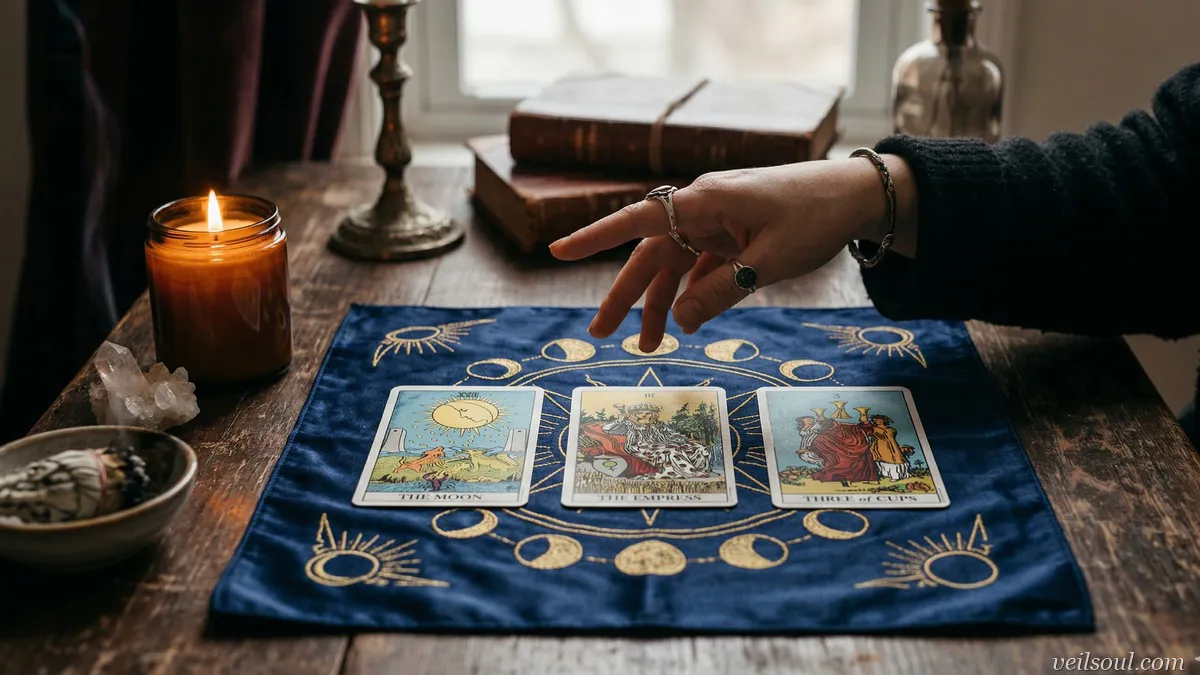
If you could only know one Tarot spread for the rest of your life, the three-card spread would be the wisest choice. It's simple enough for your very first reading and deep enough to use for the rest of your Tarot journey. Three cards are enough to tell a story but few enough to read without getting overwhelmed.
The beauty of the three-card spread is its radical flexibility. The same three positions can become past-present-future, situation-action-outcome, mind-body-spirit, or any framework you create. It adapts to any question, any mood, and any level of experience. It's the Swiss Army knife of Tarot spreads.
If you've mastered the daily one-card draw and are ready for more depth, the three-card spread is your natural next step.
The Classic Frameworks
Each framework assigns a different meaning to the three positions. Choose the one that best fits your question:
1. Past — Present — Future
The most well-known framework. Card 1 shows the relevant past influence, Card 2 reveals where you are now, and Card 3 points toward where things are heading.
Best for: Understanding the trajectory of a situation. Getting perspective on how the past is influencing the present.
Example question: "What is the arc of my career situation right now?"
2. Situation — Action — Outcome
Card 1 describes the current situation as it truly is (not as you think it is). Card 2 suggests the best action to take. Card 3 shows the likely outcome if that action is followed.
Best for: Decision-making. When you need concrete guidance about what to do.
Example question: "How should I handle this conflict with my colleague?"
3. Mind — Body — Spirit
Card 1 reflects your mental state, Card 2 your physical state or material situation, and Card 3 your spiritual or emotional state. This framework treats you as a whole being, not just a mind.
Best for: Self-check-ins. When you sense something is off but can't identify what.
Example question: "What do I need to pay attention to in my overall well-being?"
4. You — The Other Person — The Relationship
Card 1 represents your energy or perspective, Card 2 represents the other person's energy, and Card 3 shows the dynamic between you. This framework respects both perspectives without taking sides.
Best for: Relationship questions of any kind — romantic, friendship, family, professional.
Example question: "What is the dynamic between me and my partner right now?"
5. What to Keep — What to Release — What to Embrace
Card 1 shows what is serving you well and should continue. Card 2 reveals what has run its course and needs to go. Card 3 points to new energy or opportunities to welcome in.
Best for: Transitions and turning points. New Year readings, birthday reflections, or any moment of change.
Example question: "As I enter this new chapter, what should I carry, leave, and seek?"
6. Strengths — Challenges — Advice
Card 1 highlights your strengths in the current situation. Card 2 names the challenge or obstacle. Card 3 offers guidance for moving forward.
Best for: Problem-solving. When you're facing a difficulty and need perspective.
7. Option A — Option B — What to Consider
Card 1 shows the energy and likely outcome of choosing Option A. Card 2 does the same for Option B. Card 3 reveals something important you haven't considered about the decision.
Best for: When you're torn between two choices and need clarity.
8. Conscious — Unconscious — Integration
Card 1 shows what you're aware of. Card 2 reveals what's happening beneath your awareness. Card 3 suggests how to integrate both into a coherent understanding.
Best for: Self-discovery work and understanding your own patterns.
9. Morning — Afternoon — Evening
A practical daily framework where each card represents the energy or theme of a different part of your day.
Best for: Daily planning. A more detailed alternative to the one-card draw.
10. Create Your Own
The three positions can represent anything meaningful to you. "Head — Heart — Gut." "Fear — Truth — Courage." "What I think — What I feel — What I know." The best framework is one that matches your question perfectly.
How to Read the Story Between the Cards
The real power of a three-card spread isn't in reading each card individually — it's in reading the relationship between them. Here's how:
The Narrative Arc
Three cards naturally form a beginning, middle, and end. Even in non-temporal frameworks, look for the story: How does Card 1 lead to Card 2? How does Card 2 evolve into Card 3? What's the emotional journey from left to right?
Elemental Connections
Notice which suits appear. Three Cups suggests an emotionally saturated situation. A mix of Swords and Wands might indicate a conflict between thought and action. All Major Arcana cards signal that big, archetypal forces are at play.
Visual Flow
Look at where the figures are facing. Are they looking toward each other or away? Does the figure in Card 1 seem to be moving toward Card 3, or retreating? These visual details add layers of meaning that individual card definitions miss.
Repeated Numbers or Themes
Two or three cards with the same number amplify that number's energy. Multiple cards showing solitary figures might speak to independence or isolation. Noticing these patterns turns three separate cards into one unified message.
A Practice Exercise
Try this exercise to deepen your three-card reading skills:
- Shuffle and draw three cards using the Strengths — Challenges — Advice framework.
- Write down each card's individual meaning (one sentence each).
- Now write the story of all three cards together (one paragraph). How does your strength relate to your challenge? How does the advice address both?
- Finally, distill the entire reading into one sentence. This is your core message.
This exercise trains you to move from card-by-card reading to holistic interpretation — the skill that separates confident readers from uncertain ones.
Common Mistakes to Avoid
- Reading cards in isolation: The cards talk to each other. Don't interpret each one as a separate fortune — look for the conversation between them.
- Ignoring your question: Always relate the cards back to what you actually asked. A card's "textbook meaning" might be completely different from what it means in the context of your specific question.
- Pulling clarifiers compulsively: Resist the urge to pull extra cards when a reading confuses you. Sit with the confusion — it often resolves itself with time. Pulling more cards usually creates more confusion, not less.
- Forgetting reversals are optional: If reversals overwhelm you, read all cards upright. You can always add this layer later.
From Three Cards to Deeper Spreads
Once you're comfortable with three-card readings, you can:
- Add a fourth card as an "underlying influence" or "advice" card to any framework.
- Try five-card spreads for more complex questions.
- Create multi-row spreads where each row is its own three-card story.
- Use three-card spreads within larger readings — many experienced readers use a three-card core with additional cards for context.
But don't rush to complexity. Many professional readers use three-card spreads as their primary tool for years. Mastering simplicity is more powerful than collecting spreads you half-understand.
The three-card truth: You don't need elaborate spreads to give profound readings. Three cards, read with attention, intuition, and genuine curiosity, can reveal more than a ten-card spread read mechanically. Master the three, and every other spread becomes easier.
chat_bubble 0 Comments
Leave a Comment