
Card Combination
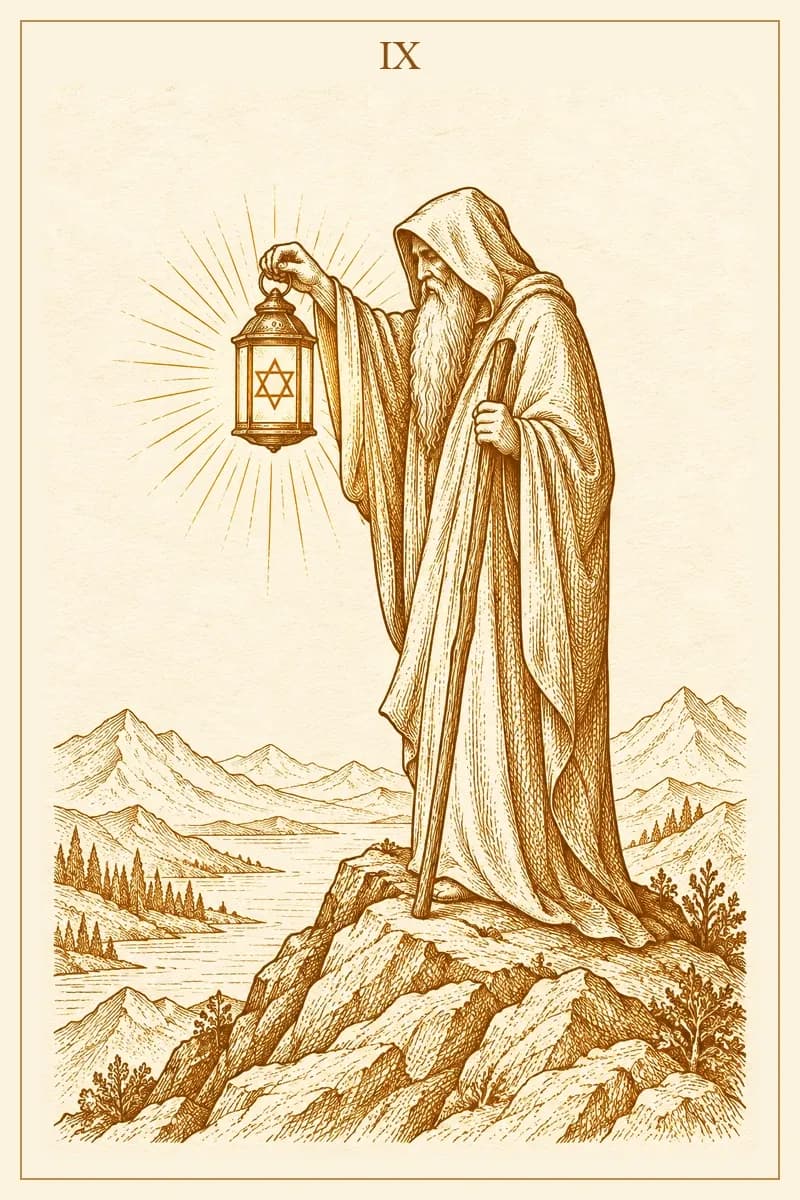

Meaning of The Hermit and King of Cups Combination: Wisdom Holds Its Depth
Mastered inner depth
Picture a conductor who rehearses alone. Not because the orchestra is unavailable, but because something about the score only becomes clear in silence. He listens to a recording, stops it, listens again. He is not emotionally distant from the music—he is steeped in it—but he refuses to let the feeling move faster than his understanding. When he finally raises the baton in front of a hundred musicians, every choice he makes carries the weight of that private hour. The interpretation is felt, but it has been earned through isolation.
That figure is what happens when the Hermit and King of Cups occupy the same reading. The Hermit has walked inward long enough to know what he carries. The King of Cups has felt the full range of the emotional register and learned—through experience, often painful—how not to be ruled by it. Neither of them is cold. Neither of them is naive. They are the two musicians who have practiced longest and therefore play with the most apparent ease.
This is not a combination that creates turbulence. It creates something rarer: steadiness that has actually been paid for.
The Core Tension
The tension here is quieter than most card pairs produce, which makes it harder to locate and easier to ignore. Both the Hermit and the King have already done enormous interior work. Both have achieved a kind of equilibrium. The risk is not that they will clash—it is that their combined composure becomes a performance of depth rather than depth itself.
A conductor who only ever rehearses alone eventually loses touch with what an audience actually hears. The King of Cups who maintains perfect emotional mastery in every circumstance may be mastering his feelings rather than genuinely having them. Equanimity earned through real reckoning is different from equanimity maintained by suppression. This pairing asks which kind is operating.
The productive tension lives in that question. Not whether to feel, but whether the feeling is still real—or has been so thoroughly managed it has become an aesthetic.
Love & Relationships
In love, the Hermit and King of Cups together describe a partner who is profoundly reliable and genuinely hard to reach. Not unreachable—but the distance to true intimacy is longer than it appears from the outside. The emotional control that makes this person a steady presence in a crisis is the same quality that requires patient, sustained attention to move past.
The King does not perform distance. He is simply accustomed to being the one who holds the container for other people's feelings, not the one whose feelings need holding. The Hermit has learned to be self-sufficient so completely that asking for something can feel foreign, even unnecessary. Together, these energies in a relationship call for deliberate inversion: the person who usually holds must practice being held.
For someone in a new relationship, this combination may signal that what looks like emotional unavailability is actually something more interesting—a person who will not offer depth cheaply, and whose depth, once accessed, does not evaporate.
Career & Purpose
Professionally, this pair describes the senior advisor who never raises his voice in the boardroom because he does not need to. The authority is not performed—it is structural. It comes from having thought longer and more honestly than anyone else in the room about the problem at hand.
The King of Cups reads the emotional dynamics of a group with precision. The Hermit has the insight that emerges from extended, solitary inquiry. The combination produces a person whose counsel people seek not because it is delivered dramatically, but because it reliably holds up over time. This is a good pairing for long-horizon work—mentorship, strategy, any domain where patience and perspective matter more than speed.
The professional risk is the same as the personal one: distance mistaken for wisdom. The Hermit knows things from his mountain; the King manages the room. Neither role includes being changed by the people around them. Watch for calcification dressed as stability.
Shadow Side
Two cards this self-contained have a specific shadow: they can make a virtue of not needing anyone. The Hermit has his lantern. The King has his throne and his cup, emotions held steady above the turbulent water below. The shadow asks whether that steadiness is a gift offered to others or a wall that prevents others from offering anything back.
There is also the shadow of the unheard note. A conductor who has rehearsed alone and then stands before an orchestra without listening—who knows the score so well that he cannot hear what the players are actually producing—is no longer interpreting music. He is delivering a monologue in an empty hall.
Action Steps
- 1Notice one moment this week when you maintained composure and ask honestly whether you were genuinely steady or simply unwilling to be seen uncertain.
- 2Identify someone whose emotional read you have been quietly overriding; let their interpretation of a situation stand without correction for one full conversation.
- 3Set aside thirty minutes not for reflection but for expression—write, speak aloud, or create something where the feeling comes before the form.
Related Pairings
Continue through published pairings that share The Hermit or King of Cups.
Solitary wandering
Meaning of The Fool and The Hermit Combination: Solitary Wandering
Unarmed diplomacy
Meaning of The Fool and King of Cups Combination: Unarmed Diplomacy
Visible craft, hidden depth
Meaning of The Magician and The Hermit Combination: Mastery Behind Closed Doors
Commanding emotion with skill
Meaning of The Magician and King of Cups Combination: Mastery in Two Languages
Inner lantern
Meaning of The High Priestess and The Hermit Combination: Inner Lantern
Intuitive composure
Meaning of The High Priestess and King of Cups Combination: Quiet Emotional Mastery
✦ Bring it to the cards ✦
Bring The Hermit and King of Cups into your own reading
Use this pairing as a starting point, then let a spread listen to the situation that is actually yours.
Begin a contextual reading