Tarot Meditation Techniques: Finding Stillness Through the Cards
Veil Soul
Published on · 7 min read
When Tarot Becomes Meditation
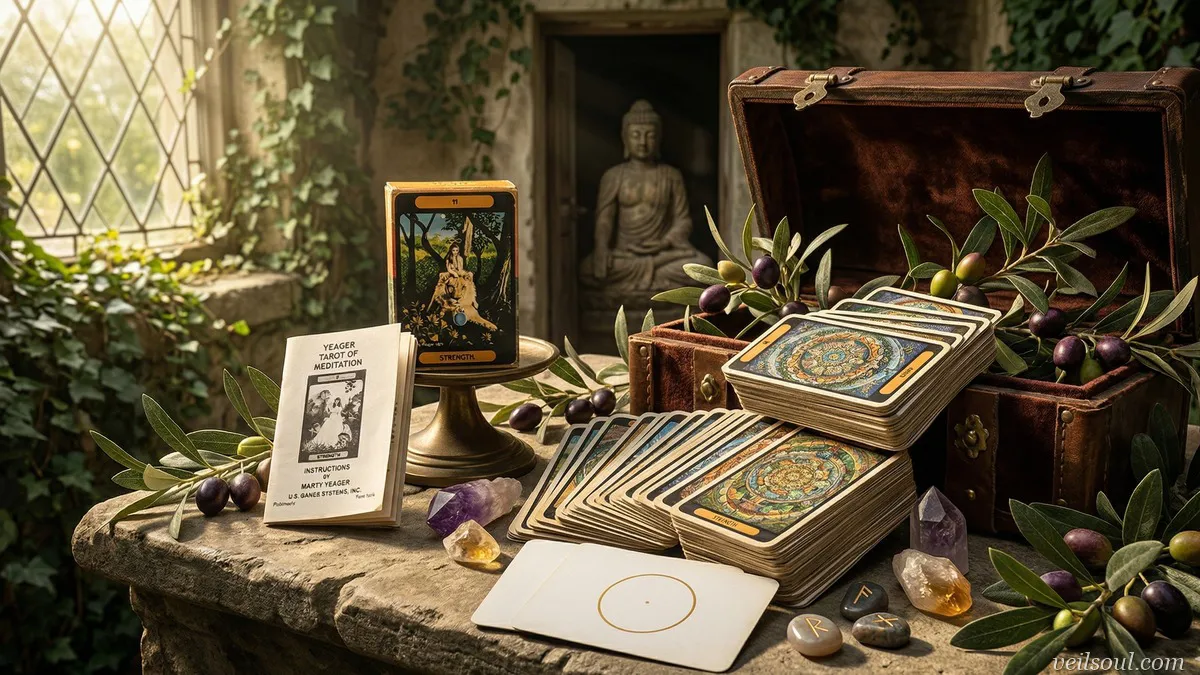
Most people think of Tarot as a tool for doing — asking questions, getting answers, making decisions. But some of the most transformative Tarot experiences happen when you stop doing and simply be with the cards. Tarot meditation is the practice of using a card's imagery as a gateway to stillness, inner exploration, and deep presence.
You don't need meditation experience. You don't need to sit in lotus position or empty your mind. You simply need a card, a few quiet minutes, and the willingness to look — really look — and let the image speak to the part of you that exists beneath thoughts.
Why Tarot and Meditation Belong Together
Traditional meditation asks you to focus on a single point — the breath, a mantra, a flame. For many people, this feels impossibly abstract. Tarot meditation offers something tangible: a rich, symbolic image that gives the wandering mind something beautiful to land on.
- The imagery holds attention. Tarot cards are designed to be visually captivating. Unlike staring at a blank wall, there's always something new to notice — a color, a symbol, an expression you've never seen before.
- Symbols speak to the unconscious. Tarot imagery bypasses the analytical mind and speaks directly to your deeper self — the same part that dreams, imagines, and intuits.
- Each card is a world. A single Tarot card contains an entire landscape, characters, emotions, and stories. Entering that world through meditation is like stepping into a guided visualization that your own psyche co-creates.
- It builds card fluency. After meditating with a card, you'll understand it at a cellular level — far deeper than any book definition. Your intuitive readings will transform.
Five Tarot Meditation Techniques
1. Card Gazing (Trataka-Inspired)
Duration: 5-10 minutes
Best for: Calming the mind, building focus, beginners
- Choose a card — either drawn randomly or one you feel drawn to today.
- Prop it up at eye level, about arm's length away.
- Set a timer for 5 minutes.
- Gaze softly at the card. Don't analyze, don't interpret, don't think about meanings. Just look.
- When your mind wanders (it will), gently return your gaze to the card. No judgment.
- Notice: What details emerge the longer you look? What shifts in your body? What feelings arise?
- After the timer, close your eyes and hold the card's afterimage in your mind for 30 seconds.
- Open your eyes and journal one word that captures your experience.
2. The Card Journey (Guided Visualization)
Duration: 10-20 minutes
Best for: Deep inner work, understanding a specific card, self-discovery
- Choose a Major Arcana card. (These work best because their imagery is richest.)
- Study the card for one minute, absorbing every detail.
- Close your eyes and recreate the card's scene in your imagination.
- Now step into the scene. You are physically present in the card's world.
- Look around. What do you see beyond the card's borders? What's behind you? What does the air feel like?
- Approach the card's central figure. They have a message for you. Ask: "What do I need to know?" Listen without forcing an answer.
- Spend time in this world. Explore. Touch objects. Notice emotions.
- When ready, thank the figure and slowly return to your physical space.
- Journal everything — what you saw, heard, felt, and the message received.
3. Breath-Card Syncing
Duration: 5 minutes
Best for: Anxiety relief, grounding, quick centering
- Choose any card.
- On each inhale, focus on one detail of the card (a color, a symbol, a figure's expression).
- On each exhale, release the detail and soften your gaze.
- Inhale: next detail. Exhale: soften.
- After 5 minutes, you'll have explored 15-20 details — and your nervous system will be significantly calmer.
This technique is especially powerful for managing anxiety because it gives the busy mind a structured task while simultaneously engaging the calming breath cycle.
4. The Shadow Card Meditation
Duration: 15-20 minutes
Best for: Emotional processing, working with difficult cards, forgiveness work
- Choose a card that makes you uncomfortable — one you always dread seeing in readings.
- Sit with it. Don't look away from the discomfort.
- Ask yourself: "What about this card reflects something in me that I'm afraid to see?"
- Close your eyes and enter the card (as in the Card Journey).
- But instead of approaching the figure, become the figure. See through their eyes. Feel what they feel.
- From their perspective, ask: "What wisdom do I hold that [your name] needs?"
- Listen. The answer often surprises. The Tower might teach courage. The Ten of Swords might teach surrender. Death might teach freedom.
- Return to yourself with the wisdom received.
5. The Daily Presence Practice
Duration: 2-3 minutes
Best for: Daily integration, combining with daily draws
- After your daily card pull, hold the card and close your eyes.
- Take three breaths.
- Ask: "What is the feeling of this card?" Not the meaning — the feeling. Warmth? Tension? Expansion? Stillness?
- Let that feeling settle into your body. Carry it with you into the day.
- That's it. Two minutes of presence that transforms a reading into an embodied experience.
Creating Your Meditation Practice
Getting Started
- Start with technique 1 (Card Gazing) or 5 (Daily Presence). These are the simplest and most accessible.
- Don't expect "results." Meditation isn't about achieving a state — it's about being present. Some sessions will feel profound. Some will feel like staring at cardboard. Both are valid.
- Use the same card for a week. Meditating with one card for seven days reveals layers that a single session never will.
- Start short. Five minutes is plenty. You can always extend if the moment calls for it.
Best Cards for Meditation
- Beginners: The Star, The High Priestess, Temperance — calming, receptive energies
- Emotional processing: The suit of Cups — any card that mirrors what you're feeling
- Grounding: The suit of Pentacles — earthy, stabilizing imagery
- Courage: Strength, The Chariot, The Sun
- Shadow work: The Tower, Death, The Devil, The Moon
Deepening the Practice
- Combine with breathwork. Technique 3 is a starting point — experiment with different breathing patterns (box breathing, 4-7-8 breathing) while gazing at a card.
- Meditate with reversed cards. The reversed version of a card can reveal entirely different meditation landscapes — the energy turned inward, blocked, or seeking expression.
- Use ambient sound. Soft instrumental music, nature sounds, or singing bowls can deepen the meditative state while you gaze or journey.
- Create a meditation deck. Over time, you'll discover which cards are your most powerful meditation partners. You might create a smaller "meditation deck" of your 10-15 most resonant cards.
Please note: Tarot meditation is a complementary wellness practice. If you experience distressing thoughts, overwhelming emotions, or dissociation during meditation, please stop and reach out to a mental health professional. Deep inner work sometimes surfaces material that benefits from professional guidance.
The meditation invitation: Your Tarot deck holds 78 worlds. Each card is a doorway you can walk through, sit within, and discover something about yourself you didn't know was there. You don't need to believe anything special. You just need to be still, look closely, and listen. The cards have been waiting for you to do exactly this — not ask them a question, but simply be present with them. Try it tonight. Choose one card. Look. Breathe. And see what the silence has to say.
chat_bubble 0 Comments
Leave a Comment