
Storing and Caring for Your Tarot Cards: A Complete Guide
Veil Soul
Published on · 7 min read
Why Card Care Matters
Your Tarot deck is a tool you'll handle thousands of times. The oils from your hands, humidity, dust, and physical wear all take their toll over time. Proper storage and care aren't superstition — they're practical maintenance that keeps your cards shuffling smoothly, looking beautiful, and lasting for years.
Beyond the physical, caring for your deck is an act of respect for your practice. Just as a musician maintains their instrument or an artist cares for their brushes, giving attention to your Tarot cards honors the relationship between reader and tool.
Storage Options
Tarot Bags and Pouches
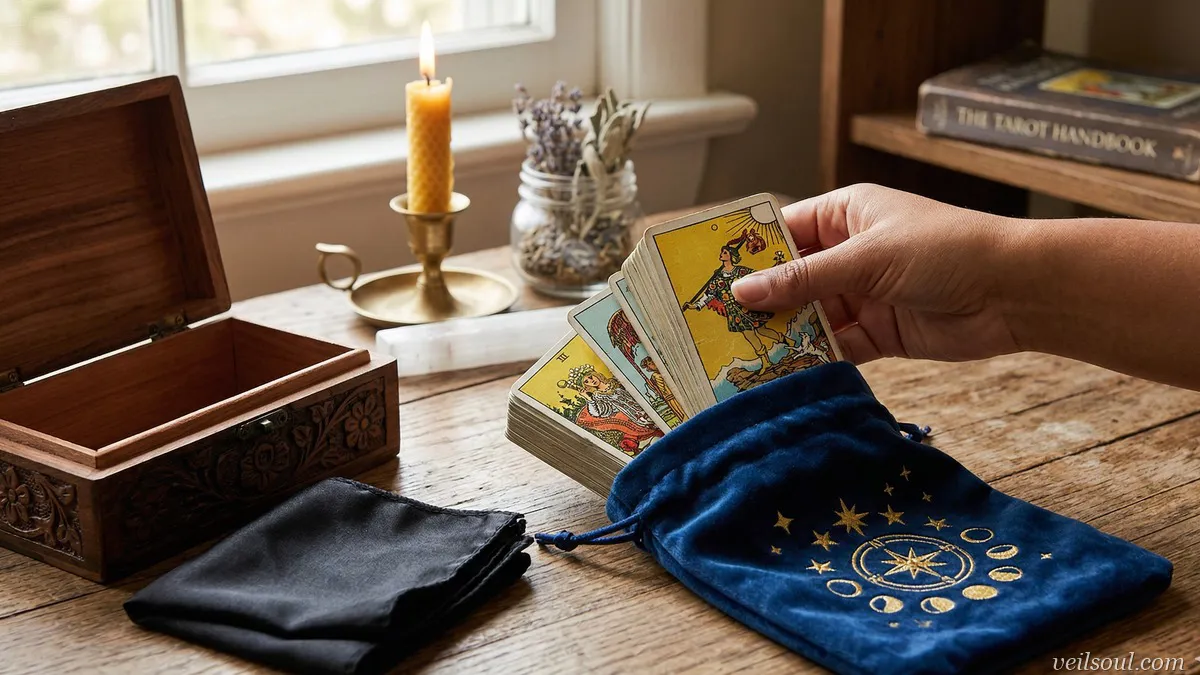
The most popular storage option for good reason. A fabric pouch protects your cards from dust, light, and physical damage while being easy to transport.
Best materials: Silk, velvet, cotton, or linen. Natural fibers breathe better and are gentler on card surfaces than synthetic materials.
Size: Choose a pouch slightly larger than your deck to allow easy insertion and removal. Too tight and you'll bend cards getting them in and out; too loose and they'll slide around.
DIY option: A clean bandana or scarf wrapped around your deck and secured with a ribbon works perfectly if you don't have a purpose-made pouch.
Wooden Boxes
A wooden box offers excellent protection and a satisfying sense of ceremony when you open it. Many readers love the ritual of opening a box to begin a reading.
Best woods: Cedar naturally repels moisture and insects. Pine, walnut, and bamboo are also popular. Avoid treated or heavily lacquered woods that may off-gas chemicals.
Lining: A box with a fabric lining (silk or velvet) prevents cards from sliding and adds cushioning. If your box is unlined, simply place a cloth inside.
Wrapping Cloths
Wrapping your deck in a cloth — typically silk or cotton — is one of the oldest Tarot storage traditions. The cloth does double duty: storage when wrapped around the deck, reading surface when unfolded on the table.
Traditional choices: Black silk is the most traditional, said to absorb negative energy. But any natural fabric in a color meaningful to you works well.
The Original Box
Many decks come in sturdy, well-designed boxes that work perfectly for storage. There's no rule against using the box your deck came in — if it protects the cards and feels right, use it. Some readers prefer the original box because it keeps the deck organized with its guidebook.
Storage Environment
Where you keep your deck matters as much as what you keep it in:
- Avoid direct sunlight: UV light fades card art over time. Store in a drawer, shelf, or covered area.
- Control humidity: Excessive moisture causes cards to warp, stick together, or develop mold. Excessive dryness makes them brittle and prone to cracking. Room temperature and average humidity are ideal.
- Keep away from liquids: Water damage is the most common cause of deck destruction. Keep your deck away from drinks, open windows during rain, and bathroom humidity.
- Minimize dust: Dust accumulates between cards and affects shuffle quality. A closed container (bag, box, or wrapped cloth) solves this easily.
Handling Your Cards
Clean Hands
The simplest and most effective card care practice: wash or wipe your hands before handling your deck. Hand oils, lotions, and food residue gradually build up on card surfaces, making them sticky and degrading the finish over time.
Shuffling With Care
Different shuffling methods have different impacts on card longevity:
- Overhand shuffle: Gentlest on cards. Recommended for most decks.
- Hindu shuffle: Gentle and effective. Good for standard-sized cards.
- Riffle shuffle: Efficient but bends cards. Best reserved for decks with flexible, resilient cardstock.
- Pile shuffle: No bending at all — purely random distribution. Great for delicate or oversized decks.
- Messy pile shuffle: Spreads cards on a surface and swirls them. Easy on cards but requires table space.
Avoiding Bent Cards
Card bending is the most common form of wear. To prevent it:
- Don't force cards into containers that are too small.
- Don't leave your deck in a back pocket or under heavy objects.
- If a card bends, place it under a heavy book overnight to flatten.
- Handle cards by the edges rather than pinching the face or back.
Traveling With Your Deck
If you take your deck on the go:
- Use a protective case — a padded pouch or small hard case prevents damage in bags and pockets.
- Avoid extreme temperatures — don't leave your deck in a hot car or exposed to freezing conditions. Temperature fluctuations can warp cards.
- Consider a travel deck — if your primary deck is precious or oversized, keep a smaller, less expensive deck for travel readings.
Long-Term Preservation
For decks you want to keep for decades:
- Rotate decks: If you own multiple decks, rotating between them extends the life of each one.
- Consider card sleeves: Transparent card sleeves (like those used for trading cards) protect individual cards from wear, spills, and fingerprints. They change the feel of shuffling but dramatically extend card life.
- Store rarely-used decks carefully: Decks you're not actively using should be stored flat (not on their sides), in a dry, cool, dark place.
When to Replace a Deck
Even with perfect care, decks eventually wear out — and that's okay. Signs it's time for a new copy:
- Cards are so worn that specific ones are identifiable by touch (creating an unintentional bias in your readings).
- Shuffling has become difficult due to warping or stickiness.
- Card art is so faded that visual details important for reading are lost.
- Cards are torn, creased, or damaged beyond repair.
A well-loved, well-worn deck has its own beauty and history. Many readers keep retired decks as meaningful objects even after replacing them for active use.
The Energetic Side of Card Care
Beyond physical maintenance, many readers incorporate energetic practices into their card care:
- Regular cleansing to reset accumulated energy.
- Sleeping with a new deck under your pillow for a few nights to bond with it.
- Keeping a crystal (clear quartz or selenite) with your stored deck for ongoing energetic maintenance.
- Speaking to your deck — expressing gratitude, setting intentions, or simply acknowledging it as a partner in your practice.
Whether you view these as energetic practices or psychological rituals, they deepen your connection to your tool and enhance the quality of your readings.
Quick Card Care Checklist
- Store in a bag, box, or cloth — never loose in a drawer or bag.
- Keep away from sunlight, moisture, and extreme temperatures.
- Clean hands before handling.
- Shuffle gently with a method appropriate for your card quality.
- Cleanse energetically on a regular schedule.
- Check periodically for damaged or missing cards.
- Replace when wear begins affecting readings.
The care principle: Your Tarot deck gives you insight, guidance, and a mirror for self-understanding. In return, give it a clean home, gentle hands, and the respect of proper care. A deck that is well cared for becomes a trusted companion — one that only grows more powerful with time and use.
chat_bubble 0 Comments
Leave a Comment